Unknown's avatar

Posts by Leonie Andrews

I am an artist of the landscape of common objects. Discarded items and suburban life fuel my art practice.

Dancing Shiva

The statue of Shiva, Lord of the Dance (Nataraja) at the National Gallery of Australia (NGA), has been danced into a controversy with what appear to be convincing allegations that the statue was stolen from a temple in Tamil Nadu, India. The allegations have also contributed to the resignation of the Director of the Gallery, Mr Ron Radford.

So with heightened interest I took the opportunity to make a ‘blind drawing’ of the statue while visiting the NGA today.

Shiva as Lord of the Dance (Nataraja), 11th-12th century, bronze, National Gallery of Australia (well for now anyway), 24 March 2014.

Shiva as Lord of the Dance (Nataraja), 11th-12th century AD, bronze, National Gallery of Australia (well for now anyway), 24 March 2014.

This truly is an amazing work of art and devotion. The more I studied the statue the more the slender limbs came into focus. On each of the arms and legs bracelets and anklets adorned the moving figure.

Shiva's raised foot, drawn from the rear of the sculpture, 24 March 2014.

Shiva’s raised foot, drawn from the rear of the sculpture, 24 March 2014.

This is a work that clearly evokes deep feelings, even in people from outside of its originating culture, so to consider the negative impact of its theft from a place of worship is disquieting to say the least. I strongly feel that the statue should be repatriated as a matter of urgency.

UPDATE

Only two days after I drew the Shiva Nataraja at the National Gallery of Australia, the sculpture has been removed from display. This follows the Australian government receiving a formal request from the government of India for the return of the statue. The ABC TV program Four Corners on Monday also aired  a program looking at the case of this sculpture and raising doubts over the purchase of a number of other works by  both the NGA and the Art Gallery of New south Wales from the same dealer. The dealer is currently under arrest in India.
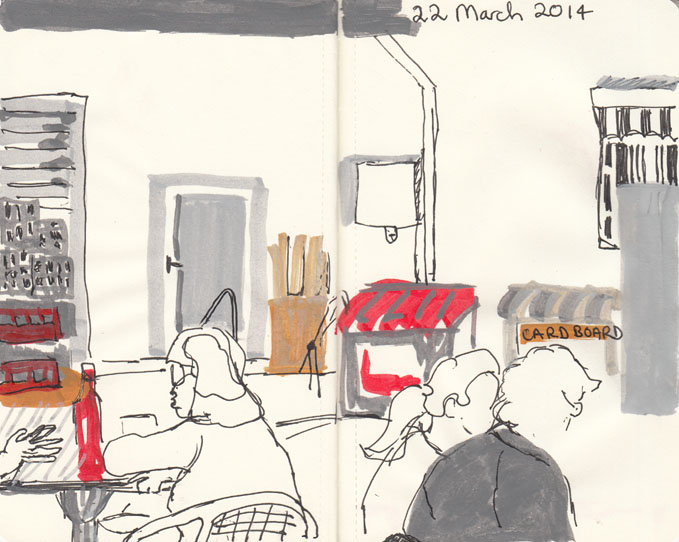
Saturday at the Italian Bakery

It’s early days working with my new paint markers. I took several colours with me when I went for coffee on Saturday morning, being mindful that I didn’t want to ‘paint’ my subject, just sketch it. The view is out the bakery window and looking at the back entrances of the shops across the road.

The Italian bakery, 22 March 2014 pen and paint marker.

The Italian bakery, 22 March 2014 pen and paint marker.

As my partner commented the trick is not to lose the drawing amidst the colour. I’m not sure that I have the balance right yet. I also scanned this image in ‘grayscale’ to give me an idea of how my tonal values are working. It’s something I hadn’t thought about before and I’ll probably do again. If anything it probably reinforces the benefits of limiting my colour palette.

'Greyscale' version of the Italian bakery, 22 March 2014.

‘Greyscale’ version of the Italian bakery, 22 March 2014.

Paint marker practice

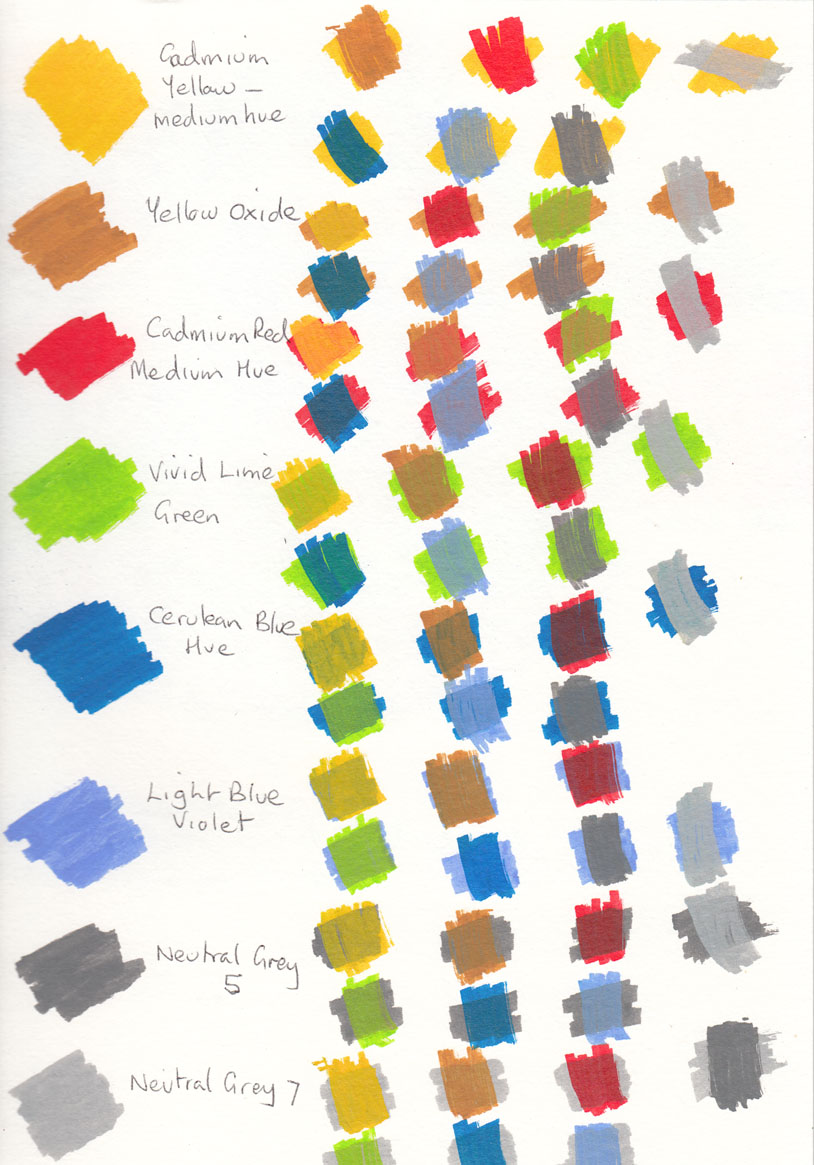
Yes I have gone out and bought myself several more paint markers. I’m pretty much sticking to the tried and true colours, including a cadmium yellow, cerulean blue and yellow oxide. I’ve also selected a bright green, a lighter blue and two greys.

Liquitex paint markers, testing for colour and opacity.

Liquitex paint markers, testing for colour and opacity.

The two colour patches were done using wet over dry and as you can see these colours are quite opaque. There are several colours in the range which are transparent but I haven’t tried any of those yet. The other aspect I like about these markers is that they are very quick drying. So that is a plus for my sketching.

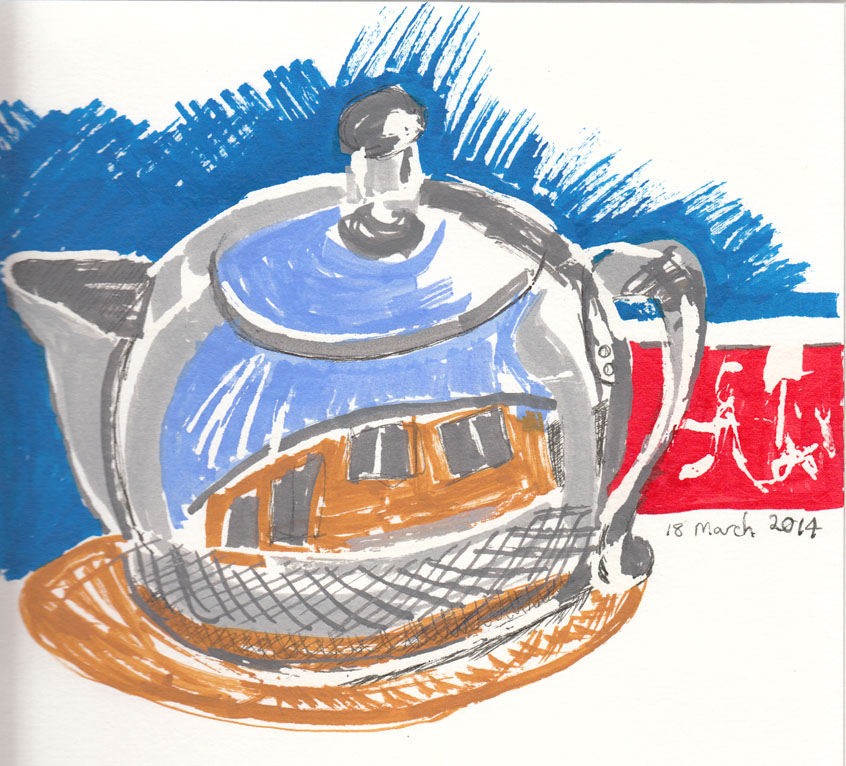
I thought I’d better try the colours out in a ‘real’ drawing, so I did the following sketch of my stainless steel teapot, sitting on a table outside.

Teapot using Liquitex paint markers and ink, 18 March 2014.

Teapot painted using Liquitex paint markers and ink, 18 March 2014.

I don’t plan to use so much colour in my regular sketches, but I’m pleased with how they worked in this quick sketch.

I see red

These drawings contain evidence of my even newer, newest art ‘toy’, paint markers. I am testing a Liquitex Paint Marker, which is a water-based acrylic paint in a marker-style tube. I have the smaller nib version 2-4 mm, but a larger 8-15mm is also available.

It started like this. I dropped by the art supply shop, just before lunchtime on Friday and as I was the only customer there I took the opportunity to ask the staff to give me their views on the range of marker pens that have become so popular lately, particularly for cartooning and graphic art. I haven’t used a felt pen since primary school and at a general starting price of about $10 per pen it’s not the sort of thing I’m going to buy to try ‘on spec’ (‘speculation’ for the non-Aussies out there). I was pleased that I struck two knowledgeable people who could walk me through what was on offer. One of them suggested that apart from the Copic type of marker I should also consider paint markers. Even better, the supplier had given them a whole stack of these pens to test. So they sent me home with my own cadmium red paint marker to play with.

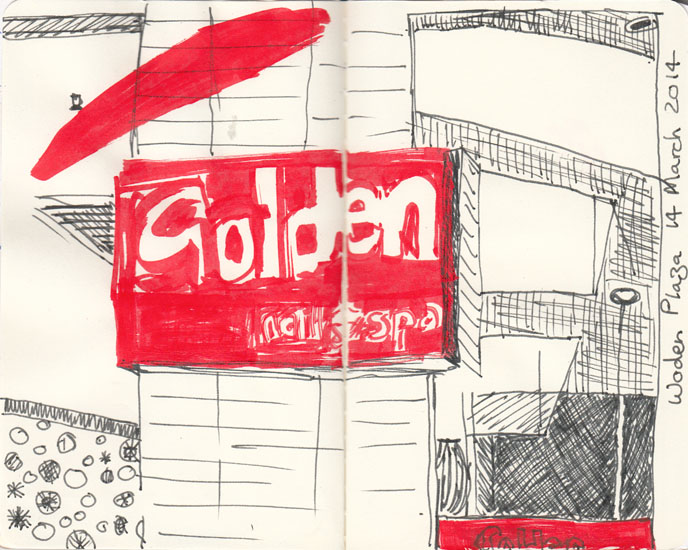
En route I dropped in to the local mall, where I spotted just the right type of sign – red!

In the Mall, ink and paint marker, 14 March 2014.

In the Mall, ink and paint marker, 14 March 2014.

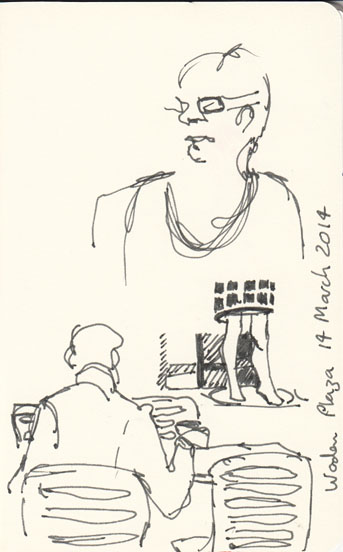
I did also manage to get in a practice sketch of a some people, without even using the marker pen.

People studies, ink, 14 March 2014.

People studies, ink, 14 March 2014.

Today I had another chance to use it. Our favourite bakery cafe has been re-decorated, as has the wall on the other side of the road.

Graffiti outside the cafe, ink, pencil  and paint marker, 15 March 2014.

Graffiti outside the cafe, ink, pencil and paint marker, 15 March 2014.

The paint marker has a chisel point so it can make quite fine lines as well as thicker marks. It will also give good flat coverage, should you want to do that as well. There are 50 colours available and packets of replacement nibs can also be purchased. My thinking is that I would like get a few colours, and one or two greys, based on what I normally paint with, in the smaller tubes so I can add them to my ‘field’ sketch kit. The bigger tubes are just way too jumbo-sized to consider taking them with my regular sketching setup.

Has anyone else used these paint markers? I’d be interested in your thoughts. I see from their website that Liquitex has been offering a free sample to European and American customers, although UK, US and Canadian requests have apparently outstripped currently available supplies. Anyway keep an eye out for them or ask if your local art shop has some samples you can try.

More play

Recently I was given a Moleskine Sketchbook, nice gift. I have used their watercolour books before, I lashed out and bought some when I did an overseas trip, but the sketchbook was new to me. Time to put it through it’s paces. I decided to use my fountain pen with black ink and then try some watercolour washes.

OK, I was rather surprised to see my black ink get sucked into the page so that there was only a medium grey colour left behind. Not promising. Then the watercolour wash ‘beaded’, very finely, on the paper with as much paper exposed as covered. My ink isn’t permanent so there was quite a bit of ‘running’. I wasn’t too happy. But then I looked at the page as it dried and decided it wasn’t so bad after all – I’m referring to the top half of the image below. I quite like the way the watercolour and ink has worked on the red backpack.

Ink and watercolour on Moleskine sketchbook.

Ink and watercolour on Moleskine sketchbook.

I then tried reversing my approach, laying down some washes and a bit of watercolour sketching. The teapot on the left was far more subtle than I expected. I discovered that I could draw back into the wash, after it had dried a bit and the ink remained a lot darker. As you can see the ink didn’t bleed even though the paper remained somewhat damp.

I’ve also done more drawings on the back of this page using washes and I’m really pleased to see that there is no bleeding from one side to the other. I did leave the page to dry out a bit between drawings. The washes dried reasonably quickly, enough for me to be convinced I could get a rapid sketch with washes done and still have it dry enough to close the book up after only a few minutes drying time.

The main drawback for me to effectively use this journal remains the ink. Given that I like to make notes to go with my sketches using this fountain pen with the current type of ink clearly isn’t going to be too successful. Particularly if I want my notes to remain visible. I did see that Moleskine has a rollerball pen that can be clipped for easy carriage onto the sketchbook, but at just under $20 for the pen and $5 each for the refills I think I’ll pass on the “innovative rectangular design” that is “fashioned to specifically compliment the shape and personality of a Moleskine journal”, for a more rudimentary ball point pen!

Fashioned specifically to compliment the shape and personality of a Moleskine journal, the innovative rectangular design feels nice in the hand and lies flat. – See more at: http://www.eckersleys.com.au/products/moleskine-roller-pen#sthash.syJInMZE.dpuf