A very quick drawing of our reflections in the window while we were having coffee. It felt quite odd to be drawing myself, drawing myself, if you get my meaning.


A very quick drawing of our reflections in the window while we were having coffee. It felt quite odd to be drawing myself, drawing myself, if you get my meaning.
Latest from the cafe, after a somewhat unfortunate drawing of a person at the cafe – drawing people isn’t my strong point – I decided to move on to a subject that was more forgiving, the wheelie bins outside the cafe.
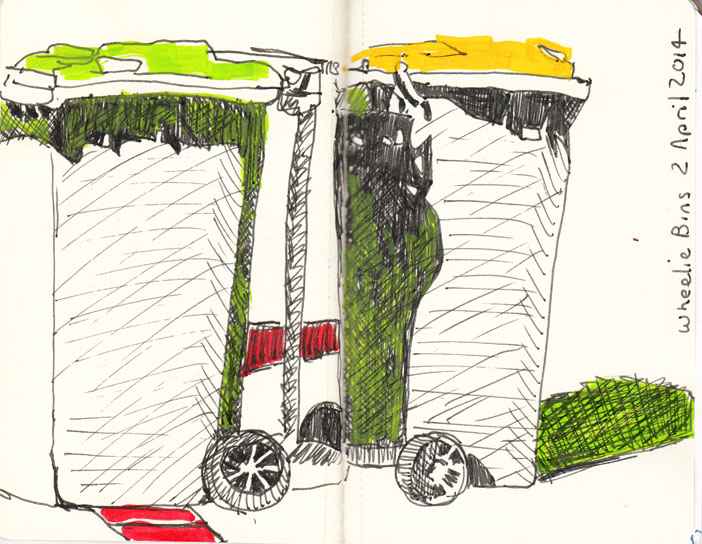
Wheelie bins at the Cafe, 2 April 2014.
I think I’m getting the hang of using just enough of my paint markers.
Driving home through heavy fog last night. Trying to capture the glow of sodium streetlights on the road.
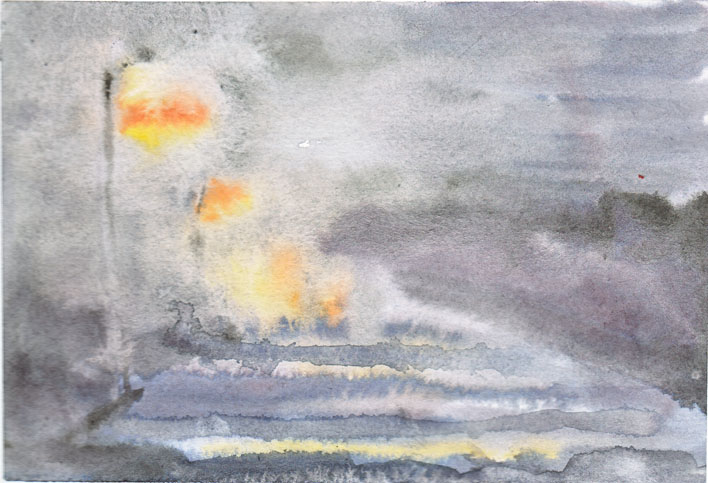
Streetlights on a foggy autumn night, 30 March 2014.
Looking out my kitchen window I could see a light in the next street and my neighbours trees silhouetted against the light.
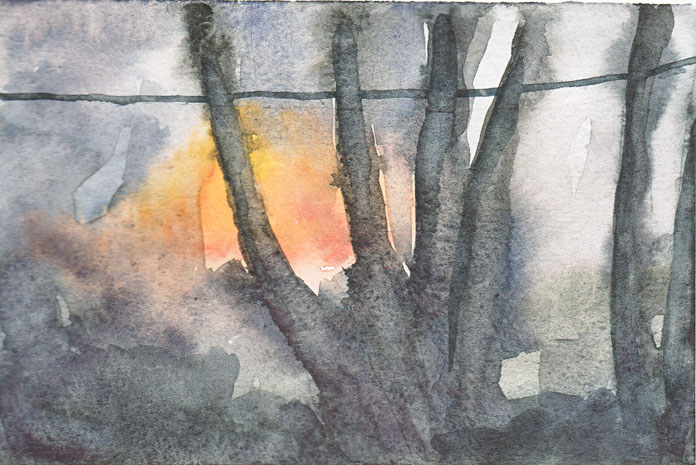
Light in the next street, trees and powerline, 30 March 2014.
It has been fairly quiet this week. I’ve been working on exhibition applications of my own and also with friends so there hasn’t been too much going out and about.
I did have a quick coffee at the National Portrait Gallery, one of the newest national institutions in Canberra. They have a very welcoming attitude and encourage drawing and community participation.

Napkin and condiment box at the National Portrait Gallery of Australia, 24 march 2014.
I had my red paint marker in my bag so the red box and table number just begged to be drawn.
Back to the Bakery the next day, looking up the street in the opposite direction to my last Bakery drawing.
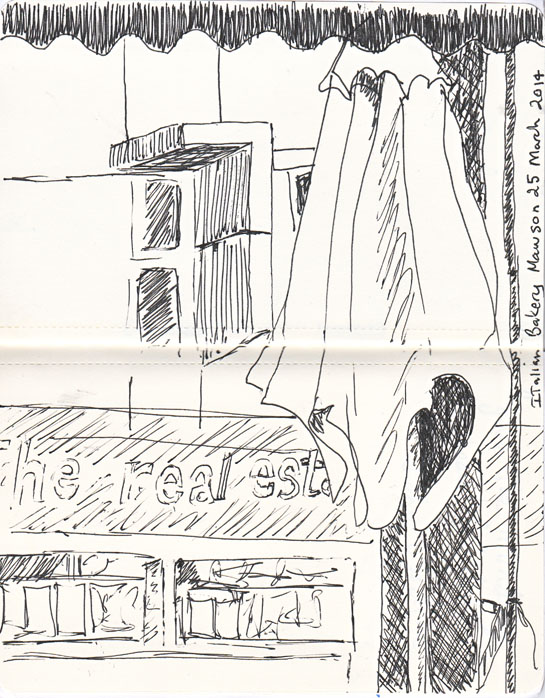
View from the Italian Bakery, Mawson, 25 March 2014.
I bravely decided that I didn’t have to use my red paint marker in all my drawings.
I have a season pass to the Gold and the Incas exhibition, at the National Gallery of Australia. I like being able to spend time having a good look at one or two individual works in detail. I do this by drawing them. However drawing is proving very challenging in the low-light conditions in the exhibition. For a lot of the time while I was making these drawings I couldn’t actually see the tip of my pencil on the page.
This visit I drew two ‘stirrup’ vases, (they get their name from the shape of the handle), although this is clearly not what their makers, the Moche people called them* because stirrups were not introduced into South America until the Spanish invasion, some 800 years after these pots had been made. Both of these works come from the Museo Larco, in Lima, Peru. Some highlights of the Museum ‘s collection are also accessible through the Google Art Project, which is both in English and Spanish.
Most striking in the vases on display are the portrait vases, where faces are deftly sculpted in the round and painted in strong colours.

Moche vase, portrait head, 100-800 AD, ceramic, from the collection of the Museo Larco, Lima, Peru ML000267.
I also made a second drawing of another Moche pot in the shape of four pepinos. The symbolism of the four melons is believed to be related to the four cardinal directions.

Moche culture, vase in the form of Pepinos, ceramic, from the collection of the Museo Larco, Lima, Peru ML006659.
I particularly enjoy the colours used on these pots so once I got home I scanned and printed out the pictures I had drawn and then I indulged myself with a bit of good old-fashioned colouring in.

Moche pot with pepinos, 24 March 2014 watercolour.
The coloured stripes on the face in the next image are not shadows. The face actually has two colours, umber on one side and a burnt sienna on the other, painted over the glazed terracotta and provide evidence of painted facial decoration.

Moche portrait pot, 24 March 2014, watercolour.
*Actually the Moche pots are referred to as pacchas in the exhibition catalogue. These are ritual objects, also made in materials other than ceramics, which generally consist of a form that conducts or conduits liquid through them. These vessels were used in life and were also buried with the dead. Their symbolism is related to the connection between the exterior and interior ‘worlds’ that meet during rituals and at the moment of death.
 leonieandrews