I am at the end of a very brief encounter with Ikara-Flinders Range National Park and I would desperately love to be giving it more attention.
The southern end of Wilpena Pound with a headcovering of cloud.
We have just spent the second of two full days staying at Wilpena Pound. Tomorrow we leave. The weather has been vile. Cold, rainy and blowing a gale. But, but, but … it’s breathtaking.
The view from Razorback Lookout with a rainbow between showers (PS that funny line in the photo is one of the wires around the lookout).
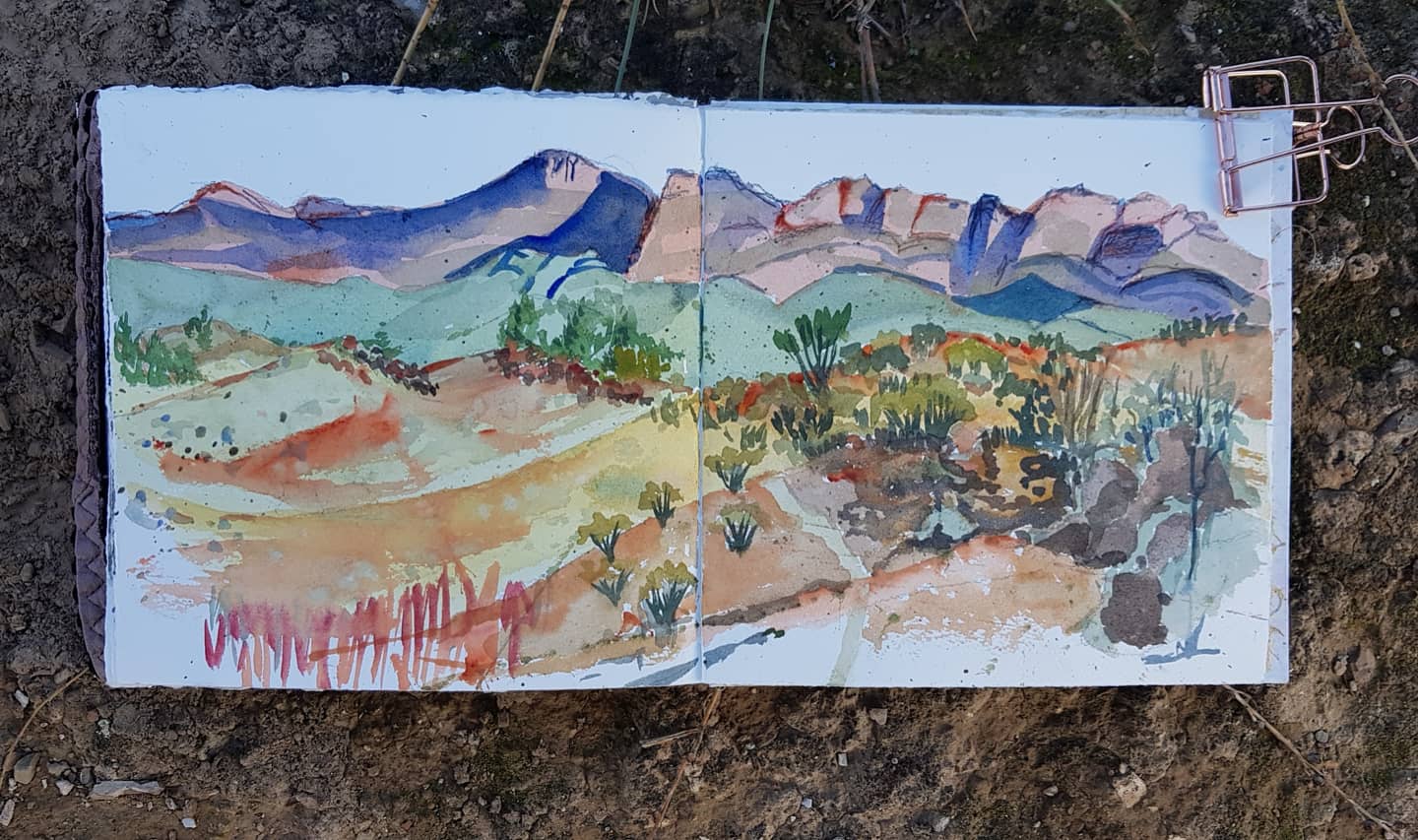
We have sketched from our car, all of the first day and some of our second day. But my biggest frustration with this experience is finding my own voice because I seem to be painting other people’s paintings.
Wilpena Pound from Razorback Lookout, sketched from the car while it rained and blew a gale.
Australians will have some familiarity with the work of watercolourist Albert Namatjira and possibly with photographer Harold Casneaux, whose image ‘Spirit of Endurance‘, was made only a short distance from where we are staying.
Before (left) and after (right).Thinking like me on the left and then remembering all those deep blue shadows in Namatjira’s paintings.
So when I start painting I see Namatjira’s work floating in front of me. It’s a challenge to paint with that over your head. However, the more I thought about it I realised that I should learn from those artists, before I worry about my own style.
Our hope for a day of sketching more at the farm disappeared along with the good weather.
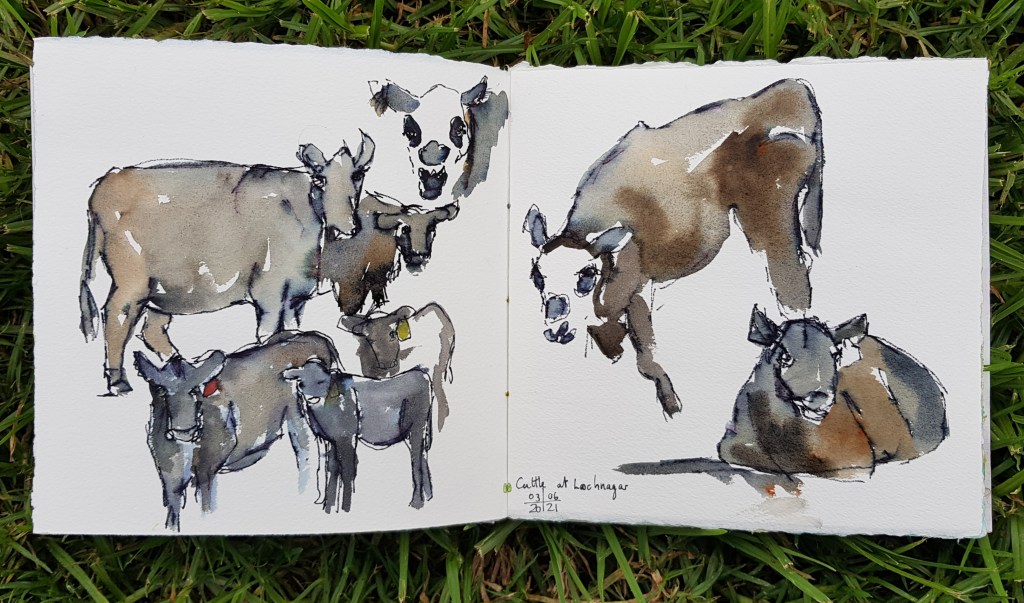
As there were cows on hand, so to speak, I decided to start with them. In fact this is one cow and several calves, two which have been abandoned by their mothers and one belonging to said cow.
A cow and calves. Felt tip pen and watercolour.
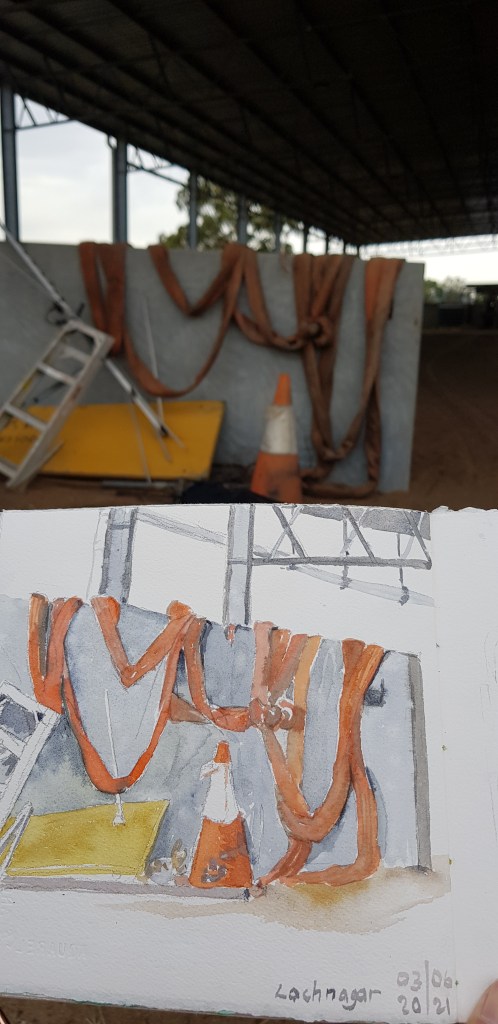
I then moved back to the riding arena (the family breed stock horses) and sketched this still life. The orange ‘ropes’ are slings used in conjunction with the heavy machinery for lifting things.
Farm equipment on the wall. Watercolour and pencil.
It’s a cliche but when I arrived at the farm yesterday I did feel my shoulders relax.
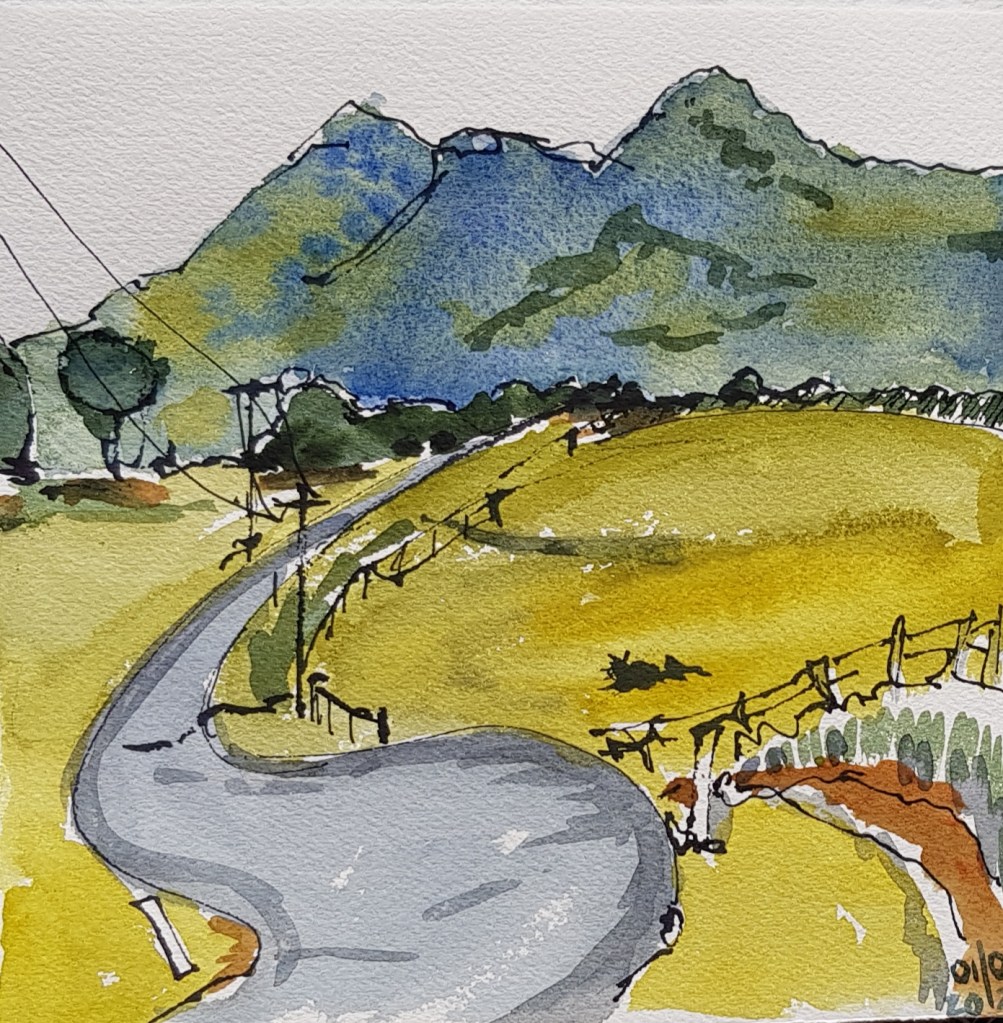
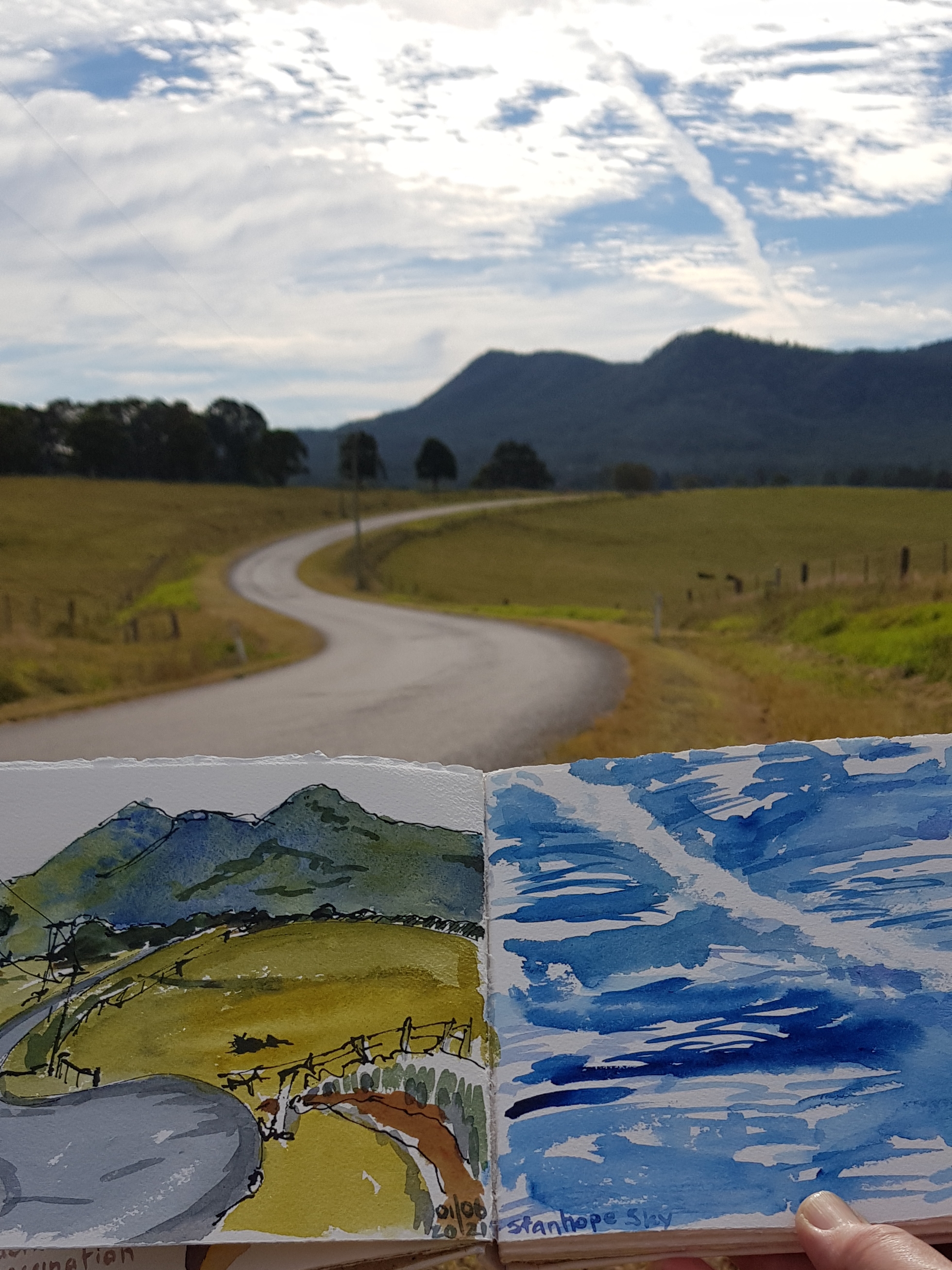
I spotted several points to sketch on my walk this morning so I set about working pretty quickly.
Looking down the road to the mountains. Pen and ink and watercolour. The skies were amazing so I tried a cloud study.The two pages of my sketchbook. Part way through my 3rd sketch, trying to block in big shapes with some wet into wet painting.The finished sketch. The most accurate colour is the red triangle in the foreground, which is a dam covered in duckweed.
Yesterday (20 November 2017) we went for a pleasant walk around our local landmark Black Mountain. A walking track circles it below the summit. The walk is posted as taking 45 minutes to complete, but allowing for stopping to botanise and sketch we managed the circumnambulation at a cracking two hours and ten minutes!
“roll up your catalogue and view each picture through it. … You will be rewarded with a wonderful suggestion of light and air and sufficient detail, and finish.” So said critic Percy Leason and fellow student of Clarice Beckett (1887- 1935), of her 1931 solo exhibition *.
Tea Gardens, c.1933, oil on canvas on pulpboard, 51.0 cm x 43.7 cm
Clarice Beckett’s work, rather like the artist herself, can be difficult to pin down. Her life story of is the stuff to make movies of and has inspired at least one novel (Night Street, by Kristel Thornell, joint winner of the 2009 Vogel Award). Her work only entered public collections in Australia some 35 years after her death. The vast majority of her output has been lost to both accidental and deliberate destruction. (I have included a very brief bio of her at the end of this post).
This major retrospective at the Art Gallery of South Australia features 130 works by Beckett. I believe that this is the largest exhibition of her work ever shown.
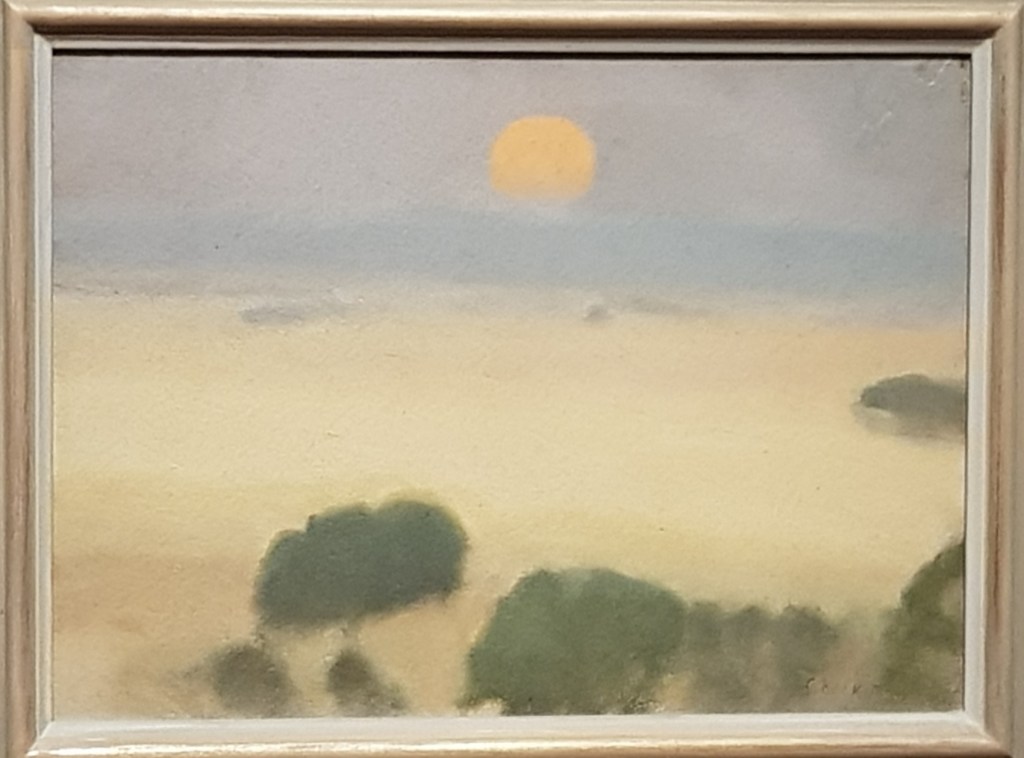
Summer Fields, Naringal, 1926, oil on board, 24.5 cm x 34.5 cm
Clarice Beckett falls under the broad rubric of an Australian Modernist artist. Her control of light and atmospheric effects is equal to that of Turner. She references Whistler in her own painting titles, is frequently compared to Corot and her colour studies (such as still remain) are a precursor of Rothko’s. That pretty much ticks the boxes for me.
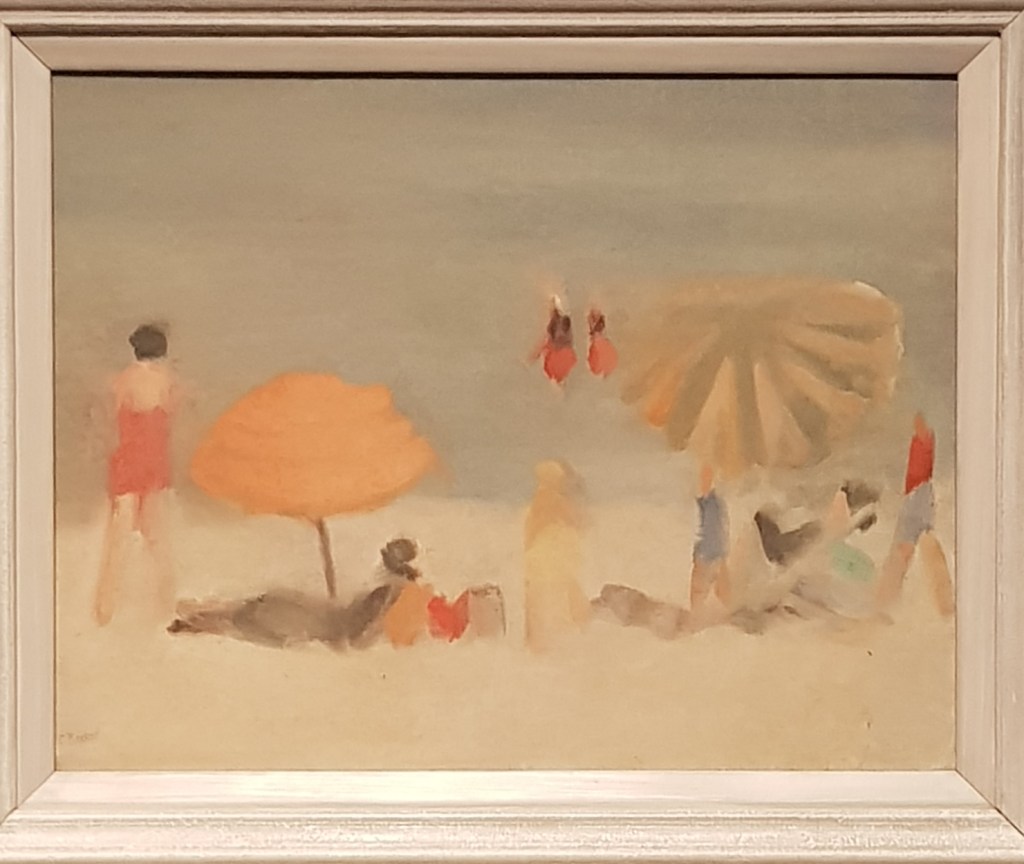
Beach Scene, c. 1932-3, oil on canvas, 52.1 cm x 62.0 cm
The subject matter of the majority of Beckett’s extant work is of Beaumaris, a bayside suburb of the city of Melbourne and the city of Melbourne itself.
The Bus Stop, c. 1930, oil on board, 41.0 cm x 34.0 cm
It strikes me that you could easily be misled by the deliberate simplicity of the composition of the paintings. Beckett’s approach was a “technique of applying broad areas of finely graded tones produces an image that is slow to come to life”.* While there is weight in the subject matter, this approach allows the focus of her painting to be on the light effects she observes.
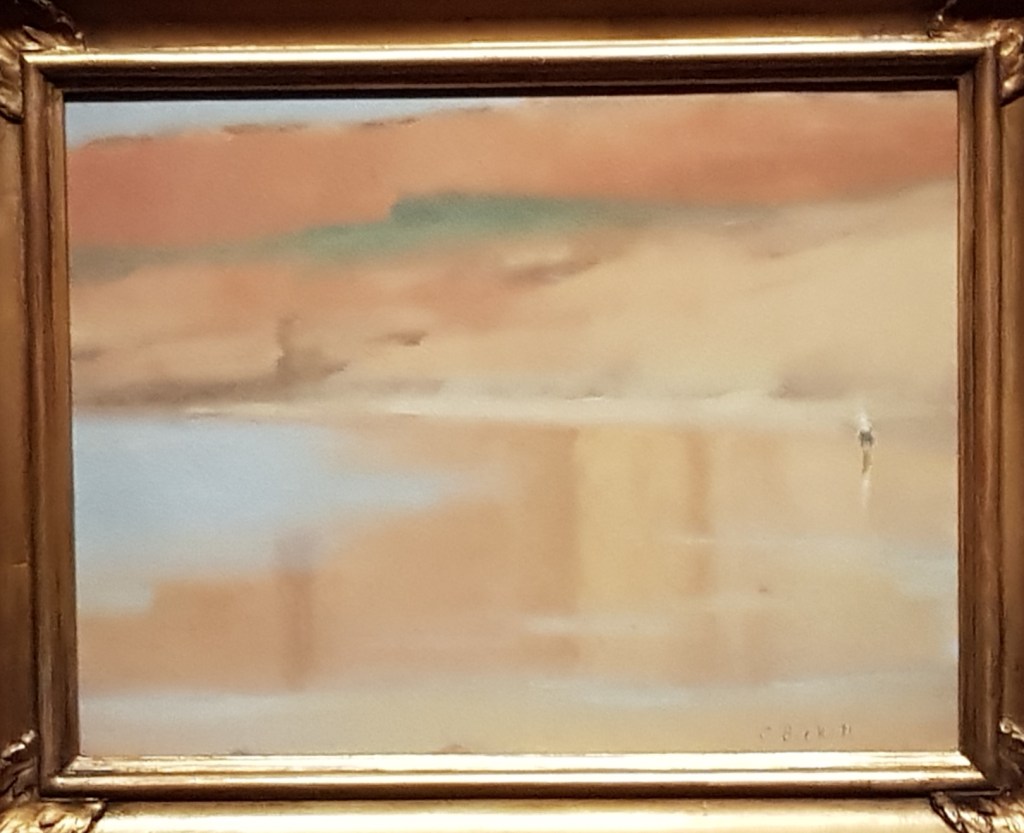
Wet Sand, Anglesea, 1929, oil on board, 29.3 cm x 39.0 cm
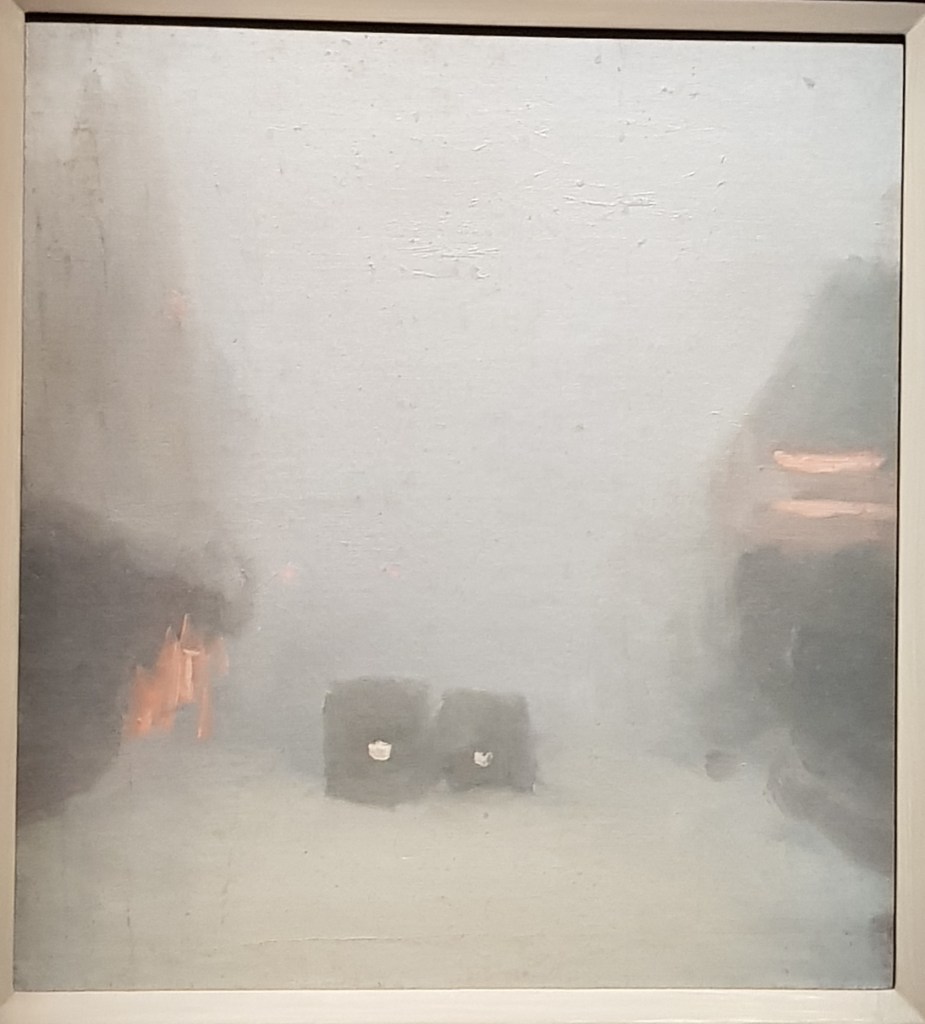
In many works the subject matter is almost an abstracted form, such as Passing Trams, c 1931 and in others, such as Wet Night, Brighton, 1930, an exercise in geometry, and yet there is such intensity in her focus that the results transcend such easy charaterisations.
Passing Trams, c. 1931, oil on board, 48.6 cm x 44.2 cmWet Night, Brighton, 1930, oil on board, 26.6 cm x 38.0cm
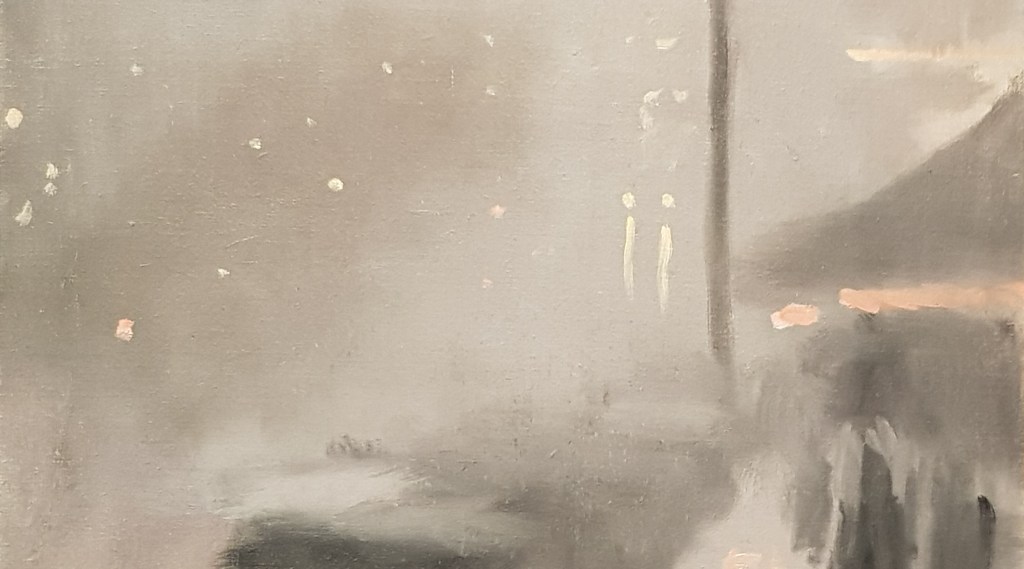
Beckett made most of her paintings on location. She wheeled her hand cart with her supplies, walking around a 5 km radius of her house, or travelling into the city. Her paintings are quite small by today’s art extravaganzas, often no more than A3 size, so the intensity of her work is all the more focussed into these small works. I am apologetic as these photographs barely do justice to the intensity of the paint surface. I will share with you some detail shots so hopefully this may become a bit more apparent.
Dusk, c. 1928, oil on canvas on board, detail, 37.5 x 45.5 cmTaxi Rank, c. 1931, oil on canvas on cardboard, detail, 58.5 x 51.0 cm
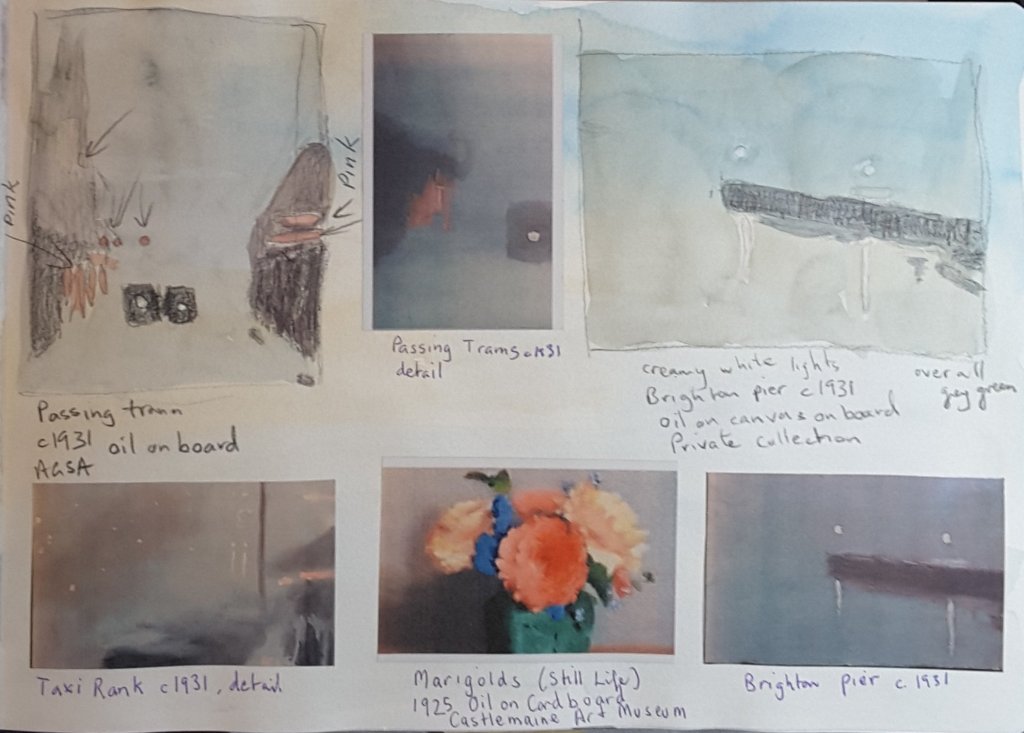
Per usual I took as many painting notes inside the exhibition as time permitted, alas never as much time as I would like. I also did some further studies of her work from the exhibition catalogue.
A page from my gallery sketchbook, focussed on Beckett’s use of high toned pink highlights.A page from my gallery sketchbook. Looking at Beckett’s compositions.
Clarice Beckett: The Present Moment is currently on show in Adelaide at the Art Gallery of South Australia. The exhibition runs until 16 May 2021. The exhibition is ticketed, but there are no timed entry requirements.
All quotes in this post come from the exhibition catalogue The Present Moment: The Art of Clarice Beckett, Tracey Lock, Art Gallery of South Australia, 2020 ; p 104 quoting P. Leason, ‘Current art shows’, Table Talk, 5 December 1931, p14; p 104 Tracey Lock
Biography
Beckett, the eldest daughter of a rural bank manager, studied art at the National Gallery School in Melbourne with Fredrick McCubbin (1914-16) and also for a brief period under the tutelage of Tonalist painter Max Meldrum. Clarice regularly exhibited and her work gathered notice, among a small group of people and was recognised briefly, even as far afield as New York. She exhibited with several groups and held solo exhibitions every year from1923 to 1933. But when she died from pneumonia at age 48 her work was largely forgotten.
After her death some of her work was deliberately burnt by her father. Other major pieces from her time staying with friends in rural Victoria were lost in a house fire. The vast majority of her canvases were put in a shed in rural Victoria where they disintegrated under an onslaught of weather and vermin. The canvases were tracked down in 1970 by Dr Rosalind Hollingrake who had been searching for years to find out more about the work of one C. Beckett. Of those canvases some 369 were saved and 1600 were beyond retrieval.
Beckett’s work was never acquired by a public gallery in her lifetime. Her works first entered the National Gallery of Australia in 1971, after Hollingrake showed the work at her gallery in Melbourne.









 leonieandrews