It seems like only minutes since our feet touched home again after being away for four months, but again we have jumped back on a plane to join fellow Urban Sketchers in Suwon, South Korea. This is the location for the Asialink Sketchwalk, where sketchers get together to draw for 4 days.
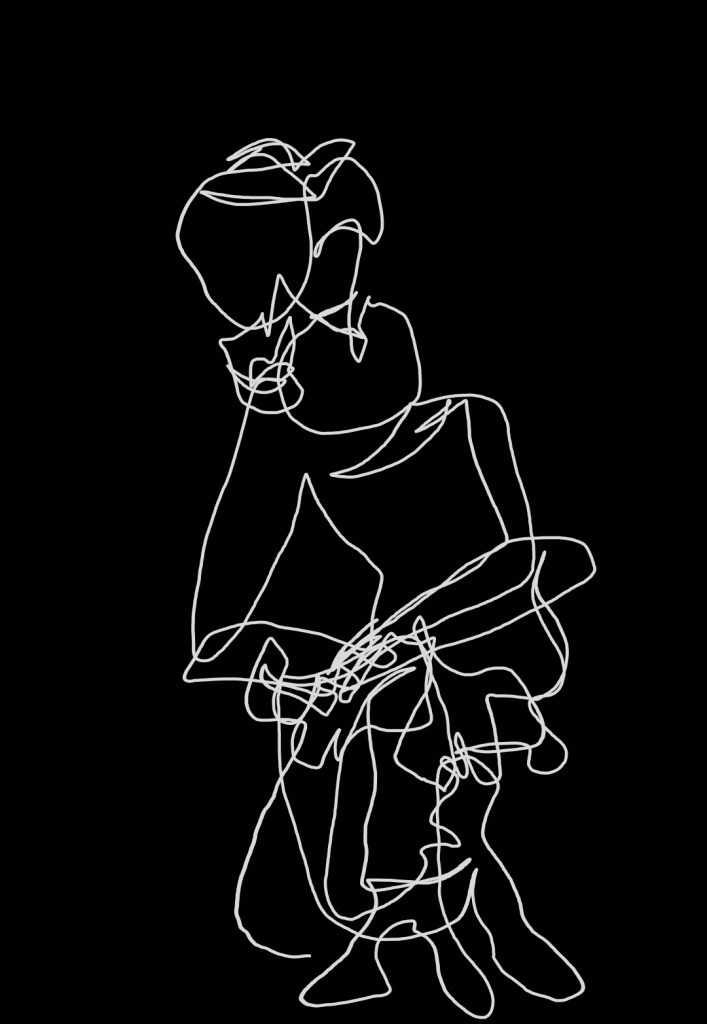
We have been staying in Seoul for a few days and have been doing a lot of walking and some drawing. Yesterday we went to the National Museum of Korea which holds many treasures. I was intrigued by the space called ‘The Room of Quiet Contemplation’, which holds two statues made in the 7th century of Pensive Bodisattvas. I took the opportunity to do blind contour drawings of both sculptures, remembering to breathe slowly as I focused my eyes on following my way around their forms.
As often with this type of drawing I feel that it captures an essence of what I saw more effectively than any detailed academic drawing would.
Well it’s been a while since I posted, mainly because I have been busy finalising my first solo exhibition in Sydney, (more of that in another post). We had to drive up from Canberra for the installation so once we arrived we had some spare time to get some sketching done.
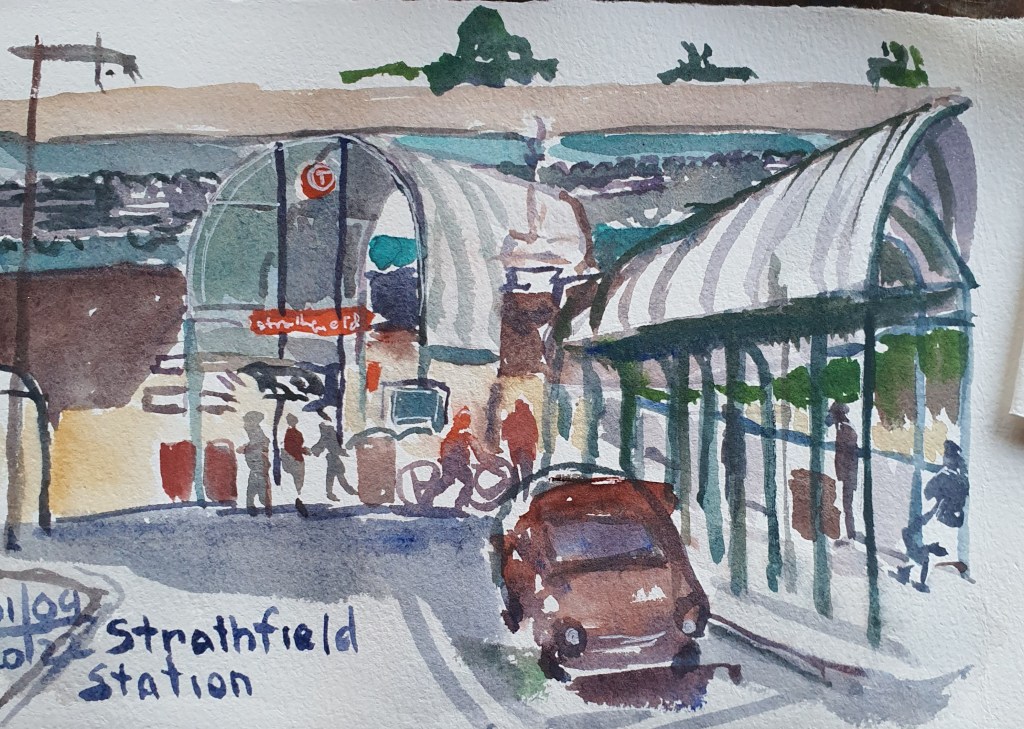
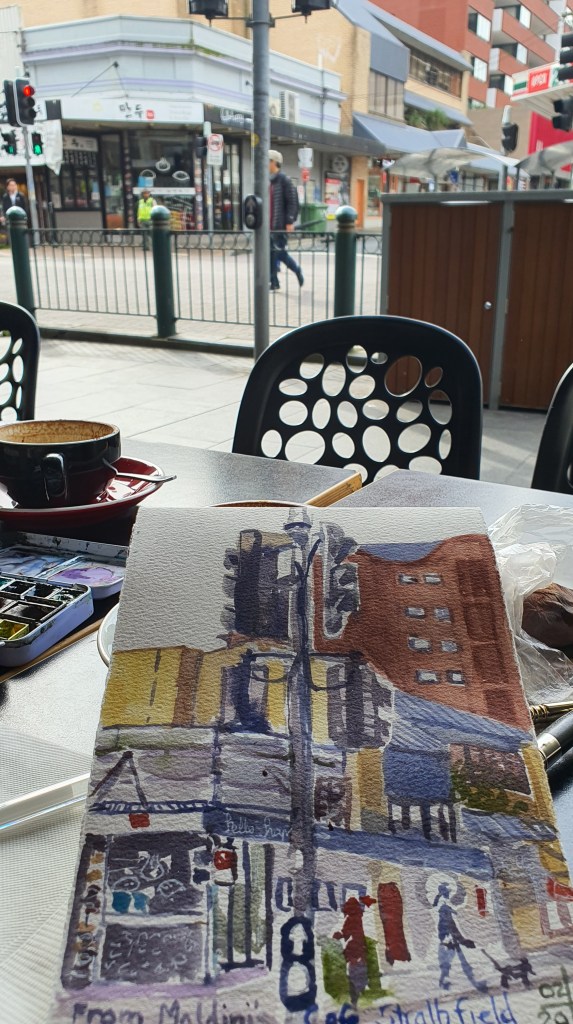
You probably won’t be surpised that this has meant sitting in cafes and sketching, although it’s also been about taking the opportunity to look out at the busy urban settings as much as drawing people. We are staying in the inner-ish suburb of Strathfield, close to the railway station. It’s a lively area with plenty of activity all day.
Early morning coffee sketching at Maldini’s Espresso. The place across the road must have the good dumplings because there were always queues there at night.
The area also has a very strong Korean focus. You can’t go wrong with Korean barbecue restaurants and the style and content of the local grocery and specialty shops is a far cry from what we have in our local area. It makes a heady mix for us sketchers!
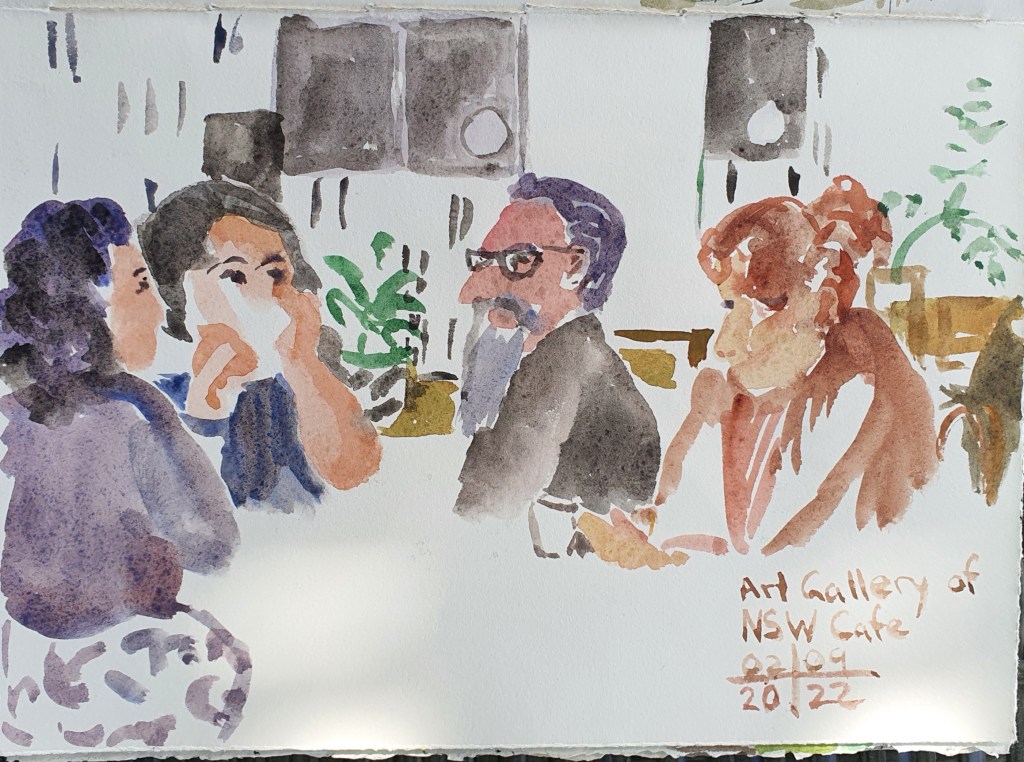
We also spent some time at the Art Gallery of New South Wales, where I had just enough time to sketch some sculptures as fit in another cafe sketch.
Lyndon Dadswell, The Birth of Venus, 1944. One of a number of smaller sculptures displayed together.
I love the way these groupings of sculptures relate to each other and the art around them. It was a bit of a challenge to see enough detail in the Dadswell sculpture to draw it, as it was silhouetted against a bright window. The view of the back of the sculpture was much better lit. Unfortunately I didn’t have enough time to sketch that as well.
The rear view of the Birth of Venus by Lyndon Dadswell. One final cafe sketch.
Pure form: Japanese sculptural ceramics*, is a new exhibition at the Art Gallery of South Australia showcasing Japanese ceramics from the 1950s to the present day.
Installation shot of work, (foreground to background), Object (nogata), saiseki zōgan, Kishi Eiko, 2005; Shell-shaped covered vessel (Kai futamono), Koike Shōko, 2009: No.3 Erosion, Shingu Sayaka, c. 2020; Untitled, Katsumata Chieko, 2021; and Box Batter-17, Mishima Kimiyo, 2017.
The exhibition spreads across several rooms and is breathtaking in it’s array of forms, textures and graphic presence. I had only a limited time to draw in the gallery today. The hardest thing was to decide what to sketch first.
I started with a darkly glazed vessel by Mihara Ken, whose concertina-shaped folds reminded me of Issey Miyake garments.
Sekki, Mihara Ken, c. 2010, Matsue, stoneware and glaze, collection of Raphy Star. Sketch, graphite on paper.
Next to the work of Mihara Ken was a form by Misaki Mitsukuni. The surface, which I was unable to do justice to, is created by the artist rubbing slip into the surface, which he has described as ‘Rothkoing’.
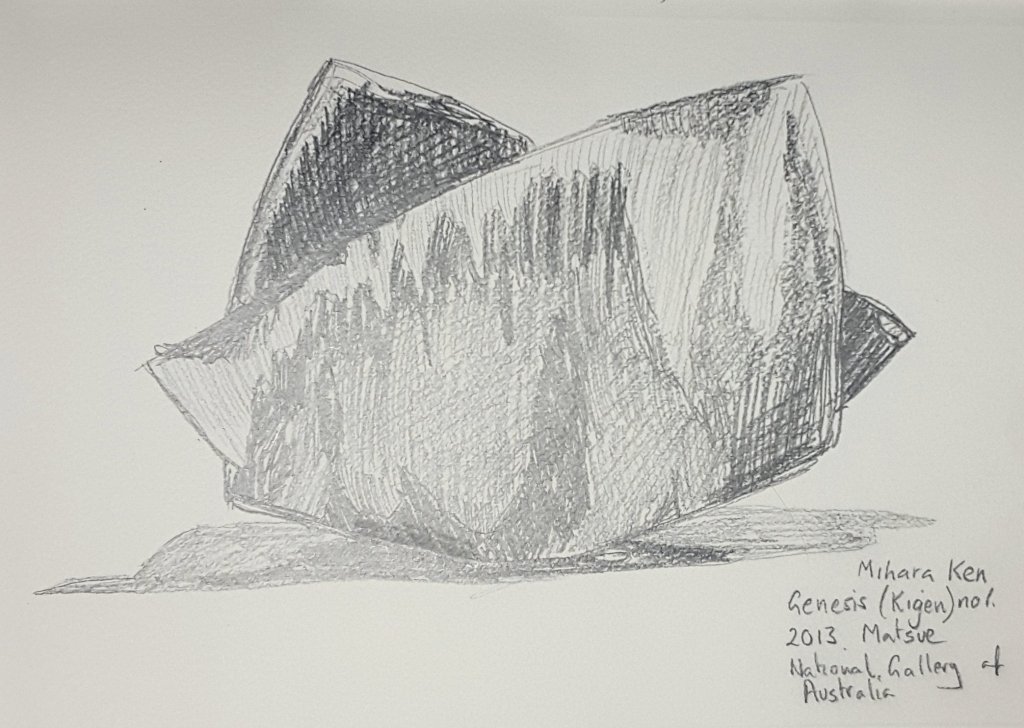
Turning my chair I could see another work by Mihara Ken, a form that appeared as if folded out of sheets of clay. The glazes were very subtle blue greys and deep brown.
Genesis (Kigen) no.1, Mihara Ken, 2013, stoneware, glaze, National Gallery of Australia. Sketch graphite on paper.
Finaly, I did a very quick sketch, part contour drawing, of Kaneshige Kosuke’s work, Tall sculptural form, c. 2006.
Tall sculptural form, Kaneshige Kosuke, c. 2006, Bizen city, stoneware, collection of Raphy Star. Sketch, graphite on paper.
*Pure form: Japanese sculptural ceramics is accompanied by an extensive catalogue (which I will be looking at for quite some time).
The exhibition and book are by Russell Kelty, Curator of Asian Art, Art Gallery of South Australia.
The exhibition runs until 6 November 2022 at the Art Gallery of South Australia. Get there if you want to see some amazing ceramics!
As I walked into the large room, people moving in front of me, I looked up and saw ‘The Duke’. Our eyes met, a shiver ran down my spine. OMG! IT’S A GOYA!!!
The Duke of Wellington by Francisco de Goya, 1812-14
If you are wondering about my delirium over this work, apart from the fact that it’s just a bloody marvellous painting, it’s because paintings by Goya rarely make it to our shores. I did a quick check and the only Goyas permanently in Oz are of Goya’s Los Caprichos series of etchings.
I was also surprised as nowhere in the pre-publicity for this exhibition did I see a mention of a Goya, nor Vermeer or Velasquez, all of whose works were in the show.
Arthur Wellesley, the 1st Duke of Wellington, (1769-1852) was arguably the leading military (and political) figure of the 19th century in the United Kingdom. His most prominent victory was the defeat of Napoleon at the Battle of Waterloo alongside the Prussian army under Generalfeldmarchal Blücher.
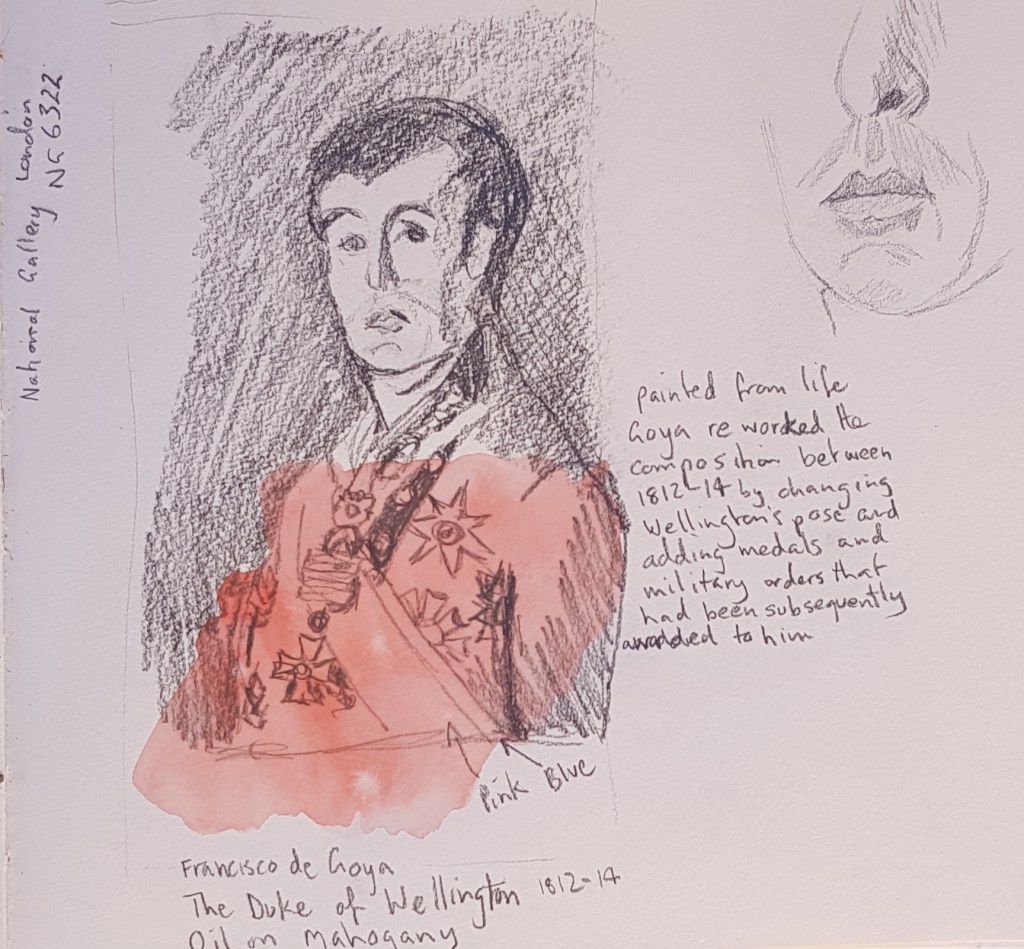
As this was my second visit to the exhibition (see my previous post here) I decided to prepare my page with a splash of red paint. This reflects the colour of the Duke’s uniform, but I wasn’t trying to be literal about painting it.
The Duke of Wellington, by Francisco de Goya, 1812-14. Prepared watercolour and pencil.
I also chose to do a closer study of the lower part of the face. By this time I had realised that trying to replicate the fine modelling of the oil paint was more than my pencil could manage.
The actress of the title is Mrs Siddons (Sarah Siddons, nee Kemble, 1755-1831). A famous tradegienne she was renowned for her portrayal of Lady Macbeth and Isabella from Isabella, or The Fatal Marriage by Thomas Sotherne. As an interesting aside, Siddons also played the role of Hamlet on numerous occasions over a 30 year period.
The portrait of Siddons in the exhibition is by Sir Thomas Gainsborough (she was also painted by Sir Joshua Reynolds and Sir Thomas Lawrence whose work is also included in this exhibition). Her head is shown in profile with her powdered wig and her dramatically large hat framing her face.
Mrs Siddons by Sir Thomas Gainsborough, 1785
William Hazlitt said of Sarah Siddons “Tragedy personified … to have seen Mrs Siddons was an event in everybody’s life.”
The final grace note was to find out, via Wikipedia, that the Duke and Mrs Siddons were acquainted, as the Duke attended some of Mrs Siddons receptions.
From March to June 2021 the National Gallery of Australia is hosting a raft of paintings, including many masterpieces from the National Gallery, London,in the Boticelli to Van Gogh exhibition. I have to say masterpieces because there is not a single work by a female artist is included in this show! Really? Yes, the National Gallery London is a very blokey affair, although I would have been happy to see their works by Rosalba Carriera, Artemesia Gentilleschi, Rosa Bonheur or Berthe Morisot. Rather ironic as the Know My Name exhibition of women artists is taking up almost all of the rest of the main floor of the gallery at present.
I have purchased a season ticket that allows me to visit the exhibition as many times as I can. My first post focused on Van Gogh’s Sunflowers 1888, but I must admit I have spent a lot more time looking elsewhere in the exhibition.
By drawing my way through the exhibition I can spend time looking closely at the paintings trying to learn what I can by copying. Though the reality is that a pencil (the only drawing tool allowed in the Gallery), is not always the right tool to capture a finely wrought portrait.
My first sketches included Joseph Wright of Derby’s double portrait of Mr and Mrs Thomas (Mary Barlow) Coltman, c. 1770-72 (NG6496) and Frans Hal’s Portrait of a Woman with a Fan, c. 1640 (NG 2529).
Mr and Mrs Thomas Colton, by Joseph Wright of Derby, c 1770-72
The Coltman’s were painted in a ‘conversation piece’ portrait, which was a popular convention of the time, showing the couple in a charmingly relaxed pose, (something that the Curator Susan Foister notes that would have required quite some forethought on Wright’s part). It is a portrait of ease and nicely observed detail, including Mary’s horse with it’s ears back, because their spaniel (not in my sketch) is nipping at it.
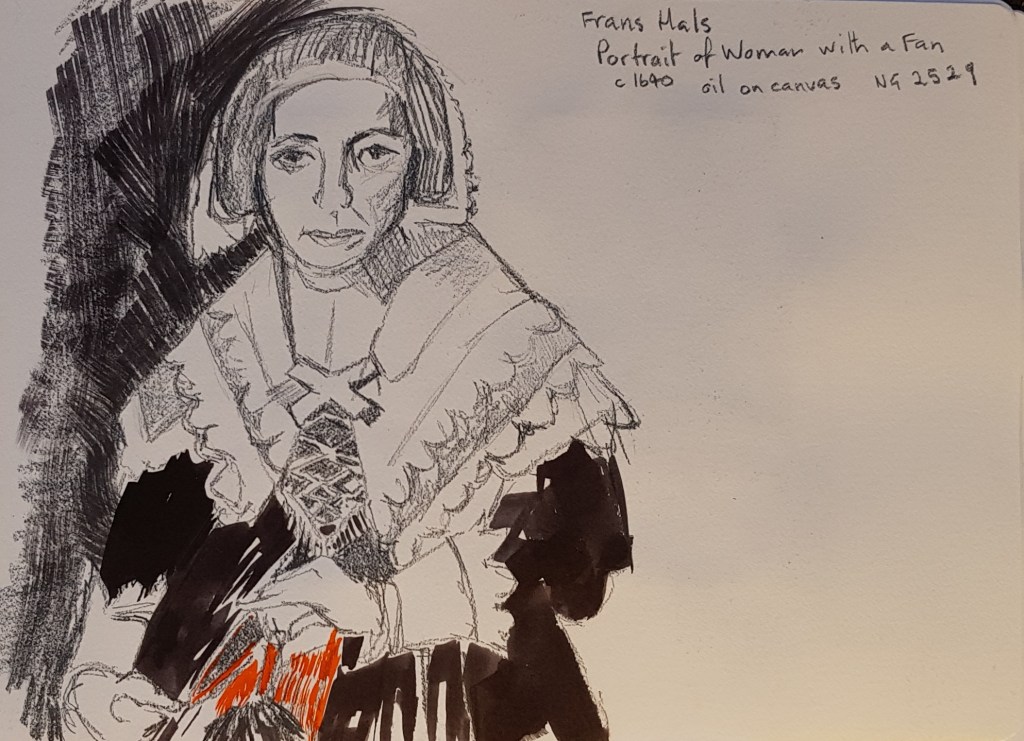
Alas my sketch of the Woman with a Fan was rather less successful. I have turned the sitter from a young woman into a middle-aged version of herself! The figure itself and dress with the lace collar and cuffs I am quite happy with.
Woman with a Fan, by Frans Hals, c.1640. The colour and black marker was added later as only pencil can be used in the Gallery.
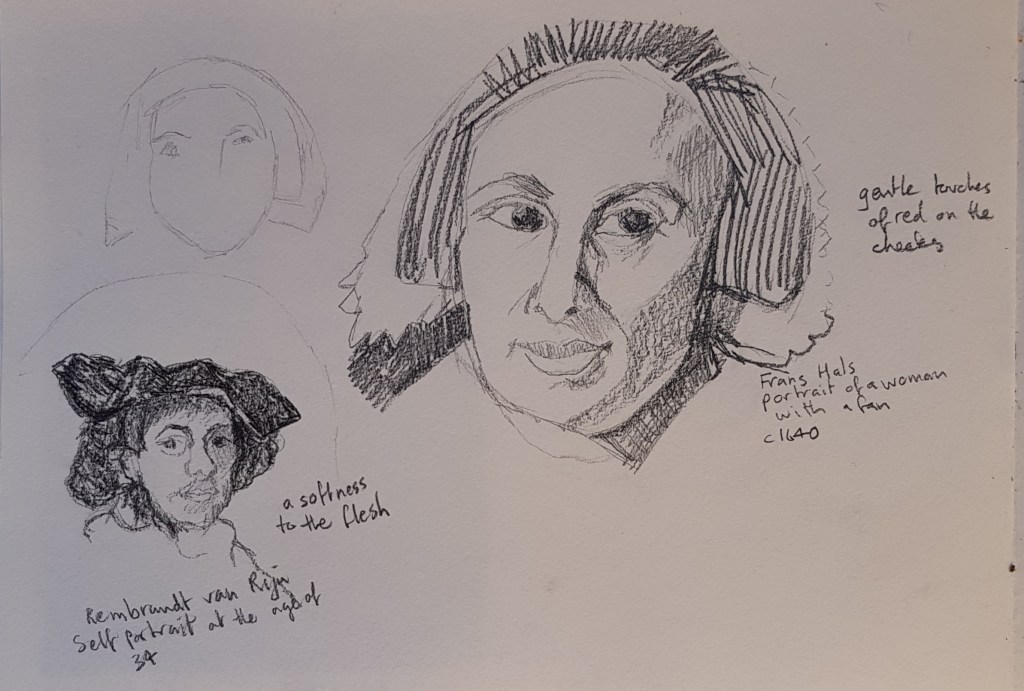
I made a somewhat better go of this work the next time I visited. At least there is some vague resemblance in this version, although she still looks much older than she does in Hal’s portrait.
Frans Hals reboot and a cameo appearance by Rembrandt’s self-portrait aged 34.
Stay tuned for Part 2, where we meet the Duke and the Actress!









 leonieandrews