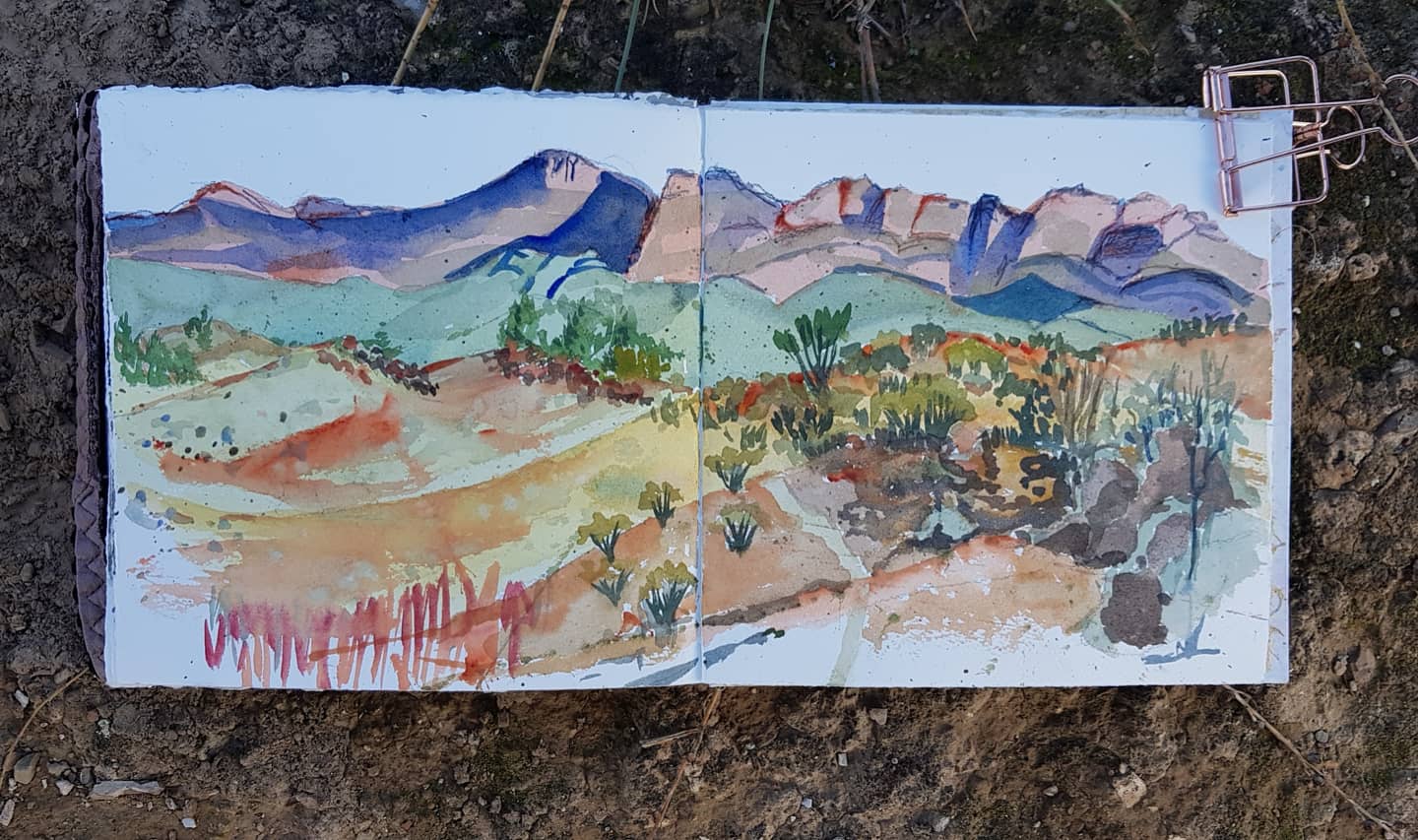
Two more farm sketches

Our hope for a day of sketching more at the farm disappeared along with the good weather.

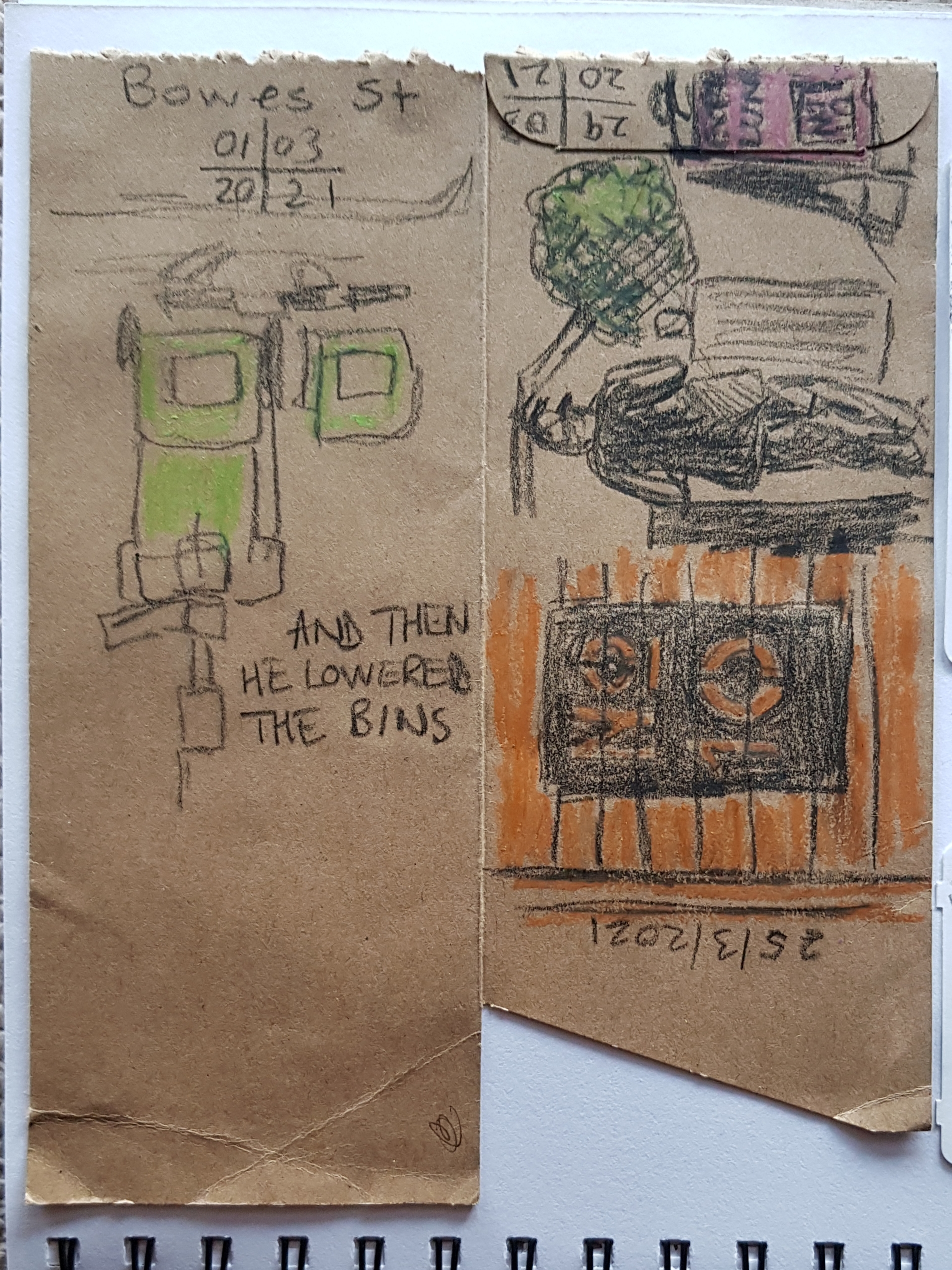
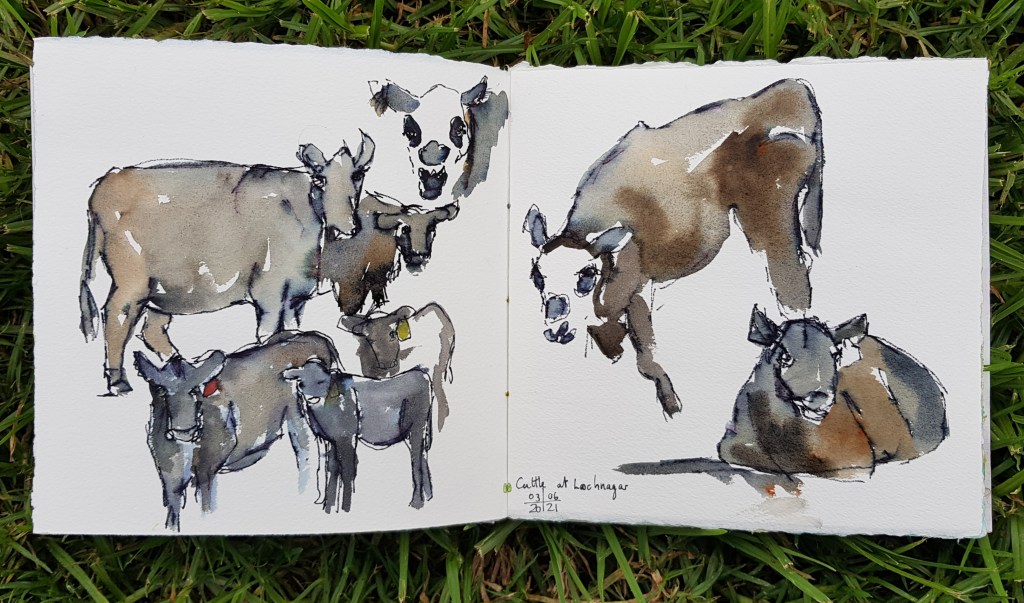
As there were cows on hand, so to speak, I decided to start with them. In fact this is one cow and several calves, two which have been abandoned by their mothers and one belonging to said cow.

A cow and calves. Felt tip pen and watercolour.

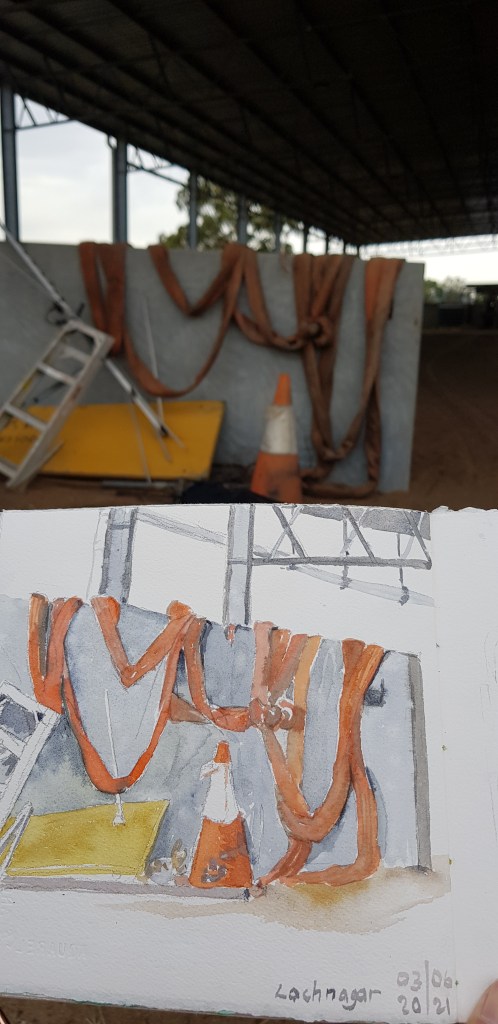
I then moved back to the riding arena (the family breed stock horses) and sketched this still life. The orange ‘ropes’ are slings used in conjunction with the heavy machinery for lifting things.

Farm equipment on the wall. Watercolour and pencil.

Drawing the exhibition: Boticelli to Van Gogh – Part 2

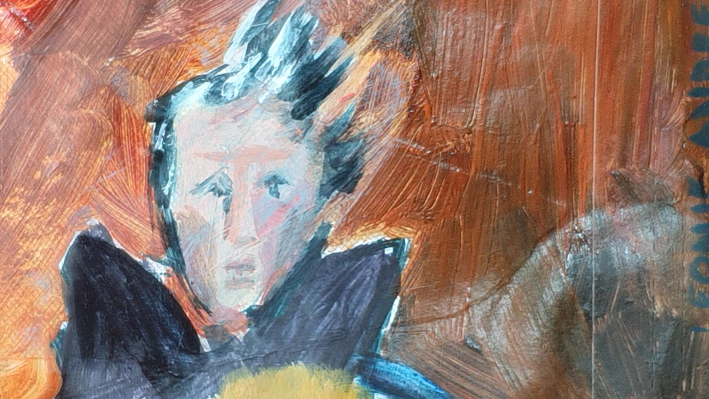
As I walked into the large room, people moving in front of me, I looked up and saw ‘The Duke’. Our eyes met, a shiver ran down my spine. OMG! IT’S A GOYA!!!

The Duke of Wellington by Francisco de Goya, 1812-14

If you are wondering about my delirium over this work, apart from the fact that it’s just a bloody marvellous painting, it’s because paintings by Goya rarely make it to our shores. I did a quick check and the only Goyas permanently in Oz are of Goya’s Los Caprichos series of etchings.

I was also surprised as nowhere in the pre-publicity for this exhibition did I see a mention of a Goya, nor Vermeer or Velasquez, all of whose works were in the show.

Arthur Wellesley, the 1st Duke of Wellington, (1769-1852) was arguably the leading military (and political) figure of the 19th century in the United Kingdom. His most prominent victory was the defeat of Napoleon at the Battle of Waterloo alongside the Prussian army under Generalfeldmarchal Blücher.

As this was my second visit to the exhibition (see my previous post here) I decided to prepare my page with a splash of red paint. This reflects the colour of the Duke’s uniform, but I wasn’t trying to be literal about painting it.

The Duke of Wellington, by Francisco de Goya, 1812-14. Prepared watercolour and pencil.

I also chose to do a closer study of the lower part of the face. By this time I had realised that trying to replicate the fine modelling of the oil paint was more than my pencil could manage.

The actress of the title is Mrs Siddons (Sarah Siddons, nee Kemble, 1755-1831). A famous tradegienne she was renowned for her portrayal of Lady Macbeth and Isabella from Isabella, or The Fatal Marriage by Thomas Sotherne. As an interesting aside, Siddons also played the role of Hamlet on numerous occasions over a 30 year period.

The portrait of Siddons in the exhibition is by Sir Thomas Gainsborough (she was also painted by Sir Joshua Reynolds and Sir Thomas Lawrence whose work is also included in this exhibition). Her head is shown in profile with her powdered wig and her dramatically large hat framing her face.

Mrs Siddons by Sir Thomas Gainsborough, 1785

William Hazlitt said of Sarah Siddons “Tragedy personified … to have seen Mrs Siddons was an event in everybody’s life.”

The final grace note was to find out, via Wikipedia, that the Duke and Mrs Siddons were acquainted, as the Duke attended some of Mrs Siddons receptions.

Three sketches outside Stanhope New South Wales

It’s a cliche but when I arrived at the farm yesterday I did feel my shoulders relax.

I spotted several points to sketch on my walk this morning so I set about working pretty quickly.

Looking down the road to the mountains. Pen and ink and watercolour.
The skies were amazing so I tried a cloud study.
The two pages of my sketchbook.
Part way through my 3rd sketch, trying to block in big shapes with some wet into wet painting.
The finished sketch. The most accurate colour is the red triangle in the foreground, which is a dam covered in duckweed.

Drawing the exhibition: Boticelli to Van Gogh – Part 1

From March to June 2021 the National Gallery of Australia is hosting a raft of paintings, including many masterpieces from the National Gallery, London, in the Boticelli to Van Gogh exhibition. I have to say masterpieces because there is not a single work by a female artist is included in this show! Really? Yes, the National Gallery London is a very blokey affair, although I would have been happy to see their works by Rosalba Carriera, Artemesia Gentilleschi, Rosa Bonheur or Berthe Morisot. Rather ironic as the Know My Name exhibition of women artists is taking up almost all of the rest of the main floor of the gallery at present.

I have purchased a season ticket that allows me to visit the exhibition as many times as I can. My first post focused on Van Gogh’s Sunflowers 1888, but I must admit I have spent a lot more time looking elsewhere in the exhibition.

By drawing my way through the exhibition I can spend time looking closely at the paintings trying to learn what I can by copying. Though the reality is that a pencil (the only drawing tool allowed in the Gallery), is not always the right tool to capture a finely wrought portrait.

My first sketches included Joseph Wright of Derby’s double portrait of Mr and Mrs Thomas (Mary Barlow) Coltman, c. 1770-72 (NG6496) and Frans Hal’s Portrait of a Woman with a Fan, c. 1640 (NG 2529).

Mr and Mrs Thomas Colton, by Joseph Wright of Derby, c 1770-72

The Coltman’s were painted in a ‘conversation piece’ portrait, which was a popular convention of the time, showing the couple in a charmingly relaxed pose, (something that the Curator Susan Foister notes that would have required quite some forethought on Wright’s part). It is a portrait of ease and nicely observed detail, including Mary’s horse with it’s ears back, because their spaniel (not in my sketch) is nipping at it.

Alas my sketch of the Woman with a Fan was rather less successful. I have turned the sitter from a young woman into a middle-aged version of herself! The figure itself and dress with the lace collar and cuffs I am quite happy with.

Woman with a Fan, by Frans Hals, c.1640. The colour and black marker was added later as only pencil can be used in the Gallery.

I made a somewhat better go of this work the next time I visited. At least there is some vague resemblance in this version, although she still looks much older than she does in Hal’s portrait.

Frans Hals reboot and a cameo appearance by Rembrandt’s self-portrait aged 34.

Stay tuned for Part 2, where we meet the Duke and the Actress!

Summit Walk (unposted from 2017!)

Yesterday (20 November 2017) we went for a pleasant walk around our local landmark Black Mountain. A walking track circles it below the summit. The walk is posted as taking 45 minutes to complete, but allowing for stopping to botanise and sketch we managed the circumnambulation at a cracking two hours and ten minutes!

Black Mountain telecommunications tower.

'Tiger' orchid, Diuris sulphurea, Black Mountain ACT