This could be the start of something big *

You just never know how things will start. You see several sketchers ‘found’ each other through the Urban Sketchers Australia group and we decided we’d see if there was enough interest to get a Canberra group off the ground. When the call went out just over a week ago for sketchers to meet at the National Gallery of Australia (NGA) this Sunday morning we weren’t sure just how many people would turn up. We were really pleased that there were 9 people who answered the call. The NGA offers all sorts of drawing opportunities so after brief introductions everyone went off to find their particular place to draw.

Some of the group comparing their sketches, 8 February 2015

Some of the group comparing their sketches, 8 February 2015

Several of us went to the Fern Garden, one of the rather hard to find gems of the Gallery, as access is only via the back end of the building sort of stuck behind a carpark and service areas. I love the shape of the tree ferns so that was where I started.

The Fern Garden, designed by Fiona Hall, pen and ink, pencil and watercolour pencil, 8 February 2015

The Fern Garden, designed by Fiona Hall, pen and ink, pencil and watercolour pencil, 8 February 2015

Other people had quite a different view of exactly the same area. Forget the ferns, this sketch by one of the other participants, was focused solely on Hall’s underlying structure of pathways for the garden.

The pathways in the Fern Garden, Copic Multiliner, 8 February 2015

The pathways in the Fern Garden, Copic Multiliner, 8 February 2015

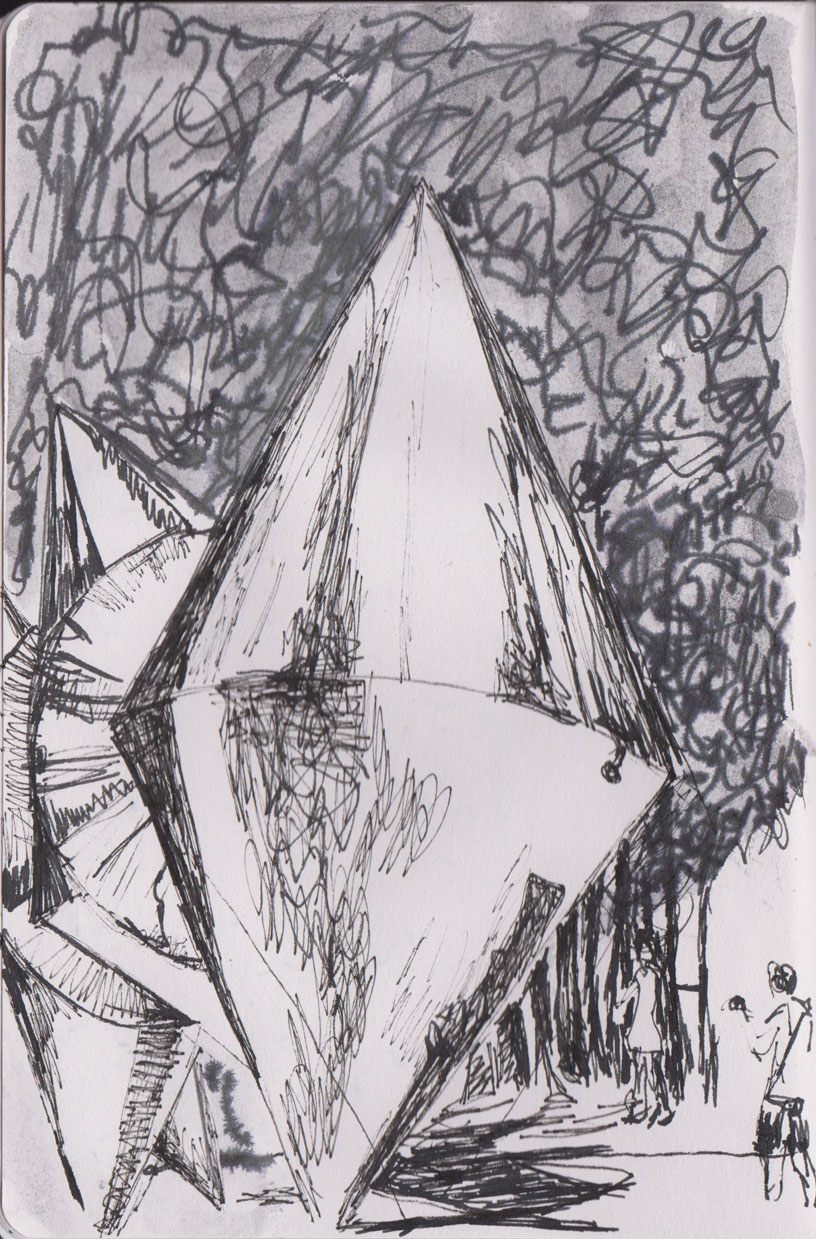
Later I moved around into the Sculpture Garden, which was proving to be a popular place to be. I completed a second drawing, this time of Bert Flugelman’s iconic Cones. It was also a popular choice to draw, you can see Sharon B’s version here.

Cones by Bert Flugelman, pen and ink, Copic Multiliner, liquid graphite, 8 February 2015

Cones by Bert Flugelman, pen and ink, Copic Multiliner, liquid graphite, 8 February 2015

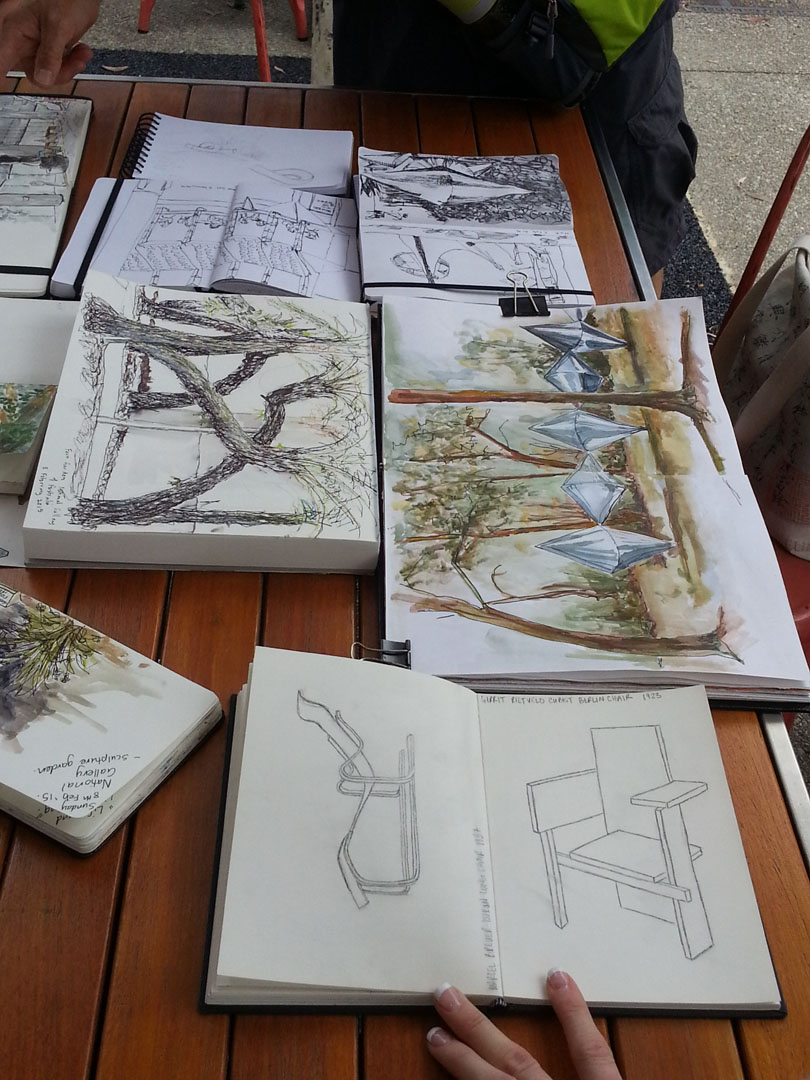
The two hours we allocated to drawing went by so quickly. We reconvened at the cafe to share our morning’s work. There were sculptures, architecture, gardens and chairs. Lots of watercolours, ink, pen and pencil as well.

Canberra sketchers, our first get together, 8 February 2015

Canberra sketchers, our first get together, 8 February 2015

An another shot of our collected works.

Another view of the finished sketches, 8 February 2015

Another view of the finished sketches, 8 February 2015

It was so much fun that we are doing it again next month. If you’re interested in coming along just meet us on Sunday 1 March, at the coffee shop outside the entrance to the National Gallery of Australia at 10.30 am.

PS we will be exploring other areas of Canberra, but the group decided that there was still plenty of material to be explored at the NGA so we’ll have another session there before moving to other venues.

PPS if you can’t wait until then you might like to go along to the National Portrait Gallery’s monthly ‘Drawn In’ event, on Sunday 22 February from 1-3 pm, where you can draw with the accompaniment of the Night Cafe Jazz Trio.

*I hope you enjoy this ‘vintage’ clip of Steve Allen, (the composer of this song and TV host), with his guests, including a surprising cameo towards the end of the clip. This Could be the Start of Something Big

… and other animals

No rest for the wicked. Today’s outing was to the National Zoo and Aquarium, which I’m rather embarrassed to admit that I had never visited in all my years of living in this city. We went armed with sketchbooks and plenty of enthusiasm to try and draw some of the animals we saw. After having a lot of fun with the quick watercolour sketch at the beach I thought that it was probably a good approach to try with the animals, which I assumed would be unlikely to be sitting still for very long.

At first we wondered whether there were any animals to see. The Snow Leopards were hiding so effectively that no one could spot them and ditto for the next few cages we looked into. At least we did see the recently arrived hyenas. The Black Capuchins (Sapajus nigritus) were more obliging and after a false start so too were the Bolivian Squirrel Monkeys (Saimiri boliviensis), who decided to come out for a play. I’d never seen a yellow monkey before! And yes, the colour I’ve used in my drawing is a close match for their fur. They are quite small, extremely agile and quite entrancing to watch.

The Bolivian Squirrel Monkey

The Bolivian Squirrel Monkey, watercolour and pencil, 9 January 2015

We decided to keep moving. On to the White lions and then the Sumatran Tigers. We were watching the female Sumatran Tiger, who is at the zoo with a view to a future mating with the male in the cage next to hers. We saw her walking back and forth in the one spot, never a good sign for a captive animal, until we realised she could see two small children who were playing on the nearby path! Once the parents had collected the children, oblivious to the tiger’s interest, the tiger moved off quite happily to other parts of her large enclosure. I was also quite excited, although that’s probably not the best way of expressing it, to see the tiger scent-marking one of the trees in her area.

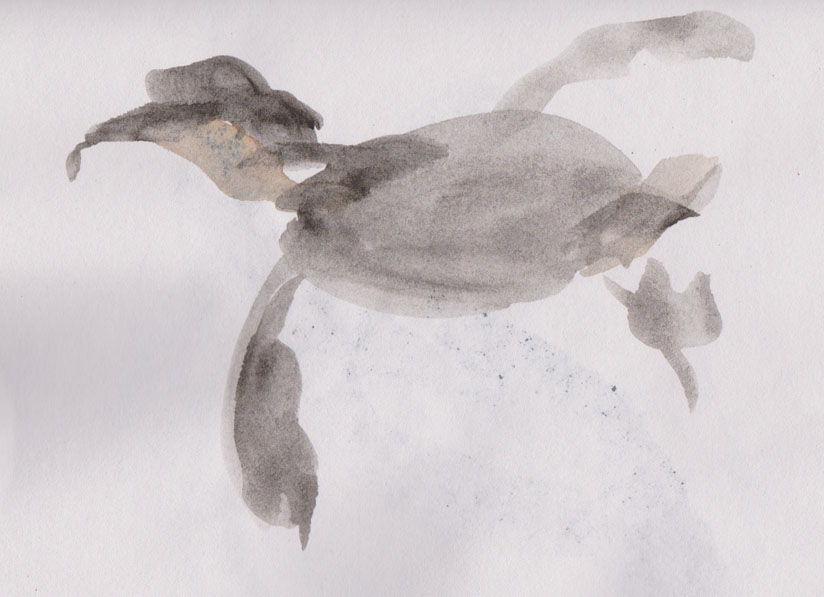
Moving from the large and back to the small we stopped to draw the Little Penguins. The little penguin (Eudyptula minor) is the smallest species of penguin growing to an average of 33 cm (13 in) in height and 43 cm (17 in) in length. Apparently it’s no longer ‘kosher’ to call them Fairy Penguins, which is how I always knew them as a child. Their long, very clear pool, is built so you can lean right over to see them rocketing up and down its length. Great for drawing!

A Little Penguin floating by, watercolour, 9 January 2015

A Little Penguin floating by, watercolour, 9 January 2015

The other feature of these birds, just to pick one, is their colouring, which up close is distinctively a deep slatey-blue, hence yet another common name for them as the Blue Penguin. This particular animal had a white patch on the end of both it’s flippers and a whitish head.

The Little Penguin, AKA, the Blue Penguin, AKA the Fairy Penguin, watercolour, 9 January 2015

The Little Penguin, AKA, the Blue Penguin, AKA the Fairy Penguin, watercolour, 9 January 2015

Near the penguins were another animal I find quite fascinating, the Goodfellows Tree Kangaroo (Dendrolagus goodfellowi). It seems like a contradiction in terms but these are basically tree dwelling kangaroos. This species comes from the New Guinea rainforests, as do the majority of these odd-looking beasts. To combat the heat of the day their pens had very fine sprays of water, which also cooled the air for passing visitors. The first animal I drew was sitting inside a hutch, up a pole, along with another Tree Kangaroo, with it’s back resting along one wall.

Quite relaxed, a Goodfellows Tree Kangaroo, watercolour, 9 January 2015

Quite relaxed, a Goodfellows Tree Kangaroo, watercolour, 9 January 2015

In this case there is a discrepancy in the colours I’ve used. While the majority of the fur is chestnut red, with paler yellow ochre areas, I didn’t have the intense dark brown that characterised the darker areas on the animal’s forearms and legs and the wide stripe down its back. When the animal moved I took the opportunity to try for a tail sketch. Again its a combination of the chestnut and pale ochre in a blotchy sort of pattern. I really need to work out how to get the texture of the tail fur, which reminded me of the fur wrap in Ingres painting of Mademoiselle Caroline Riviere.

Mademoiselle Caroline Riviere, 1806, Jean Ingres, Oil on canvas, 27 3⁄8 × 27 1⁄2 inches. The Louvre, Paris

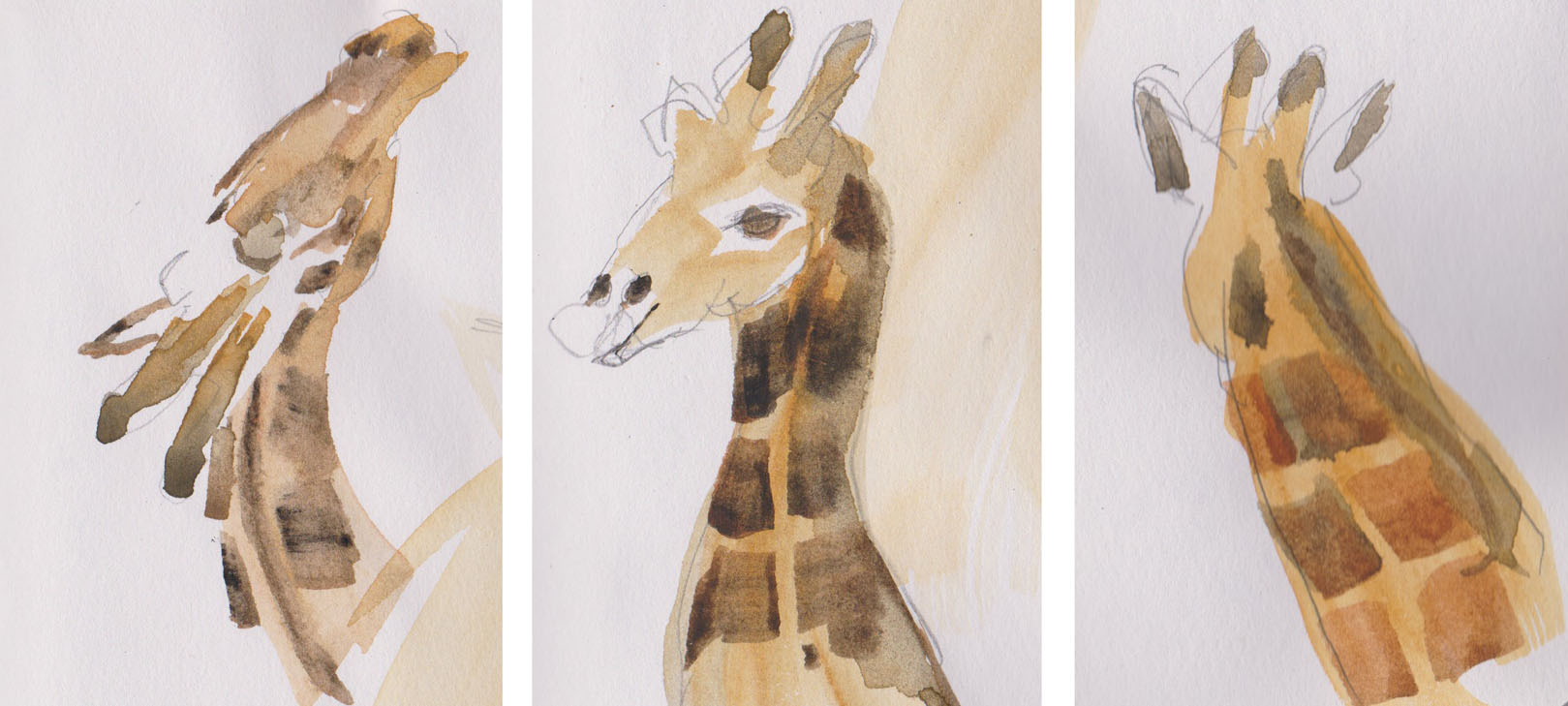
Moving on to another elegant neck, my final sketching subject of the day was the zoo’s Giraffe (Giraffa camelopardalis), who was temporarily under house arrest while waiting for some training by the keepers. The upside of this, from a drawing perspective, was that he was in one space rather than moving all over his enclosure and that space was fairly close to where we could sit and draw. He also seemed interested in having some visitors to watch while he was waiting.

There is no doubt that the head of a giraffe is more unusual than you might imagine. Can you see the head in your mind’s eye? Not only does a giraffe have two ‘horns’, or more correctly ossicones, on the top of its head, being a male this giraffe also had a well developed medium lump on the front of its skull – who’d a thought it! Luckily he was happy to demonstrate the flexibility of his lovely neck (unless you are being whacked by it).

Look at me, look at me, giraffe, watercolour and pencil, 9 January 2105

Look at me, look at me, giraffe, watercolour and pencil, 9 January 2105

I found drawing the animal’s head was a challenge. It’s a wedge shape which appears way too wide at top for the overall length of the head and the very narrow, chisel shaped lips designed for grasping at leaves and other food. In fact it was so hard to draw that I had to excise one drawing which appeared to demonstrate a direct anatomical link between the giraffe and the Loch Ness monster. Not flattering to the giraffe at all.

In all we spent over 4 hours at the zoo and I can see that this is yet another fascinating place to visit, for the purposes of drawing. I’m really pleased that the Zoo has a Friends of the Zoo membership so I will be encouraged to go back whenever I like.

A Christmas full of art

Santa was very generous with art-related presents this year. There were color markers and visual diaries and drawing books and some art even got made.

Christmas, the aftermath, pencil, 25 December 2014

Christmas, the aftermath, pencil, 25 December 2014

For some post-Christmas entertainment there is also the film about JMW Turner, Mr Turner, in which Timothy Spall gives a strong and characterful performance as the artist. Beautiful photography of the landscapes that inspired Turner’s art add to the fascination of the story. Full of dry wit and complex emotions, this film is definitely worth seeing.


Drawn in – November

Its been quite a while since I went to one of the National Portrait Gallery’s Drawn In sessions. A friend suggested we go and so we joined lots of other people for an afternoon session of sketching and listening to some beautiful singing.

I managed 3 sketches in various styles and media. First a blind drawing in pencil of a floral arrangement in the area we were drawing.

Blind drawing, floral arrangement, National Portrait Gallery Canberra, 30 November 2014, pencil

Blind drawing, floral arrangement, National Portrait Gallery Canberra, 30 November 2014, pencil

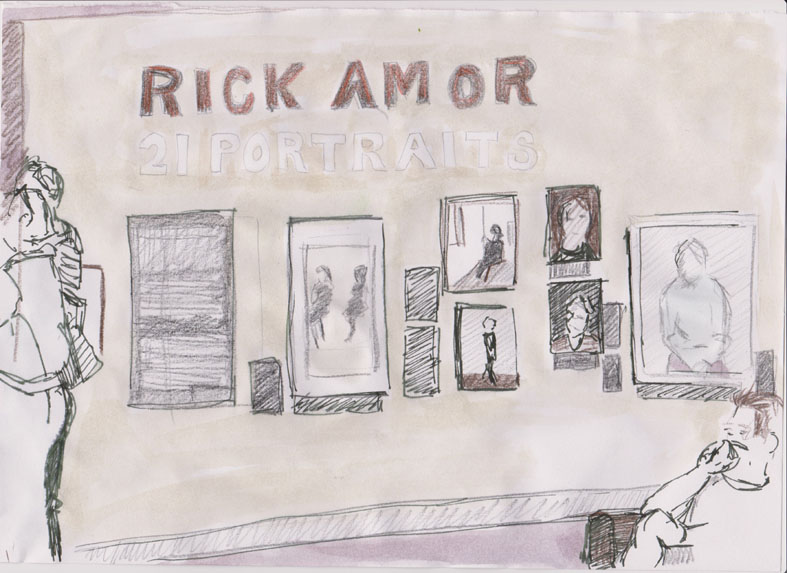
A view to the display of portraits by Rick Amor in the gallery entrance.

Rick Amor, Gallery 1, National Portrait Gallery, Canberra, 30 November 2014, pencil, ink and watercolour.

Rick Amor, Gallery 1, National Portrait Gallery, Canberra, 30 November 2014, pencil, ink and watercolour.

The last was a still life and partial figure of the woman sitting in front of me.

Bags and partial figure, National Portrait Gallery, pen and ink, 30 November 2014

Bags and partial figure, National Portrait Gallery, pen and ink, 30 November 2014

After I’d finished drawing I went over to look more closely at the Rick Amor portraits which vaguely appear in my sketch. I was particularly interested in the preparatory drawings for Amor’s 1994 portrait of Gary Catalano.

Gary Catalano

Gary Catalano , 1994 by Rick Amor Gary Catalano, 1994 by Rick Amor pencil and watercolour on yellow paper (56.5 x 76.0 cm) Collection of the National Portrait Gallery of Australia

I was impressed by the economy of the drawings with no need for extensive explanatory detail.

Gary Catalano, 1994 by Rick Amor

Gary Catalano, 1994 by Rick Amor, oil on canvas (57.0 x 57.0 cm) , private collection.


Their adaptation to the final painting doesn’t lose the spareness conveyed by the drawings. There’s quite a lesson in that approach.


Arthur Boyd, Agony and Ecstasy

A major retrospective of Arthur Boyd’s work is currently on show at the National Gallery of Australia. Drawing largely on the donations of work that the artist made to the gallery in 1975, the show includes works in a range of media, from pen and ink, oil, oil and tempera, pastel and tapestry.

With a show of such magnitude I can only touch on a few points I found of interest. Firstly I agree with the friend who commented on the wide range of styles that Boyd employed or reflected over the years. To my mind Boyd’s early works went from reflections of the Heidelberg School (Australian Impressionism), then to a strong influence of the artist Albert Tucker. At the same time his drawings in pen, ink and wash have a decided renaissance feel to them, possibly enhanced by their mythological and biblical themes. By the time he gets to England you can see strong influences of Turner, particularly in his landscapes.

I also felt that the hanging series of work, such as the Nebuchadnezzar paintings and the ‘caged painter’ series, reset my response to many of the individual paintings I had previously seen. The Nebuchadnezzar series, depicts episodes in the wanderings of Nebuchadnezzar and includes quite lyrical works which I was unfamiliar with.

Arthur BOYD | Nebuchadnezzar's dream of the tree

Arthur Boyd, Nebuchadnezzar’s dream of the tree 1969 oil on canvas 174.5 h x 183.0 w cm, National Gallery of Australia, 1975.3.95

My favourite work was an oil, painted in 1979-80, titled A Skate in a Merric Boyd Pot. In this work a skate, an image which Boyd has painted many times, is merged with and is emerging from the type of pot that characterised the work of his father, the studio potter, Merric Boyd.

Skate in a Merric boyd Pot, pencil and watercolour, 15 October 2014

Skate in a Merric boyd Pot, pencil and watercolour, 15 October 2014

I spent a lot of time looking at the many examples of drawing displayed throughout the exhibition. Boyd showed the same facility with drafting, as did the young Picasso,  then proceeded to refine and simplify his style as he grew more experienced.

Arthur BOYD | Figure in a fountain with watching figures

Arthur Boyd, Figure in a fountain with watching figures 1944-1949 ink; paper , drawing in pen, brush and black ink 38.0 h x 56.0 w cm, national Gallery of Australia, 1975.3.1381

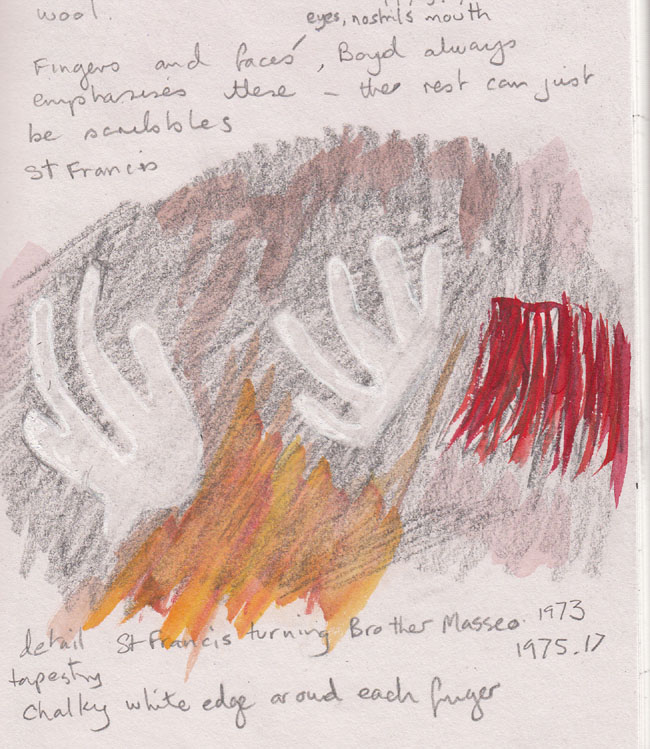
In his later works, the figures emphasise hands and feet, and faces are represented by blots for eyes and nostrils and small lines for mouths. These are no less powerful works for their brief notations. I tried to capture this focus in the quick study of the hands in one of the works in the St Francis tapestry series.

A detail of St Francis Turning Brother Masseo, pencil, eraser and watercolour, 15 October 2014

A detail of St Francis Turning Brother Masseo, pencil, eraser and watercolour, 15 October 2014

This final room is a fitting conclusion to the exhibition, showing nine of the 17 St Francis tapestries, designed by Boyd and superbly woven in Portugal at the Tapapecarias de Portalegre. As you approach, the works appear, glowing, quite literally with the strong colours Boyd used in his pastels, translated into the very large woollen tapestries.

For locals there are still another few weeks to see the exhibition, which runs until 9 November. Don’t be put off by the introduction of paid parking at the National Gallery. Visitors can validate their parking ticket at the cloak desk and will get free parking for 3 hours.