Gods in glass islands

Maybe its a sign of advancing age, but I found myself rather saddened by the display of sacred Polynesian images and objects (atua) in the latest exhibition at the National Gallery of Australia. The quality of the work was so high and as a textile artist I was very impressed by the very finely woven and plaited coconut fibre used in many works. But… Each atua sat on it’s little plinth, mostly is glass boxes, arranged by island group in a sad mockery of the vast Pacific Ocean they came from. While I was in awe of the carving skills displayed in these atua I just kept thinking that they wanted only to be returned to their marae (sacred enclosures). I struggled to feel comfortable drawing them, which was why I went to the exhibition in the first place.

In the end I made these two sketches.
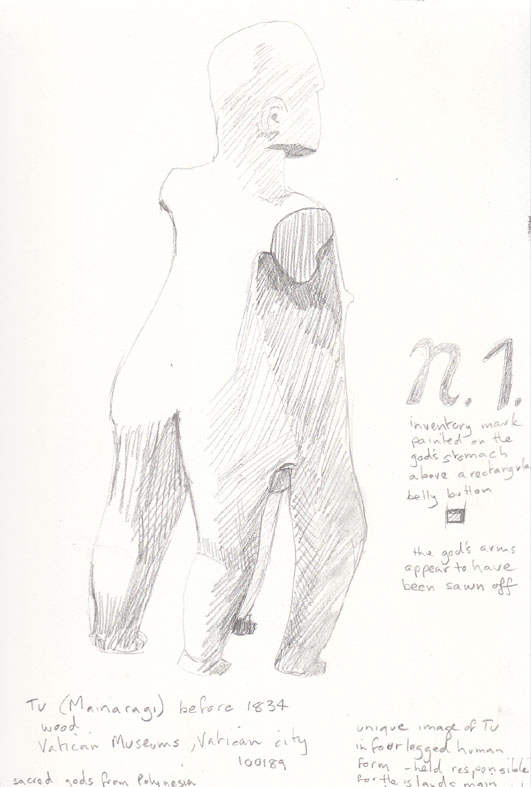
The atua Tu, from the island of Mainaragi. Tu was responsible for the island's main food source, the breadfruit.

The atua Tu, from the island of Mainaragi, before 1834. Tu was the atua responsible for the island’s main food source, the breadfruit.

The large N1 on my page is, what I assume to be an inventory mark painted on the atua’s stomach. This piece is in the collection of the Vatican Museum. I think it is a horrible thing that this sacred image is held by a religious organisation that was/is antipathetical to the island’s religions.
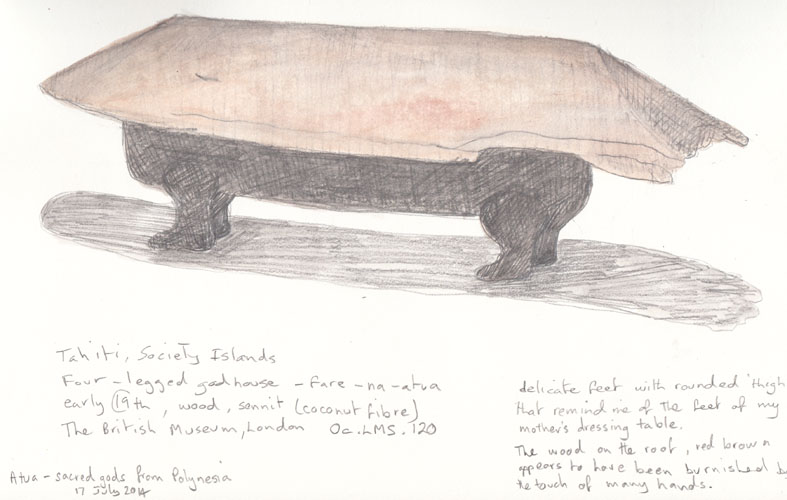
Fare-no-atua (a god house), early 19th century, wood and coconut fibre.

Fare-no-atua (a god house), Tahiti, early 19th century, wood and coconut fibre.

I loved seeing the burnished surface of the wood of this piece. It looked as though many hands had touched it’s surface over a long period of time. This piece is in the collection of the British Museum. I added the colour after I left the gallery.

Concrete pergola – three ways

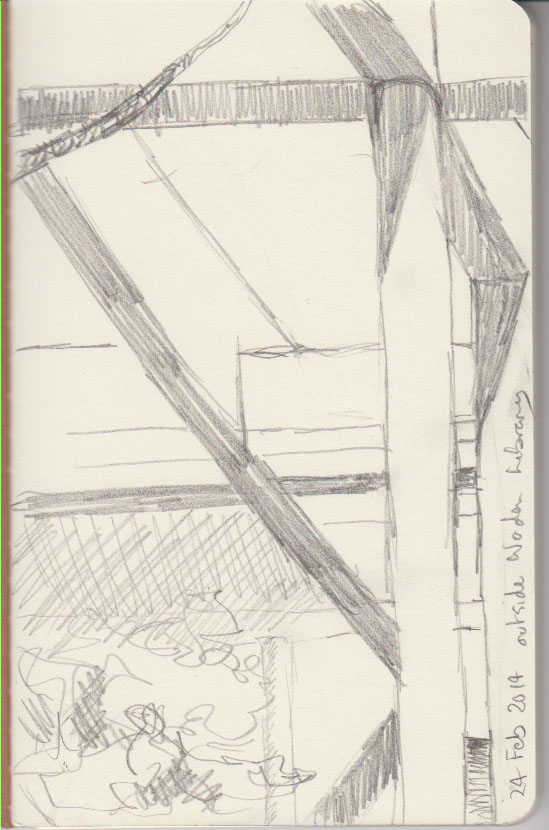
I didn’t intend to do this drawing 3 times, but while I was sitting at one of the local libraries I saw this intriguing piece of architecture – an outsized concrete pergola. The structure itself is two stories high, each of the horizontal blades looks to be at least a metre high.

Firstly I tried drawing it with my fountain pen. I found it hard to control my tonal values and got rather lost somewhere between the vegetation and the structure.

Concrete pergola outside Woden Library, 24 February 2014.

Concrete pergola outside Woden Library, 24 February 2014.

The second attempt, from a slightly different perspective. This drawing shows a much better grasp of the structure, as I started by drawing the negative spaces. I also decided to skip most of the vegetation.

Second version of the concrete pergola outside Woden Library, 24  February 2014.

Second version of the concrete pergola outside Woden Library, 24 February 2014.

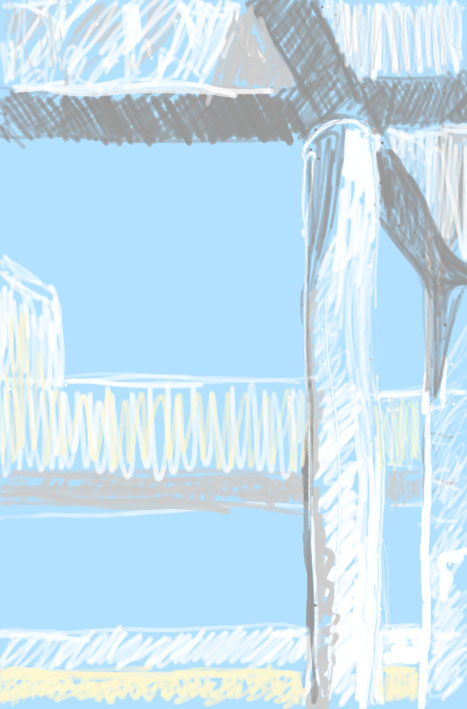
My last version was done on my phablet using PS Touch. I decided that one of the most attractive aspects of this scene were the colours of the concrete against the clear summer sky. So I ditched the vegetation and just stuck to the architecture. I quite like this one.

Third view of the pergola outside the Woden Library, 24 February 2014.

Third view of the pergola outside the Woden Library, 24 February 2014.