The undoubted highlight of our trip to France and Spain (Portugal still to come), is the thrill of seeing up close and personal, works of art that I have previously only seen in books or online. The Prado is definitely in the ‘big hitter’ league, even if you only consider, Velasquez, El Greco or Goya individually and don’t include all the other amazing works of art between it’s walls.
In person I could see that El Greco really went for strongly clashing colours in his works; and that Goya borrowed the same poses in his paintings of the Spanish Royal family as Velasquez used for portraits of the Hapsburgs back in his day.
I completed all these sketches in the Prado, but I later added some watercolor to highlight certain elements of the paintings.
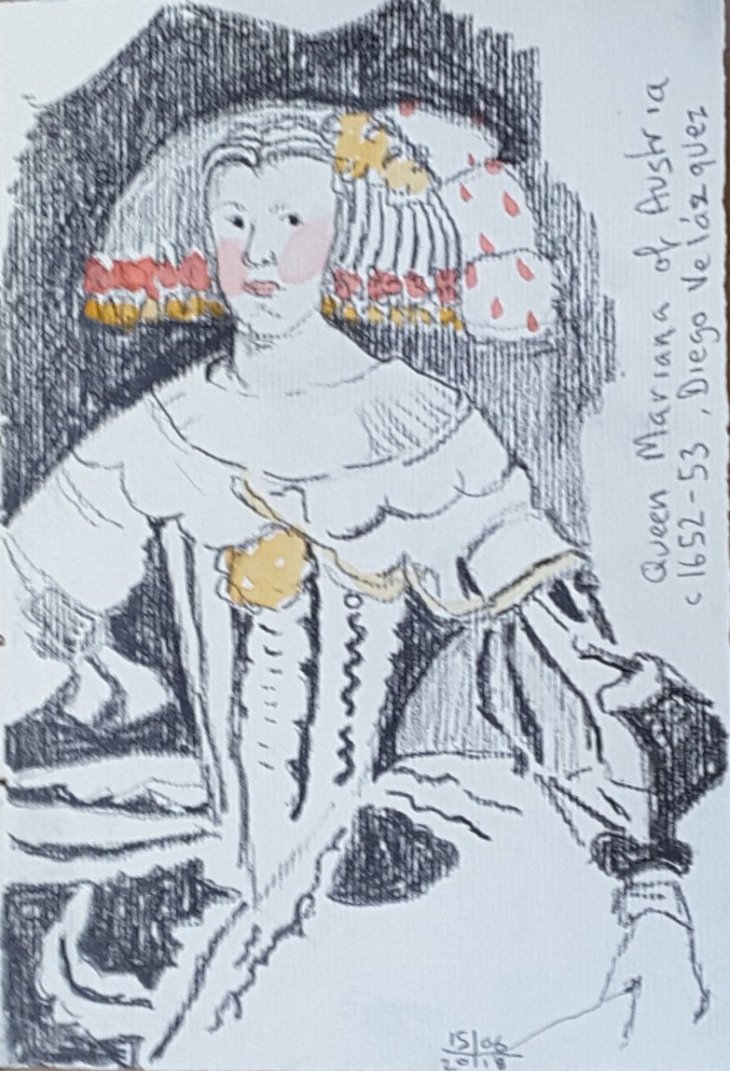
In his portrait of Queen Mariana of Austria, Velasquez lines up her very prominent pink cheeks with the red ribbons in her hair and the plume at the side of her wig. The Queen’s gown is a study of black and grey. The painting on the whole has a very restricted palette which results in emphasising the highly formal nature of this work.

After Velasquez, Queen Mariana of Austria, c 1652-1653, graphite
The Infanta Margarita of Austria, here painted by Jaun Bautista Martinez del Mazo, is the same little girl that Velasquez painted in his most famous painting Las Meninas, which hangs only a few metres away from this portrait. Del Mazo’s portrait was painted several years after the Valasquez portrait when the Infanta was betrothed to the Emperor Leopold of Austria (who she married in 1666). Del Mazo was Velasquez’s son-in-law and was appointed court painter after Velasquez death.
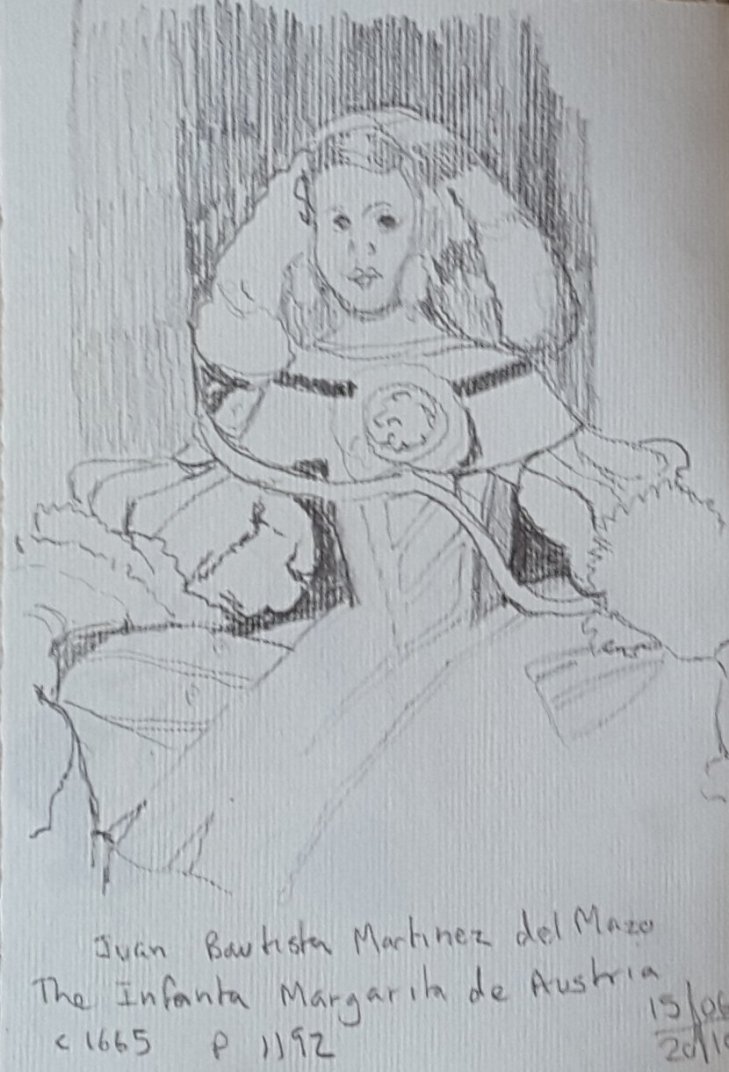
After Jaun Bautista Martinez del Mazo, the Infanta Margarita of Austria, c 1665, graphite
In his portrait del Mazo also uses the colour red to great effect. The background is treated with a range of warm-hued browns and reds and the result is far more tender than the portrait of her mother, Queen Mariana.

After del Mazo, The Infanta Margarita of Austria, graphite and watercolour, added later
The other sketch I drew was one of Goya’s ‘black’ paintings. These were originally painted on the walls of his house and later transferred onto a backing so they could be hung. These are strange and disturbing works. Their meanings have been the subject of some pretty varied interpretations over the years since they were made public.
The sketch I made is of a painting called Atropos, or the Fates (I assume that the titles were post-Goya as he didn’t intend for thees works to be public). Four dark figures float above the yellow-toned landscape, appearing to hold scissors and other attributes of the mythological Fates who were thought to control human destiny.

After Francisco Goya, Atropos, or The Fates, detail, pencil on Fabriano paper
I found this a compelling work, the sort you can’t quite look away from, but wish you could. The floating figures were quite convincing which is rather a contradiction as they are also malevolently manifest and solid. Many of the other works in this series really creeped me out. If I have to spend a night at the museum I bags NOT staying in this room.




 leonieandrews