Monga National Park

Last Friday we drove about an hour and a bit east of Canberra to visit the Monga National Park, a patch of wet sclerophyll forest on the escarpment above the south coast of New South Wales. We had hoped to find some Monga waratahs (Telopea mongaensis) in flower, but we were at least a month too early.

We did visit  Penance Grove, where in the 1980’s, prior to the forest being declared a National Park, some sad and selfish individual came in and cut out the tops of many of the tree ferns growing in this remnant rainforest glade. The tops of tree ferns will re-grow from their trunks, but the section left behind just dies. These protected plants are stolen for illegal sale to gardeners or nurseries. Even today, 30 years later, the devastation is there for all to see.
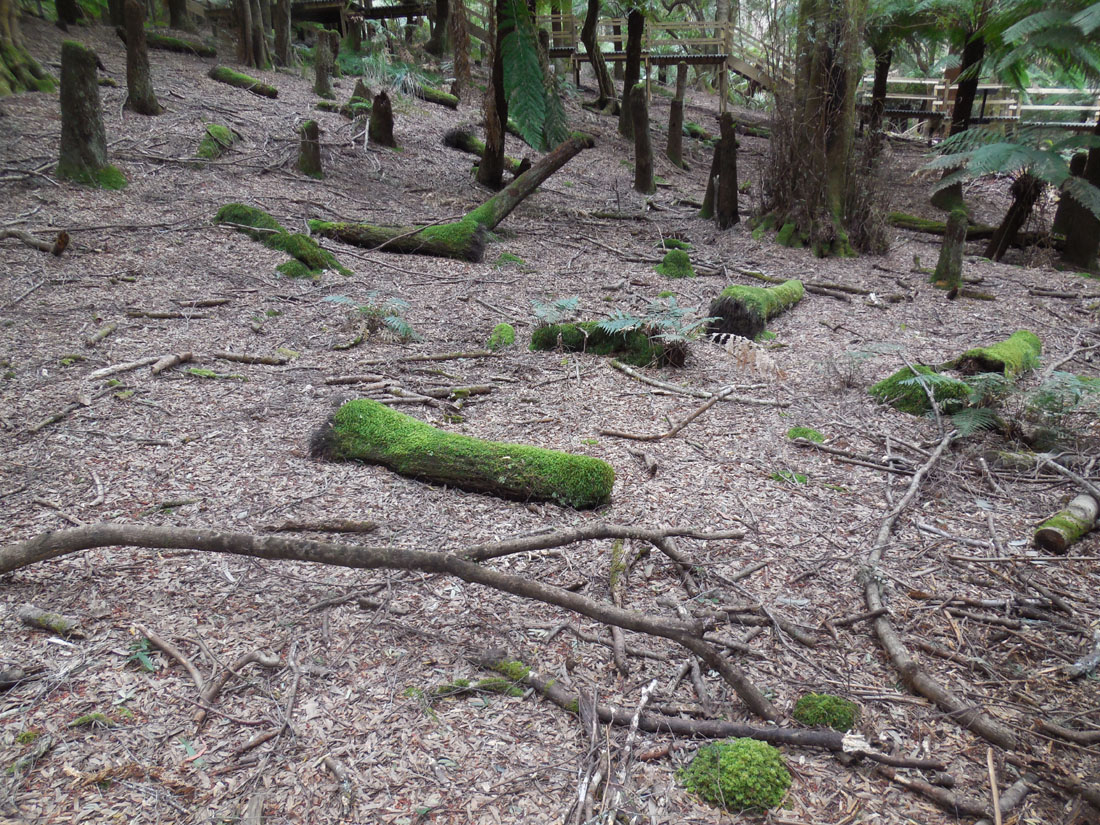
Penance Grove, Monga National Park, what's left 30 years after the tree ferns were stolen, 18 September 2015

Penance Grove, Monga National Park, what’s left 30 years after the tree ferns were stolen, 18 September 2015

In some ways it would have made an excellent subject to paint, but I found it all too painful and depressing.

We decided to move to the nearby picnic ground where we had some lunch. While we were eating we were visited by several flibertigibbet Grey Fantails. After we walked down to the Mongarlowe river, along a track that promised waratahs at the right time of the year. At the water’s edge the vegetation was growing thickly and I had quite a fiddle to find a spot where I could set up my stool without being stabbed by stray lomandra leaves (a spiky tipped sedge-like plant). I managed a perch in the end, but failed to capture a good likeness of the far bank of the river. My attempt at wet into wet paint became such a soggy mass that the super ‘darks’ I wanted to put under the vegetation just kept blending into the areas above. Drying time was not optimal, as our earlier sunny day had, by this time, settled into a dull overcast.
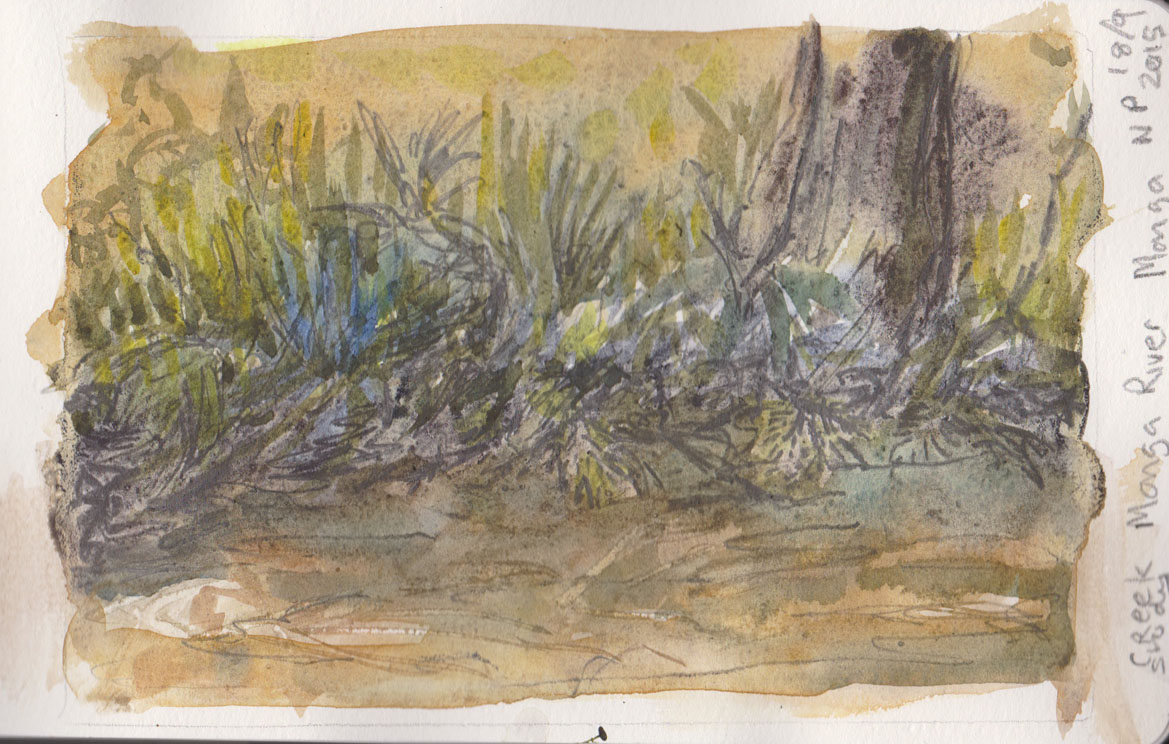
Bank of the Mongarlowe River, Monga National Park, graphite and watercolour, 18 September 2015

Bank of the Mongarlowe River, Monga National Park, graphite and watercolour, 18 September 2015

I was also trying to avoid looking at what was in the water just below me, the carcass of a dead wallaby. Thankfully odourless, as the fast-running water was washing the smell away, I didn’t really want to look at the remains of this once beautiful creature. In the end I decided to make a quick sketch of it and though the subject matter was rather grim I think it was a better outcome than my overworked riverbank.
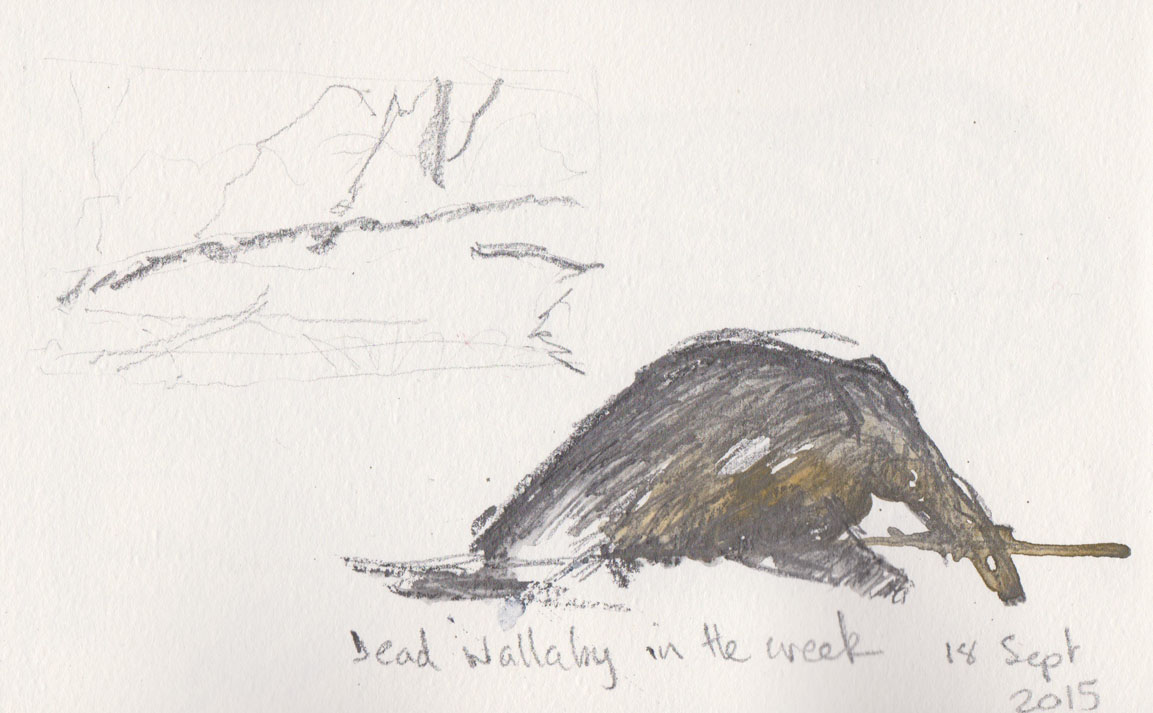
Dead wallaby in the river, watercolour and graphite, 18 September 2015

Dead wallaby in the river, watercolour and graphite, 18 September 2015

I guess this just proves that not every sketching expedition pans out the way you expect.
 

Drawing the Exhibition – Myth + Magic 2

The 16th of September was Papua New Guinea’s Independence Day, so what better way to celebrate than return to the Myth + Magic exhibition at the National Gallery of Australia. This time I also managed to drag some friends along, as well as my partner, so we all set about sketching.

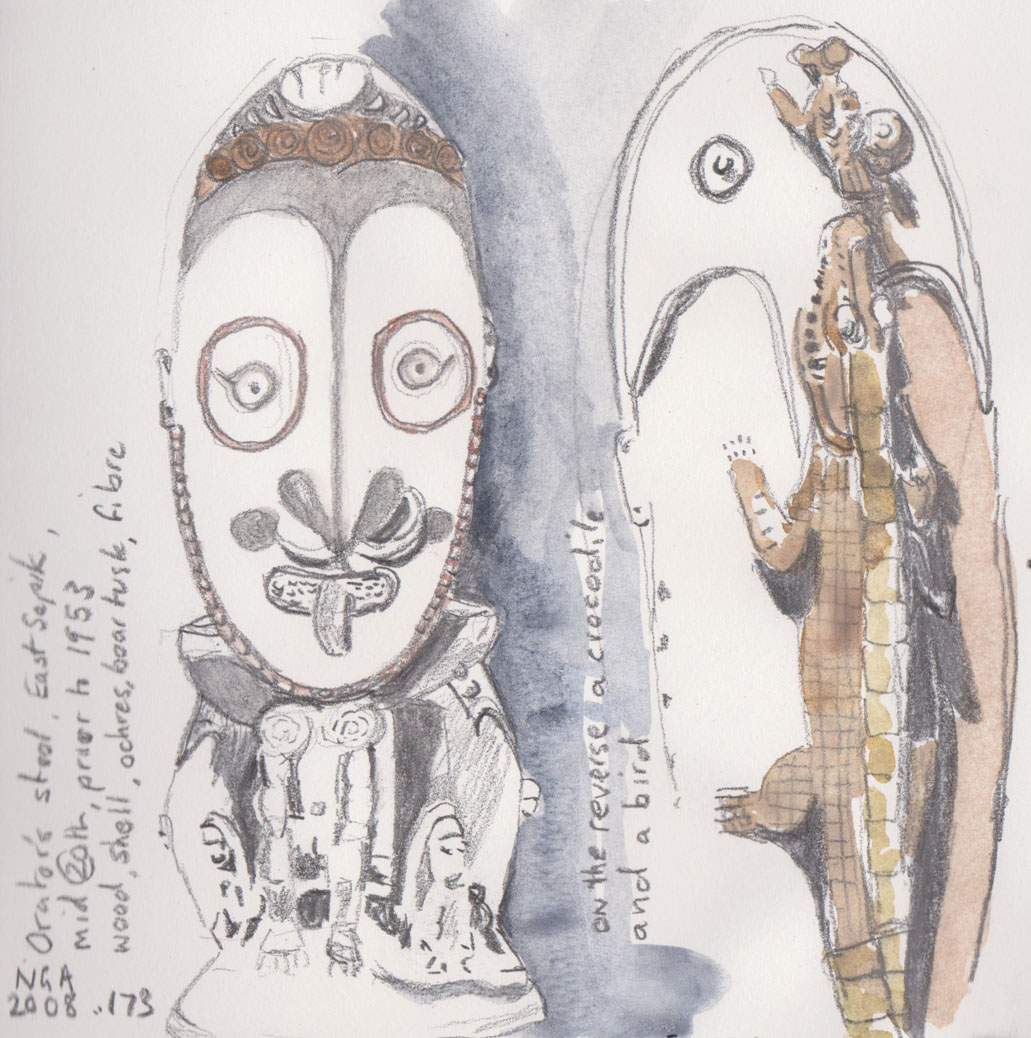
My first target was the Orator’s Stool from the East Sepik. I started with the face and enjoyed working with the deep shadows cast by the dramatic lighting.

Orator's Stool, East Sepik, PNG, study in graphite pencil with watercolour added later, 16 September 2015

Orator’s Stool, East Sepik, PNG, NGA 2008.173, mid 20th cent. prior to 1953, study in graphite pencil with watercolour added later, 16 September 2015

It was only after I’d finished this first drawing and went to record the details of the work, that I found the carvings of the crocodile and bird on the reverse of the stool.

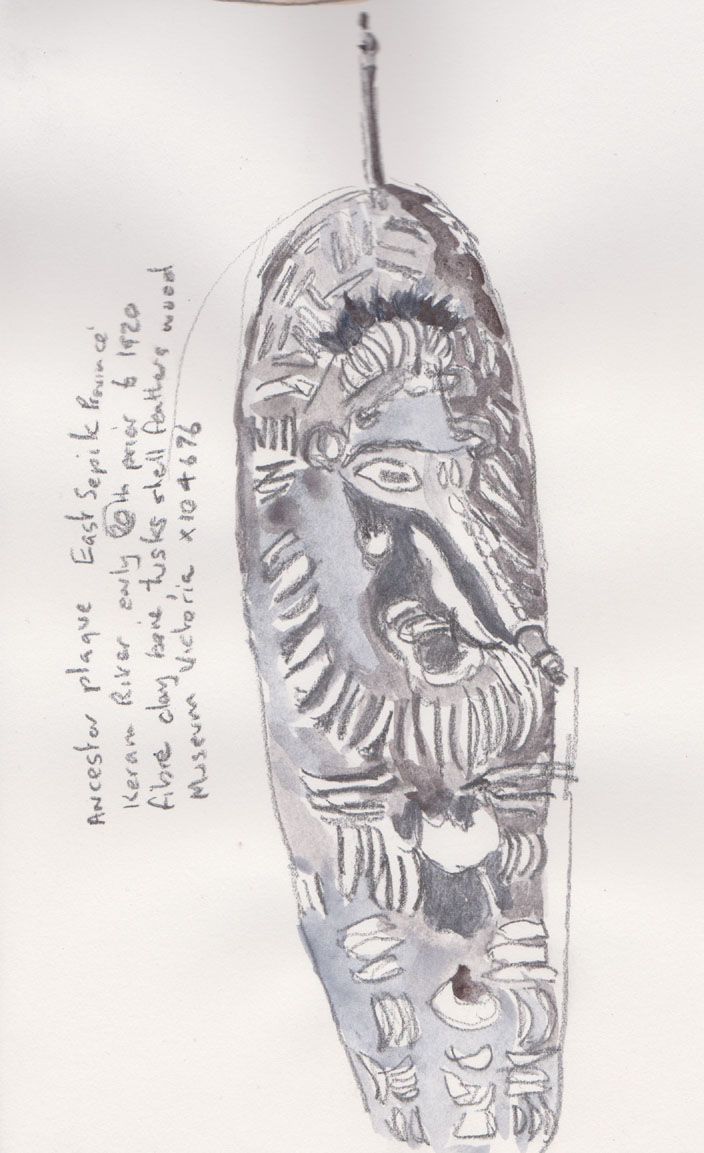
I still had some 20 minutes before our meet-up time so I went and did a ‘quick’ study of this ancestor plaque.

Ancestor Plaque, East Sepik Province, Keram River, early 20th cent. prior to 1920, Museum Victoria X104676, graphite, with added watercolour, 16 September 2015

Ancestor Plaque, East Sepik Province, Keram River, early 20th cent. prior to 1920, Museum Victoria X104676, graphite, with added watercolour, 16 September 2015

This work has a very strong presence. It is made of fibre, largely for the backing and is covered with thick grey mud. It is decorated with lots of embedded pig tusks and shells. The image wears a headband of cassowary feathers. I haven’t captured much of its ‘presence’ so I will try to return and focus on this piece again.

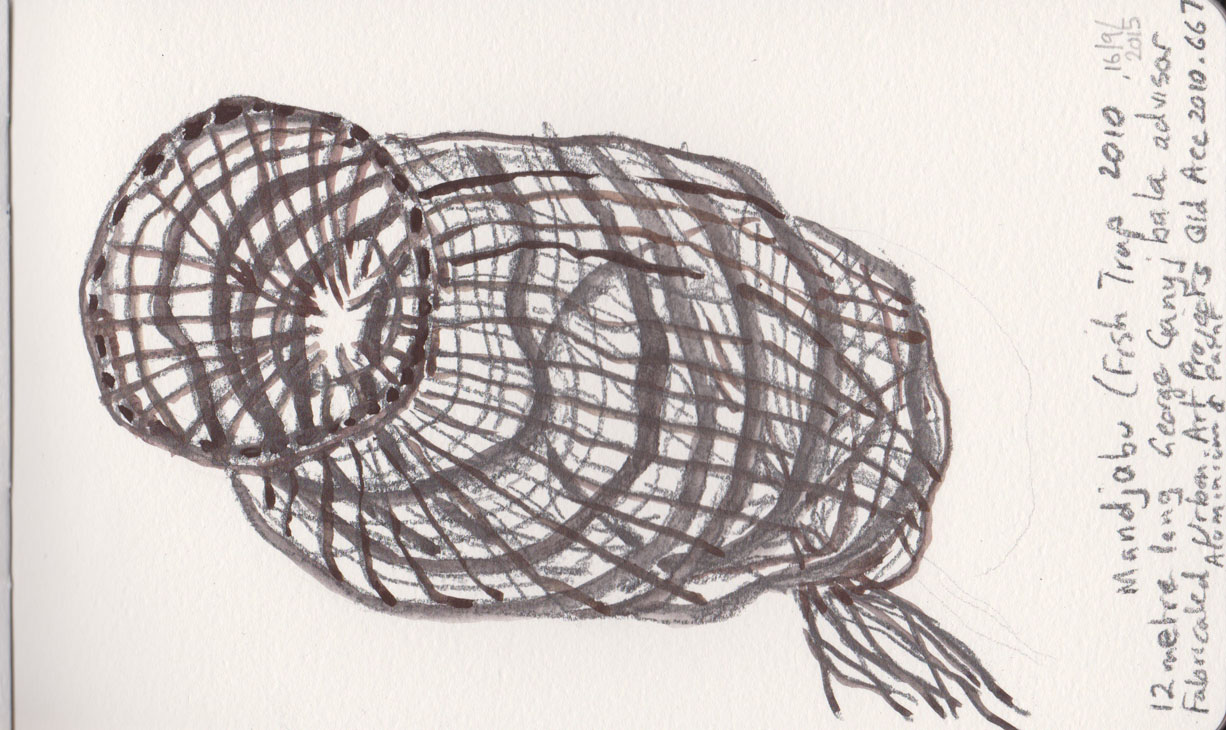
After the drama of the exhibition space it was somewhat of a relief to retreat to the airy lightness of the Members Lounge for lunch. Afterwards, our friends decided that they wanted to look at the Aboriginal and Torres Strait galleries so we headed off there for a final sketch. I sat out near the entrance to draw the giant, 12 metres long, fish trap, that hangs above the gallery foyer.

Mandjabu (Fish Trap), 2010, created with assistance from George Ganyjbala, fabricated in aluminium and paint by Urban Arts Projects, Acc2010.667, graphite with added watercolour, 16 September 2015

Mandjabu (Fish Trap), 2010, created with assistance from George Ganyjbala, fabricated in aluminium and paint by Urban Arts Projects, Acc2010.667, graphite with added watercolour, 16 September 2015

I didn’t realise that I was being observed, but this photo gives you an idea of the scale of the work.

The loneliness of the long-distance sketcher, 16 September 2015, National Gallery of Australia

The loneliness of the long-distance sketcher, 16 September 2015, National Gallery of Australia

Out and about on a botanical Friday

Here are two drawings from different botanically-related outings today.

The first was drawn at the Yarralumla Gallery next to the Heritage  Nursery where I’d been buying plants to help renovate our front garden. While there is nothing particularly different with this drawing, the notebook its drawn on is something fairly new, a Leuchtturm Whitelines Link® notebook. This notebook is designed to be used in conjunction with an app for your smartphone so that it can be digitised and shared easily on a variety of platforms. Enough of that for the moment as I plan to explain more and do a bit of a review in another post.

Yarralumla Gallery, pen and ink on a Leuchtturm Whitelines Notebook, 11 September 2015

Yarralumla Gallery, pen and ink on a Leuchtturm Whitelines Notebook, 11 September 2015

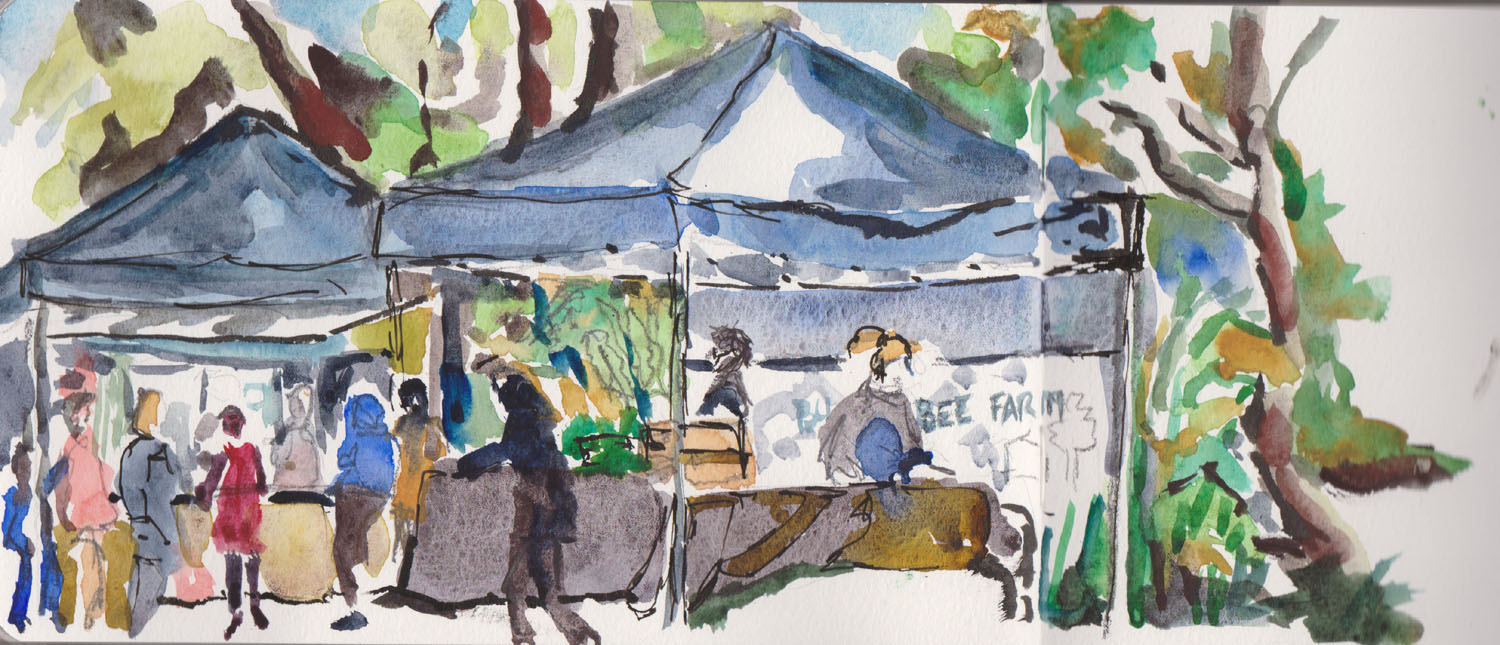
Our second outing was to the Australian National Botanic Gardens, not as you may expect to see the plants, but rather to check out the newest farmer’s market in Canberra. This was only the second week of the Eat Local Friday market’s operation so we didn’t know what to expect. There were plenty of people there and they seemed quite keen to get among the produce. It is unusual to see a market in such a pleasant setting and I’m sure that the extra foot traffic will benefit the gardens. I set up at one end of the stalls and was pleased to have plenty of people to include in the scene. I struggled with capturing the light coming from behind the stalls, so it looks like that’s something else I’ll need to work on.

Stalls at the Eat Local Friday markets at the Australian National Botanic Gardens, brush pen, watercolour, pen and ink, 11 September 2015

Stalls at the Eat Local Friday markets at the Australian National Botanic Gardens, brush pen, watercolour, pen and ink, 11 September 2015

I was quite intrigued at the number of people who walked several metres past the last stalls and then asked whether there was anything else there. No more stalls I’ll grant you, but only the whole of the gardens at the height of it’s springtime flowering!


Sketching at the War Memorial

It might have been overcast today but we had a good turn out to the monthly get together of the Canberra Sketchers Group at the Australian War Memorial (AWM) – including 5 people who came along for the first time. Having briefly met for a quick chat and orientation everyone dispersed to draw.

Group photo time, the AWM behind us.

Group photo time, the AWM behind us.

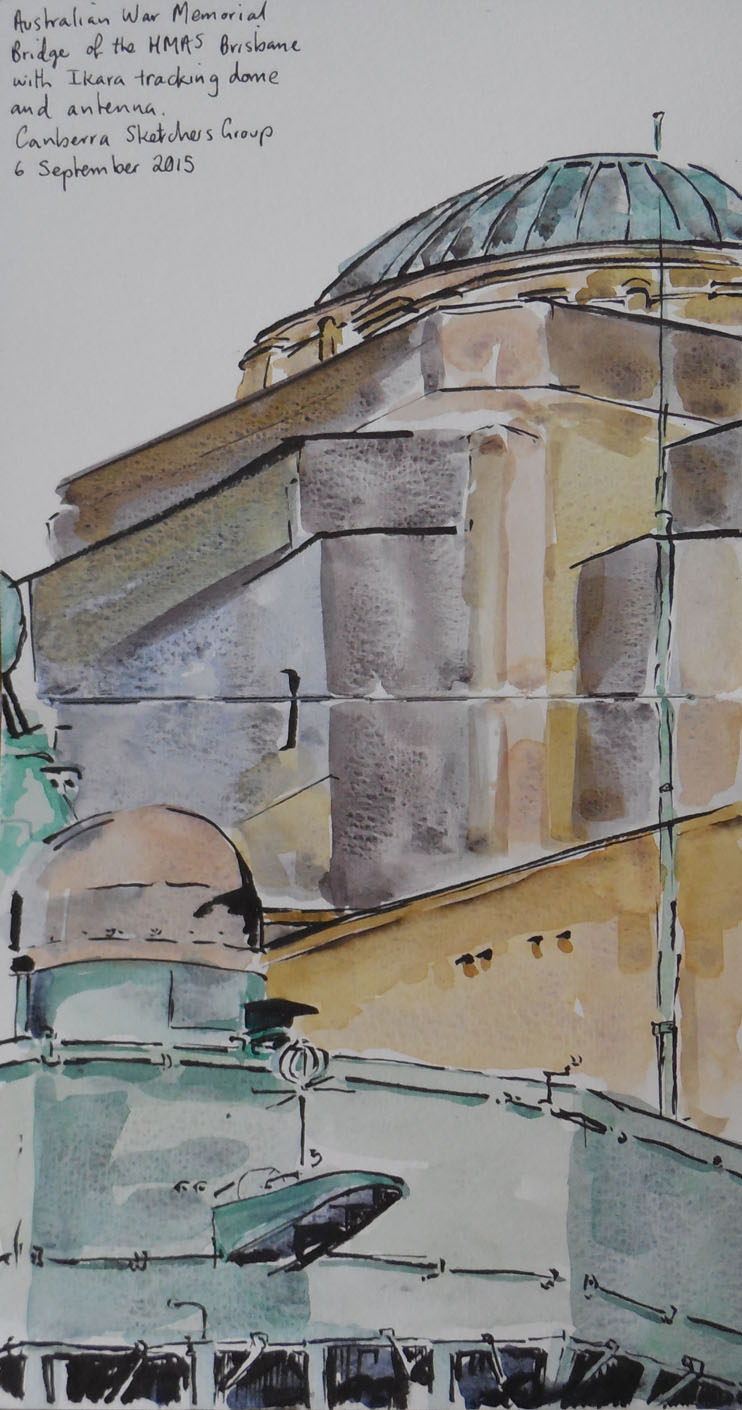
The Memorial building itself is interesting and there are so many different perspectives that is can be hard to choose just one spot to draw from. On previous visits I had discovered, not that it is hard to spot, the bridge of the HMAS Brisbane – the whole top section of the battleship – which was removed and re-sited in the grounds of the memorial. Today’s cooler temperature meant that I could spend all the time I wanted to get the sketch done.

The bridge of the HMAS Brisbane with the Auatralian War Memorial in the background, watercolour and brush pen, 6 September 2015

The bridge of the HMAS Brisbane with the Auatralian War Memorial in the background, watercolour and brush pen, 6 September 2015

Afterwards we got together in Poppies cafe for coffee, chat and comparison of our sketches. As always it was fascinating to see the various styles and subjects of everyone’s drawings.

Our collective efforts!

Our collective efforts!

The next Canberra Sketchers Group sketchwalk will be on 4 October, 10.30 am, we will be meeting to sketch at Floriade, Canberra’s annual floral festival. If you will be in Canberra you would be welcome to come along. For more details please contact me through the link at the top of this page.

Tidbinbilla tracking

My partner and I have been taking the new online class by Marc Taro Holmes on Travel Sketching. Today we decided to to practice some of the drawing approaches that Marc has been teaching. We headed out to the Tidbinbilla Tracking Station, (otherwise known as the Canberra Deep Space Communication Complex – CDSCC), in the rural part of the Australian Capital Territory, to draw the antennae in their bushland setting.

One of the key techniques we are learning is drawing simplified shapes to quickly gather enough information to capture a scene. This way you can do some drawing and still have sufficient time away from your sketchbook to enjoy your holiday! The goal is to capture basic shapes in one line, or maybe 5 or so lines, which I find quite hard to do.

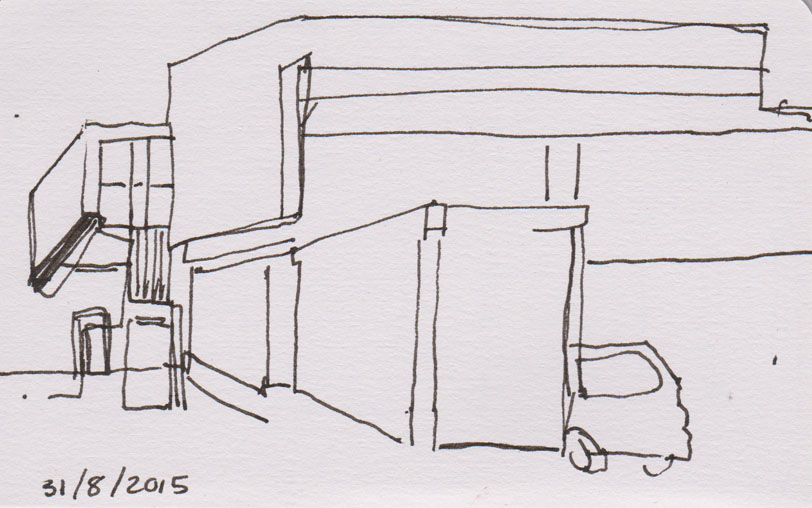
The ‘blind contour drawing’ I learned at art school tends to be my default position when drawing quickly. It’s actually a good approach, but it’s not quite what Marc is suggesting. The difference with Marc’s approach is that you look frequently at your page as well as your subject and that allows the development of a more accurate outline. If you have time, you can then add further lines and build up your drawing that way. I have worked out that if I think about this as drawing the ‘edges’ then my drawings are more successful. I get less inclined to get bogged down in details along the way. I was pretty happy with this drawing I made of a local convenience store earlier in the day, well except for that very dodgy car welded the side of the building.

A simplified line drawing in pen and ink, 31 August 2015

A simplified line drawing in pen and ink, 31 August 2015

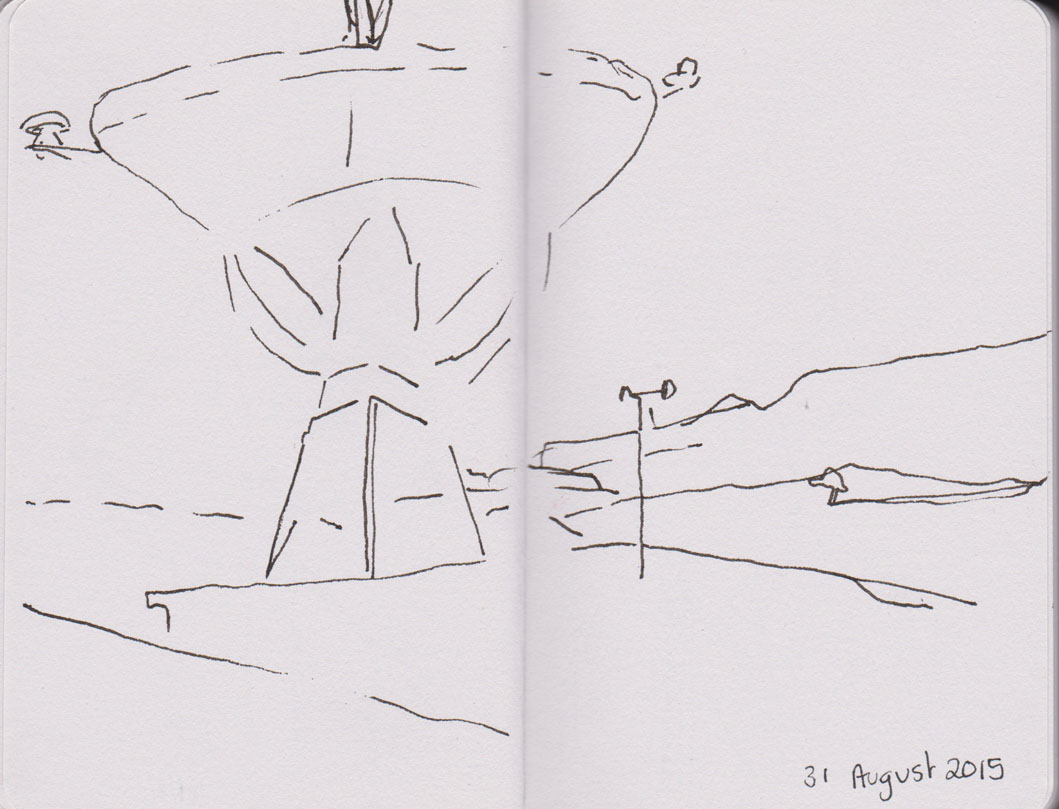
Out at Tidbinbilla there were plenty of interesting subjects to tackle. I settled on the 26 metre dish, or DSS46, (formerly sited at Honeysuckle Creek), that was the antenna that received and relayed to the world the first historic pictures of man walking on the Moon, on Monday, 21st July 1969. As the Centre’s website so eloquently says “DSS46 was retired from service in November 2009 and now remains at CDSCC as celebrated and recognised historic monument.”

While I could hardly describe the following drawing as using one or two lines, it certainly captured the key elements of the scene in front of me with more economy than I usually manage. I will admit though, that I also made several other drawings, which I could only politely describe as being ‘less successful’.

Simplified line drawing of the 26 metre dish, pen and ink, 31 August 2015

Simplified line drawing of the 26 metre dish, DSS46, pen and ink, 31 August 2015

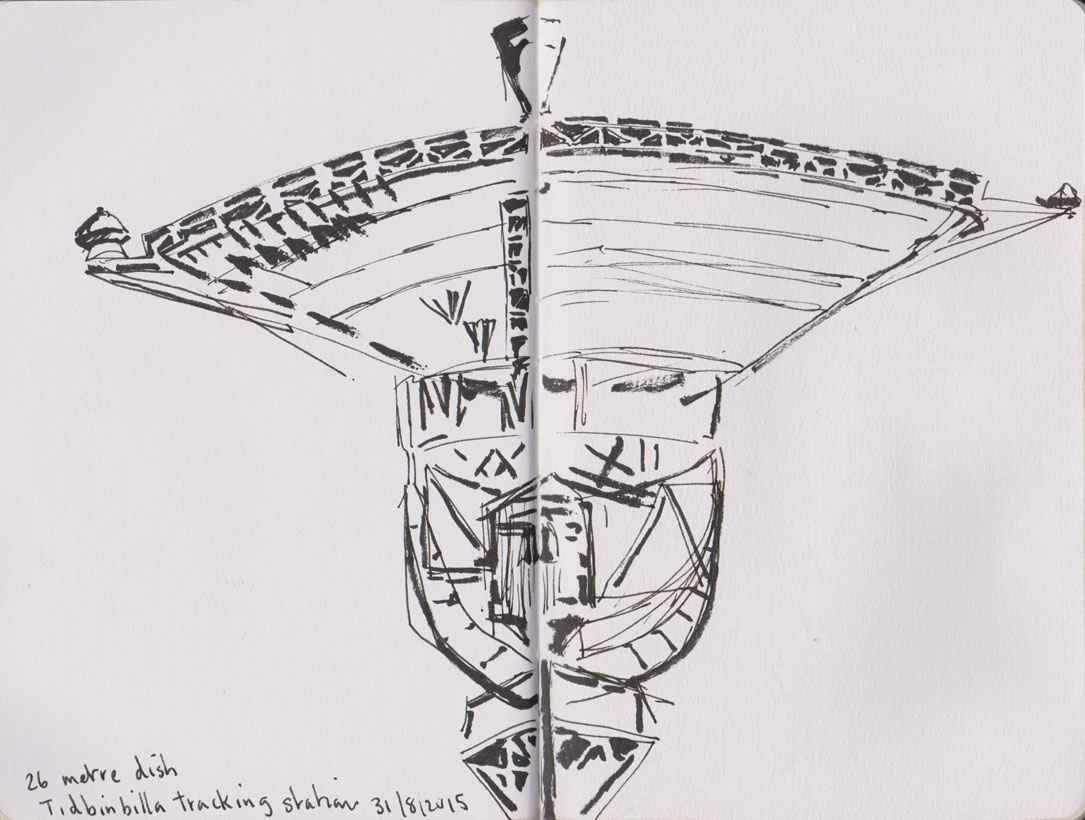
I liked the scene enough to try a more detailed drawing. Having completed a simplified outline I moved on to providing  some solidity with shadow lines drawn with my brush pen. It didn’t take long to realise that the structure of the antenna was such that I’d probably go insane before I could get more than a ‘feel’ for the structure of struts and beams supporting the dish.

The 26 metre antenna, line and shadow, pen and ink and brush pen, 31 August 2015

The 26 metre antenna,DSS46, line and shadow, pen and ink and brush pen, 31 August 2015

At this point we made a strategic withdrawal to the coffee shop. Of course from the cafe’s deck the 70 metre antenna, DSS43, completely dominated the view – not surprising really as it is the largest single antenna in the southern hemisphere. It’s been busy recently with transmitting commands and receiving data from the Mars Odyssey and the New Horizons Pluto and Charon missions among many others.

I couldn’t resist! With a rapidly cooling cup of coffee I set about doing my final drawing for the day.

DSS43, the 70 metre antenna, pen and ink, brush pen and watercolour, 31 August 2015

DSS43, the 70 metre antenna, pen and ink, brush pen and watercolour, 31 August 2015

We are lucky to have so many interesting places, like the tracking station, to visit within our local area. It’s an amazing combination of leading edge technology in a truly beautiful setting.