Rotterdam

A quick-ish hop around the world via Singapore and now I find myself sketching in Rotterdam.

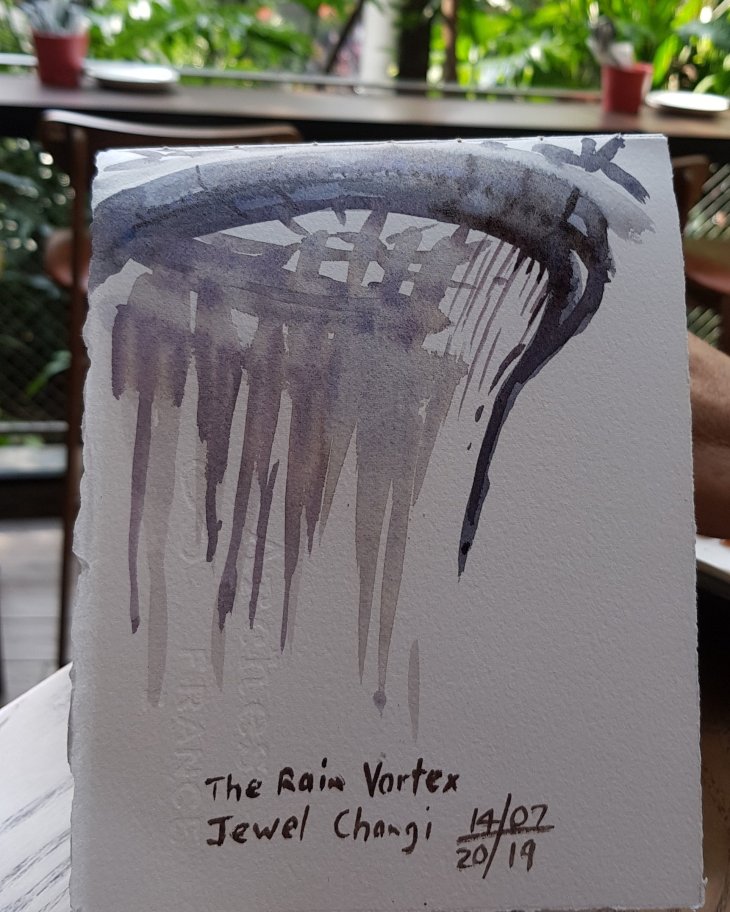
Rain Vortex at Jewel Changi. Watch our for large numbers of people dragging their luggage around while looking at their smartphones.

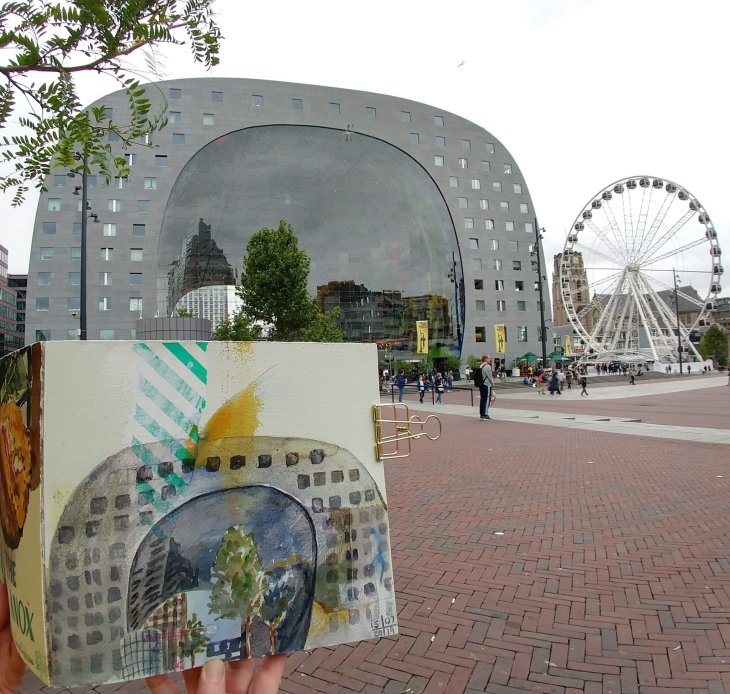
First sketch in Rotterdam the Markthal (Market Hall) by MVRDV architects, (2014).

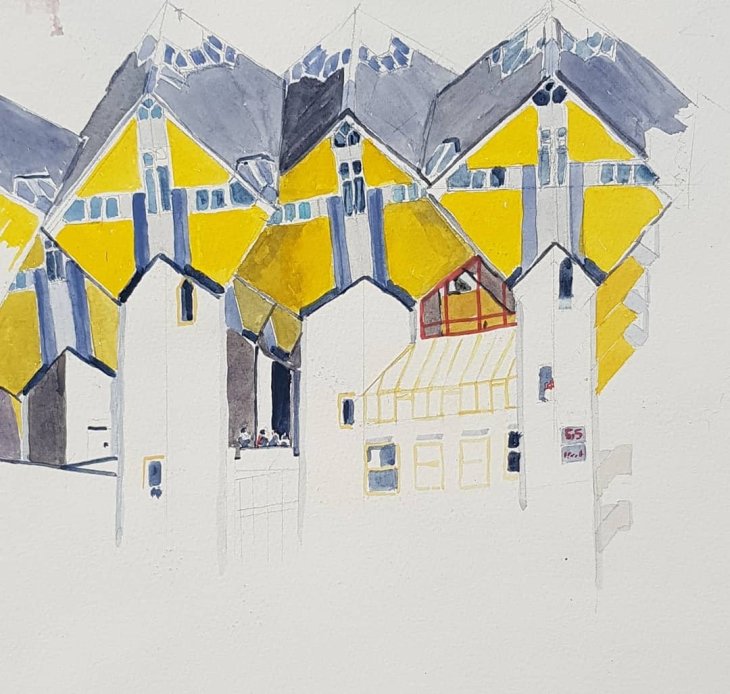
Next the Kubuswoningen (Cube Houses) by Pier Blom (1984).

This is an earlier version which I wish I had left at this stage instead of turning it into a turgidly overworked mess.

Then part of Auke de Vries sculpture ‘Maasbeeld’, with De Rotterdam, by Rem Koolhaas (2013) and the Erasmus Bridge in the background.

Today even further challenges with De Hef, (Koninginnebrug) a now defunct, lifting railway bridge.

Backgrounds with people

Here are some more sketches from my current cafe sketching booklet. I am currently putting in some more backgrounds rather than letting my people float on the blank page. Some work better than others.

The red bottle, 1 December 2018, watercolour and graphite.

Woman under an umbrella, 3 December 2018, watercolour and graphite.

Mother with her two sons, 5 December 2018, watercolour and graphite.

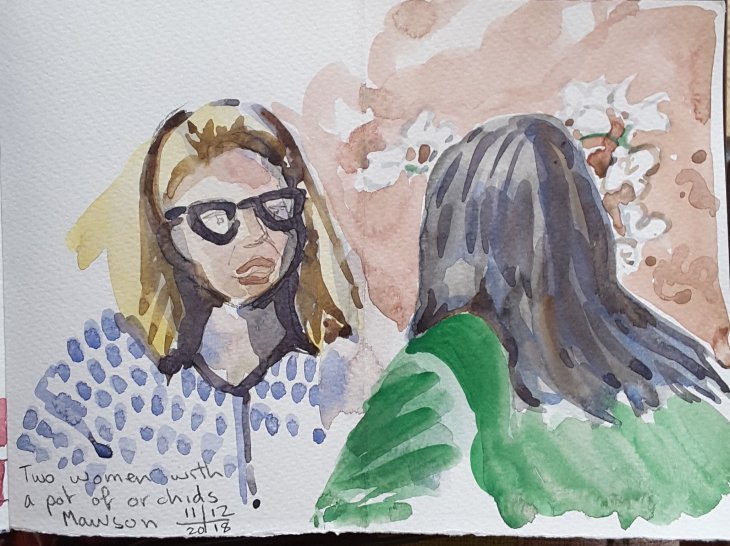
Two women with a pot of orchids, 11 December 2018, watercolour and graphite.

Urban Sketches – Granada

Here is another sketch from the backlog of my recent travel.

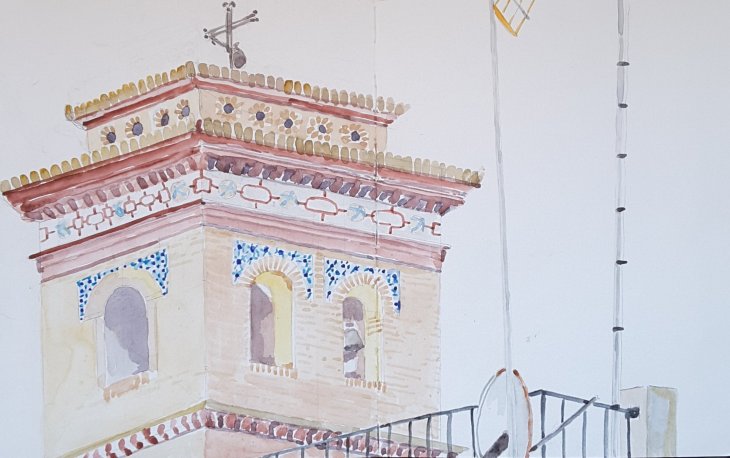
We were staying in the older part of Granada and it turned out that we had some interesting views from our apartment. On our first full day in the city I started working on a sketch of the church of San Andreas, built between 1528-42. It was great to be able to open our balcony doors and sit in the cool morning air drawing while hundreds of swifts darted around demolishing hoards of insects in the morning sky. It ended up taking three days to complete this piece. I was trying to make it reasonably accurate so having drawn it one day I had to erase it and start again on the second day and then finish the drawing and paint it on day three.

The bell tower of San Andreas Church, in the Albacin area of Granada. Pencil and watercolour

This building is considered to be a fine example of the Mudéjar style of architecture, which was heavily influenced by the Moorish styles in the years following the ‘reconquista’ when the Catholic Monarchs, Isabella and Ferdinand regained Spain for their Christian kingdom.

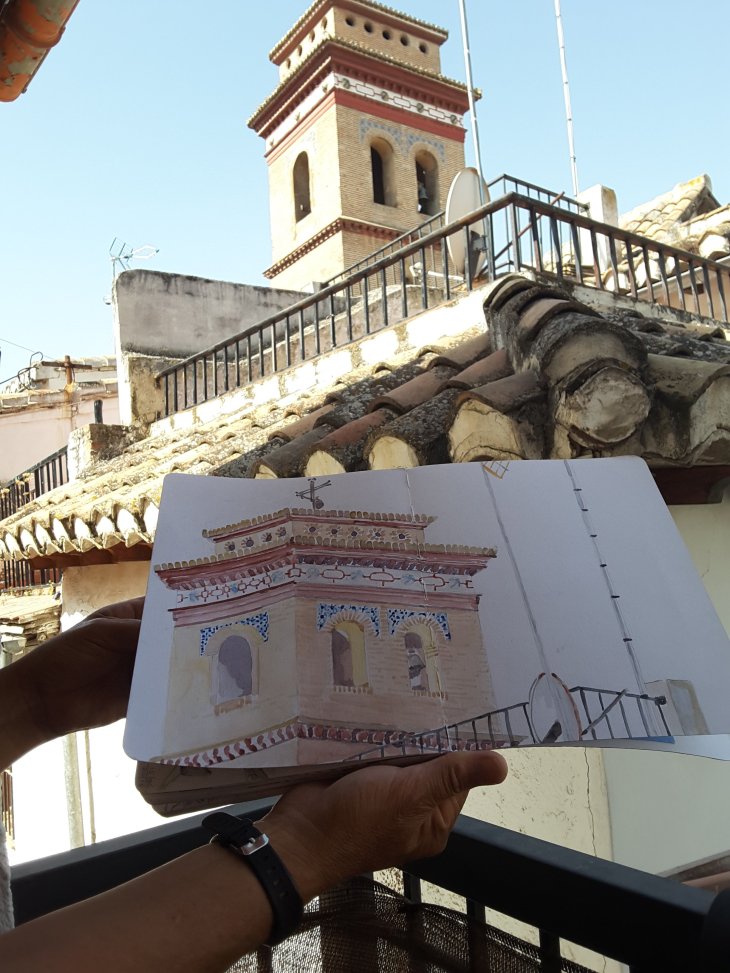
You can see from the photo the foreshortening in my sketch as I was looking up from underneath the bell tower.

After Porto

This post was originally written in August of 2018, shortly after I had returned from three months of travel in Europe (France, Spain and Portugal). I have no idea why I didn’t post it at the time, however I am interested to see how I wrote about aspects of watercolour painting, that are now part of my regular ‘style’. I have also included my latest cafe sketch at the end to show what I am doing now. Enjoy!

Reading the social media sites, post the Urban Sketchers Symposium held at the end of July 2018 in Porto, I was intrigued to see the number of people,who are reviewing their sketching practices. They have been inspired by the various styles and techniques of other people that they met at the event.

I too have found the approach of a number of other artists has made me re-consider my use of watercolour.

In May 2018 I briefly met Marion Rivolier at a USk (Urban Sketchers) Paris event at the Rodin Museum, (I can even be seen lurking in the photo taken of the event). Subsequently I have been inspired by her loose expressive watercolours. I went to her painting demonstration at the Porto Symposium to see if I could better understand how she was achieving her results. Marion’s advice included both the practical and the personal:

  • ‘know your colours so you can sketch fast’ – obvious in one way, but by using a limited number of colours and knowing in advance how they mix, you will speed up your process.
  • ‘You don’t have to draw everything you see – select like a stage director’
  • ‘[pencil] drawing at the beginning is like creating a prison for colour’. (Not in a good way).

Marion is especially good at capturing people and movement, so that will be an extra challenge for me.

People practice, sketching figures from photos in the weekend newspapers

Another teacher at the Symposium who was gaining a lot of attention was Maru Godas, with her ‘gouache like a child’ workshop. Maru’s advice to simplify and compress, rather than allowing yourself to be lost in detail. This is something I often need reminding about.

I fully appreciate that both these artist’s style has developed over year’s of practice. So, like I am always saying to new sketchers, you need to get “the brush-miles in” to get the result. I have taken out my bigger brushes to work with (makes painting fiddly detail difficult) and I’m on my way with lots of practice.

View into the front garden, with the Ibis sculpture ‘Gordon’ (found at a secondhand shop)

People drinking coffee.
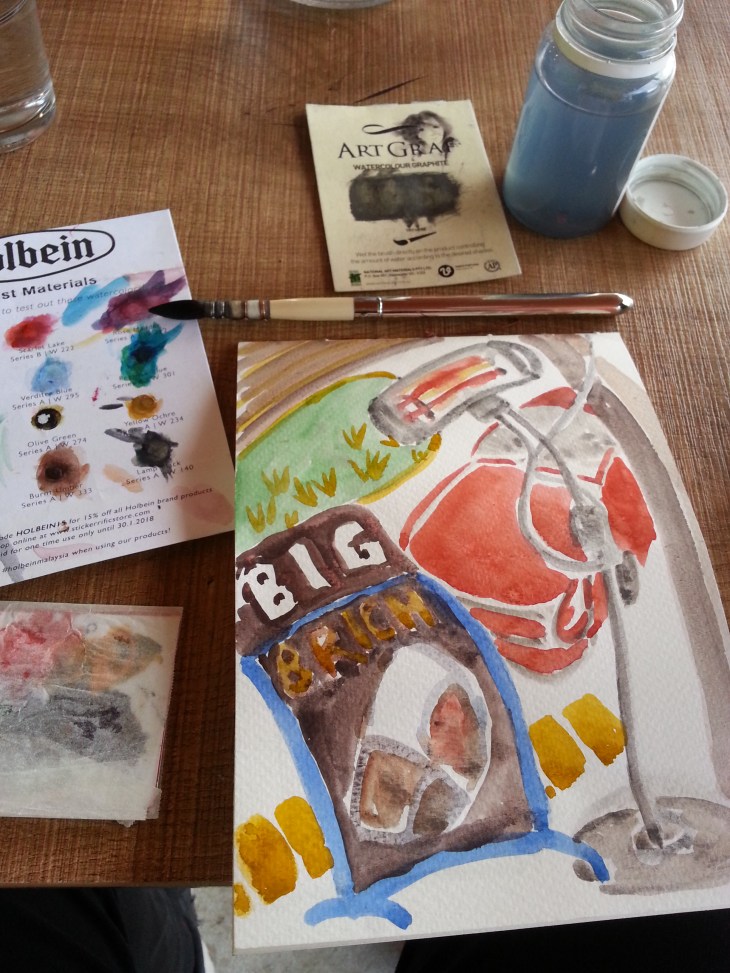
Sketching the scene at the coffee shop.

My latest cafe sketch from June 2021 is here.

Friends chatting over coffee in the winter sunlight. Watercolour, 11 June 2021

Urban Sketches – Madrid

I realised that I have a stack of sketches from my travels that I haven’t shared on my blog. My street sketches in Madrid came to a grand total of two. Mainly we spent most of our time in the museums, I will be sharing some sketching from of those visits in other posts.

Early evening, Calle de Zurita, Madrid, watercolour and pencil.

We painted in the Calle de Zurita the night of the first World Cup game between Spain and Portugal. Needless to say there were loud cheers and groans coming from the nearby bars. After sketching we went and joined the locals to watch the rest of the match.

My second sketch was of a building that I thought had an interesting roofline and I also liked the way the date palm appeared out of the courtyard. I was sketching, perched on a security block next to a bus-stop. An older couple stopped to explain that I was drawing the back end of the Cardinal’s Palace. They also mentioned that a famous painter was born there. When I walked up to look at the historic marker I could see that the artist was Claudio Coello, appointed to the court of Carlos II. Coello was born at the in 1642. I have no idea why he was born in the Cardinal’s Palace, but his dad was a sculptor so maybe he was working there at the time – this is purely speculation on my part.

The Cardinal’s Palace Madrid, from the Place Puerto de Cerrada, pencil and watercolour.

The Cardinal’s Palace, the plain end, watercolour and pencil.