Serendipity and The Big Draw

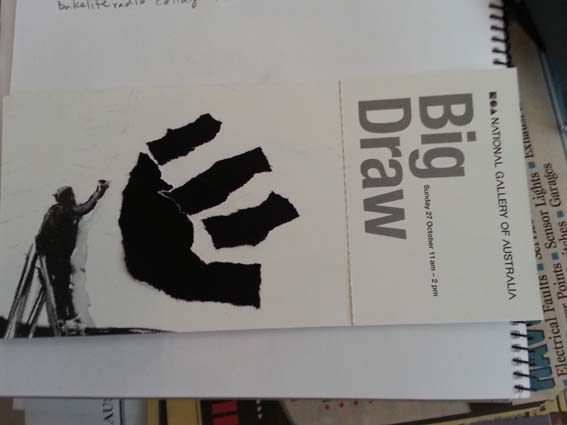
I just received my return postcard from the Big Draw, held at the National Gallery of Australia on 27 October this year.

My return Big Draw postcard from last month's event at the National Gallery of Australia.

My return Big Draw postcard from last month’s event at the National Gallery of Australia.

Earlier in the day I read that The Big Draw came about when the Guild of St George, a charitable organisation founded by John Ruskin, decided to celebrate the centennial of Ruskin’s death. The aim of the celebration was “to get everybody drawing” (Christian McEwen’s book World Enough and Time) . The Big Draw continues to be celebrated annually in the UK and around the world under the auspices of  The Campaign for Drawing, which is funded, in part, by the Guild.  Serendipity!

Drawing extended

For anyone who enjoys the art of drawing two recent exhibitions in Canberra demonstrate this art at its highest level. William Kentridge is known internationally for his work based on the techniques of drawing and collage, which is frequently translated into animation. Less well known, even in his own country, is the work of the late Roy Jackson. For both artist’s the impact of the drawn line  extends directly into their work across their chosen media.

A retrospective of Jackson’s work has just closed at the Australian National University’s Drill Hall Gallery. Sadly Jackson died earlier this year.

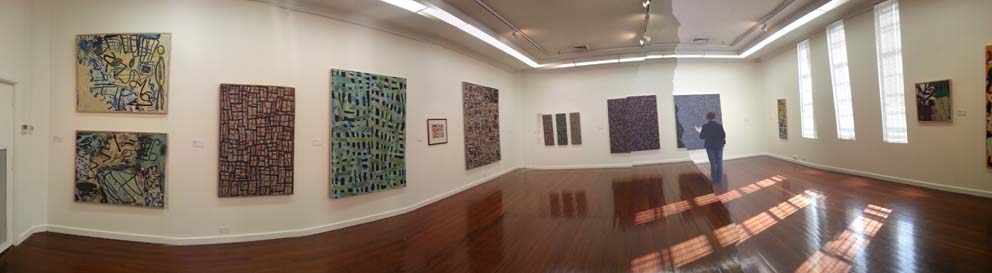
A panorama of Gallery 2 at the Roy Jackson retrospective, ANU Drill Hall Gallery.

A panorama of Gallery 2 at the Roy Jackson retrospective, ANU Drill Hall Gallery.

This retrospective features a wide range of Jackson’s practice from note and sketchbooks, collages, paintings and drawings. In the Preface to the exhibition catalogue it says “The hand is obviously apparent in all Roy Jackson’s imagery. Marks of the brush and of various drawing implements register with the maximum directness and immediacy.”

Roy Jackson notebooks and sketchbooks.

Roy Jackson notebooks and sketchbooks.

Jackson’s hand, influenced by the work of Ian Fairweather and Tony Tuckson, champions the apparently loose and expressive line. Sometimes words and figures appear, but the overall impression is of a vigorous abstraction. In one of Jackson’s notebooks on display he writes “Too much technique happening, not free or quick enough or crude or rough enough work…”. I was particularly interested in Jackson’s collage works, where he has taken drawings on small scraps of paper, adding them to a base sheet and then worked further into them.

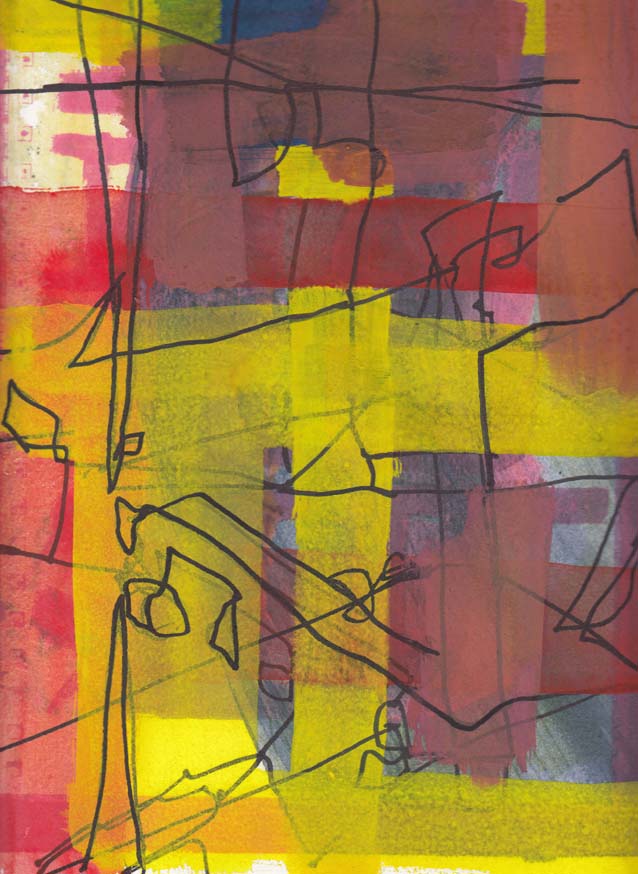
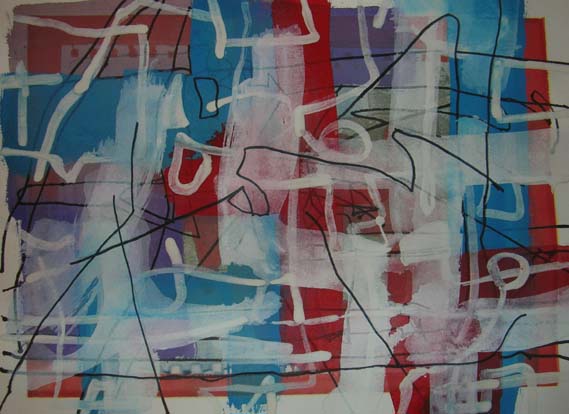
My own notes on my first visit to the retrospective were ‘often/linear/delineation over colour/blind drawing/drawn into paint with brush end or stick.’ After my second visit I decided to try some of Jackson’s approaches for myself. I used some of my less felicitous print experiments as a base, then drew onto these with permanent maker and paint, working back into two or three successive layers.

Inspired by Roy Jackson #1, 3 November 2013.

Inspired by Roy Jackson #1, 3 November 2013.

Inspired by Roy Jackson #2, detail, 3 November 2013.

Inspired by Roy Jackson #2, detail, 3 November 2013.

Inspired by Roy Jackson, #3, 3 November 2013.

Inspired by Roy Jackson, #3, 3 November 2013.

If you would like to see more of Roy Jackson’s work you can find some here.

Cafe Wednesday 30 October

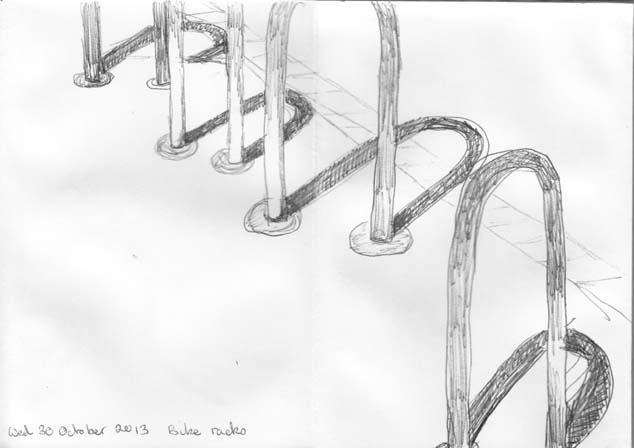
I applaud the comment I read the other day that a bit of watercolour improves a pencil drawing no end. I’m hoping the same applies to this pen sketch.

Bike racks at the cafe, 30 October 2013

Bike racks at the cafe, 30 October 2013

However I think that I’ll need more than colour to fix the ‘errors’ in this supposedly observational drawing! Perhaps next time.

Bike racks with colour, 30 October 2013.

Bike racks with colour, 30 October 2013.

The Big Draw

The Big Draw, my postcard for the postcard swap.

The Big Draw, my postcard for the postcard swap.

The Big Draw was held at the National Gallery of Australia last Sunday. In the very short period of 3 hours participants had the opportunity to explore 10 different areas to work in. I made it to 6.

I started off fairly conventionally with my preferred ‘blind drawing’ of models from the Canberra Institute of Technology, wearing garments designed by current students.
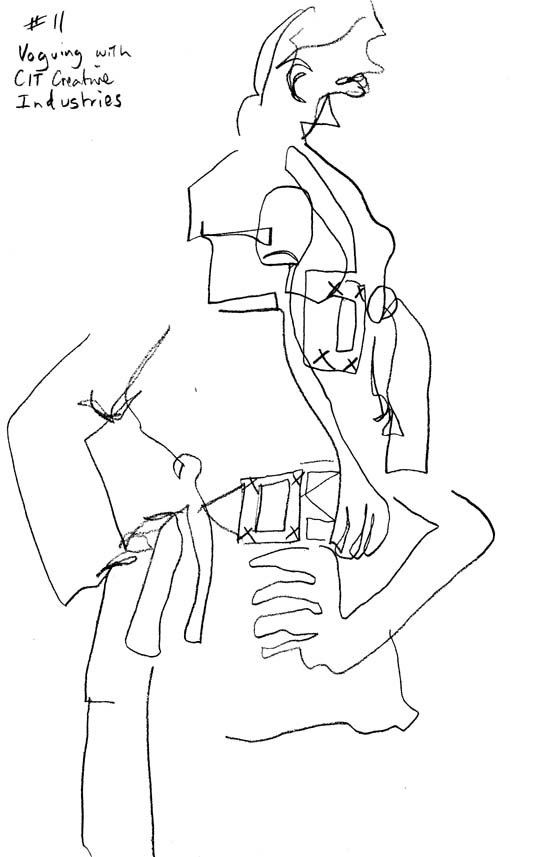
Two sketches 'Voguing' with the CIT students.

Two sketches ‘Voguing’ with the CIT students.

I then headed around to ‘Altered  Books’, outside the William Kentridge exhibition where participants were encouraged to use pages from books as the basis for drawing and collage.
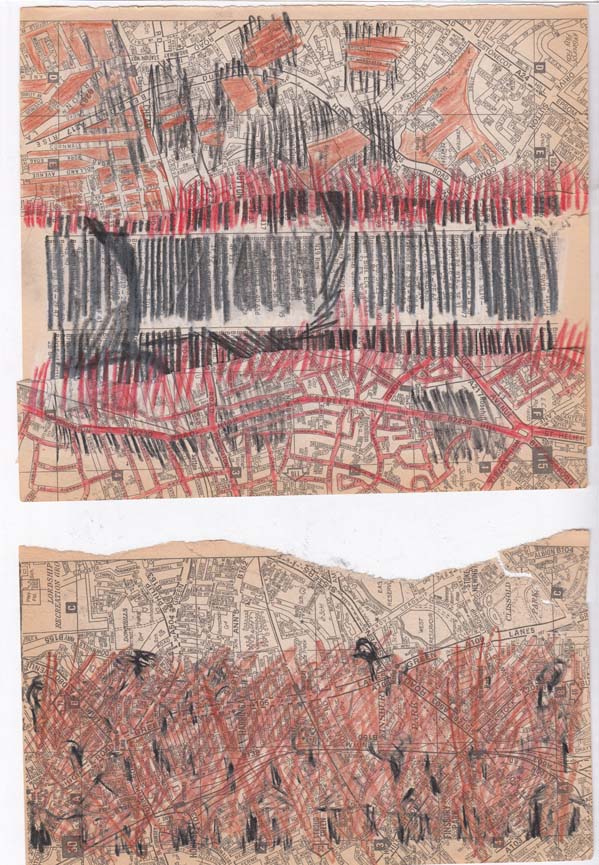
Two drawings, one with collage elements, at 'Altered Books'.

Two drawings, one with collage elements, at ‘Altered Books’.

What I really liked here were the lovely charcoal pencils we were given to draw with. I also discovered that the waxy Lyra pencils we had also provided a great resist to the charcoal. My next drawing took advantage of these properties.
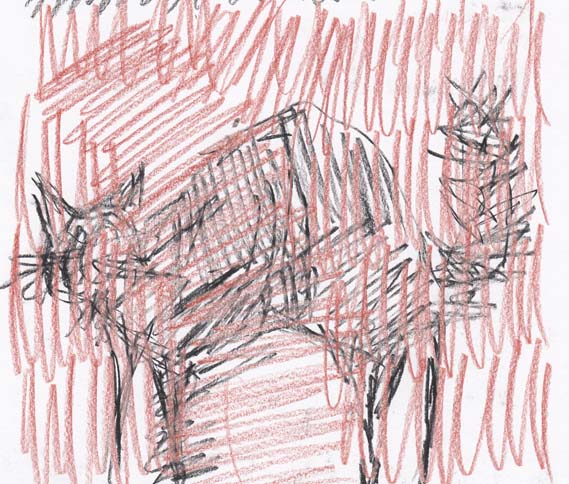
Cat drawn in charcoal over a Lyra pencil background.

Cat drawn in charcoal over a Lyra pencil background.

I then went into the most exciting station ‘Drawn to Move’, inside the Kentridge show, where I-pads had been set up with a stop animation app that allowed you to capture your image as you drew. You could then send the animation to yourself. Alas my animation never made it home (I’m not sure why), but I’ve since found a similar app for my android phablet that I’ll demonstrate in a future post.

By the time I made it to ‘What do you see?’ a large group participation work on the floor in front of Jackson Pollock’s Blue Poles, I was starting to flag. I moved fairly quickly onto ‘Exquisite Corpses’, that favourite Surrealist parlour game where I ran into my life drawing teacher from university. It was good to see you again Tess!

Time was running out so I made a dash past ‘Balcony Blueprints’ and headed into ‘Stick with it’  and ‘Paperscapes’ in the Aboriginal and Torres Strait Islander galleries. These stations were lots of fun and very inventive and thankfully didn’t require any major effort to participate in. Playing a very clever riff on ‘dot’ painting ‘Stick with it’ used an office-workers trove of coloured adhesive dots to make patterns on a large circle of cardboard taped to the floor. There was plenty of space for everyone to join in.
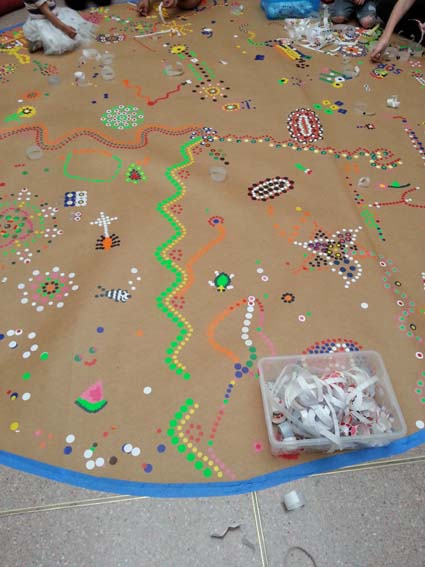
Part of the 'Stick to it' work.

Part of the ‘Stick to it’ work.

I moved on to ‘Paperscapes’ for my last piece of work. I was all ‘drawn out’ by this stage so I stuck to using large pieces of coloured paper to make a collage inspired by the striping of the Bungle Bungle ranges, very apt in this room of inspired landscapes.
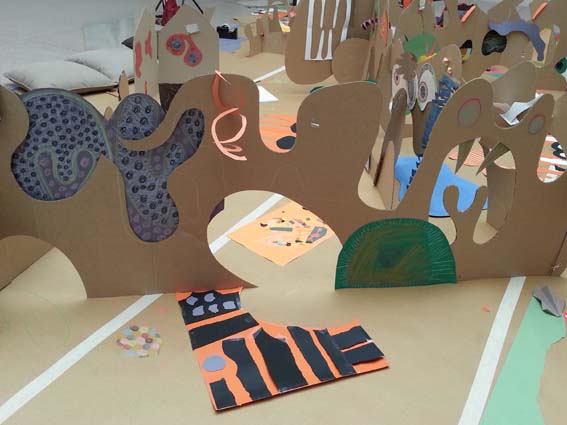
'Paperscapes' in the Aboriginal and Torres Strait Islander galleries.

‘Paperscapes’ in the Aboriginal and Torres Strait Islander galleries.

After three hours it was all I could do to stagger to the information desk and hand in my postcard, to be swapped sometime in the future, with one from another participant.

I really enjoyed myself last Sunday, but I came away pondering who the target audience was for this event. The obvious answer was that everyone was the audience and people of all ages were participating. My corollary to that was that I saw few ‘solo’ adults participating in the activities. Most adults appeared to be there as adjuncts to children and weren’t actively engaged on their own behalf, which I thought was a shame. I think this reflects the feeling that art is for ‘artists’ or something only permissable for children to enjoy.  I’m reminded of one of my favourite quotes from Art & Fear (David Bayles & Ted Orlando, Capra Press, 1993):

“When my daughter was about seven years old she asked me one day what I did at work. I told her I worked all day at college – that my job was to teach people how to draw.

She stared back at me, incredulous, and said, “You mean they forget?” – Howard Ikemoto”

Lines of Inquiry II

I have been trying hard not to lose the sense of momentum that I gained from the Michael Brennand-Wood workshop I did earlier this month. Without the excitement of the class atmosphere I find it all too easy to fall back into familiar practices and patterns.

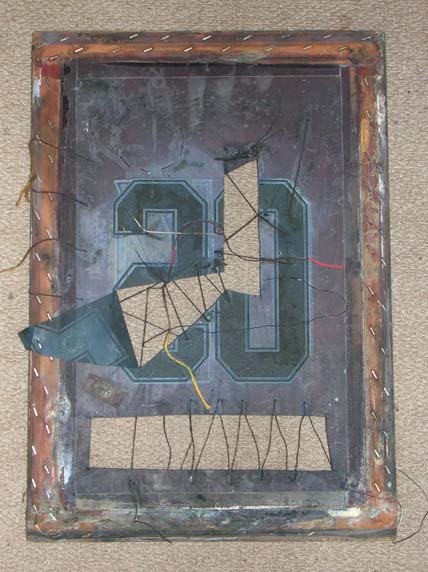
I was pretty excited to realise that one very direct response that I could take from the class was to use one of the pieces I produced for it’s original purpose, as a screen to print from.

The screen with cut and stitched sections.

The screen with cut and stitched sections.

In the workshop the screen had been the frame for exploration of 3D layers with connecting threads between them. When it came to printing I first put the thickened dyes I use onto the ‘back’ of the screen and then placed paper directly onto it, carefully pressing down to transfer the image. The result is a subtle background with a much stronger transfer of colour where the original image remains on the screen.

Stitched and cut screen image using thickened dye on Japanese paper, 9 October 2013.

Stitched and cut screen image using thickened dye on Japanese paper, 9 October 2013.

In order to use the ‘front’ of the screen, the normal approach, I had to cut those strings that prevented me from running the squeegee across the screen.

The 'front' of the screen prior to printing.

The ‘front’ of the screen prior to printing.

Because the screen already had an exposed image on it, the thickened dyes only transferred to the paper where the original image was and where the screen had been cut away. This resulted in a very different image from the one above. I like the large amount of white space in this piece.

Image resulting from the 'front' of the screen. 9 October 2013.

Image resulting from the ‘front’ of the screen. 9 October 2013.

I have continued to use the same screen for printing, modifying it as I go. Most recently I combined the use of certain sections of the screen with other techniques to produce this multi-layered approach.

A combination of printing approaches, using the manipulated screen and de-contructed screen printing, with masking and overlapping. 25 October 2013.

A combination of printing approaches, using the manipulated screen and de-contructed screen printing, with masking and overlapping. 25 October 2013.

I think this is a very fruitful approach and I intend to continue exploring this idea at my next sessions at Megalo.