Rotterdam

A quick-ish hop around the world via Singapore and now I find myself sketching in Rotterdam.

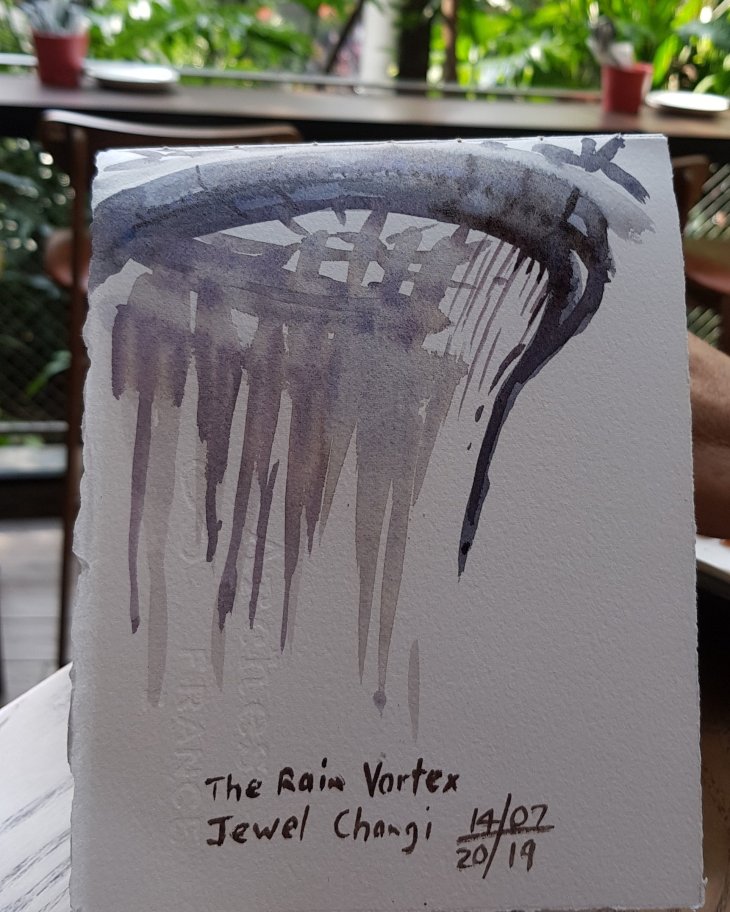
Rain Vortex at Jewel Changi. Watch our for large numbers of people dragging their luggage around while looking at their smartphones.

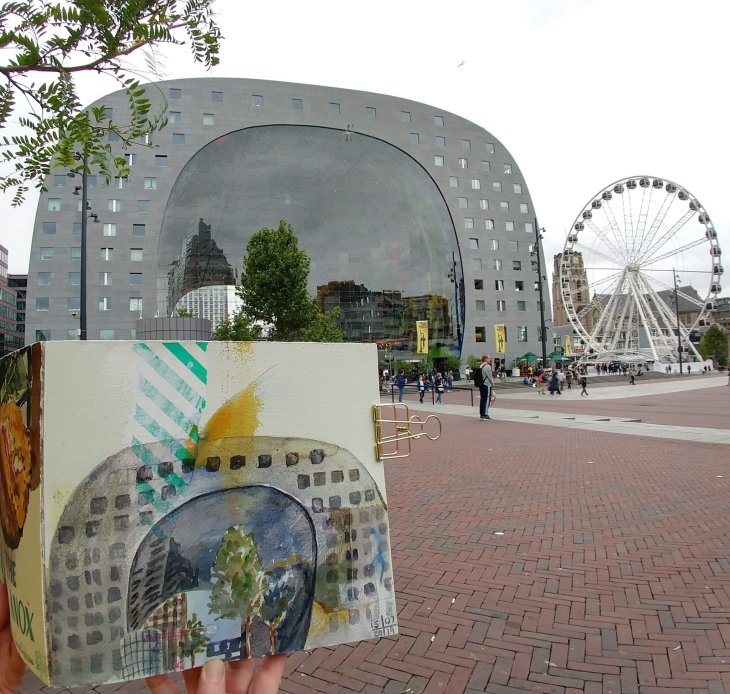
First sketch in Rotterdam the Markthal (Market Hall) by MVRDV architects, (2014).

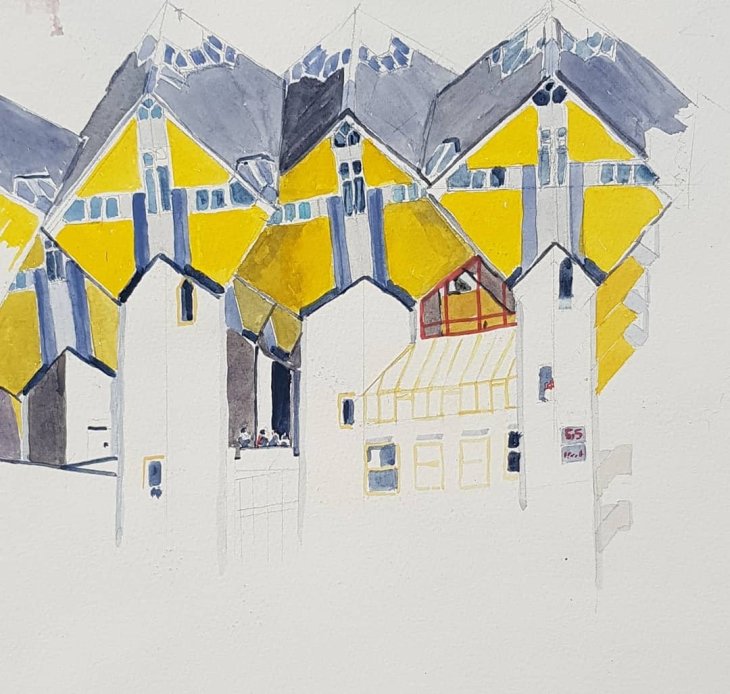
Next the Kubuswoningen (Cube Houses) by Pier Blom (1984).

This is an earlier version which I wish I had left at this stage instead of turning it into a turgidly overworked mess.

Then part of Auke de Vries sculpture ‘Maasbeeld’, with De Rotterdam, by Rem Koolhaas (2013) and the Erasmus Bridge in the background.

Today even further challenges with De Hef, (Koninginnebrug) a now defunct, lifting railway bridge.

Matthew Evans at the National Library of Australia

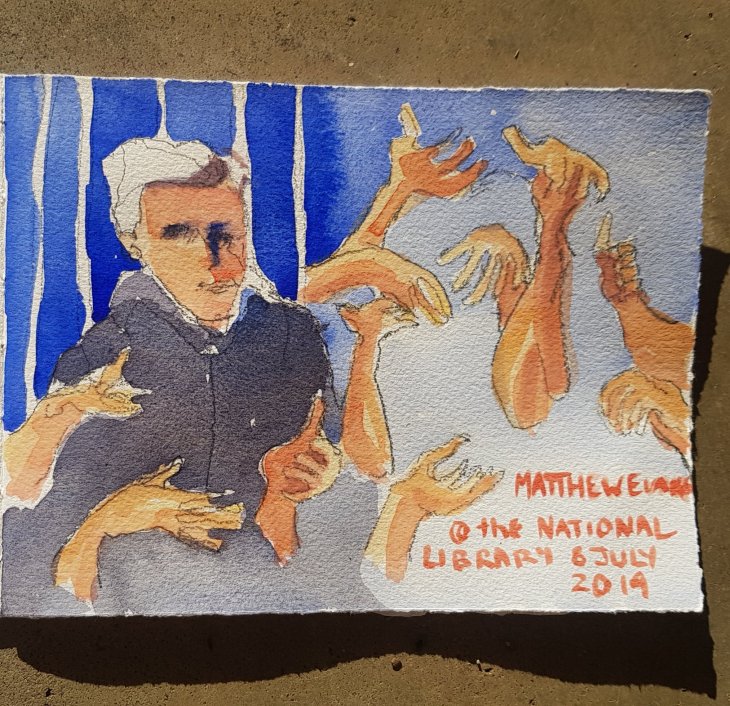
Two quick sketches of Matthew Evans, TV presenter and author, who was speaking last night at the National Library of Australia on his latest book On Eating Meat.

Matthew in conversation with Karen Hardy from the Canberra Times

Matthew is as eloquent with his hands as he is with words.

Pencil sketches were made during the event and watercolours were added when we got home.

Travels with my paintbox

It’s been a year since my big European sketching adventure, so I decided it was time to take a look at my paintbox and see what I have and haven’t used, paint-wise, over that time.

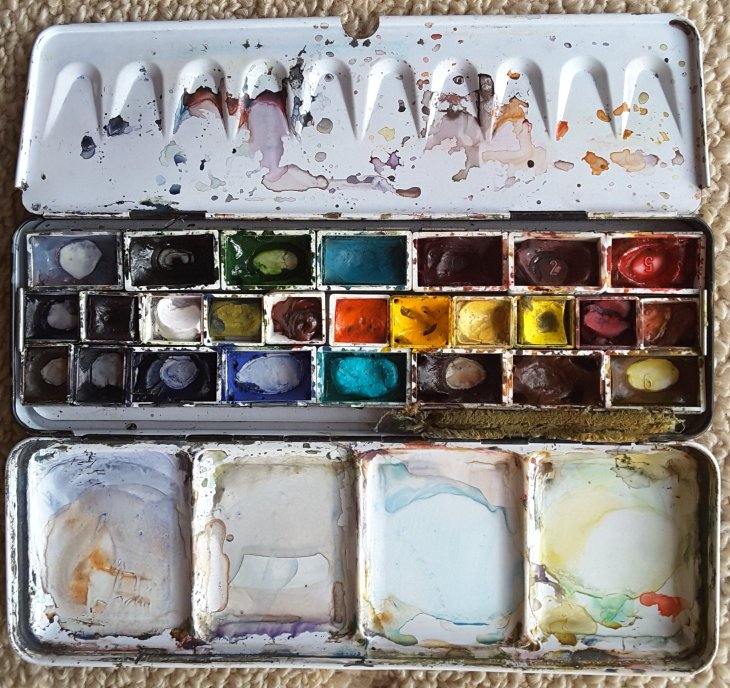
The paintbox after one year’s use.

I bought this set in Paris about this time last year, but it no longer resembles the Sennelier set that I purchased, nor does it have many Sennelier paints in it anymore.

My biggest issue is that the Sennelier paints use honey as a binder, which is fine in moderate climates but doesn’t do the job in high temperatures. It was quite an alarming experience to be sitting, a few weeks later, in the streets of Cordoba realising that all my paints were liquid under a thin top skin. It was awful for painting and even worse when they started running together across the box.

So having started out using the kit as purchased, this paint box has been modified as I have gone along. The original set only had pans in half of the box, so I immediately started filling the empty spaces with extra half pans I bought as I travelled.

Longer term I also added full pans, all of which are filled by tube paint. It took me a while to appreciate that using full pans made it easier to get juicy colours onto my palette and paintings, without unnecessarily wearing down the hairs on my good brushes. When travelling using full pans also means less refills.

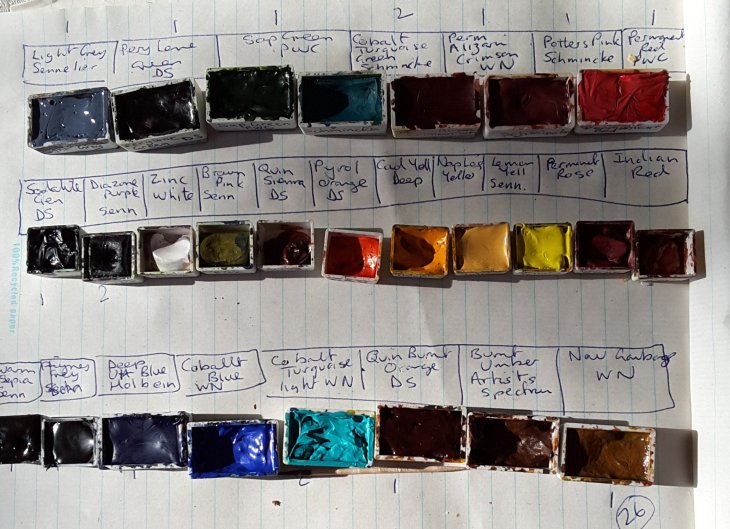
Sorting out what I have ready for re-filling.

In the middle of the box sits a row of colours that get used at a lesser rate than others. Some, such as pyrol orange and diazine purple that are almost impossible to mix from scratch and for me at least, are absolute necessities in some sketches.

I can’t resist trying new colours and no kit I have seen holds all the colours that I want to use. I am also a firm believer that art supplies make excellent souvenirs, particularly as so many brands are hard to get (other than online) in Australia. Included in my box are paints I got in Japan, France, Singapore and Portugal. Brands include Windsor and Newton, Daniel Smith, Artist’s Spectrum, Holbein, Schmincke, Sennelier, Mission Gold and PWC. My latest purchases made in Taiwan last year, haven’t found a space in the box yet, even though I am desperately attached to the Mission Gold Red Brown.

Comparing colours between what I had at home (the paints at either end) and replacements bought while travelling, when I ran out or couldn’t find the right colour.

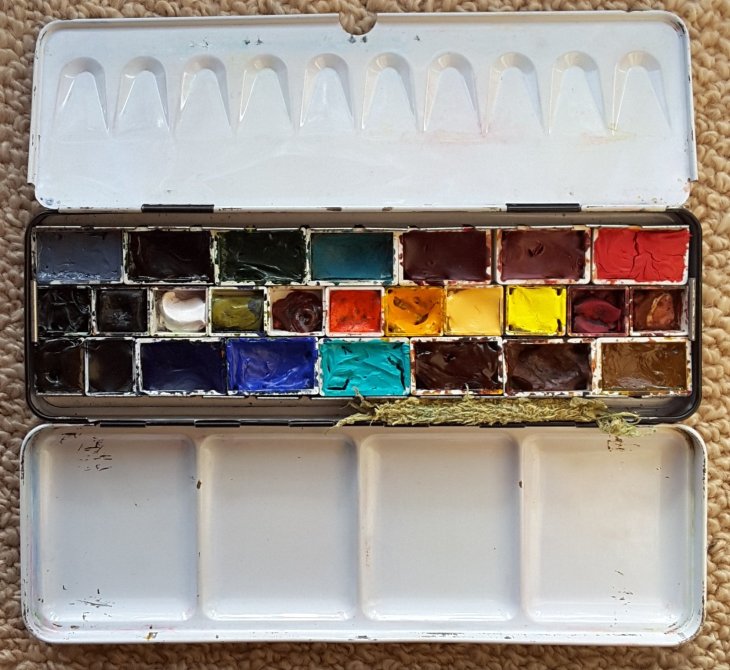
I am looking forward to travelling again so it will be interesting to see what new paints I find! Here’s to my re-filled palette.

My shiny clean paintbox , not for long!

Drawing the exhibition – Bodies of Art

Bodies of Art: Human form from the national collection, is currently on display in the downstairs sculpture rooms of the National Gallery of Australia. I spent the morning there quietly sketching away. The exhibition is a stimulating mix of sculpture, paintings, photography and video works which provided me with lots of interesting compositions to work on.

My first sketch was a grouping of stone sculptures, Torso, 1948 by Rosemary Madigan and Number 24, Harry Boyd by Robert Klippel and a third piece, an Anthropomorphic monument [gowe nio niha], (19th century or earlier) from the island of Nias in Indonesia. I was instantly drawn to the sandstone used in the two Australian works. The deep gougemarks on the Klippel sculpture acted like lines drawn across the surface. In contrast the smoother texture of Madigan’s work supported the subtlety of her torso’s carved planes.

Left to Right, Torso; Anthropomorphic Figure; Number 24, Harry Boyd, graphite with added watercolour

Behind me was an interesting juxtaposition of a hanging work by Giulio Paolini, Aria (Air), 1983 and beyond that, Triptych, 1970, by Francis Bacon.

Paolini’s work consists of two photographs of a renaissance sculpture sandwiched between perspex and hang from a steel cable. The work slowly gyrates beneath the high gallery ceiling, while underneath lies a piece of shattered glass. Behind it hangs Bacon’s equally fractured figures, curiously feeling much more grounded and solid than Paolini’s figure does.

Giulio Paolini, Aria (Air), 1983 and Francis Bacon, Triptych, 1970, pencil with added watercolour

While I drawing the partial elements of the Bacon triptych into this sketch, I became quite intrigued by the figures in the work’s central panel. After a restorative cup of coffee and some biscuits in the Member’s Lounge I returned to my final sketch of the day, the detail of the central panel.

There is certainly scope for more drawing here, so I will plan to make it back there soon.

All the sketching was done in the gallery and the watercolour was added afterwards.