Three Sketches

Three sketches from the past week.

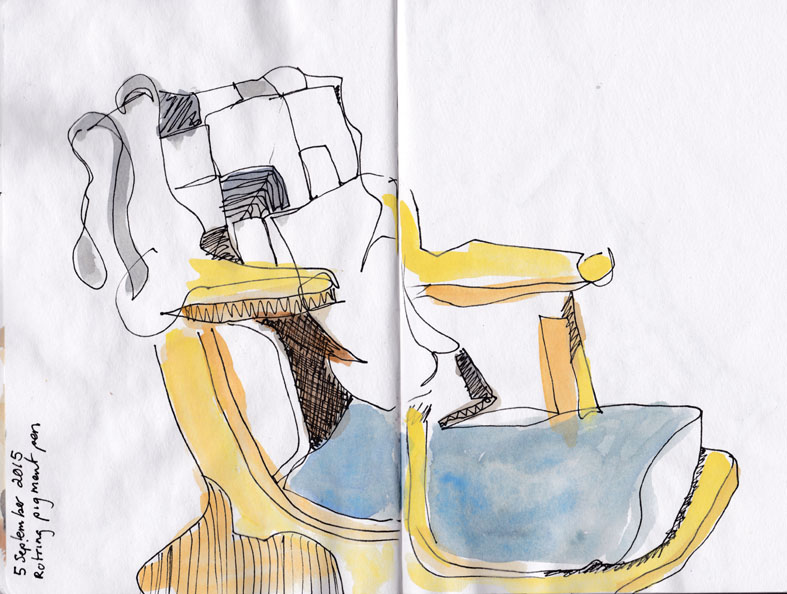
I borrowed my partner’s Rotring Tikky water proof pigment pen, 0.5 nib, to try it out with some watercolour. I like the line so I’ll probably get my own. There are several nib widths, both smaller and larger, so I might end up getting several.

Rotring pigment pen with watercolour, 5 September 2014

Rotring pigment pen with watercolour, 5 September 2014

I’m continuing to work on drawing people. This one is a combination of pen and ink and acrylic marker.

Portrait, pen and ink and acrylic marker, 6 September 2014

Portrait, pen and ink and acrylic marker, 6 September 2014

I continue to be captivated by construction. There is building work going on across the way from where we regularly buy coffee. Here is a look at the current state of scaffolding and wire safety fences. The biggest problem is the wire which was lighter in tone that the building behind it. I had trouble working out how to get the different grey tones working while I was on location, so I added some watercolour when I got home. When I scanned my amended version of the drawing  I could see that the upper half of the windows weren’t looking like they were part of the whole. So with some additional drawing I came up with the final version.

Three stages of the construction sketch, 9 September, pen, ink and watercolour.

Three stages of the construction sketch, 9 September, pen, ink and watercolour.

The final version, I’m hoping some impression of the fencing is given, without resorting to adding a white grid over the drawing. Perhaps in another drawing  I could focus on a much tighter section of the scene and see what I can do by  reserving the paper as part of the sketch.

Construction site with scaffolding and safety fencing, 10 September 2014

Construction site with scaffolding and safety fencing, 10 September 2014

Testing #2

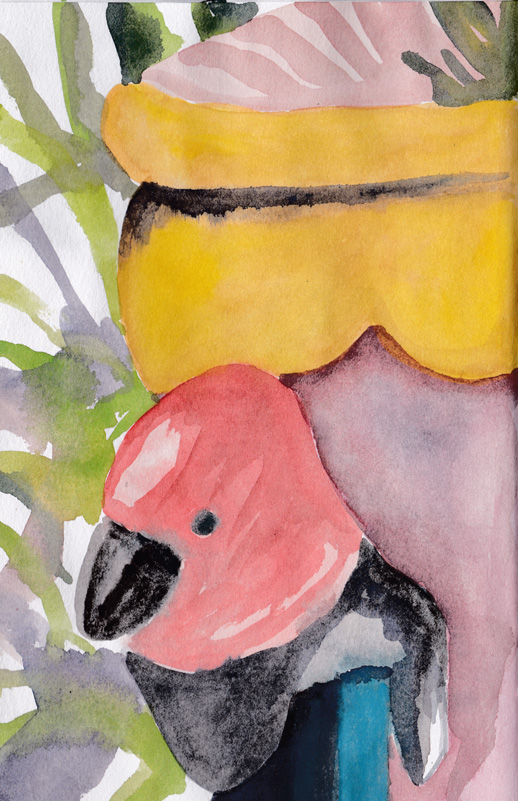
Back to the new sketchbook, but first I must make a correction. I’ve now realised that the paper in this book is actually 150 gsm, not 110 gsm as I’d previously written, so perhaps the results I’ve been getting are not so unexpected. However the best test of the paper quality is water colour. I have made two basic paintings using subjects close to hand. This is the first work and it has another water colour on the reverse side of the page.

Watercolour on the new sketchbook.

Watercolour on the new sketchbook.

You can see from the painting below that each work stands by itself and there is no bleed through from either side of the page. I used quite a bit of water on each side of the page, but I did allow the page did dry thoroughly between paintings. So I’m quite impressed with how this test has gone – I didn’t expect, even at the heavier weight of paper, that the result would be this good.

watercolour on the reverse side of the page above.

Watercolour on the reverse side of the page above.

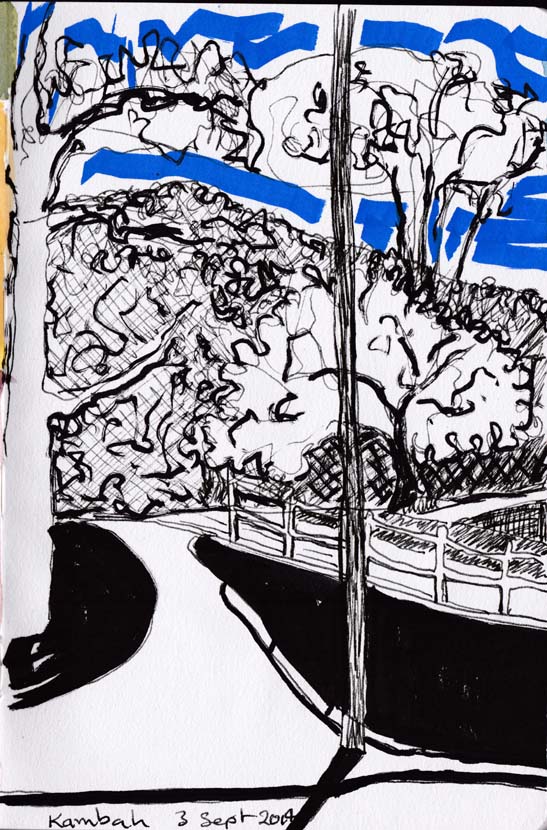
I’m now working on testing my own skills. I have been trying to integrate the different pen and ink and acrylic paint markers I’ve been working with, into a more style. It’s not as easy as I had hoped. I’ve struggled with not letting the heavier acrylic paint markers dominate the finer pen and ink lines. I’ve also had problems getting carried away and ‘colouring in’ with the paint markers. Because it’s so easy to go over the top I’ve decided to limit my palette to my black markers and one colour only.

Today I think I have made some positive progress with my sketches in mixed media. Any ideas or thoughts from your experience on how to proceed would be welcome.

Path and trees, acrylic paint marker, pen and ink, 3 September 2014.

Path and trees, acrylic paint marker, pen and ink, 3 September 2014.

Images of Koyasan, Part 2

The town of Koyasan can be roughly divided into two main areas. To the east is the Okunoin, a large cemetery and temple complex where thousands of grave markers and memorials are located. Perhaps the most dominant style of memorial marker is the Gorinto (Five-tiered stupa). The shapes of the tiers represent the five elements, from the bottom up earth, water, fire, wind and space.

A set of 3 gorintos in the Okunoin, Koyasan, Japan.

A set of 3 gorintos in the Okunoin, Koyasan, Japan.

At the other end of the town is the Dai Garan where the main temple complex is located along with many other temples and monuments.

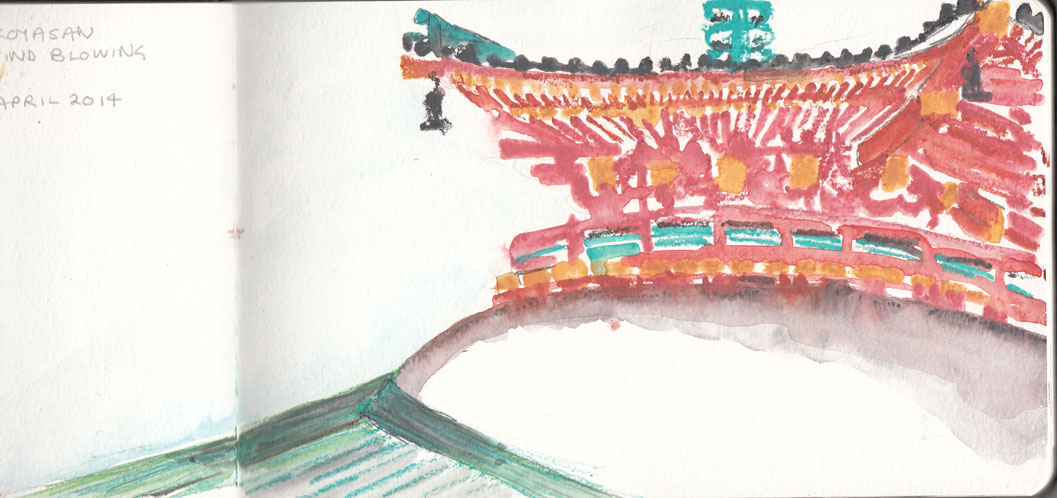
The centre of the main temple complex is the Konpon Daito or Great Pagoda. I sat painting a section of this temple in the chilly morning air, accompanied once more by the sounds of chanting coming from the Kondo or Main Hall.

Part of the dome of the Konpon Daito, Great Pagoda, Koyasan, Japan

Part of the dome of the Konpon Daito, Great Pagoda, Koyasan, Japan

This area of the town is also the home of other major buildings such as the Kongobugi Temple. The rooms of this temple are decorated, in a variety of styles, illustrating the life of Kobo Daishi (the founder of the Shingon sect). Not only were you not allowed to take photos, the signs also specifically forbade sketching. This is what I recall of one room in a series that illustrated the four seasons. This room depicted autumn; yellow and orange maple leaves fell down against a backdrop of gold leaf, a striking deep blue stream ran through the background (this is not included in my version).

Recollections of the 'Autumn' room in the Betsuden, Kongobuji Temple, Koyasan, Japan

Recollections of the ‘Autumn’ room in the Betsuden, Kongobuji Temple, Koyasan, Japan

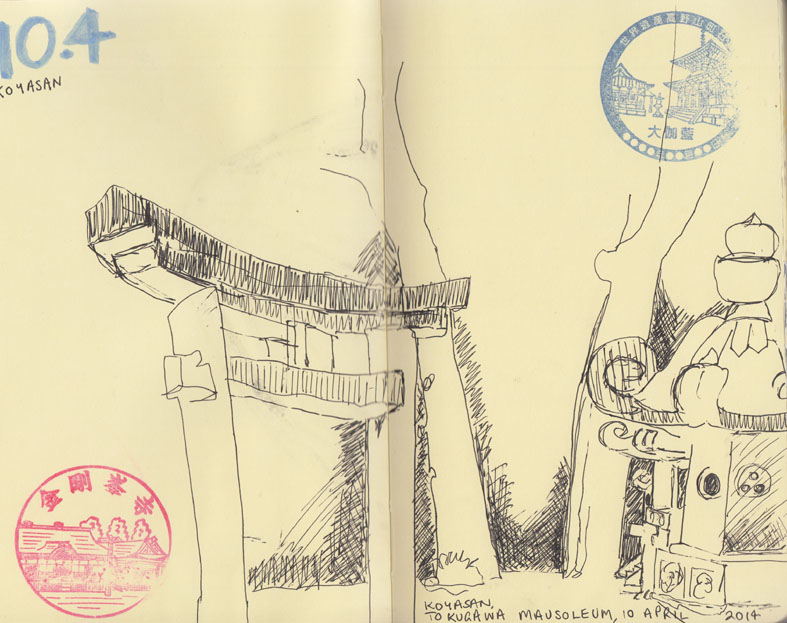
We also visited the Mausoleum of Tokugawa Ieyasu and Tokugawa Hidetada, the first and second Japanese Shoguns. From what I understand this mausoleum contains the ‘spirits’ rather than the physical remains of the shoguns. Here visitors have to content themselves with admiring the elaborate wooden carvings that grace the exteriors of the two small buildings. Views of the gold-painted interiors are restricted to glimpses in the official brochure. I enjoyed the late afternoon quiet and drew this view of the torii gate at the entrance to the mausoleums. The stamps are available at many tourist attractions, so I’ve incorporated them into my page.

Torii gate at the entrance to the Tokugawa Mausoleum, Koyasan, Japan

Torii gate at the entrance to the Tokugawa Mausoleum, Koyasan, Japan


Moche ceramics

I have a season pass to the Gold and the Incas exhibition, at the National Gallery of Australia. I like being able to spend time having a good look at one or two individual works in detail. I do this by drawing them. However drawing is proving very challenging in the low-light conditions in the exhibition. For a lot of the time while I was making these drawings  I couldn’t actually see the tip of my pencil on the page.

This visit I drew two ‘stirrup’ vases, (they get their name from the shape of the handle), although this is clearly not what their makers, the Moche people called them* because stirrups were not introduced into South America until the Spanish invasion, some 800 years after these pots had been made. Both of these works come from the Museo Larco, in Lima, Peru. Some highlights of the Museum ‘s collection are also accessible through the Google Art Project, which is both in English and Spanish.

Most striking in the vases on display are the portrait vases, where faces are deftly sculpted in the round and painted in strong colours.

Moche vase, portrait head, 100-800 AD, ceramic, from the collection of the Museo Larco, Lima, Peru ML000267.

Moche vase, portrait head, 100-800 AD, ceramic, from the collection of the Museo Larco, Lima, Peru ML000267.

I also made a second drawing of another Moche pot in the shape of four pepinos. The symbolism of the four melons is believed to be related to the four cardinal directions.

Moche culture, vase in the form of Pepinos, ceramic, from the collection of the Museo Larco, Lima, Peru ML006659.

Moche culture, vase in the form of Pepinos, ceramic, from the collection of the Museo Larco, Lima, Peru ML006659.

I particularly enjoy the colours used on these pots so once I got home I scanned and printed out the pictures I had drawn and then I indulged myself with a bit of good old-fashioned colouring in.

Moche pot with pepinos, 24 March 2014 watercolour.

Moche pot with pepinos, 24 March 2014 watercolour.

The coloured stripes on the face in the next image are not shadows. The face actually has two colours, umber on one side and a burnt sienna on the other, painted over the glazed terracotta and provide evidence of painted facial decoration.

Moche portrait pot, 24 March 2014, watercolour.

Moche portrait pot, 24 March 2014, watercolour.

*Actually the Moche pots are referred to as pacchas in the exhibition catalogue. These are ritual objects, also made in materials other than ceramics, which generally consist of a form that conducts or conduits liquid through them. These vessels were used in life and were also buried with the dead. Their symbolism is related to the connection between the exterior and interior ‘worlds’ that meet during rituals and at the moment of death.