Kunming

You know what they say about the best laid plans… Well I was expecting to be able to post some drawings of the Stone Forest, an amazing landscape of limestone rocks that we visited yesterday, but it started to rain just as we got to the stones and drawing proved impossible. Of course by the time we got back to Kunming the rain had stopped. As compensation we bought some tea, because tea plants (Camelia sinensis) are native to this area. So here is my consolation cup of chrysanthemum tea.

image

Thankfully the weather was much better today as we visited the Western Hills area of the city to climb up to the Dragon Gate, a Daoist shrine on the side of a mountain overlooking the city. Here is my sketch of the gate in its pristine state (I’m considering putting some colour on it). The character on the left is ‘gate’ and that on the right is ‘dragon’. You may notice a ball shape on the underside of the lintel. It is traditional for students about to sit their exams to climb the mountain and touch the stone.

image

So good luck to you all and we’ll settle for the weather to be kinder when we visit the ancient Buddhist sculptures at Beishan.

Yangshuo Markets

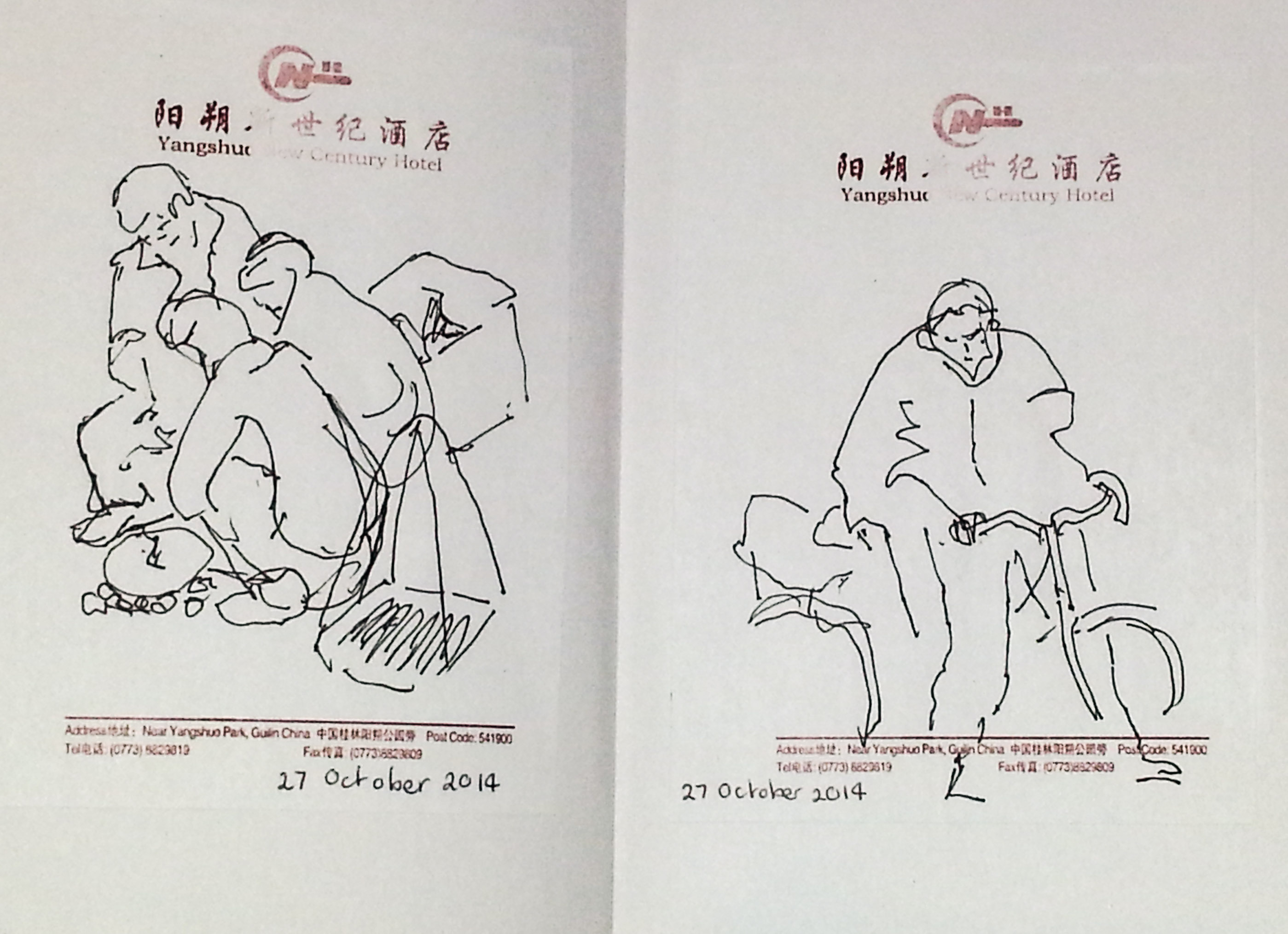
Like any Chinese city or town Yangshuo has  range of markets. Across the road from our hotel is the local fruit, vegetable and meat market. It opens very early, we were there at 6.30 and it was already getting underway. I did two quick sketches of some of the vendors and buyers on the street outside.

image

West Road is the tourist market at the river end of Yangshuo. It’s full of ‘not quite’ silk scarves and antiques that are at least a week old. Our guide suggested that it is a good place to buy cheap souvenirs, or maybe a special present for someone you don’t like very much!
It was 30 C and quite humid today so we had a pleasant cold drink while watching the world go by. This is some of what you can see looking towards the river.

image

Li River Cruising

For anyone who has been to the Guilin area a cruise on the Li River is an obligatory part of the visit. Thankfully it’s an experience that actually lives up to the hype. The scenery is like one of those Chinese paintings, all contorted mountains, sculptural rocks and bamboo growing along the river banks, with fishermen on their bamboo rafts, except it’s actually there before you. The only slight ammendment I would note is that most of the bamboo rafts have now been replaced by rafts of exactly the same design made out of pvc pipes with the ends capped. I am still trying to work out how they get them to bend at either end, with heat I presume.
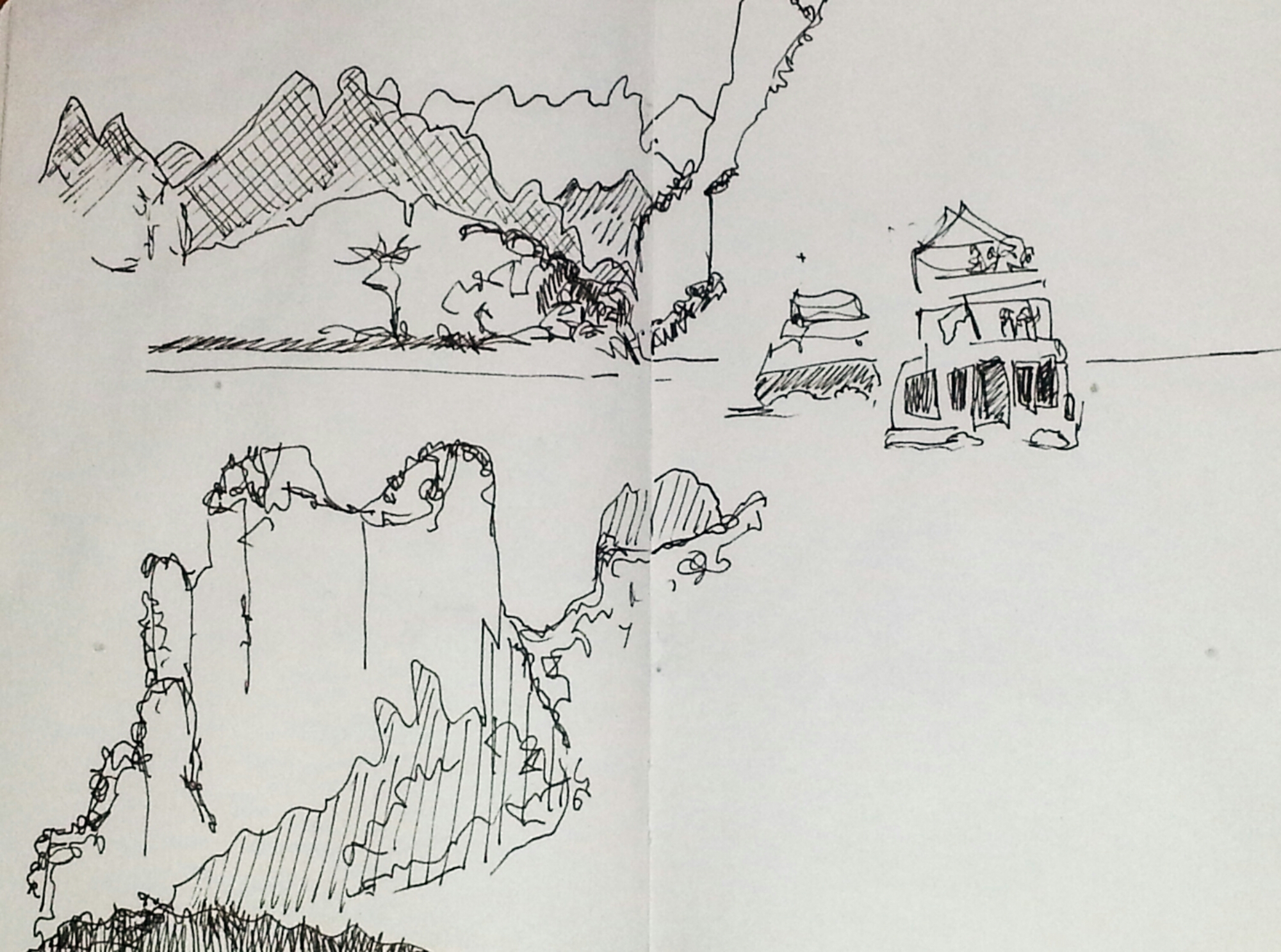
I was lucky enough to have taken this boat cruise before so I was able to focus on my drawing (and take a few pictures). I managed 12 pages of sketches before I gave up. Here is a selection.
image

On most pages I’ve tried to fit in more than one drawing. The two objects in the upper right drawing are just two of the flotilla of cruise boats making the trip.
image
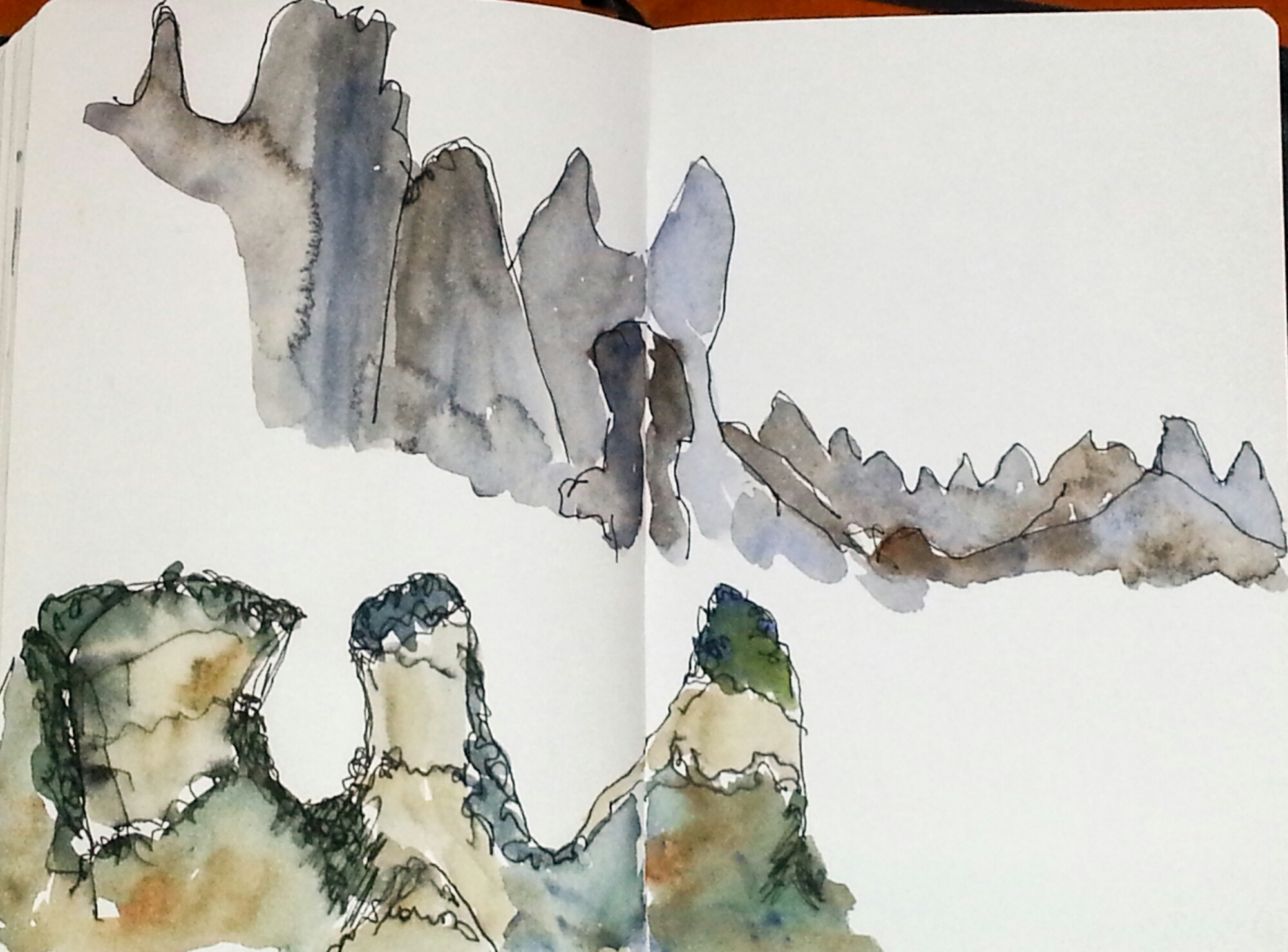
I spent some time after we got back to the hotel adding some watercolour to some of the drawings. Here is one of the successful ones, others were not so successful.
image

Shanghai and Suzhou

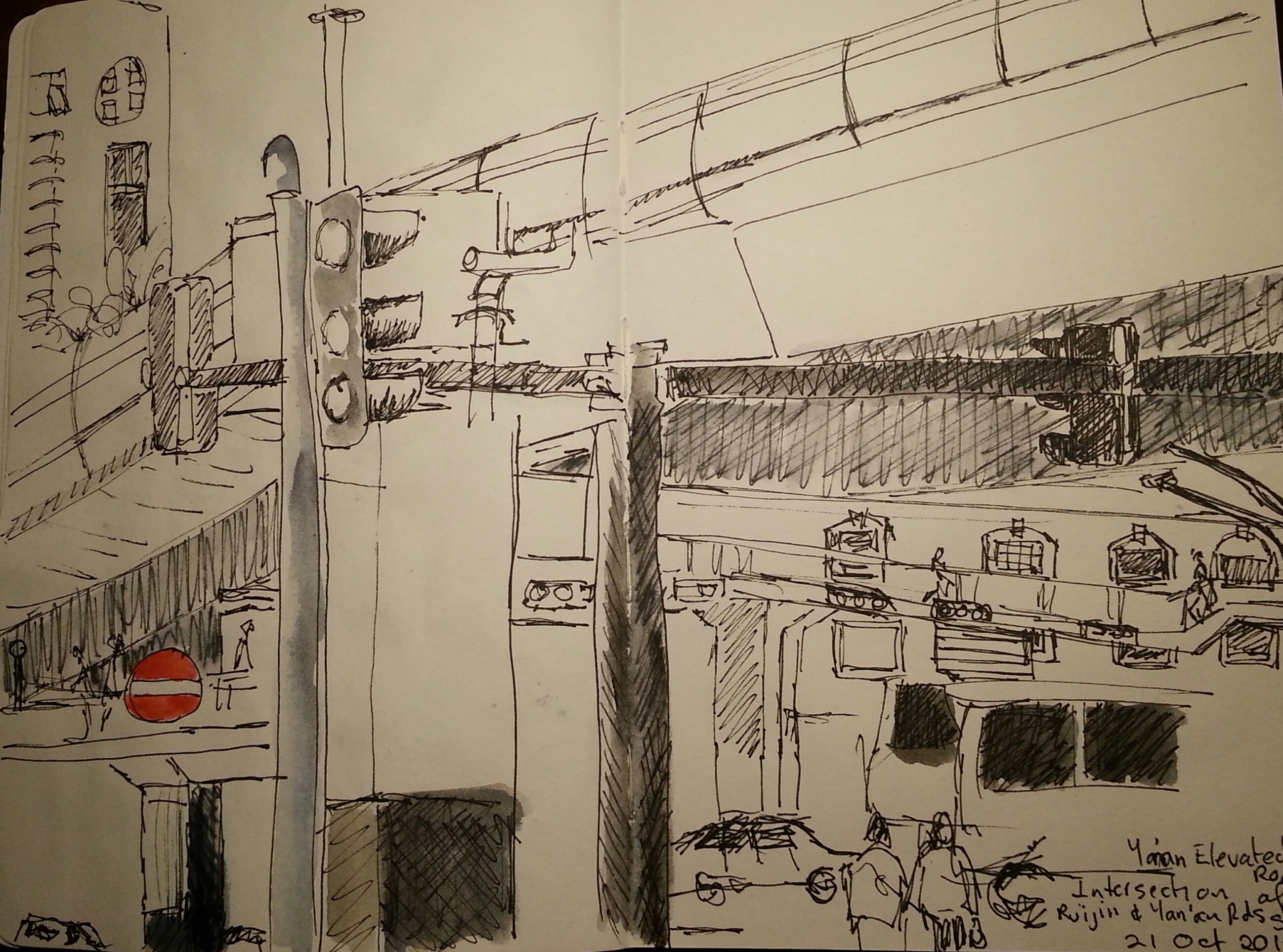
We’ve moved just up the road from Shanghai to the ‘small’ city of Suzhou (1 million people). Before we left I found a spot on the corner near our hotel at the intersection of Yan’an and Ruijin roads, where the Yan’an elevated roadway passes overhead.

image

Behind me was a small park, which are surprisingly quite common in the city. A cluster of large cycads caught my attention. I added the watercolour later.

image

We only have one day in Suzhou. A  boat trip on the Grand Canal  was followed by a visit to the Master of Nets garden, which was overrun by horticultural students, drawing plans of the gardens and making sktches of the pavilions. I felt like shaking some of them because rather than draw from what was in front of their eyes they were taking a photo then drawing from that!
Anyway here are some extremely quick sketches which I did from the boat.

image

Last stop of the day for most of the group was the Humble Administrator’s Garden, perhaps the most famous in China. However I arranged with our guide to go instead to the Suzhou Museum, designed by I M Pei, whose family comes from this city. But that story will have to wait for another wifi connection.

Arthur Boyd, Agony and Ecstasy

A major retrospective of Arthur Boyd’s work is currently on show at the National Gallery of Australia. Drawing largely on the donations of work that the artist made to the gallery in 1975, the show includes works in a range of media, from pen and ink, oil, oil and tempera, pastel and tapestry.

With a show of such magnitude I can only touch on a few points I found of interest. Firstly I agree with the friend who commented on the wide range of styles that Boyd employed or reflected over the years. To my mind Boyd’s early works went from reflections of the Heidelberg School (Australian Impressionism), then to a strong influence of the artist Albert Tucker. At the same time his drawings in pen, ink and wash have a decided renaissance feel to them, possibly enhanced by their mythological and biblical themes. By the time he gets to England you can see strong influences of Turner, particularly in his landscapes.

I also felt that the hanging series of work, such as the Nebuchadnezzar paintings and the ‘caged painter’ series, reset my response to many of the individual paintings I had previously seen. The Nebuchadnezzar series, depicts episodes in the wanderings of Nebuchadnezzar and includes quite lyrical works which I was unfamiliar with.

Arthur BOYD | Nebuchadnezzar's dream of the tree

Arthur Boyd, Nebuchadnezzar’s dream of the tree 1969 oil on canvas 174.5 h x 183.0 w cm, National Gallery of Australia, 1975.3.95

My favourite work was an oil, painted in 1979-80, titled A Skate in a Merric Boyd Pot. In this work a skate, an image which Boyd has painted many times, is merged with and is emerging from the type of pot that characterised the work of his father, the studio potter, Merric Boyd.
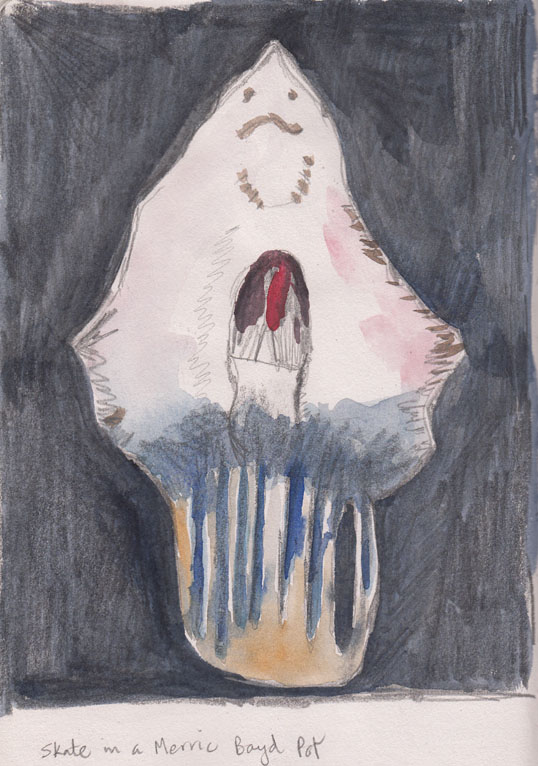
Skate in a Merric boyd Pot, pencil and watercolour, 15 October 2014

Skate in a Merric boyd Pot, pencil and watercolour, 15 October 2014

I spent a lot of time looking at the many examples of drawing displayed throughout the exhibition. Boyd showed the same facility with drafting, as did the young Picasso,  then proceeded to refine and simplify his style as he grew more experienced.

Arthur BOYD | Figure in a fountain with watching figures

Arthur Boyd, Figure in a fountain with watching figures 1944-1949 ink; paper , drawing in pen, brush and black ink 38.0 h x 56.0 w cm, national Gallery of Australia, 1975.3.1381

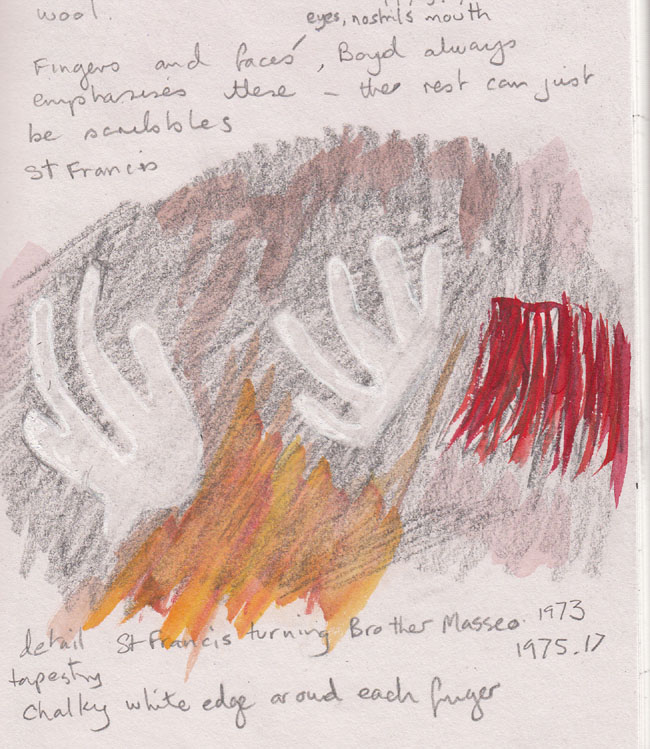
In his later works, the figures emphasise hands and feet, and faces are represented by blots for eyes and nostrils and small lines for mouths. These are no less powerful works for their brief notations. I tried to capture this focus in the quick study of the hands in one of the works in the St Francis tapestry series.

A detail of St Francis Turning Brother Masseo, pencil, eraser and watercolour, 15 October 2014

A detail of St Francis Turning Brother Masseo, pencil, eraser and watercolour, 15 October 2014

This final room is a fitting conclusion to the exhibition, showing nine of the 17 St Francis tapestries, designed by Boyd and superbly woven in Portugal at the Tapapecarias de Portalegre. As you approach, the works appear, glowing, quite literally with the strong colours Boyd used in his pastels, translated into the very large woollen tapestries.

For locals there are still another few weeks to see the exhibition, which runs until 9 November. Don’t be put off by the introduction of paid parking at the National Gallery. Visitors can validate their parking ticket at the cloak desk and will get free parking for 3 hours.