Christmas Flowers

Each year I indulge my childhood memories by buying myself a bunch of New South Wales Christmas Bush (Cerapetalum gummiferum), to display on my festive table. This plant was grown around my family home in Sydney, but is too frost sensitive to last in Canberra’s icy winters – I know I’ve killed two plants already. This year I fleshed out the display with some other Australian daisies, the drumstick-like Billy Button (Crasspedia sp.) and another with chalky whitish green flowers, which I don’t recognise, but I assume is from Western Australia. At the last moment my partner added in a large branch of his Holly Oak (Quercus ilex) which lent quite a dramatic diagonal to the ‘arrangement’.

Once again I was practising my sight measurement and angle checking. I made a light pencil outline then worked, fairly freely over this with my Copic Multiliner.

Initial ink sketch with Copic Multiliner, 29 December 2014

Initial ink sketch with Copic Multiliner, 29 December 2014

I knew I wanted to add watercolour to the drawing so I set out to do this as simply as possible.

A Christmas arrangement, pen and watercolour, 29 December 2014

A Christmas arrangement, pen and watercolour, 29 December 2014

I am pleased with a finished result but again would like to re-visit the subject matter without using a sketch outline. Unfortunately I’ll have to rely, in part, on photos as the Christmas Bush is now way past it’s best.
It’s complicated …

Our second, all singing and dancing family sketching event took place at the footbridge near a local high school. We thought that the dramatic central pylon which suspends the footbridge above the road and the sweeping curve of the bike ramp would make an excellent subject to draw. It does, but it turned out to be rather more difficult than we anticipated.

I started off with a blind drawing, just to get some idea of which section I might draw. I initially picked an area that was fairly complex and included the main ramp, and the stairs off the bridge. By the way, the main structure of the bridge is painted a bright orange colour, (which has upset some of the nearby residents).

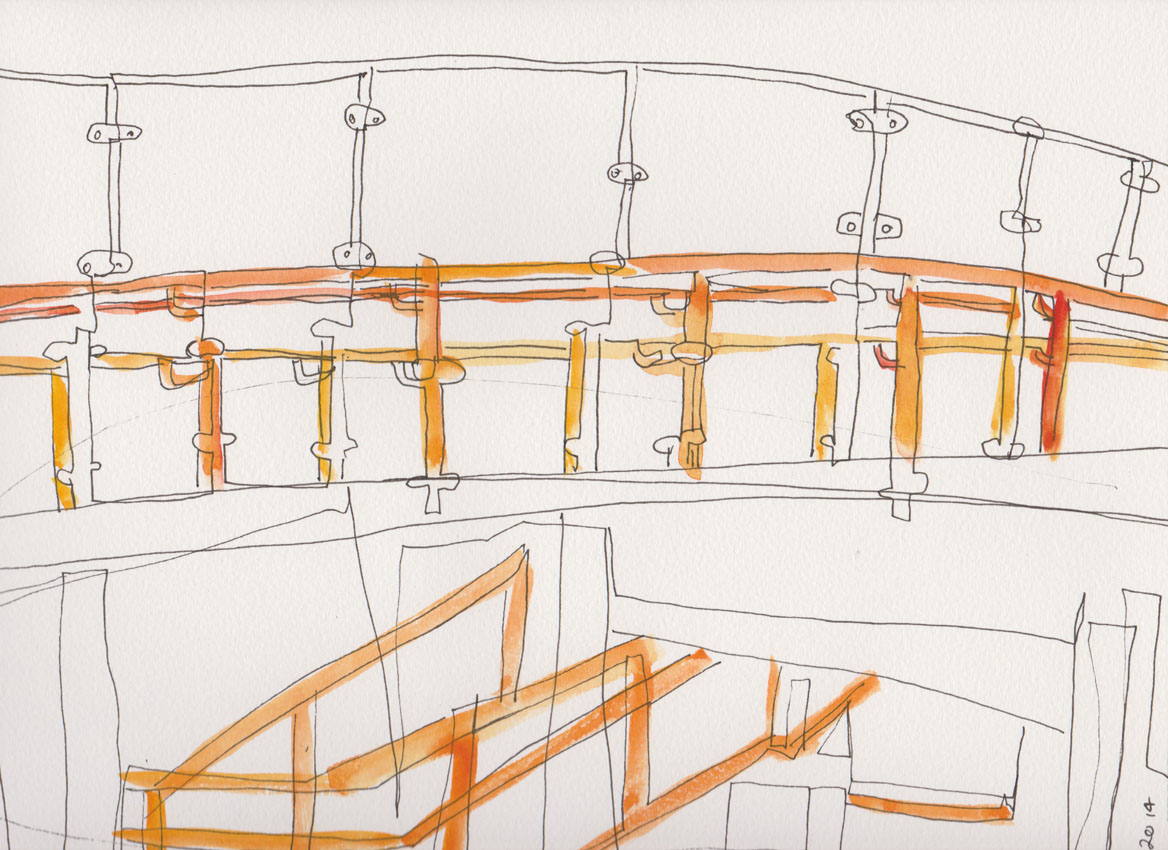
Initial blind drawing, pen and ink as well as using watercolour to indicate some of the different elements of the bridge, 19 December2014

Initial blind drawing, pen and ink as well as using watercolour to indicate some of the different elements of the bridge, 19 December 2014

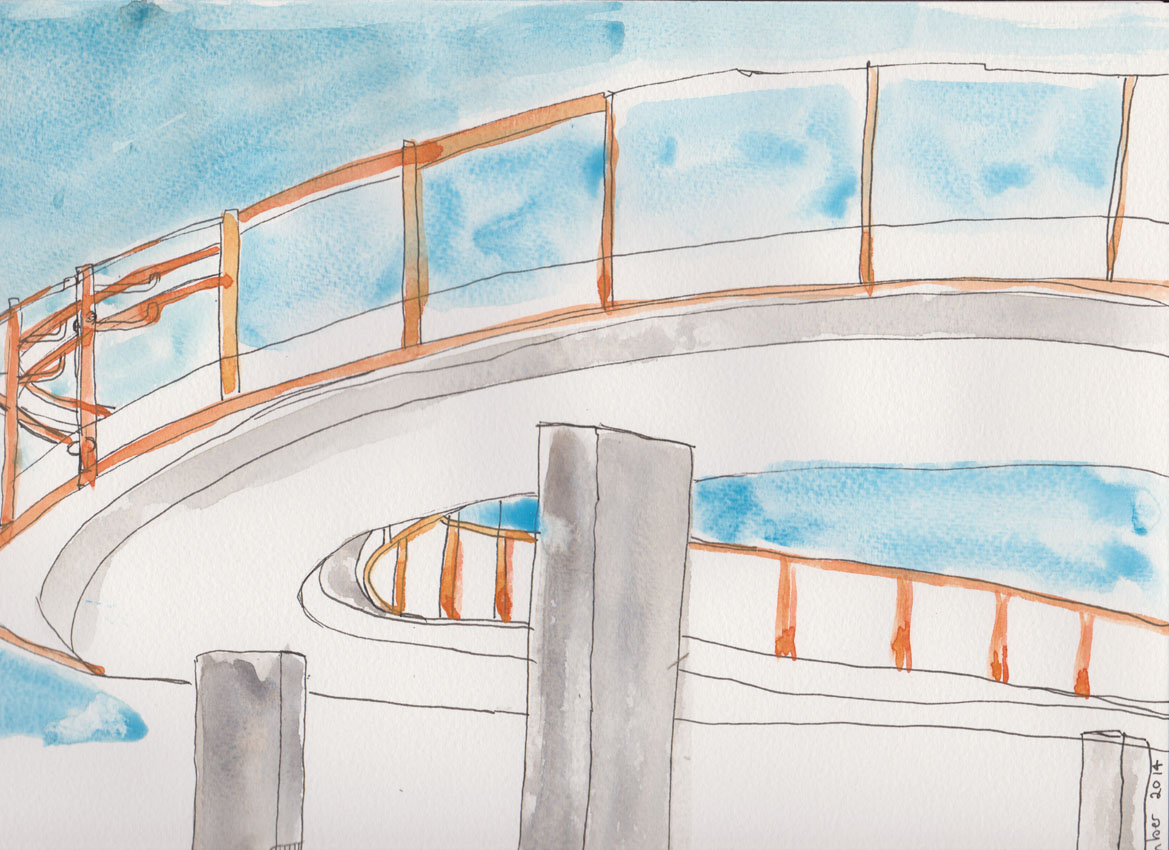
I thought this section was perhaps a bit ambitious for a first attempt, so I switched my attention to the curving bike ramp instead. I was reasonably happy with this until I realised that I was struggling to getting the double hand rail and its’ support structure in the correct position. I added the watercolour as I wanted to keep in mind the silhouette of the ramp against the skyline.

The first go at the bike ramp, Copic Multiliner and watercolour, 19 December 2014

The first go at the bike ramp, Copic Multiliner and watercolour, 19 December 2014

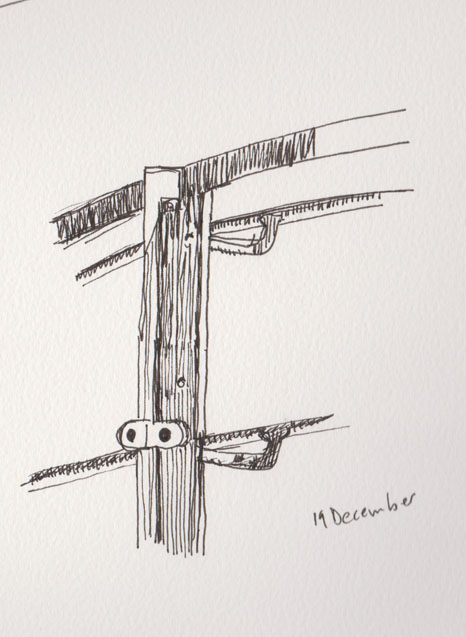
At this stage there was some muttering in the ranks about sketches not quite going to plan and needing to shift position so we were out of the sun. As the happy sketching ambience started to disappear along with the shade I decided to cut my losses and try and work out just how those little support bars hold the hand rails up.

Those little tubes holding the hand rails in place, Copic multiliner,19 December 2014

Those little tubes holding the hand rails in place, Copic multiliner,19 December 2014

By the time I’d managed this small detail there was a big push to return home to a nice cool drink. Ah, happy families!

(In my defence, I will state here that no-one was forced to go sketching against their will, it just seemed like a good idea at the time!)


Profession – artist

“Are you an artist?” was something I often got asked when people saw me sitting , drawing, while I was  in China. It always seemed easier to say yes, than go into some complicated discussion about what I do, but I found it difficult to say this without some vague feeling of being fraudulent. I’ve since realised that I’ve been missing the point completely. The Oxford English Dictionary defines the word ‘profession’ as follows:

“An occupation in which a professional knowledge of some subject, field or science is applied, a vocation or career, especially one that involves prolonged training and a formal qualification.”

And I’m not going to get hung up on the formal qualification bit either. It’s the concept of the application of knowledge combined with prolonged training that chimes with why I even bother to persist with drawing and why I am an artist. I am even more consoled by the words of the great Japanese artist Hokusai who explained:

“From the age of 6 I had a mania for drawing the shapes of things. When I was 50 I had published a universe of designs. But all I have done before the the age of 70 is not worth bothering with. At 75 I’ll have learned something of the pattern of nature, of animals, of plants, of trees, birds, fish and insects. When I am 80 you will see real progress. At 90 I shall have cut my way deeply into the mystery of life itself. At 100, I shall be a marvelous artist. At 110, everything I create; a dot, a line, will jump to life as never before. To all of you who are going to live as long as I do, I promise to keep my word. I am writing this in my old age. I used to call myself Hokusai, but today I sign my self ‘The Old Man Mad About Drawing.”
Hokusai Katsushika

So I will promise to persist and with persistence I will become an even better artist. Hokusai sensei arigato gosaimashita! (Thank you Teacher Hokusai!).

The Orange Ironing Board, 27 November 2014, pen and ink and watercolour

The Orange Ironing Board, 27 November 2014, pen and ink and watercolour


Beijing, the last leg

Beijing has been the final stop on our journey. In a few hours we’ll be flying out of China. It’s been an interesting few days here as the city has been hosting a major international meeting of the APEC group. On the down side we haven’t been able to get to some places in the city due to the security lockdowns, but on the plus side we have had 4 days of glorious blue skies and perfect autumn weather. This is thanks to the local government policy of closing nearby factories and running an odds and even system for cars in the city for the duration of the meeting.
Our tour started with the Temple of Heaven, originally an altar where the emperor prayed for good harvests.
image

The next day we visited along with the rest of the city, or so it seemed, the Forbidden City. The central axis provides gate after impressive gate and hall after massive hall. All the layout is based on the principles of feng shui.
image

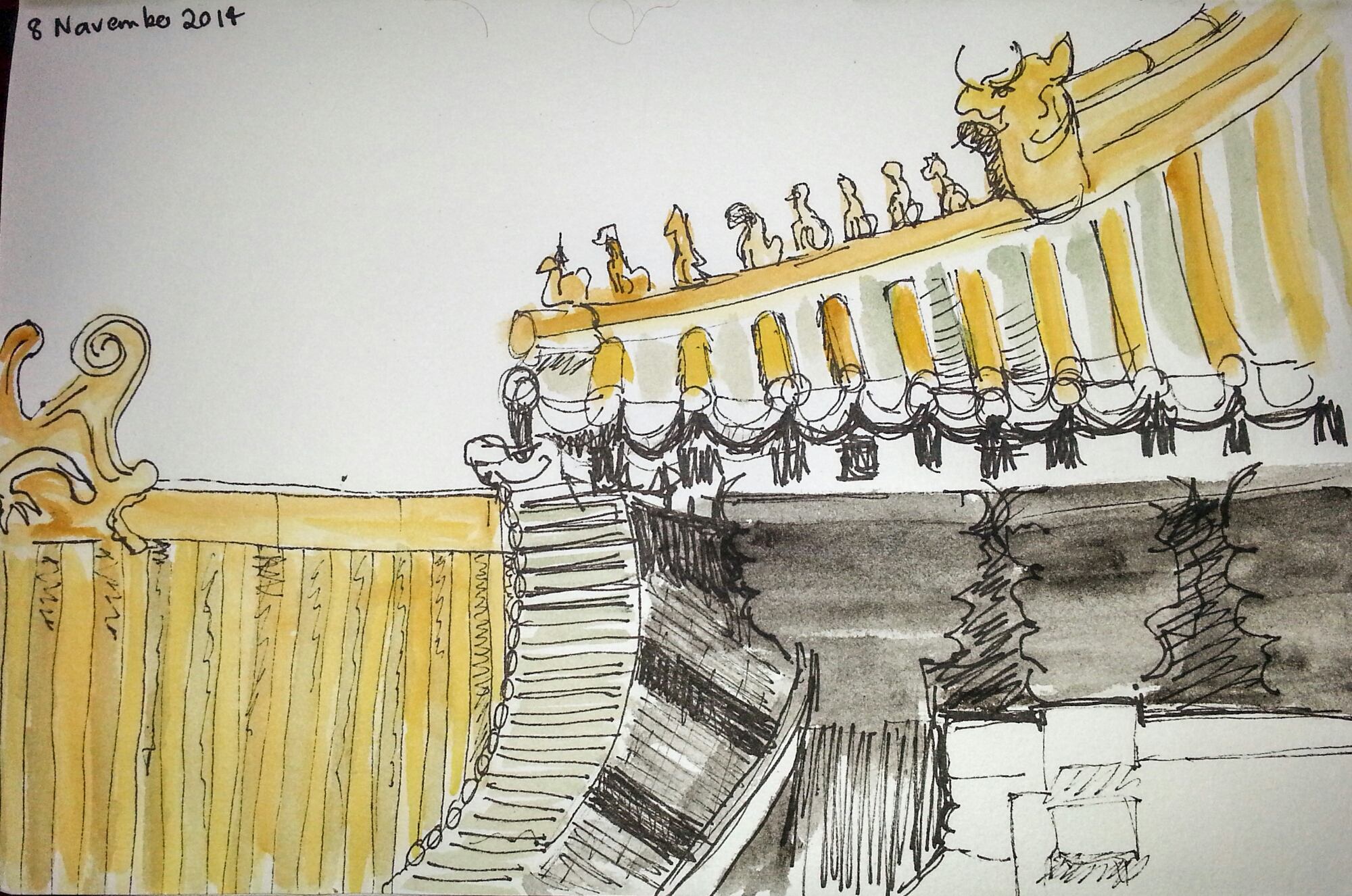
The golden roof tiles are solely used for imperial buildings. These parts of the palace have been heavily restored, which is the approach preferred by the Chinese. However, I quite liked some smaller residential areas where some original furniture and objects could still be seen through the smudgy glass and the paintwork of the buildings at least appeared to be as it was when it was last painted.
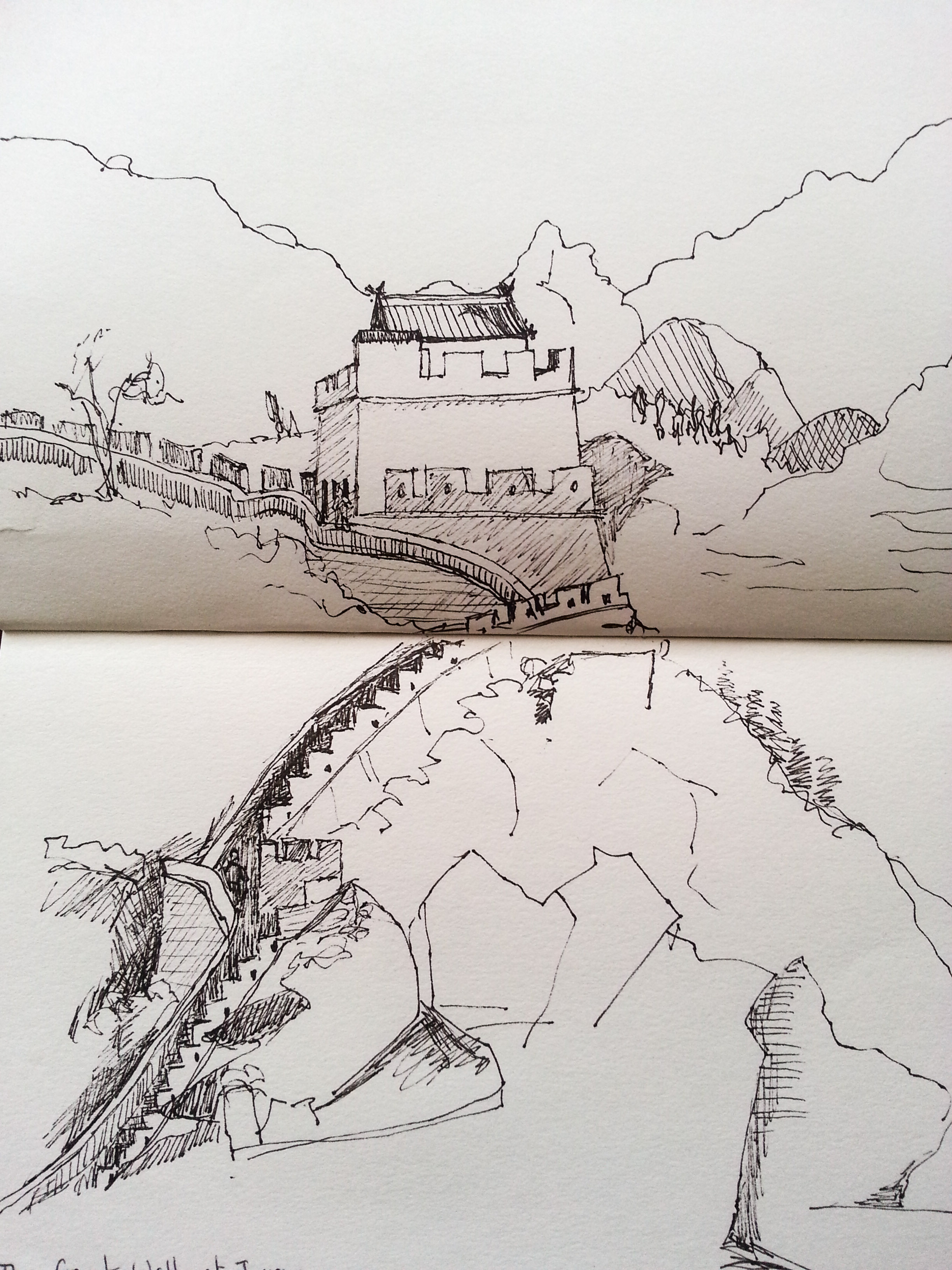
We had the best weather for our trip to the Great Wall. We arrived early and while the hardy types climbed up to the watchtowers I was content to stay at the lower levels and draw.
image

This is what you could see. A seething mass of people scrambling up the uneven steps. This section of the wall at Juyong is more dramatic than the section I had previously visited at Badaling. After restorative hot chocolate I had enough time to make a second drawing of a watchtower on the other side of the valley.
image

While I visited other interesting parts of the city I will leave my sketch diary here. Once I get back home (and tackle the washing) I’ll scan my drawings and set up an album on Flickr. Until then, safe traveling!

Friday morning in the park, Chongqing

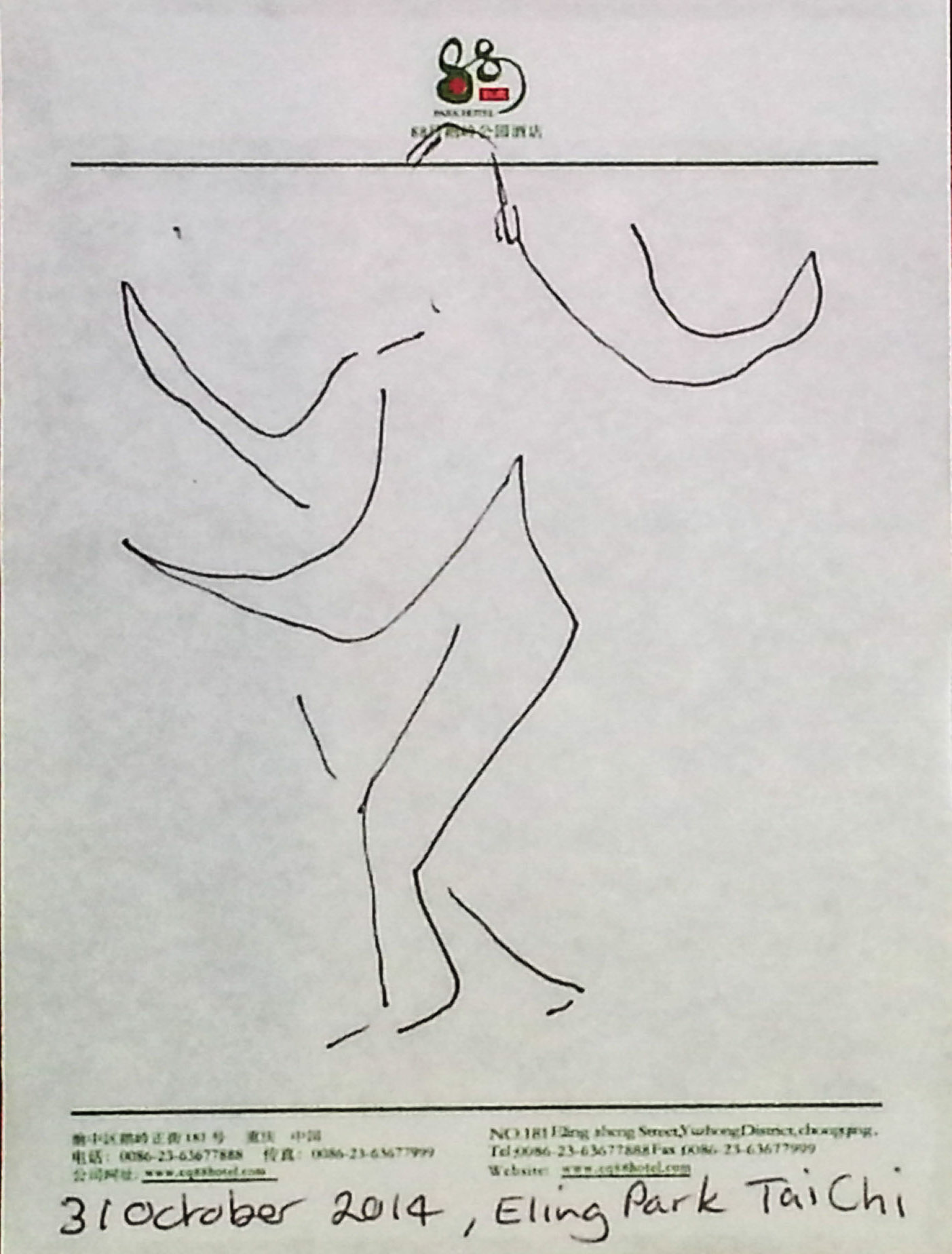
The hotel we stayed in last night is located next to Erling Park, in the Yuzhong District of Chongqing. We walked in the park after breakfast and saw many local people practicing their Tai Chi.
image

It was about this time that I discovered that it’s actually quite difficult to draw people doing Tai Chi. The movements may be slow, but the continual flow is a challenge to capture.
image

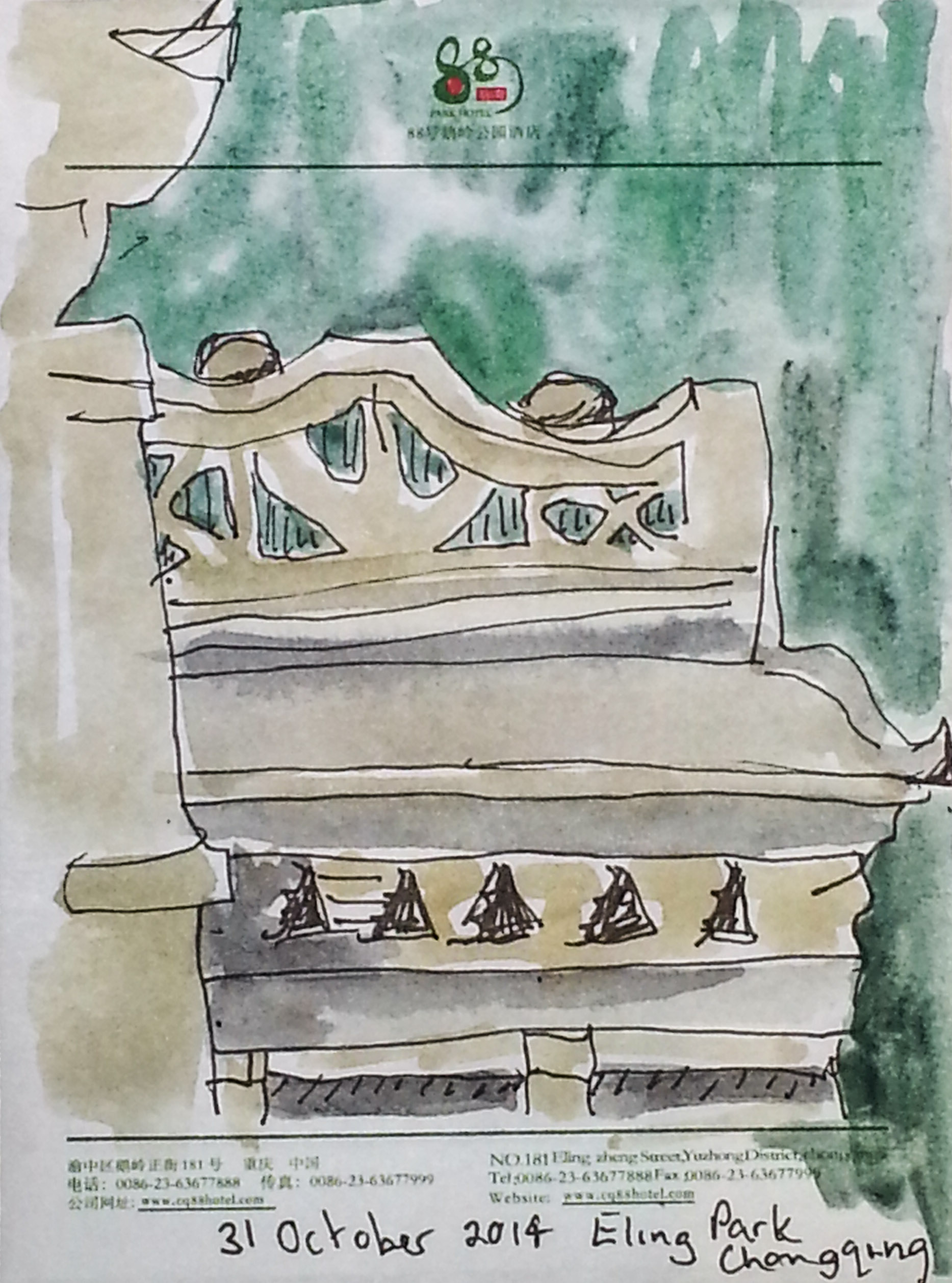
We walked through the park to a section that overlooked the river. The park was originally a private garden and we realised that the viewing platform where in fact the roof of a pavilion. Having descended the stairs we found a beautifully designed building, one small corner of which I’ve captured here.
image

On our way back through the park we saw a beautiful bridge with railings carved to resemble thick ropes and an area of the gardens where old men were ‘airing’ their caged birds in the trees. I could have stayed much longer but we had to catch our bus for our next destination.