Drawing the exhibition: Painter in Paradise

(Warning a very long, rambling post follows)
Away from my usual home turf you can often find me checking out the local art galleries. My home town of Newcastle (NSW) has always been a bit of an arty place and its favourite son for most of the 20th century was Bill Dobell, (or Sir William if you want to be formal). Of course he’s more correctly a Lake Macquarie artist, having lived at Wangi for a fair bit of his life. So its fitting that the Lake Macquarie City Art Gallery has been hosting Painter in Paradise: William Dobell in New Guinea. (For the geographically challenged Lake Macquarie, now a city in its own right, is on the southern outskirts of Newcastle, part of the greater Newcastle area).
I was having a hard time deciding whether to see this show or not. It would be fair to say that while Dobell remains a significant Australian artist of the 20th century, he’s no longer as popular these days as other artists of his era. Dobell certainly figured in my earliest art memories.

Apart from the ubiquitous portrait of HM the Queen, (by William Dargie, the only other portrait I recall hanging in our primary school was Dobell’s 1957 portrait of the poet Dame Mary Gilmore. In high school our teacher took our art class to Sydney on excursion. Two things about that day stick in my mind – the ‘shock’ of recognition when I saw one of Henry Moore’s Helmet Head sculptures in the flesh, (so to speak) at the Art Gallery of NSW and my first visit to a commercial art gallery. At Rudy Komon’s gallery in Paddington I saw, casually leant against the wall, the recently rediscovered Wangi Boy (aka Boy on the Beach). The intense gaze of the boy made quite an impact on me. So I was pre-disposed to visit this exhibition.

The show covers work inspired by Dobell’s two visits to Papua New Guinea in 1949 and 1950. This is a large body of work, covering everything from photographs and sketches to studies and finished paintings. The gallery was full. Dobell is best known for his many strong portraits, thick with gesture and paint, so the delicate miniatures that formed a significant portion of the initial work coming out of these PNG visits came as a surprise to me. They are exquisite. Coming in at 16 x 20 cms their almost enamelled surface and delicately painted lines are a revelation.

image

Another thing that stood out for me was Dobell’s conflation of mythological themes with local culture. He takes a subject, such as local men thatching a roof and transforms it into a mythic undertaking.image

Continue reading →

Fun, fun, fun

I was at the Beach Boys concert Friday night, I’ve turned into such a rabid sketcher that I even took my small sketchbook along. Before the show started I drew some backgrounds in so I only had to add the figures when the time came.

I managed this sketch, from the side of the theatre. The watercolour was added afterwards.

The Beach Boys on stage, pen and ink and added watercolour,13 November 2015

The Beach Boys on stage, pen and ink and added watercolour,13 November 2015

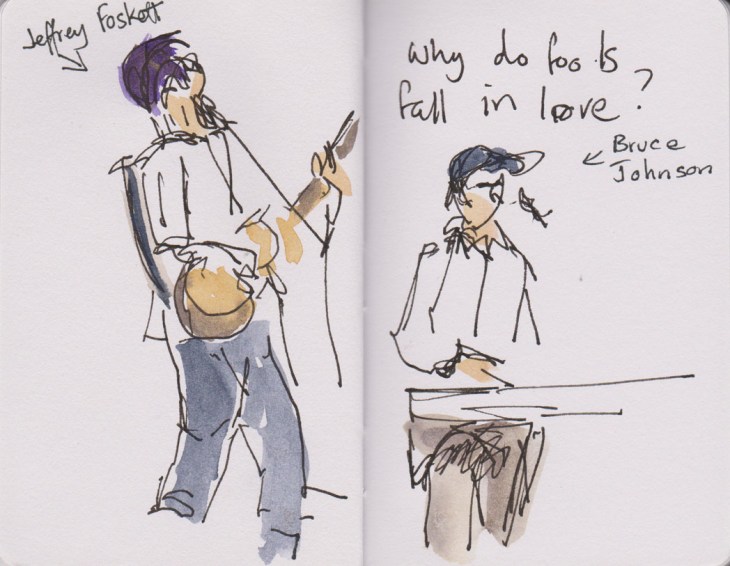
I even managed a second drawing of two of the band, Jeffrey Foskett a band regular and Bruce Johnson, who joined the Beach Boys in 1965.

Beach Boys concert, pen and ink and added watercolour, 13 November 2015

Beach Boys concert, pen and ink and added watercolour, 13 November 2015

So my figures are turned out more ‘stick’ than realistic but hey its hard to dance and draw at the same time.

My biggest regret was that this version of the band doesn’t include Brian Wilson or Alan Jardine – but we had fun nonetheless. The music was great and the musicians were all really good. John Cowsill (of the ’60’s pop group, yes those Cowsills) was a total crazy man on the drums and he’s nearly 60! No time for further drawing I just had to dance for the rest of the concert!

The Big Draw at the NGA

Today was the annual Big Draw event held at the National Gallery of Australia. Several members of Urban Sketchers Canberra met up for the event and joined the crowds. Just inside the front door patrons were serenaded by the Ukelele Republic of Canberra band, singing and playing their way through a wide ranging repertoire.

The Ukulele Republic of Canberra at the National Gallery of Australia, pen and ink, 8 November 2015

The Ukulele Republic of Canberra (most of them), at the National Gallery of Australia, pen and ink, 8 November 2015

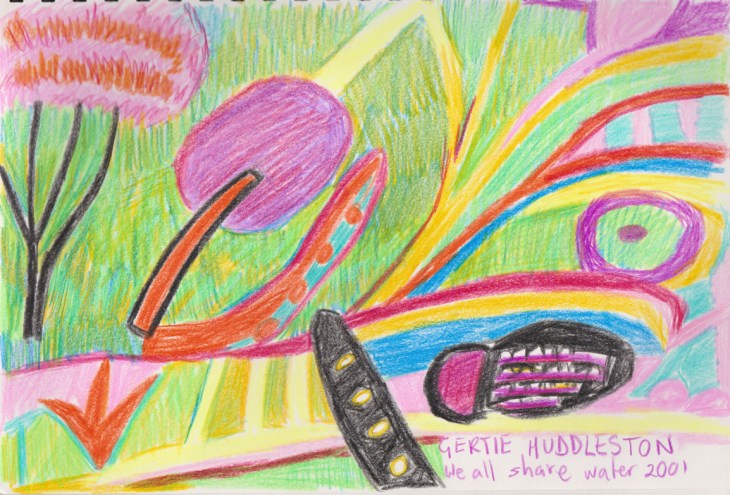
There were eight activities on offer and per usual it was impossible to get around them all in the three hour timeframe. First stop for me was Garden Country, in the Aboriginal and Torres Strait Islander Art section. Here the work of Gertie Huddlestone was used as a starting point for a group work on the floor, or for some of us some individual inspiration.

Sketch after Gertie Huddlestone, We all share water, 2001, coloured pencil

Sketch after Gertie Huddlestone, We all share water, 2001, coloured pencil

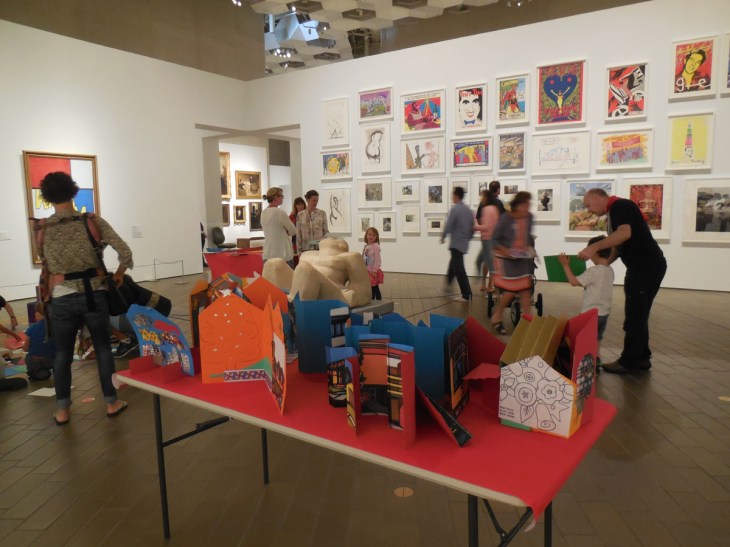
I started to walk through to some other areas of the gallery, stopping to talk to the staff members overseeing other areas such as House and Garden, where some urban houses were being put together.

House and Garden, in the Australian Art section of the Gallery

House and Garden, in the Australian Art section of the Gallery

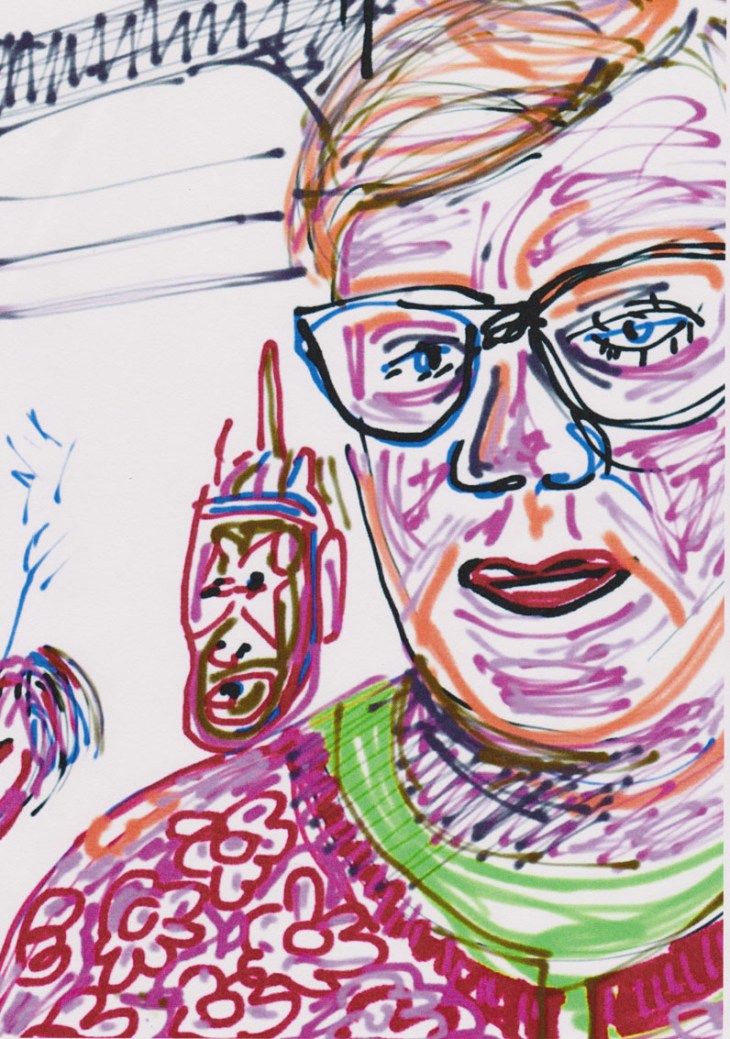
I only managed to get to one other activity before the agreed meet-up time. At Is your face a mask, people were given an I-pad to sketch themselves over a ‘selfie’. This proved to be popular with everyone as you could get a print-out of your efforts at the end.

Self-portrait with masks, I-pad

Self-portrait with masks, I-pad

Our group decided to get together for lunch over at the National Portrait Gallery where the crowds were not so busy. Here are our collective efforts from the morning.

USk Canberra sketches from the Big Draw

USk Canberra sketches from the Big Draw


Portraits of the Famous and Infamous

What a great title for a book – it was used by Rex Nan Kivell (1898-1977), for his self-published encyclopaedia of portraits of those people from the 15th to the 20th century, who had links with Australasia and the Pacific.  A colourful character himself, Nan Kivell collected the portraits that went into the book. He was a major contributor to the collections of the National Library of Australia. At present an exhibition of works related to Nan Kivell’s book is on display in the NLA’s  ‘Treasures’ Gallery.

I took the time while attending a lunchtime talk on the exhibition to practice a bit of portraiture myself, along with capturing some of the faces that appeared on the screen during the talk.

Faces real and projected, pen and ink, 4 November 2015

Faces real and projected, pen and ink, 4 November 2015

Up in the top right-hand corner is Nat Williams, the curator of the exhibition. Below him are Abraham Ortelius, the map maker; Betsey Broughton, survivor of a Maori revenge attack, who lived into her 80’s and is buried about an hour and a half’s drive from Canberra at the charmingly named Bong Bong cemetery. Sydney Spence a close friend of Nan Kivell’s and co-producer of the book and a partially finished sketch of Kalaimanokaho’owaha, a Hawaiian Chief.

Among the anecdotes that Nat shared was, that on being shown a map of Melbourne, Robert-Louis Stevenson said “When I think of Melbourne I vomit”. I can only hope for Melbournians sake that this may be inaccurate. I’ve only just been disabused of the idea that the quote, long attributed to Mark Twain, that “Newcastle [in New South Wales] consists of a long street with a graveyard at one end with no bodies in it, and a gentleman’s club at the other with no gentlemen in it” has neither primary or early secondary sources to attribute it to Twain.

Unfortunately I ran out of time and couldn’t make it to see the exhibition, but it’s on for another month so it will go on the ‘must see’ list.

Drawing the exhibition – Masterpieces from the Hermitage

It’s getting close to the end of the latest Winter Masterpieces show at the National Gallery of Victoria, Masterpieces from the Hermitage, so four of us decided to hop on a plane and head to Melbourne to spend a day with some of Catherine the Great’s collection, now housed at the Hermitage in St Petersburg. Catherine certainly collected a lot of art and other things in her time and lets face it, she had a lot of walls she could fill. So this exhibition is only a small sample of what she owned.

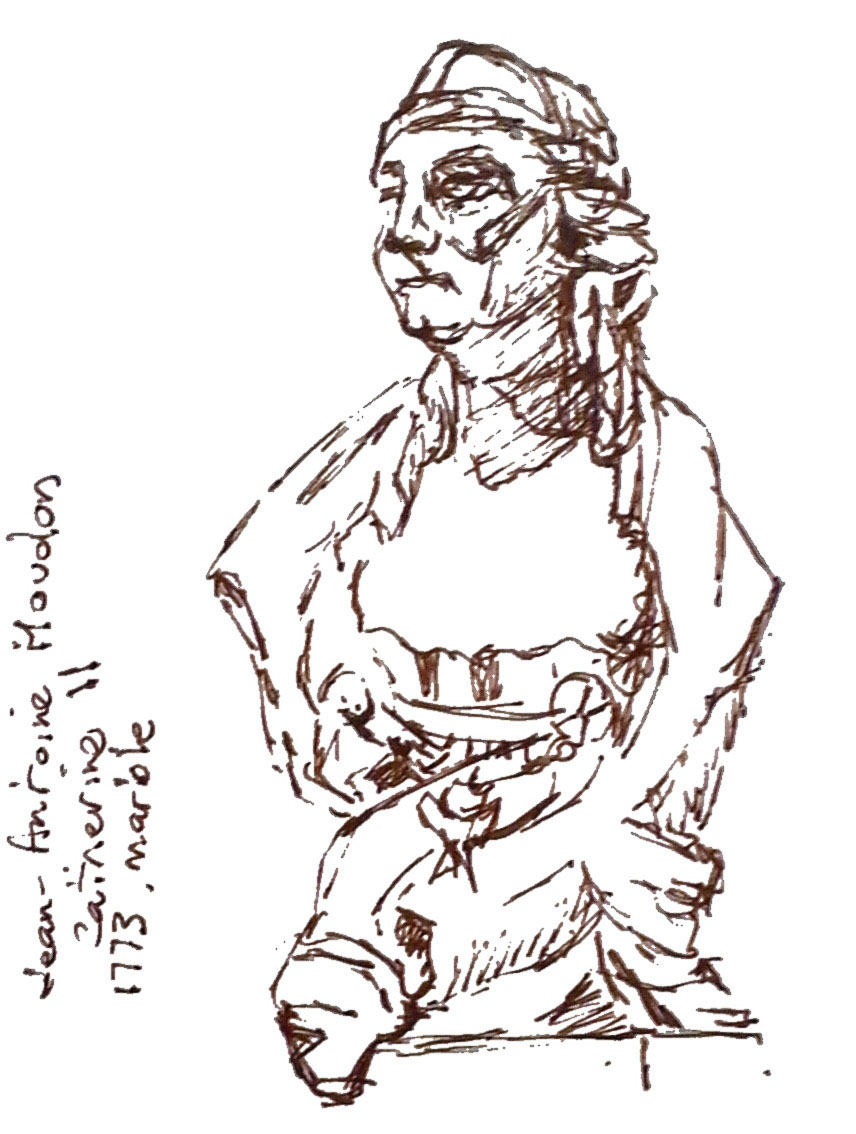
Catherine II (the Great), by Jean-Antoine Houdon, 1773 marble, pen and ink

Catherine II (the Great), by Jean-Antoine Houdon, 1773, marble, my sketch in pen and ink

I’m always interested in what will catch my attention at this type of exhibition and here it was resoundingly the Flemish works and particularly those of Sir Anthony van Dyck. Per usual I chose to draw a number of works in the exhibition. In a situation when you are exposed to so many works of high quality it gives you some space to just sit and ‘be’ with a work, at least somewhat longer than the nominal art gallery average of 10 seconds per painting.

However in my hurry to refill my pens prior to leaving for Melbourne, I accidentally filled them with ink that does not really work with my Lamy,  so apologies in advance for some scratchy pen work.

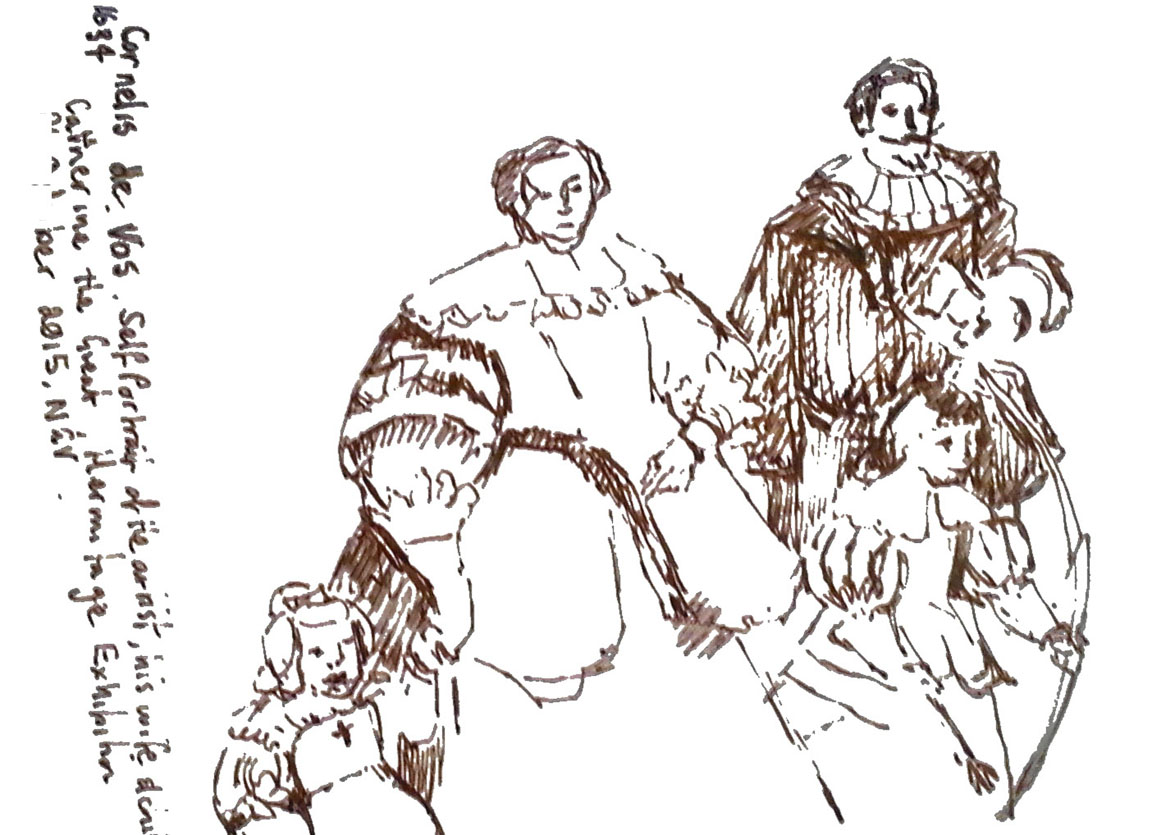
The first work to catch my attention was a family grouping by Cornelis de Vos, Self-portrait of the artist with his wife Suzanne Cock and their children.

Self-portrait of the artist with his wife Suzanne Cock and their children, c1634, oil on canvas, pen and ink

Self-portrait of the artist with his wife Suzanne Cock and their children, c1634, oil on canvas, my sketch in pen and ink

My study doesn’t capture the older children of the family, just the two youngest, one holding a bow and arrow and the youngest on leading reins. In the original the parent’s clothes form large dark masses against which their faces and those of their children are naturally highlighted. From the quality and amount of lace, fine silk and jewellery being worn by the family you get the distinct impression that the art business was good for de Vos. I found his depiction of his young children particularly charming.

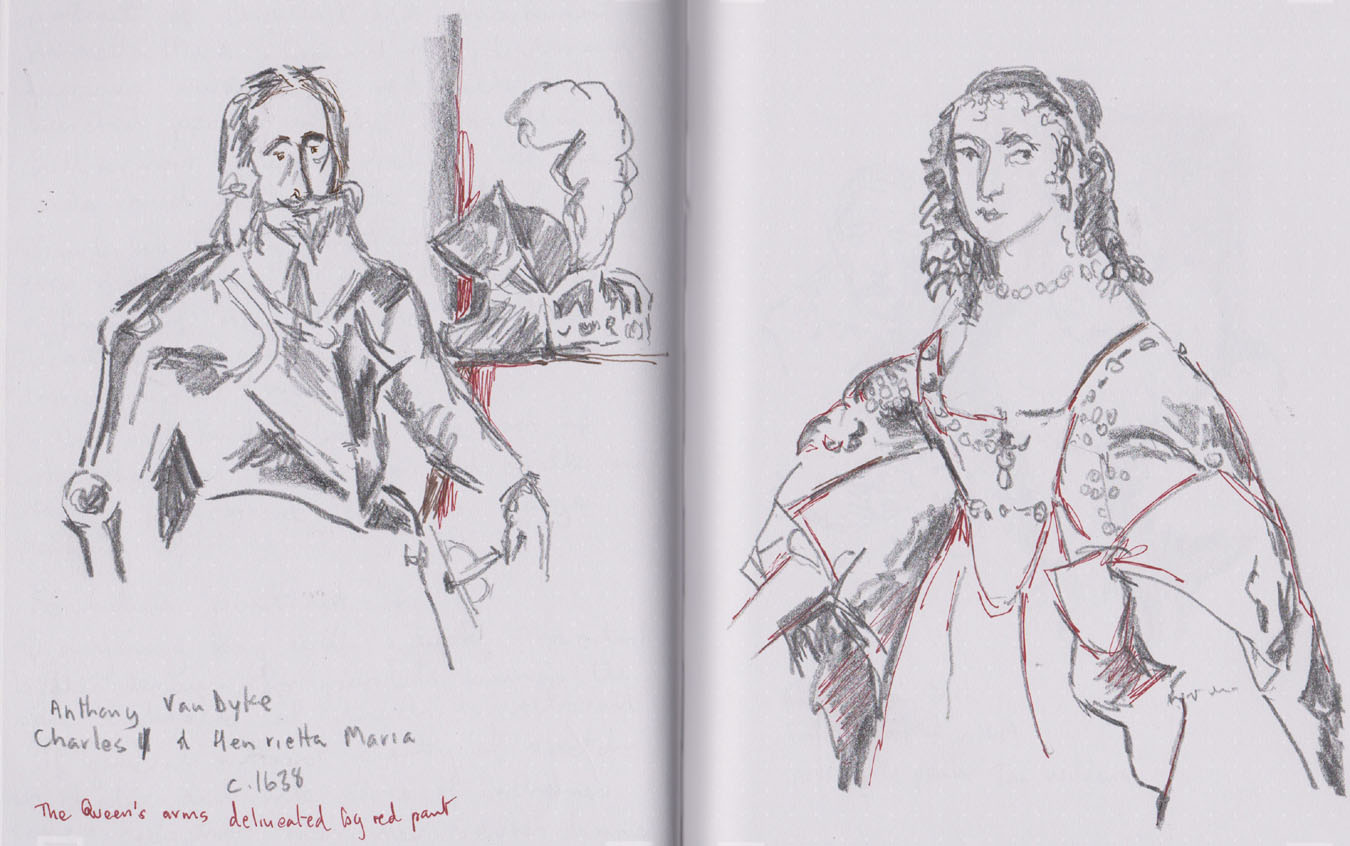
A large leap up the social ladder from the wealthy merchants that de Vos painted are Sir Anthony van Dyck’s paired portraits of Charles I of England and his Queen Henrietta-Maria. At over 2 metres in height they dominated the room they were hung in. The refinement of their faces, the lustre of the armour, silk and pearls made them hard to look away from, as was no doubt intended.

Study of King Charles I and Queen Henrietta-Maria, c 1638, graphite and gel pen

Study of King Charles I and Queen Henrietta-Maria, c 1638, graphite and gel pen

The flattery of van Dyck’s paintings was such that when Sophia, later Electoress of Hanover, first met Queen Henrietta Maria, in exile in Holland in 1641, she wrote: “Van Dyck’s handsome portraits had given me so fine an idea of the beauty of all English ladies, that I was surprised to find that the Queen, who looked so fine in painting, was a small woman raised up on her chair, with long skinny arms and teeth like defence works projecting from her mouth…”

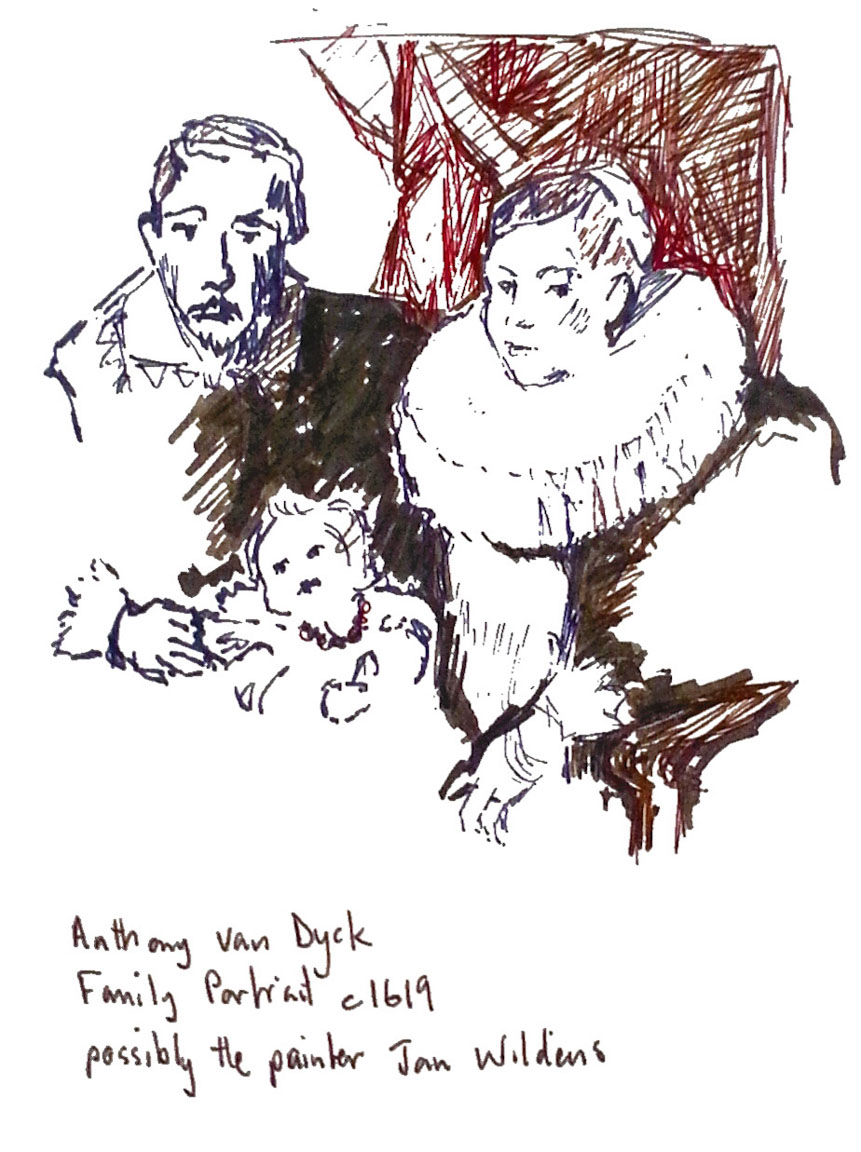
Perhaps truer to life was a smaller portrait that van Dyck made in 1619, the year after he was admitted to the Guild of St Luke as a free master painter. The Family Portrait, is thought to be of another artist, possibly Jan Wildens (in an interesting link, Wilden’s half sister, Suzanne Cock was the wife of Cornelis de Vos). His attractive young wife sits next to him while their young child, sits in his/her father’s lap looking upwards.

Study of Family Portrait, by Anthony van Dyck, pen and ink, brush pen and gel pen

Study of Family Portrait, by Anthony van Dyck, pen and ink, brush pen and gel pen

As you can see from the above study by this time I was resorting to every pen I could find in my bag just to complete the study. I’d spent most of the day in the exhibition, with a break for lunch and I was pretty exhausted. I staggered out of the gallery to have a restorative cup of coffee and lemon curd tart. Since checking up on the details for this post I have realised that there were any number of works I would have liked to go back and study in greater detail and some I managed to miss altogether.

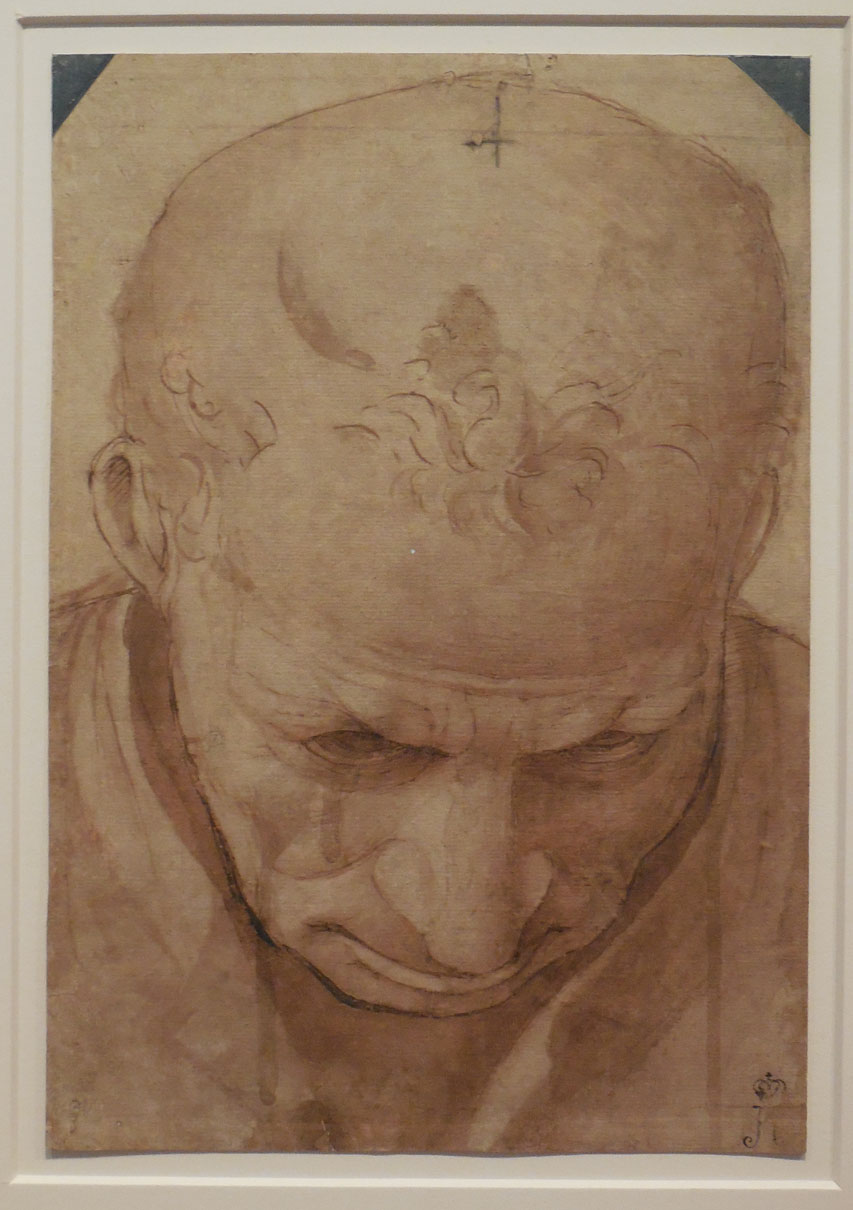
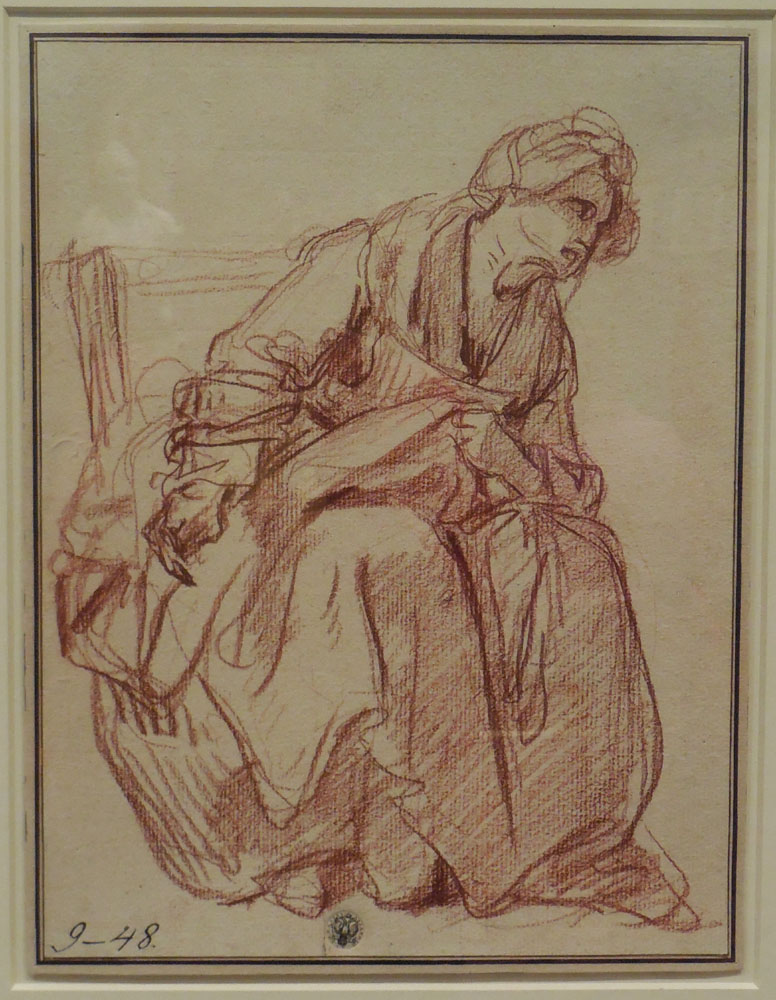
Here are two of the many amazing sketches that also caught my eye on the day.

Luca Signorelli, c1480, study of the head of an elderly man, pen and brown ink and wash, State hermitage Museum, St Petersburg

Luca Signorelli, c1480, study of the head of an elderly man, pen and brown ink and wash, State Hermitage Museum, St Petersburg


Jean-Baptiste Greuze, 1760's, Study of a seated woman (the paralytic's wife), red chalk State hermitage Museum, St Petersburg

Jean-Baptiste Greuze, 1760’s, Study of a seated woman (the paralytic’s wife), red chalk State Hermitage Museum, St Petersburg