Arthur Boyd, Agony and Ecstasy

A major retrospective of Arthur Boyd’s work is currently on show at the National Gallery of Australia. Drawing largely on the donations of work that the artist made to the gallery in 1975, the show includes works in a range of media, from pen and ink, oil, oil and tempera, pastel and tapestry.

With a show of such magnitude I can only touch on a few points I found of interest. Firstly I agree with the friend who commented on the wide range of styles that Boyd employed or reflected over the years. To my mind Boyd’s early works went from reflections of the Heidelberg School (Australian Impressionism), then to a strong influence of the artist Albert Tucker. At the same time his drawings in pen, ink and wash have a decided renaissance feel to them, possibly enhanced by their mythological and biblical themes. By the time he gets to England you can see strong influences of Turner, particularly in his landscapes.

I also felt that the hanging series of work, such as the Nebuchadnezzar paintings and the ‘caged painter’ series, reset my response to many of the individual paintings I had previously seen. The Nebuchadnezzar series, depicts episodes in the wanderings of Nebuchadnezzar and includes quite lyrical works which I was unfamiliar with.

Arthur BOYD | Nebuchadnezzar's dream of the tree

Arthur Boyd, Nebuchadnezzar’s dream of the tree 1969 oil on canvas 174.5 h x 183.0 w cm, National Gallery of Australia, 1975.3.95

My favourite work was an oil, painted in 1979-80, titled A Skate in a Merric Boyd Pot. In this work a skate, an image which Boyd has painted many times, is merged with and is emerging from the type of pot that characterised the work of his father, the studio potter, Merric Boyd.

Skate in a Merric boyd Pot, pencil and watercolour, 15 October 2014

Skate in a Merric boyd Pot, pencil and watercolour, 15 October 2014

I spent a lot of time looking at the many examples of drawing displayed throughout the exhibition. Boyd showed the same facility with drafting, as did the young Picasso,  then proceeded to refine and simplify his style as he grew more experienced.

Arthur BOYD | Figure in a fountain with watching figures

Arthur Boyd, Figure in a fountain with watching figures 1944-1949 ink; paper , drawing in pen, brush and black ink 38.0 h x 56.0 w cm, national Gallery of Australia, 1975.3.1381

In his later works, the figures emphasise hands and feet, and faces are represented by blots for eyes and nostrils and small lines for mouths. These are no less powerful works for their brief notations. I tried to capture this focus in the quick study of the hands in one of the works in the St Francis tapestry series.
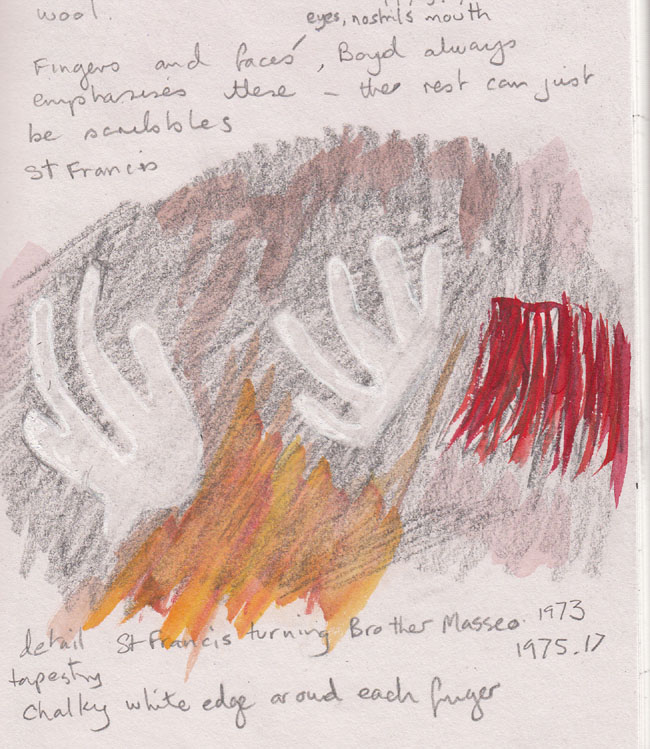
A detail of St Francis Turning Brother Masseo, pencil, eraser and watercolour, 15 October 2014

A detail of St Francis Turning Brother Masseo, pencil, eraser and watercolour, 15 October 2014

This final room is a fitting conclusion to the exhibition, showing nine of the 17 St Francis tapestries, designed by Boyd and superbly woven in Portugal at the Tapapecarias de Portalegre. As you approach, the works appear, glowing, quite literally with the strong colours Boyd used in his pastels, translated into the very large woollen tapestries.

For locals there are still another few weeks to see the exhibition, which runs until 9 November. Don’t be put off by the introduction of paid parking at the National Gallery. Visitors can validate their parking ticket at the cloak desk and will get free parking for 3 hours.
Gods in glass islands

Maybe its a sign of advancing age, but I found myself rather saddened by the display of sacred Polynesian images and objects (atua) in the latest exhibition at the National Gallery of Australia. The quality of the work was so high and as a textile artist I was very impressed by the very finely woven and plaited coconut fibre used in many works. But… Each atua sat on it’s little plinth, mostly is glass boxes, arranged by island group in a sad mockery of the vast Pacific Ocean they came from. While I was in awe of the carving skills displayed in these atua I just kept thinking that they wanted only to be returned to their marae (sacred enclosures). I struggled to feel comfortable drawing them, which was why I went to the exhibition in the first place.

In the end I made these two sketches.

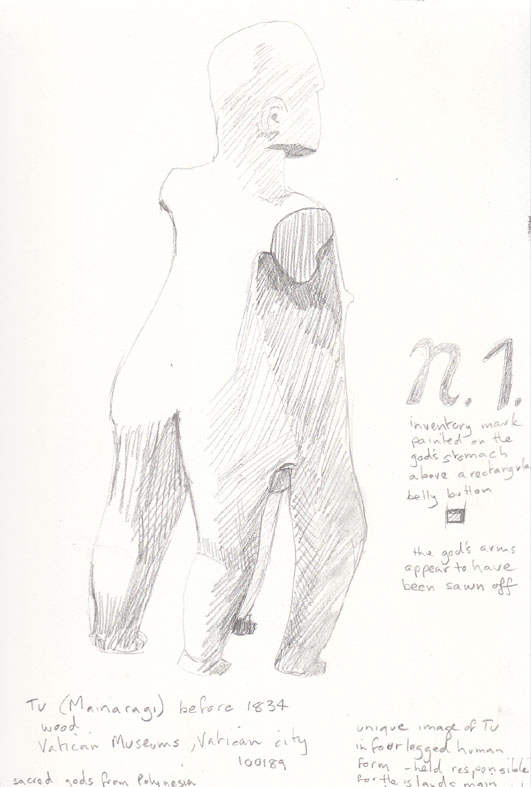
The atua Tu, from the island of Mainaragi. Tu was responsible for the island's main food source, the breadfruit.

The atua Tu, from the island of Mainaragi, before 1834. Tu was the atua responsible for the island’s main food source, the breadfruit.

The large N1 on my page is, what I assume to be an inventory mark painted on the atua’s stomach. This piece is in the collection of the Vatican Museum. I think it is a horrible thing that this sacred image is held by a religious organisation that was/is antipathetical to the island’s religions.

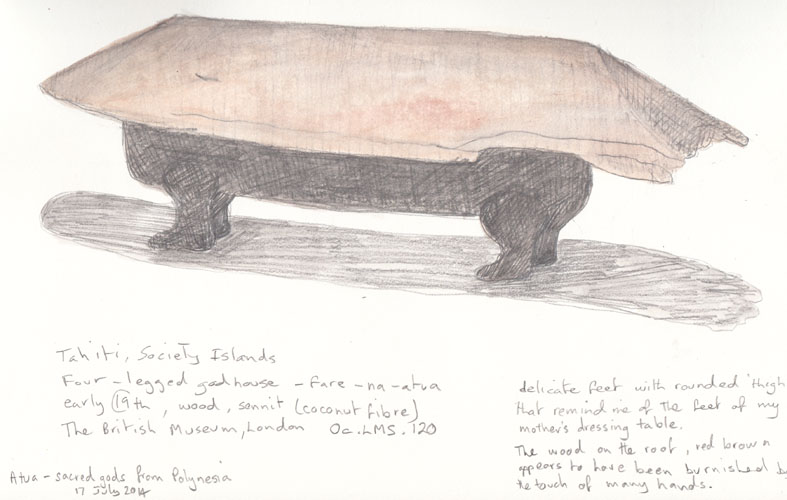
Fare-no-atua (a god house), early 19th century, wood and coconut fibre.

Fare-no-atua (a god house), Tahiti, early 19th century, wood and coconut fibre.

I loved seeing the burnished surface of the wood of this piece. It looked as though many hands had touched it’s surface over a long period of time. This piece is in the collection of the British Museum. I added the colour after I left the gallery.

Moche ceramics

I have a season pass to the Gold and the Incas exhibition, at the National Gallery of Australia. I like being able to spend time having a good look at one or two individual works in detail. I do this by drawing them. However drawing is proving very challenging in the low-light conditions in the exhibition. For a lot of the time while I was making these drawings  I couldn’t actually see the tip of my pencil on the page.

This visit I drew two ‘stirrup’ vases, (they get their name from the shape of the handle), although this is clearly not what their makers, the Moche people called them* because stirrups were not introduced into South America until the Spanish invasion, some 800 years after these pots had been made. Both of these works come from the Museo Larco, in Lima, Peru. Some highlights of the Museum ‘s collection are also accessible through the Google Art Project, which is both in English and Spanish.

Most striking in the vases on display are the portrait vases, where faces are deftly sculpted in the round and painted in strong colours.

Moche vase, portrait head, 100-800 AD, ceramic, from the collection of the Museo Larco, Lima, Peru ML000267.

Moche vase, portrait head, 100-800 AD, ceramic, from the collection of the Museo Larco, Lima, Peru ML000267.

I also made a second drawing of another Moche pot in the shape of four pepinos. The symbolism of the four melons is believed to be related to the four cardinal directions.

Moche culture, vase in the form of Pepinos, ceramic, from the collection of the Museo Larco, Lima, Peru ML006659.

Moche culture, vase in the form of Pepinos, ceramic, from the collection of the Museo Larco, Lima, Peru ML006659.

I particularly enjoy the colours used on these pots so once I got home I scanned and printed out the pictures I had drawn and then I indulged myself with a bit of good old-fashioned colouring in.

Moche pot with pepinos, 24 March 2014 watercolour.

Moche pot with pepinos, 24 March 2014 watercolour.

The coloured stripes on the face in the next image are not shadows. The face actually has two colours, umber on one side and a burnt sienna on the other, painted over the glazed terracotta and provide evidence of painted facial decoration.

Moche portrait pot, 24 March 2014, watercolour.

Moche portrait pot, 24 March 2014, watercolour.

*Actually the Moche pots are referred to as pacchas in the exhibition catalogue. These are ritual objects, also made in materials other than ceramics, which generally consist of a form that conducts or conduits liquid through them. These vessels were used in life and were also buried with the dead. Their symbolism is related to the connection between the exterior and interior ‘worlds’ that meet during rituals and at the moment of death.

Dancing Shiva

The statue of Shiva, Lord of the Dance (Nataraja) at the National Gallery of Australia (NGA), has been danced into a controversy with what appear to be convincing allegations that the statue was stolen from a temple in Tamil Nadu, India. The allegations have also contributed to the resignation of the Director of the Gallery, Mr Ron Radford.

So with heightened interest I took the opportunity to make a ‘blind drawing’ of the statue while visiting the NGA today.

Shiva as Lord of the Dance (Nataraja), 11th-12th century, bronze, National Gallery of Australia (well for now anyway), 24 March 2014.

Shiva as Lord of the Dance (Nataraja), 11th-12th century AD, bronze, National Gallery of Australia (well for now anyway), 24 March 2014.

This truly is an amazing work of art and devotion. The more I studied the statue the more the slender limbs came into focus. On each of the arms and legs bracelets and anklets adorned the moving figure.

Shiva's raised foot, drawn from the rear of the sculpture, 24 March 2014.

Shiva’s raised foot, drawn from the rear of the sculpture, 24 March 2014.

This is a work that clearly evokes deep feelings, even in people from outside of its originating culture, so to consider the negative impact of its theft from a place of worship is disquieting to say the least. I strongly feel that the statue should be repatriated as a matter of urgency.

UPDATE

Only two days after I drew the Shiva Nataraja at the National Gallery of Australia, the sculpture has been removed from display. This follows the Australian government receiving a formal request from the government of India for the return of the statue. The ABC TV program Four Corners on Monday also aired  a program looking at the case of this sculpture and raising doubts over the purchase of a number of other works by  both the NGA and the Art Gallery of New south Wales from the same dealer. The dealer is currently under arrest in India.

Gold and the Incas

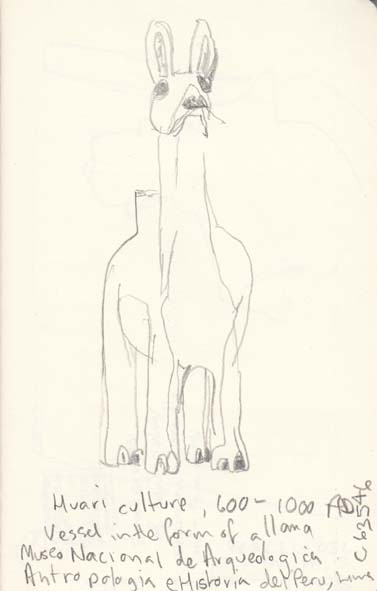
I love going to the National Gallery of Australia on New Year’s Day. It’s not too crowded and I think that looking at art is a fine way to get the year off to a good start. This was my first visit to see the latest NGA ‘blockbuster’ show Gold and the Incas. The subtitle, the Lost Worlds of Peru, gives a far more accurate summary of what’s on display. Yes there is a lot of gold, not to mention silver and precious stones on display, but to my eye it is the masterpieces of ceramics and textiles that are the outstanding elements of the exhibition. And BTW there’s not much from the Incas because the conquistadores nicked or melted down most of the good stuff. What is on show are artefacts from a number of cultures that existed in what is present day Peru, most of whom none of us has ever heard of.

A Huari vessel in the shape of a llama, 67 cm high, 600-1,000AD.

A Huari vessel in the shape of a llama, 67 cm high, 600-1,000AD.

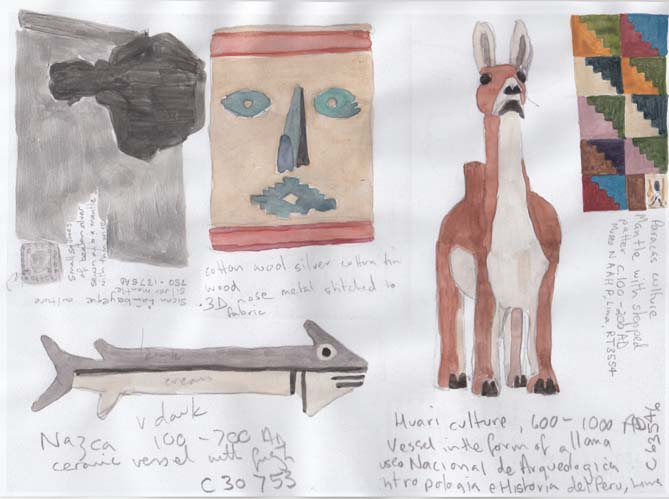
The lighting is kept very low in most of the rooms so doing drawings was a challenge. There  were also not many benches where you could sit to draw. Gallery rules allow for only the use of pencil and paper so most of my efforts were limited to quick sketches and taking notes for future reference. I subsequently decided to make a composite image of my drawings and then add colour to give some idea of what we saw.

Composite image of my sketches of 1 January 2014, with added watercolour and acrylic.

Composite image of my sketches of 1 January 2014, with added watercolour and acrylic.

Apart from the llama and the face mask most of the other sketches are just parts of larger objects. In case you were wondering about the strange grey and black blob on the left hand side it is actually a person silhouetted against a large cloak that is covered in squares of beaten silver. People, including myself, seemed to be quite transfixed by this piece and often stood still long enough for me to draw them. The burial mask illustrated above also has an interesting provenance as it is one of the items of ‘tribal art’ that was collected by the Surrealist artist Max Ernst. The NGA purchased Ernst’s collection in 1985.

Having made my initial sortie I plan to go back and try to selectively draw some of the other works on display. This exhibition runs until 21 April 2014.