Taking two lines for a walk

When I was at the library yesterday I found two drawing books that looked interesting. The one I want to touch on today is Drawing Projects: an exploration of the language of drawing, by Mick Maslen and Jack Southern (Black Dog Publishing 2011).

Drawing Projects by Mick Maslen and Jack Southern

Drawing Projects by Mick Maslen and Jack Southern

A quick first look through the book had me very excited. The book covers a wide range of drawing styles and suggests a variety of approaches to developing your own drawing techniques. Between reading the introductory sections, looking at the artist profiles and trying out the suggested projects I know that I won’t be able to take it all in within the loan period, so I’ve ordered a copy of my own.

I was immediately inspired to try the first project, drawing with two pens. The idea is to bind two pencils (of different hardness) together and with them draw a single object/person/self-portrait.  I admit that I went pretty much to my own version of the project rather than following the method precisely. This meant that I missed out on one of the prime aims of this project which is to get you making marks on the inside of the form and break the habit of “using line to draw the outer contour line first.”  I did at least manage the other purpose of the exercise, to wit, making interesting and varied marks. My first drawing was made with my Lamy Safari pen and a ballpoint pen that was just lying around, bound together.

My Cat, pen and ink and ball point pen, 18cm x 14 cm, 19 January 2014

My Cat, pen and ink and ball point pen, bound together, 18cm x 14 cm, 19 January 2014

I’m mentioning the size of the drawings because the book suggests that you limit this project to something no bigger than 30 cm. My initial reaction is that I would like to use this technique on a much larger scale where I think that the lines would be very beautiful, while the technique would be less obvious from a distance away. At this smaller scale it seems to easy to lose sight of your subject.

I had so much fun with the first drawing that I decided to use the same approach when I was at the cafe this morning. This time I used my Copic Multiliner and a Pitt Artist pen (Sanguine 188), held together in my hand as I had nothing to bind them with.
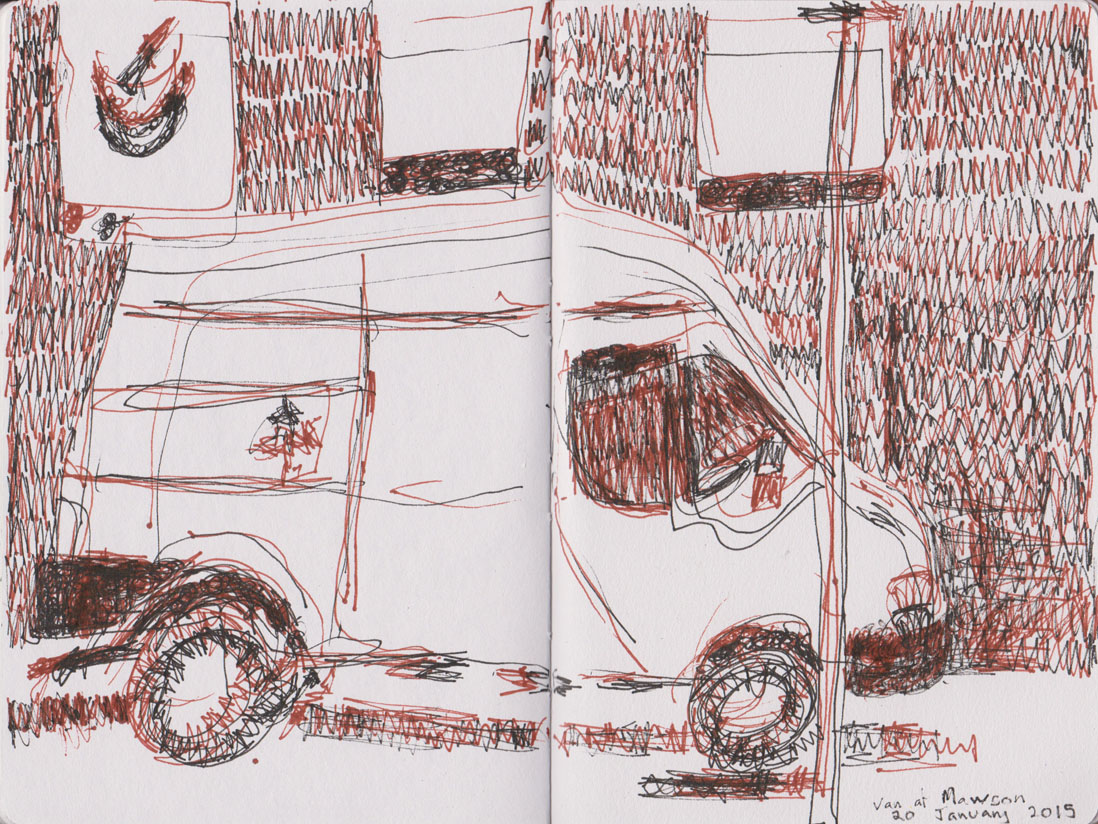
Van,  Copic Multiliner and Pitt artist pen, held together, 21 cm x 28 cm, 20 January 2015

Van, Copic Multiliner and Pitt artist pen, held together, 21 cm x 28 cm, 20 January 2015

What stands out for me in this drawing are the lovely loose lines in the body of the van. While I’ve achieved a good contrast between the van and the background, the background marks are all a bit same-y. It may have been a more interesting drawing if I varied those marks a bit more.

I couldn’t resist yet another drawing when, on my way home, I saw nearby Mt Tennant, with a cap of low cloud over it’s peak and the scar from the landslide in 2012, still visible. I chose to use two watercolour pencils held together. I varied the colours, between Faber-Castell Cold Grey V-234 and Cool Grey VI-235 with Derwent Watercolour Prussian Blue 35, Blue Grey 68 and Rexel Cumberland Derwent watercolour 17.
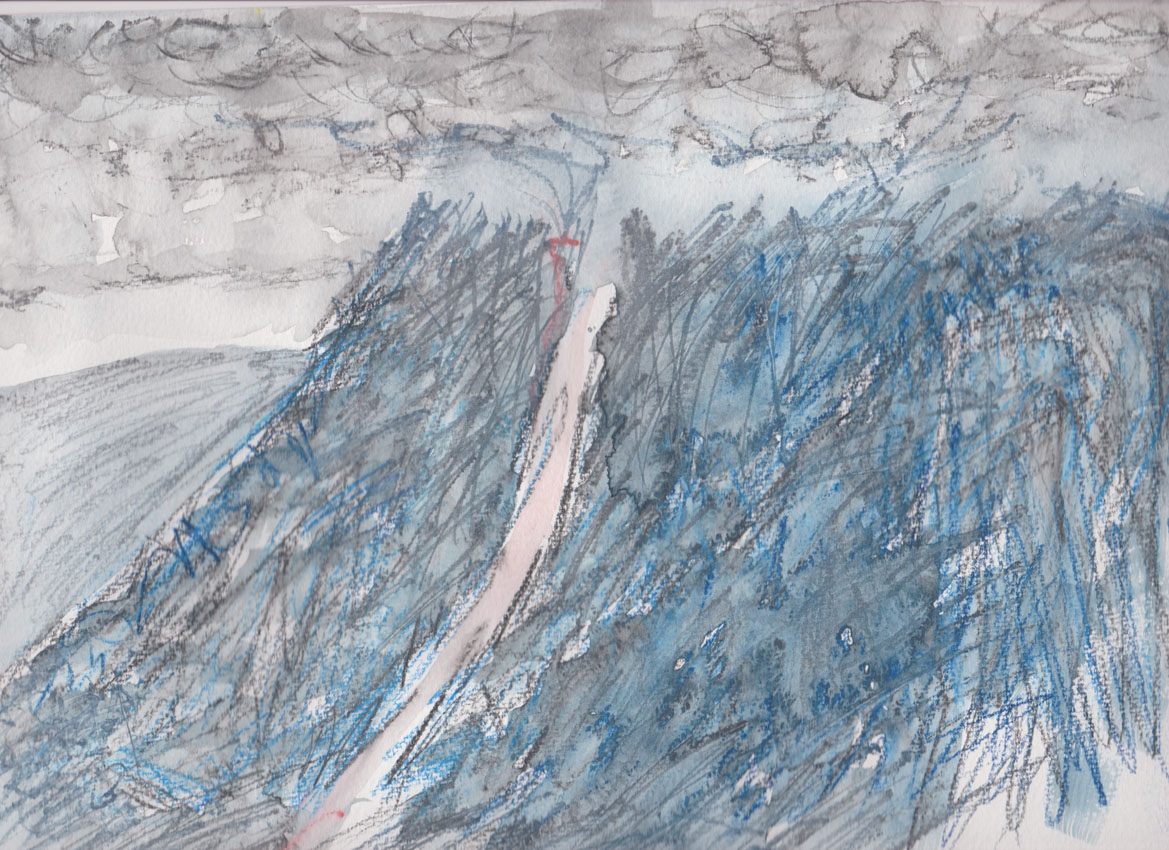
Mt Tennant under low cloud, watercolour pencils, held together, 24 cm x 32 cm on Canson Montval, 200gsm, watercolour block, 20 January 2015

Mt Tennant under low cloud, watercolour pencils, held together, 24 cm x 32 cm on Canson Montval, 200gsm, watercolour block, 20 January 2015

I think this last drawing is the least successful of the three, perhaps because the marks I made were too similar in style and lacked the contrast of the previous drawings, where I used two different types of pens. See I’m learning already.
 

Draped

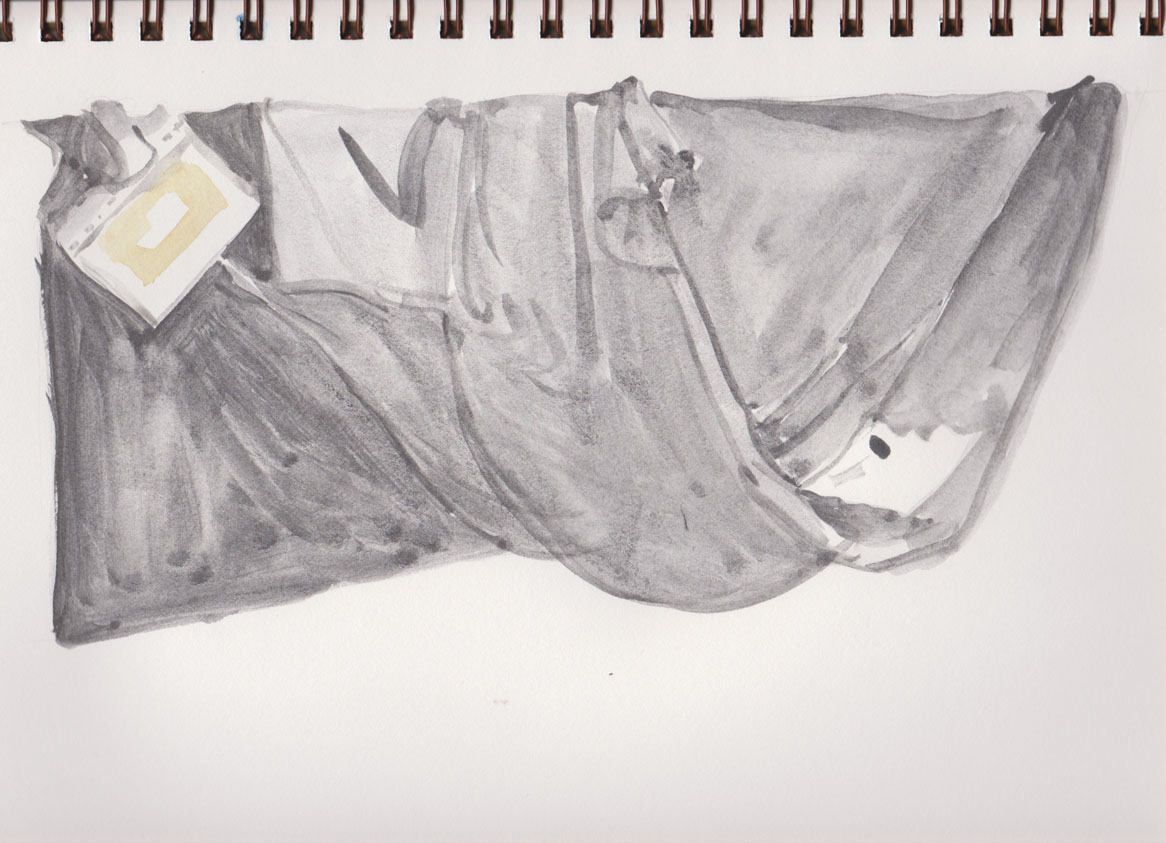
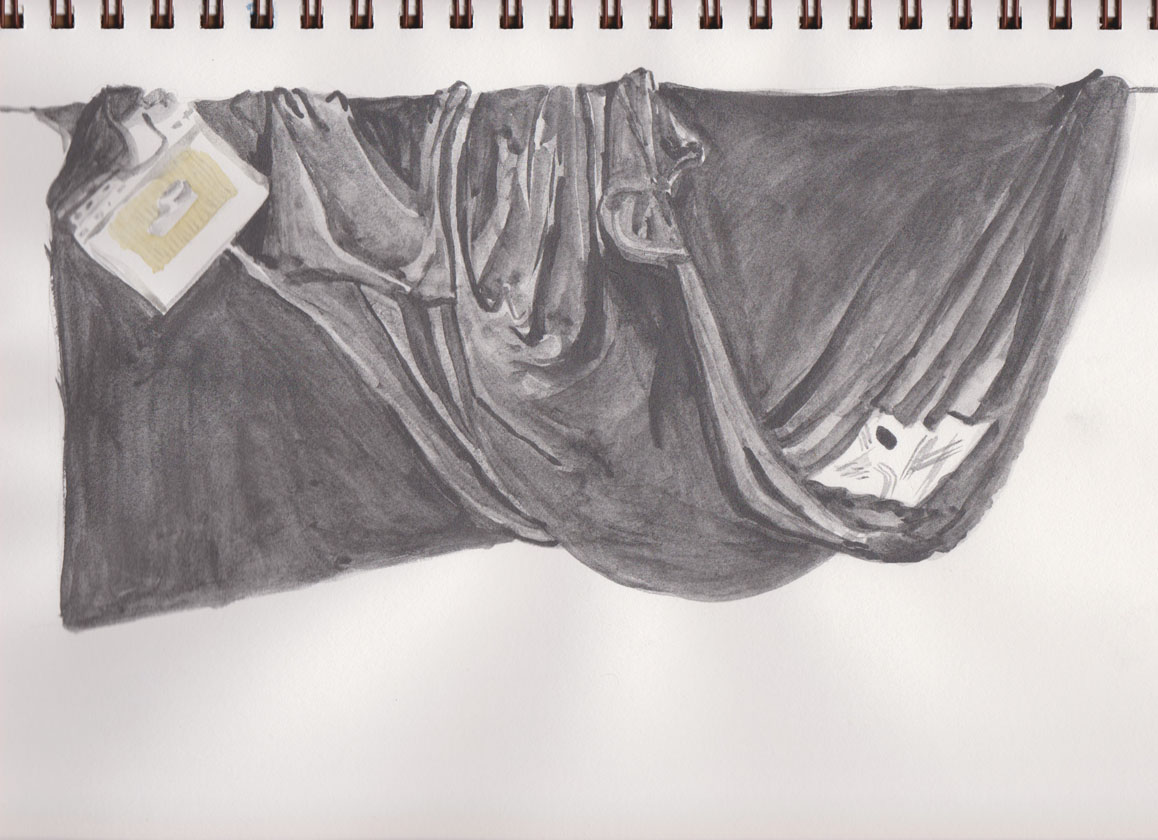
Today I got to play, at last, with my newest sketching ‘toy’, a tin of Art Graf watercolour  graphite. And I think I’m in luuurve. I first heard about this product over at parkablogs review. He suggested using this for tonal studies and I had the perfect subject – the dark cloth that I use to hang my works in progress on. We’d hung the cloth up out of the way so we could get a light background behind the vase of Christmas flowers that we were painting (more of that later), those drapes just begged to be painted.

After an initial pencil outline I just started laying in the graphite, working with fairly light washes to start off with.

Some light washes get the shaping underway, Art Graf water soluble graphite

Some light washes get the shaping underway, Art Graf water soluble graphite

It’s quite easy to build up the layers, allowing it to dry in between. I was pleasantly surprised that I could use the graphite directly from the tin onto the page as it was fairly easy to get the tone I was after by controlling the amount of water on my brush. Here is the result after a number of layers.

Final version of the tonal drapery study, Art Graf soluble graphite, 30 December 2014

Final version of the tonal drapery study, Art Graf soluble graphite, 30 December 2014

Parkablogs suggests mixing the graphite separately on a palette to get an even tone. I personally like the texture the graphite can leave on the page. There are also possibilities for getting interesting textures from a dry-er brush application which I plan to explore in due course. He also suggests using a fixative on the final work and while  I didn’t notice any obvious smudging on my page this seems to be a sensible precaution.

Another aspect I’m interested in exploring is the interaction between the watersoluble graphite and watercolours. I’ve only made the most basic samples so far, but I do like that the graphite keeps it’s line over damp watercolour, see the sample on the left. The graphite only seems to move easily when it crosses another area of still wet graphite, see sample on the right.

Watersoluble graphite over watercolour, 30 December 2014

Watersoluble graphite over watercolour, 30 December 2014

Obviously there is lots more to explore with this medium. If you are a fan of watercolour you may also enjoy using this product. You can buy a tin of Art Graf in either 20 or 60gram sizes. I sourced my Art Graf through Eckersley’s (for Aussie sketchers) and I presume it’s readily available in Europe as it is made in Portugal.

Treading the fine line

Using my Copic Multiliner pen, is certainly influencing my drawing style. With such a fine line I’m inclined to spend more time putting in detail, which in this drawing meant that I took far too long capturing the people and spent too much time working on the background. *Message to self – people first and background later.

Friday lunchtime, friends picnicing at Green Square, Kingston ACT, Copic marker, 5 December 2014.

Friday lunchtime, friends picnicing at Green Square, Kingston ACT, Copic marker, 5 December 2014.

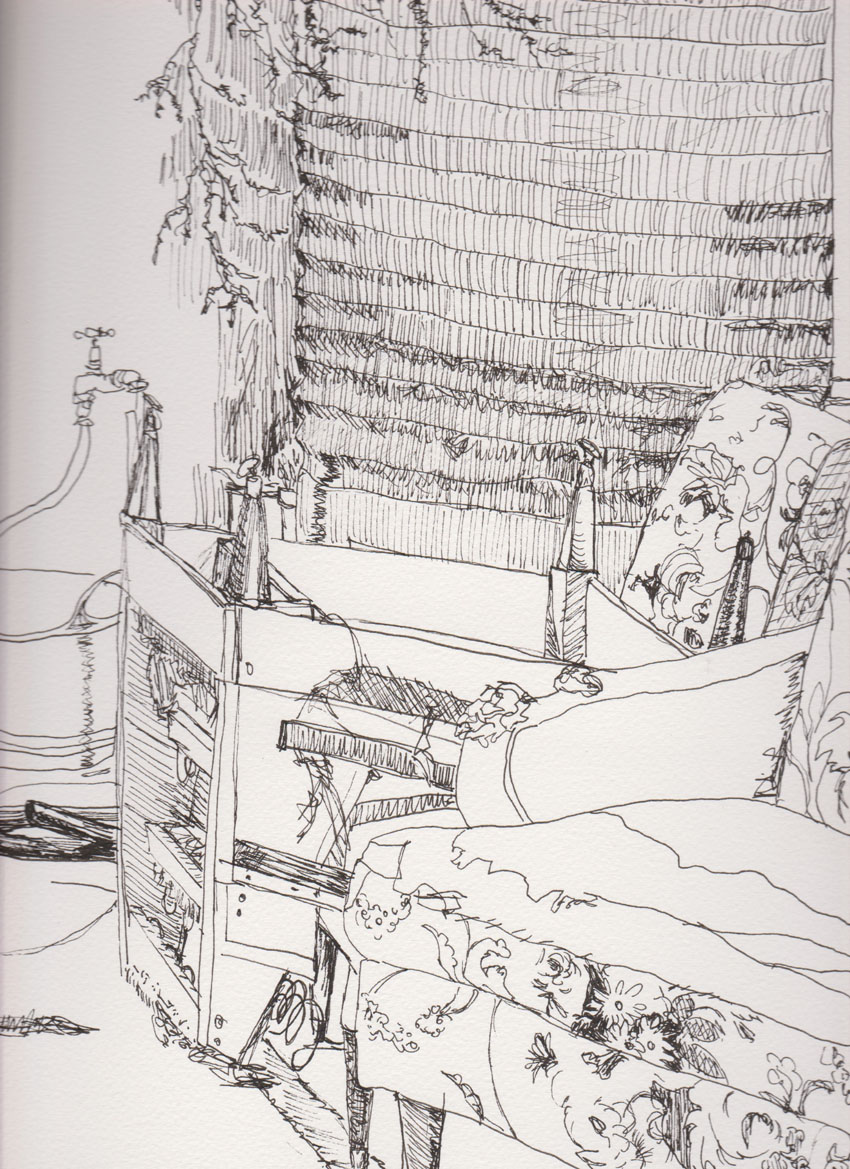
There is another issue that I’ll also have to work on, the almost overwhelming urge to use cross-hatching! Arghhh! In this second drawing my smooth plastic water tank ended up looking like a piece of 1970’s macrame. The hatching also upsets the balance of the drawing.

Old Chairs near the water tank, Copic Multiliner, 12 December 2014

Old Chairs near the water tank, Copic Multiliner, 12 December 2014

While I still like the composition this piece didn’t turn out like I expected. I was going to say didn’t turn out like I ‘planned’, but I didn’t ‘plan’ anything about this drawing except for where I was going to sit and what I going to make the drawing with.

So there are several things I need to work on here. Given that I’m not likely to get around taking the chairs to the re-cycling centre in the next little while I think I’ll try the drawing the same composition again. I will also vary the media I use and see how how that changes the work. Live and learn.

The dinosaur at my coffee shop

I’m not sure how this happened, but I forgot to publish this post from last month (15 May). Better late than never, which might be appropriate for my subject matter.

I was thinking that there wasn’t much to draw today when I went for my regular cup of coffee then I remembered the dinosaur next to the coffee shop. Yup, a Postosuchus, a North American dinosaur that was part of the ancestral lineage of today’s crocodiles.  Of course this is a model rather than the real thing and belongs to the reptile shop next door to the coffee shop. While our friend looked quite jaunty over Christmas, sporting a red Santa hat, I am glad I wasn’t around when it was alive as it was one of the top predators of it’s era.  Here is my quick pen sketch.

A pen sketch of our local Postosuchus

A pen sketch of our local Postosuchus (yes, I did get the spelling wrong on the drawing)

As someone who fancies her powers of observation, that fact that I never thought to draw this chap before seems to be rather a lapse.