Reboot

Thanks to those of you who helped with my previous posting question.  I feel I am back on track, even if it wasn’t necessarily the track I thought I might be on.

To finish off the Georgette Chen series, I sketched from a photograph of the artist in her later life. It’s so much more relaxed than her earlier studio photos. In it she’s wearing a housecoat over what appears to be an embroidered blouse that might be from one of the Slavic countries.

Georgette Chen, in later life

Chen’s biography in Wikipedia, describes a life of such interest, international travel and melodrama that it deserves a mini-series at least, https://en.m.wikipedia.org/wiki/Georgette_Chen 

I wanted to learn more so I ordered a copy of an oral history interview with Chen, held in the collection of the Singaporean Library and Archive. Alas it didn’t deliver. Chen was very vague, not to say quite inaccurate about a number of things, including where she was born. It’s not clear if it was failing memory or dissembling, but no particularly interesting  anecdotes were forthcoming.

My next subject is a return to the USA and that wonderful artist Eva Hesse. Sad to note that Chen, born some 30 before Hesse, outlived her by over 20 years.

My first Inktober

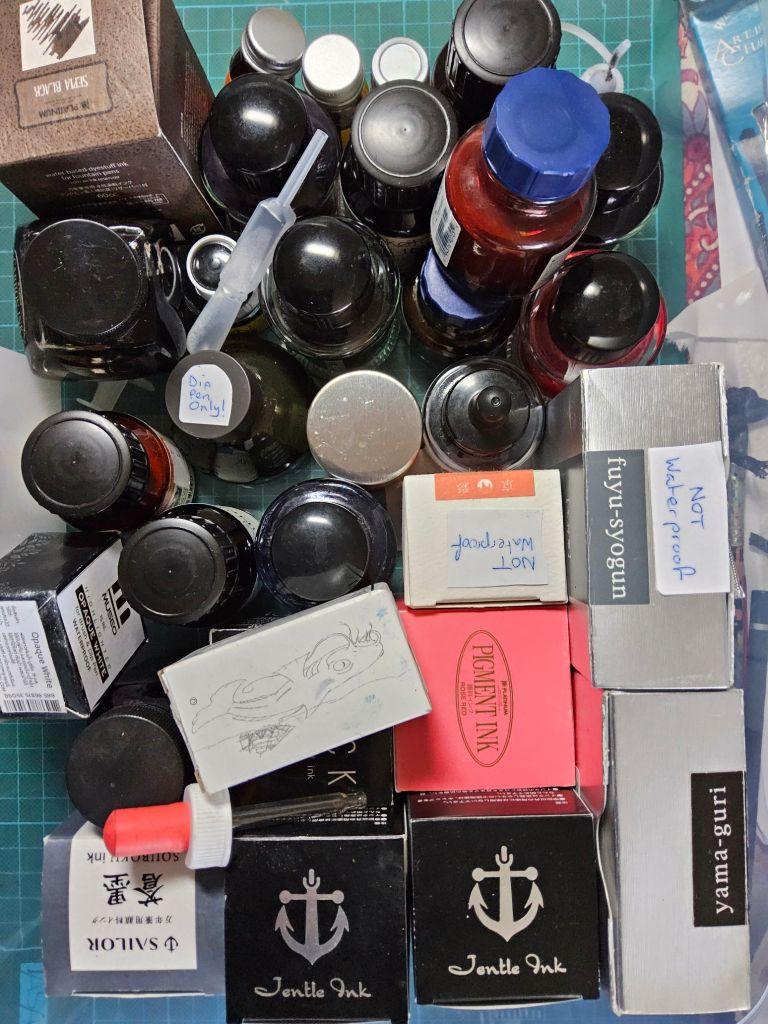
There’s no doubt that the shame of the shear amount of rarely used pens and ink that I own is a contributing factor to my first ever participation in Inktober. It’s one of those myriad art “challenges ” that breed in the dank corners of social media, however this one has become one of the better known month long events.

The sad result of too many trips where buying art supplies became our souvenirs.

Simply take whatever form of ink you like, Biro, pen and ink, brush pen, whatever and draw every day for the month of October.  The rules are satisfyingly loose enough for people to pretty much do what they want, and of course, you post the results of your daily efforts on whichever of the social media platforms you favour.

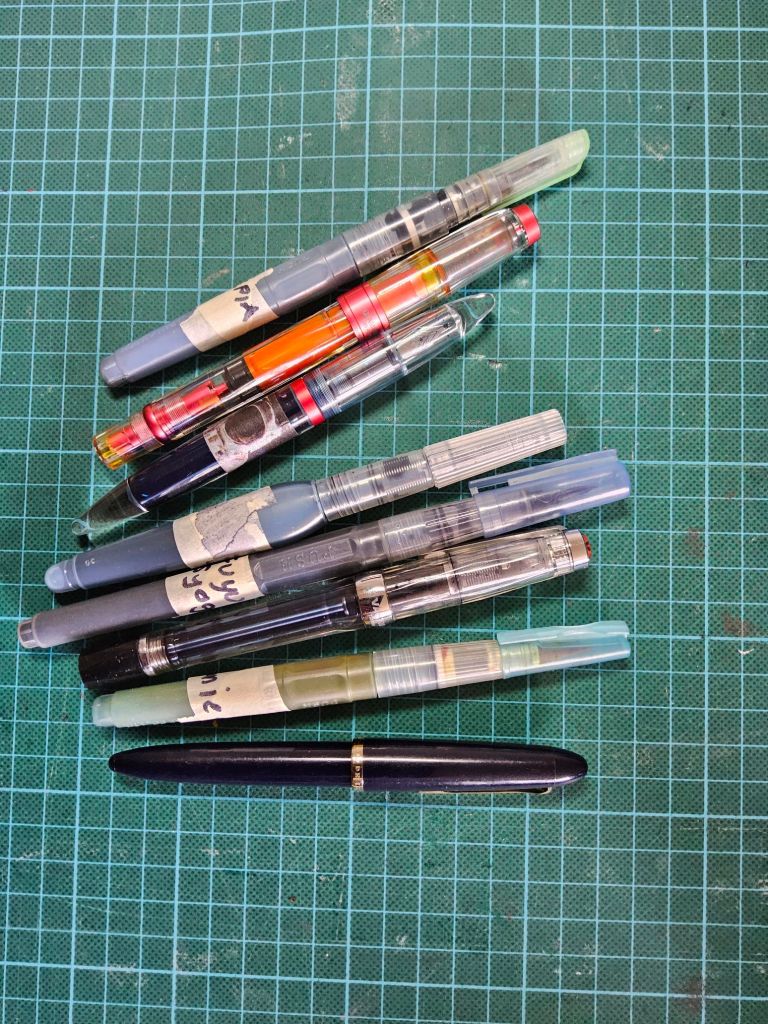
Fountain pens and brush pens filled with different inks

There is a list of daily prompts you can follow, or you can do your own thing. I’m opting for the latter. My plan is to draw portraits of artists from old photographs.  I hope this will give me sufficient leeway to focus as much on my technique as it does on the subject matter.

Now I have a month to rectify, or at least revive some skills in that area.

To be honest, I really need to! In the run-up to the challenge, I have struggled to get a reasonable result because I largely have stopped using my fountain pens for regular art making.

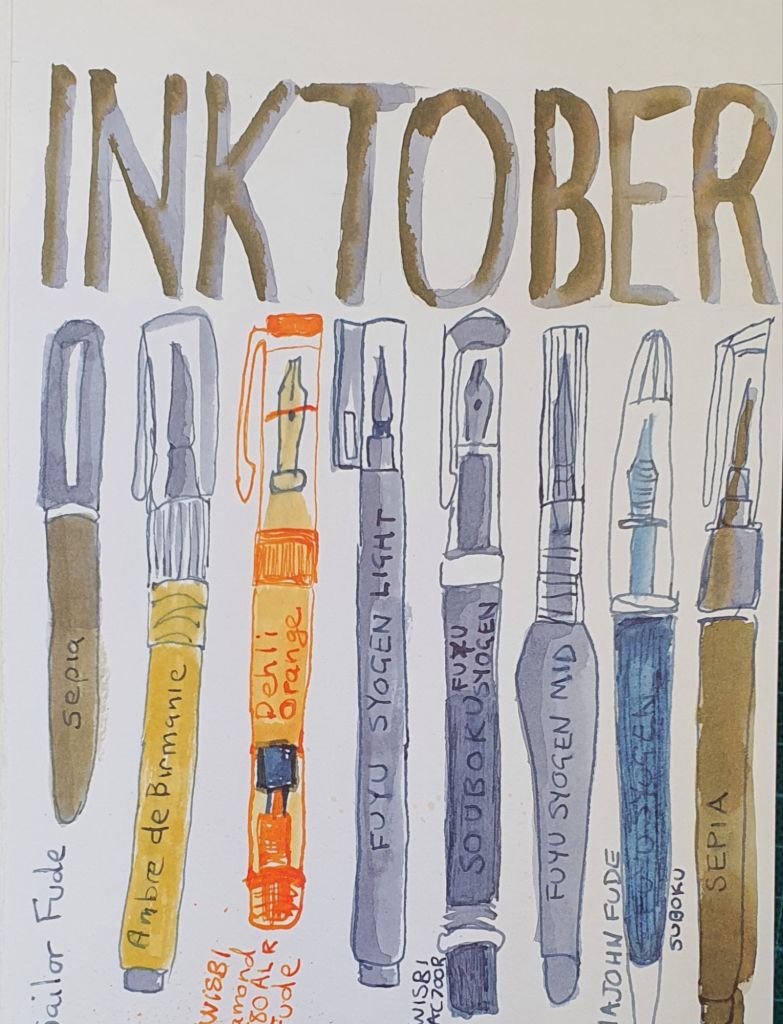
What I am using for the challenge.

I’d love to hear if any of you are doing Inktober too.

Stitch Journal

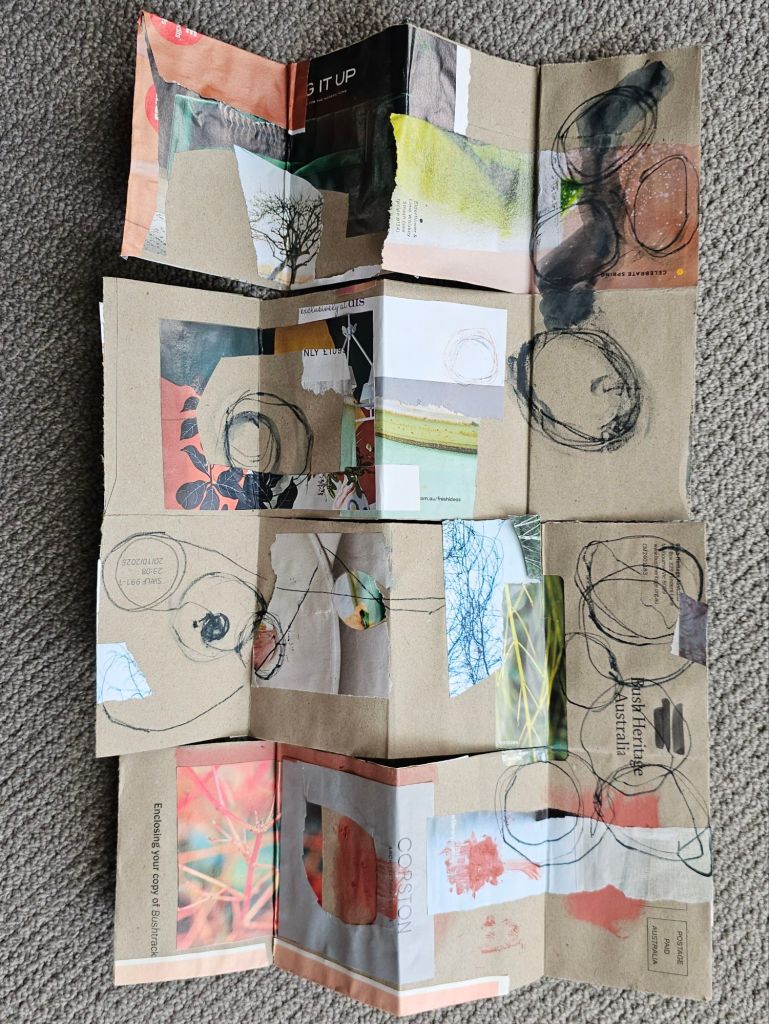
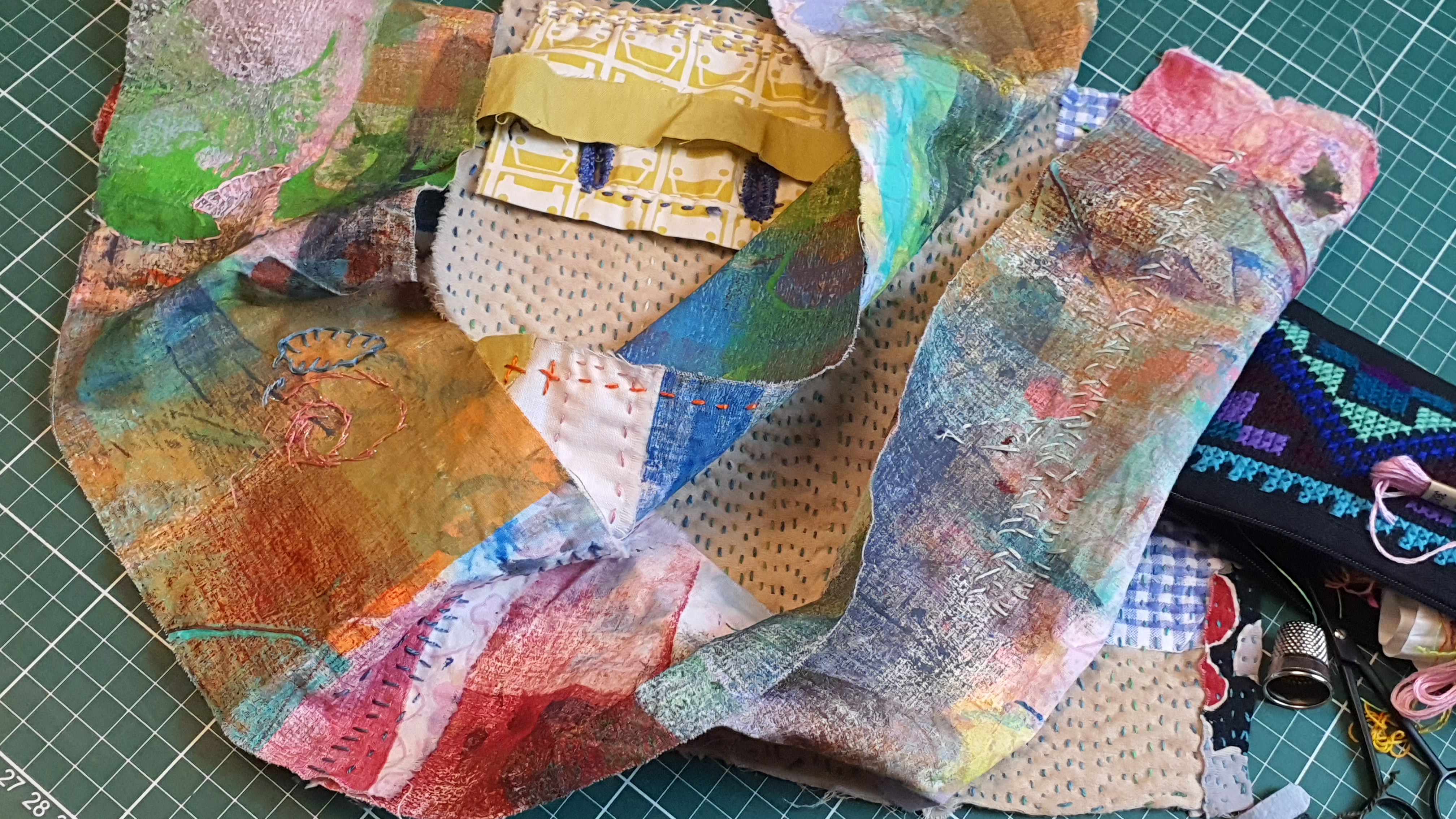
I have started a new stitch journal, something to occupy my hands when I need to stitch, or just need a distraction. I have made a video showing the journal on my YouTube channel. https://youtu.be/OUVZ0ZZBoBA

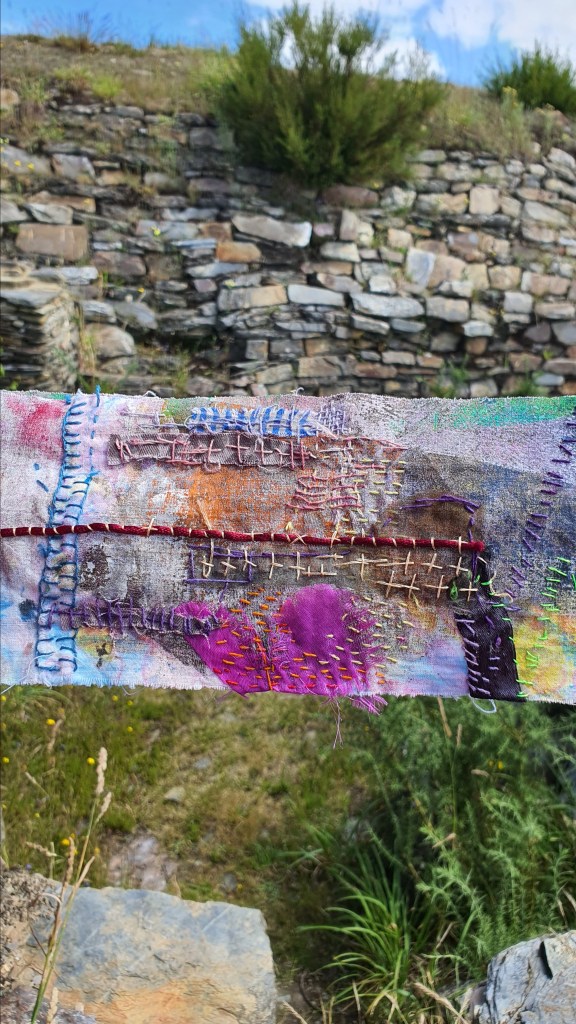
Most importantly it is with me as I travel through Spain and the UK. While I have not been able to stitch on it as much as I would like, some additions have been made.

What happens on one side is reflected on the other side.

Most recently I spent time at the archaeological site of Castro de Castromaior, an Iron age Fort and one of the most significant historical sites in the Northern Iberian region. Here I sat and stitched while admiring the stone walls of the ancient buildings, a technique which is still being used in local village houses.

My video at Castro de Castromaior,
Galicia, Spain
30 June 2023

Drawing the exhibition: Pure Form

Pure form: Japanese sculptural ceramics*, is a new exhibition at the Art Gallery of South Australia showcasing Japanese ceramics from the 1950s to the present day.

Installation shot of work, (foreground to background), Object (nogata), saiseki zōgan, Kishi Eiko, 2005; Shell-shaped covered vessel (Kai futamono), Koike Shōko, 2009: No.3 Erosion, Shingu Sayaka, c. 2020; Untitled, Katsumata Chieko, 2021; and Box Batter-17, Mishima Kimiyo, 2017.

The exhibition spreads across several rooms and is breathtaking in it’s array of forms, textures and graphic presence. I had only a limited time to draw in the gallery today. The hardest thing was to decide what to sketch first.

I started with a darkly glazed vessel by Mihara Ken, whose concertina-shaped folds reminded me of Issey Miyake garments.

Sekki, Mihara Ken, c. 2010, Matsue, stoneware and glaze,
collection of Raphy Star. Sketch, graphite on paper.

Next to the work of Mihara Ken was a form by Misaki Mitsukuni. The surface, which I was unable to do justice to, is created by the artist rubbing slip into the surface, which he has described as ‘Rothkoing’.

Coloured stoneware vessel (saiyūdeki), Misaki Mitsukuni, 2017, Tomisato, stoneware. Sketch graphite on paper.

Turning my chair I could see another work by Mihara Ken, a form that appeared as if folded out of sheets of clay. The glazes were very subtle blue greys and deep brown.

Genesis (Kigen) no.1, Mihara Ken, 2013, stoneware, glaze,
National Gallery of Australia. Sketch graphite on paper.

Finaly, I did a very quick sketch, part contour drawing, of Kaneshige Kosuke’s work, Tall sculptural form, c. 2006.

Tall sculptural form, Kaneshige Kosuke, c. 2006, Bizen city, stoneware,
collection of Raphy Star. Sketch, graphite on paper.

*Pure form: Japanese sculptural ceramics is accompanied by an extensive catalogue (which I will be looking at for quite some time).

The exhibition and book are by Russell Kelty, Curator of Asian Art, Art Gallery of South Australia.

The exhibition runs until 6 November 2022 at the Art Gallery of South Australia. Get there if you want to see some amazing ceramics!