Last sketch of 2025

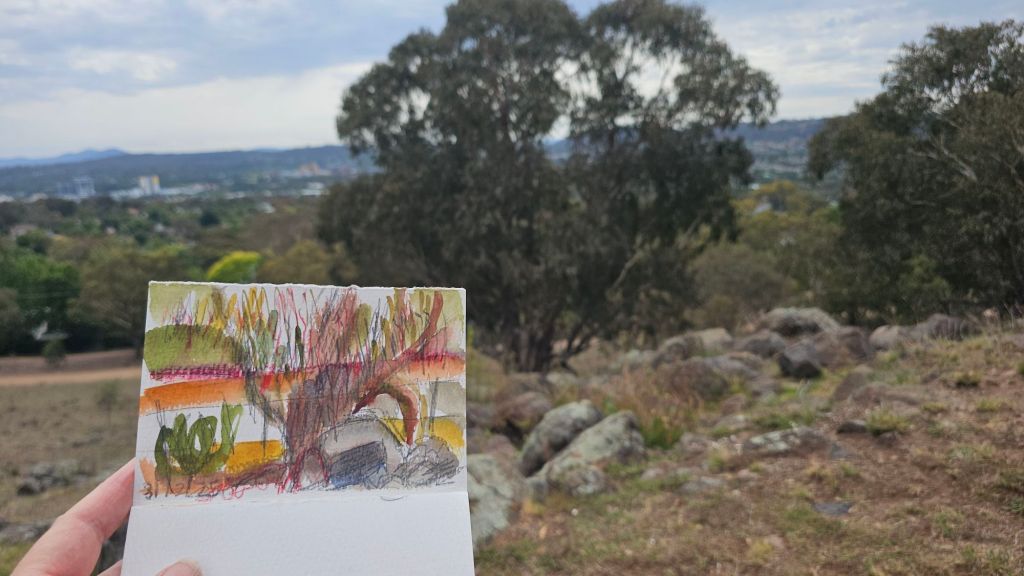
This is my last sketch of 2025 made on New Year’s eve while going for our ‘long’ walk around a nearby mountain.

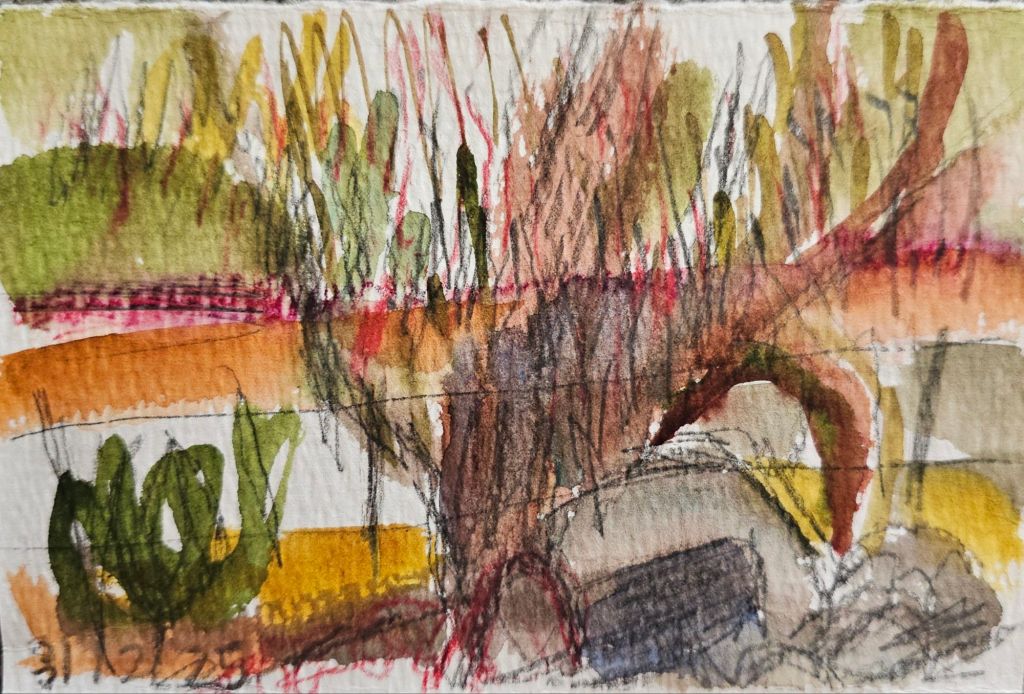
I was using my regular tiny book I carry when walking and trying out an exercise from an artist I recently discovered called Orla Stevens *. The idea is to sketch for no more than 10 minutes changing the direction of your marks for each item you draw.

Tree with rocks

Now I know I haven’t nailed this yet, but I was really excited by her very loose approach to sketching. As this is one of our ‘regular’ walks I have drawn from this spot quite a few times already this year.

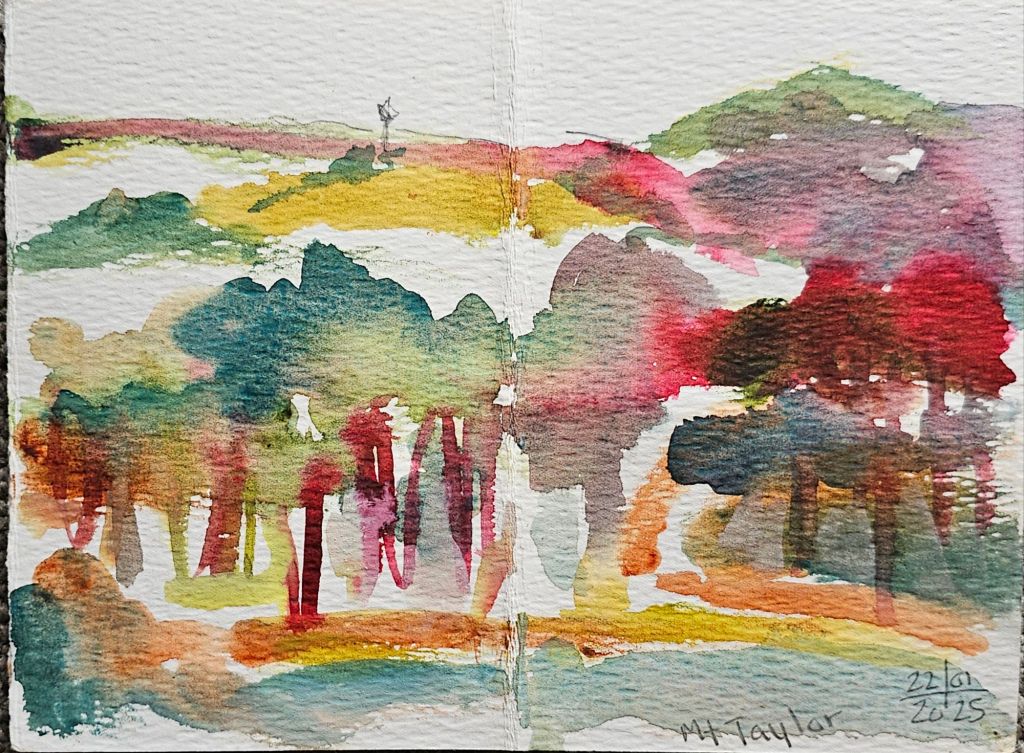
A broader view from the same location from July 2025, watercolour

I felt quite free to just go for it with this sketch. I certainly plan to do more in the future.

Super loose mark making
Sketching the tree

* You can find Orla on YouTube at https://youtube.com/@orlastevens?si=L2oCkPtSiFWU_1Ly

Exploration continues

I’m keeping on with the exploration of tonal sketches started with my class with Olivia Marcus at the Urban Sketchers Symposium in Poznan.  The more I explore, the more my own style preferences are entering the equation.

Sketching in the tiny book I carry on my walks.

One thing I have largely changed is not using black as an emphasis. Because I work predominantly in watercolour, I find the contrast between that and the black felt pen Olivia uses, can overwhelm my sketches. I’m exploring whether I can effectively substitute darker tones.

Sketching at Fyshwick Markets

I’m also testing out all different colour combinations.  Some are instantly more appealing, but I don’t want to come to conclusions too soon. As I have a whole lot of new paints from our goody bags from Poznan, there’s still a lot to consider.

At Tutto in Mawson. I also added some pencil to this one to pick out more highlights.

Are your colour/color pencils lightfast?

This is not a question that I thought I would be asking, except that I recently read an article talking about the low lightfastness rating of many of my favourite Prismacolor pencils. Given how important I think lightfastness is for watercolours it’s somewhat strange that I haven’t considered this as an issue before.

All my Prismacolors

I had a hunt through my pencil box for my Prismacolors and checked them against the lightfastness chart that the company has released. I discovered that just over half of the colours that I own are in the top two lightfastness ratings categories. Phew! Those pencils I can continue to use without worry. The rest are in the bottom three categories. That means I wouldn’t use them for any work that I would be likely to sell, but I can use them on casual projects or for general ‘colouring in’ activities.

What I am confident to use long term.

Presently I am using my pencils to make colour interpretations of photographs of statues taken by the German artist Aglaia Konrad, in her book Schaubuch: Skulptur. (Yep, weird, but so me). As this is an exercise for me and all the drawings are in a sketchbook I will continue with using the lower rates colours, but I won’t replace them.

My colour pencil interpretation of an Aglaia Konrad photo of sculpture fragments in her book Schaubuch: Skulptur

As an aside, when I dived into the depths of the world of colour pencils (I don’t recommend it, it was terrifyingly obsessed), I found out that 4 of my pencils weren’t included on the lightfastness list. It turns out that they are considered ‘rare’ (sadly not rare enough to get me on Antiques Roadshow, or upgrade my lifestyle). They are discontinued colours from a previous incarnation of the company and were made in the late 1980’s. These colours were later discontinued when the company changed hands.

In the end my other half decided to get serious and order a set of lightfast Caran d’Ache Luminance 6901 pencils. I have swatched them out below and I am pleasantly surprised by some of the colours this set of 20 includes.

Drawing the exhibition: Boticelli to Van Gogh – Part 2

As I walked into the large room, people moving in front of me, I looked up and saw ‘The Duke’. Our eyes met, a shiver ran down my spine. OMG! IT’S A GOYA!!!

The Duke of Wellington by Francisco de Goya, 1812-14

If you are wondering about my delirium over this work, apart from the fact that it’s just a bloody marvellous painting, it’s because paintings by Goya rarely make it to our shores. I did a quick check and the only Goyas permanently in Oz are of Goya’s Los Caprichos series of etchings.

I was also surprised as nowhere in the pre-publicity for this exhibition did I see a mention of a Goya, nor Vermeer or Velasquez, all of whose works were in the show.

Arthur Wellesley, the 1st Duke of Wellington, (1769-1852) was arguably the leading military (and political) figure of the 19th century in the United Kingdom. His most prominent victory was the defeat of Napoleon at the Battle of Waterloo alongside the Prussian army under Generalfeldmarchal Blücher.

As this was my second visit to the exhibition (see my previous post here) I decided to prepare my page with a splash of red paint. This reflects the colour of the Duke’s uniform, but I wasn’t trying to be literal about painting it.

The Duke of Wellington, by Francisco de Goya, 1812-14. Prepared watercolour and pencil.

I also chose to do a closer study of the lower part of the face. By this time I had realised that trying to replicate the fine modelling of the oil paint was more than my pencil could manage.

The actress of the title is Mrs Siddons (Sarah Siddons, nee Kemble, 1755-1831). A famous tradegienne she was renowned for her portrayal of Lady Macbeth and Isabella from Isabella, or The Fatal Marriage by Thomas Sotherne. As an interesting aside, Siddons also played the role of Hamlet on numerous occasions over a 30 year period.

The portrait of Siddons in the exhibition is by Sir Thomas Gainsborough (she was also painted by Sir Joshua Reynolds and Sir Thomas Lawrence whose work is also included in this exhibition). Her head is shown in profile with her powdered wig and her dramatically large hat framing her face.

Mrs Siddons by Sir Thomas Gainsborough, 1785

William Hazlitt said of Sarah Siddons “Tragedy personified … to have seen Mrs Siddons was an event in everybody’s life.”

The final grace note was to find out, via Wikipedia, that the Duke and Mrs Siddons were acquainted, as the Duke attended some of Mrs Siddons receptions.