It seems like only minutes since our feet touched home again after being away for four months, but again we have jumped back on a plane to join fellow Urban Sketchers in Suwon, South Korea. This is the location for the Asialink Sketchwalk, where sketchers get together to draw for 4 days.
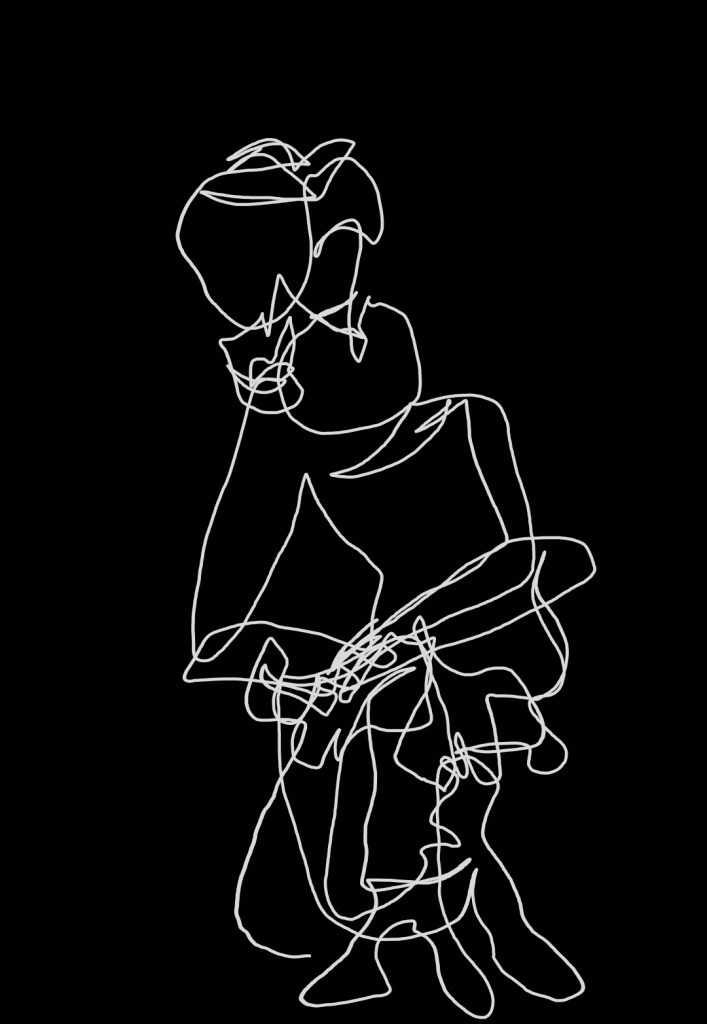
We have been staying in Seoul for a few days and have been doing a lot of walking and some drawing. Yesterday we went to the National Museum of Korea which holds many treasures. I was intrigued by the space called ‘The Room of Quiet Contemplation’, which holds two statues made in the 7th century of Pensive Bodisattvas. I took the opportunity to do blind contour drawings of both sculptures, remembering to breathe slowly as I focused my eyes on following my way around their forms.
As often with this type of drawing I feel that it captures an essence of what I saw more effectively than any detailed academic drawing would.
I have had so many things to post this year, that I never quite got around to posting. So I will do a quick scan through the photo gallery and see what I can find.
Mainly I have been preoccupied with an embroidered piece for a group show in July. We had to get our draft writing and photos in very early as there is a book to be published to accompany the show. Very exciting indeed. So sorry no finished shots until the exhibition is open. However I did make a short video of me stitching on this piece.
Pure form: Japanese sculptural ceramics*, is a new exhibition at the Art Gallery of South Australia showcasing Japanese ceramics from the 1950s to the present day.
Installation shot of work, (foreground to background), Object (nogata), saiseki zōgan, Kishi Eiko, 2005; Shell-shaped covered vessel (Kai futamono), Koike Shōko, 2009: No.3 Erosion, Shingu Sayaka, c. 2020; Untitled, Katsumata Chieko, 2021; and Box Batter-17, Mishima Kimiyo, 2017.
The exhibition spreads across several rooms and is breathtaking in it’s array of forms, textures and graphic presence. I had only a limited time to draw in the gallery today. The hardest thing was to decide what to sketch first.
I started with a darkly glazed vessel by Mihara Ken, whose concertina-shaped folds reminded me of Issey Miyake garments.
Sekki, Mihara Ken, c. 2010, Matsue, stoneware and glaze, collection of Raphy Star. Sketch, graphite on paper.
Next to the work of Mihara Ken was a form by Misaki Mitsukuni. The surface, which I was unable to do justice to, is created by the artist rubbing slip into the surface, which he has described as ‘Rothkoing’.
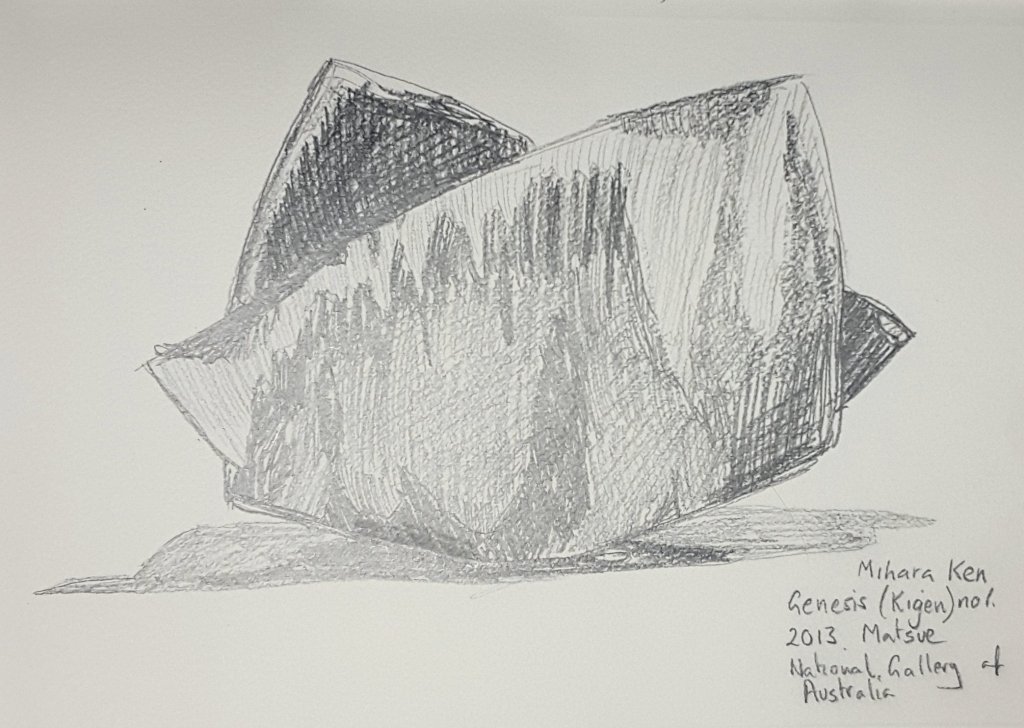
Turning my chair I could see another work by Mihara Ken, a form that appeared as if folded out of sheets of clay. The glazes were very subtle blue greys and deep brown.
Genesis (Kigen) no.1, Mihara Ken, 2013, stoneware, glaze, National Gallery of Australia. Sketch graphite on paper.
Finaly, I did a very quick sketch, part contour drawing, of Kaneshige Kosuke’s work, Tall sculptural form, c. 2006.
Tall sculptural form, Kaneshige Kosuke, c. 2006, Bizen city, stoneware, collection of Raphy Star. Sketch, graphite on paper.
*Pure form: Japanese sculptural ceramics is accompanied by an extensive catalogue (which I will be looking at for quite some time).
The exhibition and book are by Russell Kelty, Curator of Asian Art, Art Gallery of South Australia.
The exhibition runs until 6 November 2022 at the Art Gallery of South Australia. Get there if you want to see some amazing ceramics!
We found ourselves in an odd situation the other day. We went to see a major travelling exhibition, Shakespeare to Winehouse, which has come to Australia from the National Portrait Gallery, London. We knew that there was no photography allowed, but I was taken aback when the security guard asked me to put my pencil away as there was no drawing allowed in the exhibition either.*
Apart from being very annoyed I was at rather a loss because sketching is my favourite way of recording exhibitions. After going through the exhibition we beat a quick retreat to the coffee shop where I furiously wrote notes on the paintings/ photographs that caught my attention. Did I mention that you couldn’t even take notes in pencil in the gallery?
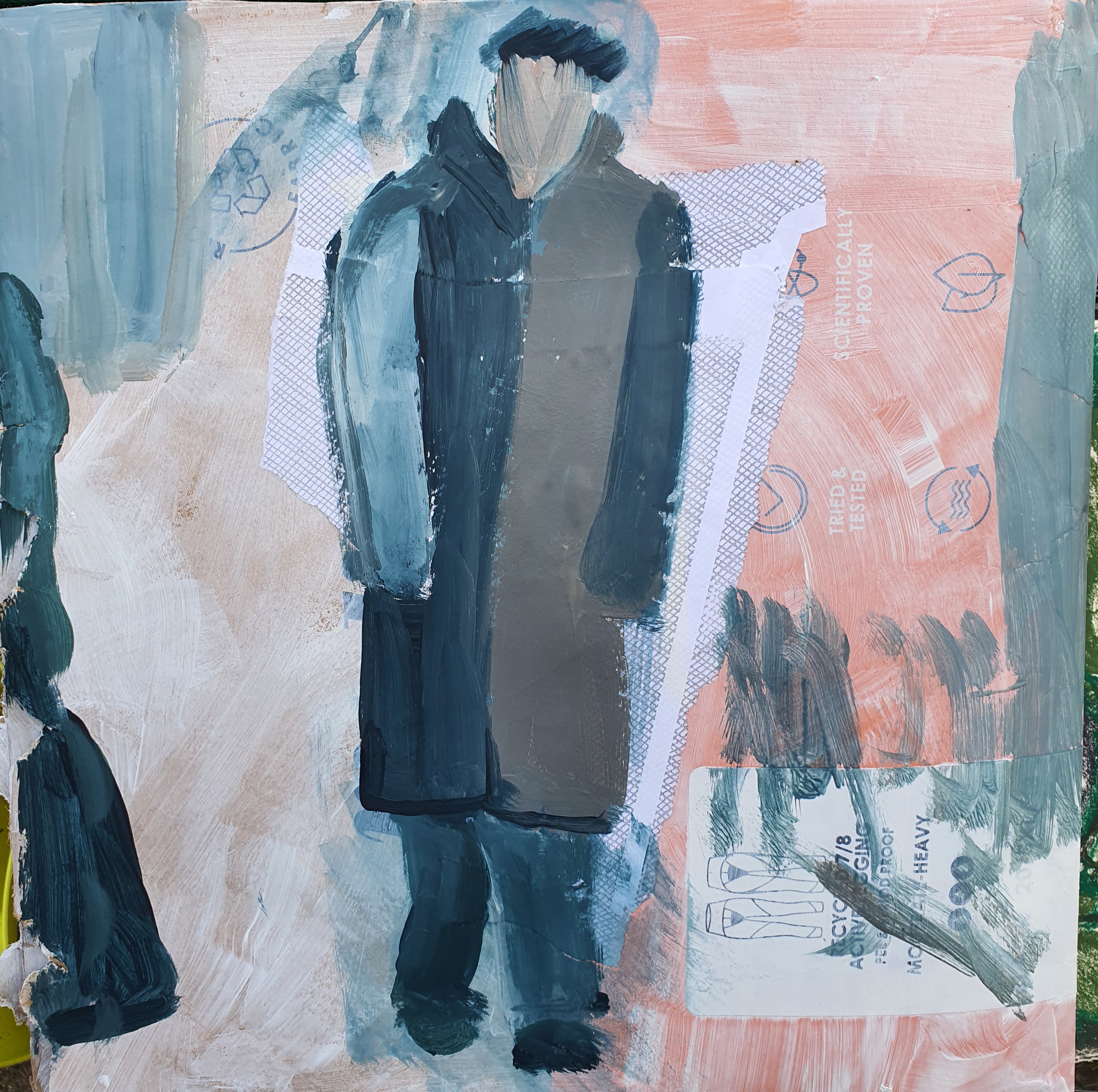
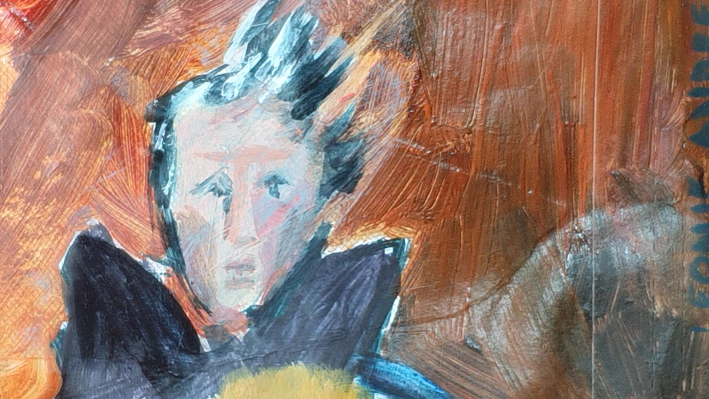
However, after we got back home, it dawned on me that I could at least try and paint some of the works from memory – it’s hard to keep a determined artist down.
This is a first for me and I can’t say that I had prepared myself for the experience. Nevertheless I managed two acrylic studies, neither of which give a terribly accurate rendering of their sources, but it was fun. (And yes, I do know that I can download all the paintings online. It was just more fun doing it this way).
Drawn from memory: partially completed, Richard Avedon, 1960, photograph of WH Auden in New York (NPG P614) – acrylic paint on collaged cardboardDrawn from memory: Sir Thomas Lawrence, 1829, unfinished portrait of Arthur Wellesley, 1st Duke of Wellington (NPG 7032)
If you are interested in 15 minutes of relaxing video you can watch me paint this study by following this link.
I have confirmed with the lending institution that both photography and sketching are allowed in their gallery. It just seems that our local host organisation has gotten all draconian. I don’t know why as so far they haven’t gotten around to replying to my complaint email. I will update this if and when I hear from them.
Shortly after posting this blog I heard from the local gallery to say that the restrictions were, in part, to do with copyright issues for living artists. Also that high visitor numbers in their relatively smaller rooms made photography and sketching a problem with obstruction (my words). They are at least holding out a ray of hope for the sketchers. Apparently, they are monitoring visitor numbers to identify quieter periods when sketching might be allowed.
The full text of both replies can be found on my Instagram account @leonieandrewsart.
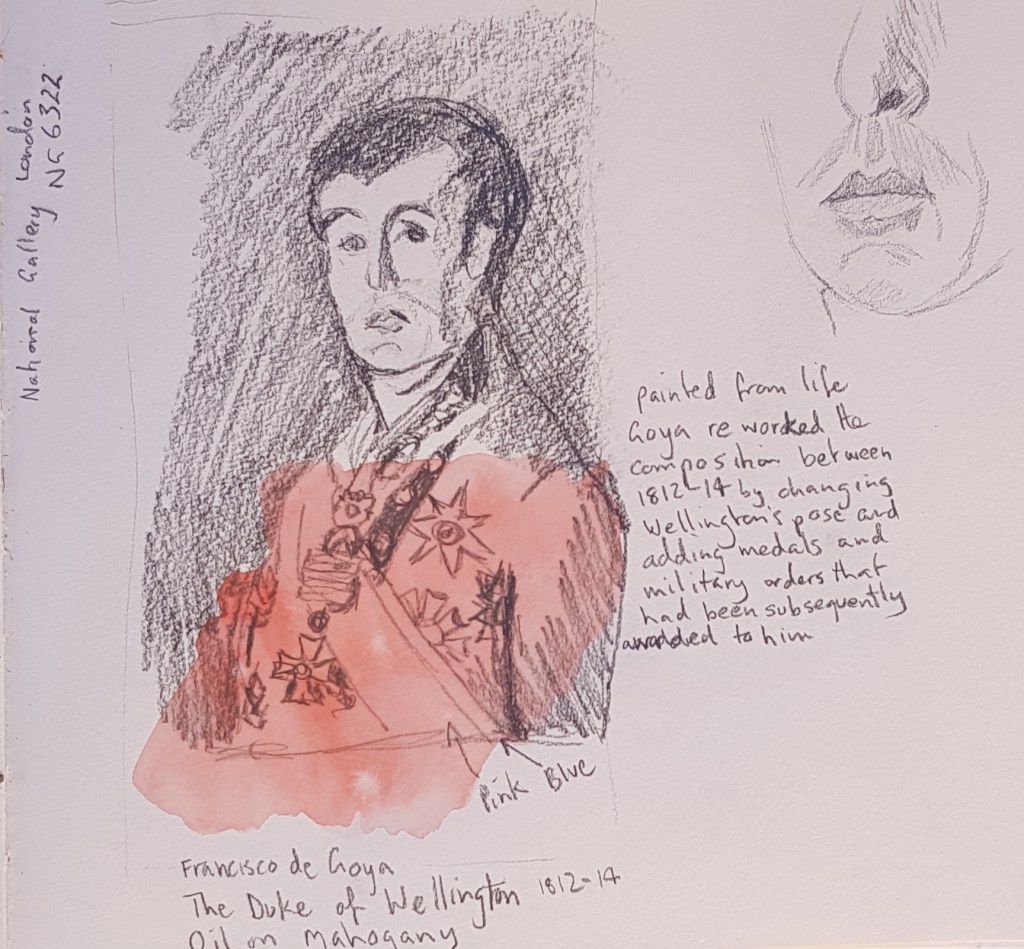
As I walked into the large room, people moving in front of me, I looked up and saw ‘The Duke’. Our eyes met, a shiver ran down my spine. OMG! IT’S A GOYA!!!
The Duke of Wellington by Francisco de Goya, 1812-14
If you are wondering about my delirium over this work, apart from the fact that it’s just a bloody marvellous painting, it’s because paintings by Goya rarely make it to our shores. I did a quick check and the only Goyas permanently in Oz are of Goya’s Los Caprichos series of etchings.
I was also surprised as nowhere in the pre-publicity for this exhibition did I see a mention of a Goya, nor Vermeer or Velasquez, all of whose works were in the show.
Arthur Wellesley, the 1st Duke of Wellington, (1769-1852) was arguably the leading military (and political) figure of the 19th century in the United Kingdom. His most prominent victory was the defeat of Napoleon at the Battle of Waterloo alongside the Prussian army under Generalfeldmarchal Blücher.
As this was my second visit to the exhibition (see my previous post here) I decided to prepare my page with a splash of red paint. This reflects the colour of the Duke’s uniform, but I wasn’t trying to be literal about painting it.
The Duke of Wellington, by Francisco de Goya, 1812-14. Prepared watercolour and pencil.
I also chose to do a closer study of the lower part of the face. By this time I had realised that trying to replicate the fine modelling of the oil paint was more than my pencil could manage.
The actress of the title is Mrs Siddons (Sarah Siddons, nee Kemble, 1755-1831). A famous tradegienne she was renowned for her portrayal of Lady Macbeth and Isabella from Isabella, or The Fatal Marriage by Thomas Sotherne. As an interesting aside, Siddons also played the role of Hamlet on numerous occasions over a 30 year period.
The portrait of Siddons in the exhibition is by Sir Thomas Gainsborough (she was also painted by Sir Joshua Reynolds and Sir Thomas Lawrence whose work is also included in this exhibition). Her head is shown in profile with her powdered wig and her dramatically large hat framing her face.
Mrs Siddons by Sir Thomas Gainsborough, 1785
William Hazlitt said of Sarah Siddons “Tragedy personified … to have seen Mrs Siddons was an event in everybody’s life.”
The final grace note was to find out, via Wikipedia, that the Duke and Mrs Siddons were acquainted, as the Duke attended some of Mrs Siddons receptions.








 leonieandrews