After Porto

This post was originally written in August of 2018, shortly after I had returned from three months of travel in Europe (France, Spain and Portugal). I have no idea why I didn’t post it at the time, however I am interested to see how I wrote about aspects of watercolour painting, that are now part of my regular ‘style’. I have also included my latest cafe sketch at the end to show what I am doing now. Enjoy!

Reading the social media sites, post the Urban Sketchers Symposium held at the end of July 2018 in Porto, I was intrigued to see the number of people,who are reviewing their sketching practices. They have been inspired by the various styles and techniques of other people that they met at the event.

I too have found the approach of a number of other artists has made me re-consider my use of watercolour.

In May 2018 I briefly met Marion Rivolier at a USk (Urban Sketchers) Paris event at the Rodin Museum, (I can even be seen lurking in the photo taken of the event). Subsequently I have been inspired by her loose expressive watercolours. I went to her painting demonstration at the Porto Symposium to see if I could better understand how she was achieving her results. Marion’s advice included both the practical and the personal:

  • ‘know your colours so you can sketch fast’ – obvious in one way, but by using a limited number of colours and knowing in advance how they mix, you will speed up your process.
  • ‘You don’t have to draw everything you see – select like a stage director’
  • ‘[pencil] drawing at the beginning is like creating a prison for colour’. (Not in a good way).

Marion is especially good at capturing people and movement, so that will be an extra challenge for me.

People practice, sketching figures from photos in the weekend newspapers

Another teacher at the Symposium who was gaining a lot of attention was Maru Godas, with her ‘gouache like a child’ workshop. Maru’s advice to simplify and compress, rather than allowing yourself to be lost in detail. This is something I often need reminding about.

I fully appreciate that both these artist’s style has developed over year’s of practice. So, like I am always saying to new sketchers, you need to get “the brush-miles in” to get the result. I have taken out my bigger brushes to work with (makes painting fiddly detail difficult) and I’m on my way with lots of practice.

View into the front garden, with the Ibis sculpture ‘Gordon’ (found at a secondhand shop)

People drinking coffee.

Sketching the scene at the coffee shop.

My latest cafe sketch from June 2021 is here.

Friends chatting over coffee in the winter sunlight. Watercolour, 11 June 2021

Drawing in the gallery – The Prado, Madrid

The undoubted highlight of our trip to France and Spain (Portugal still to come), is the thrill of seeing up close and personal, works of art that I have previously only seen in books or online. The Prado is definitely in the ‘big hitter’ league, even if you only consider, Velasquez, El Greco or Goya individually and don’t include all the other amazing works of art between it’s walls.

In person I could see that El Greco really went for strongly clashing colours in his works; and that Goya borrowed the same poses in his paintings of the Spanish Royal family as Velasquez used for portraits of the Hapsburgs back in his day.

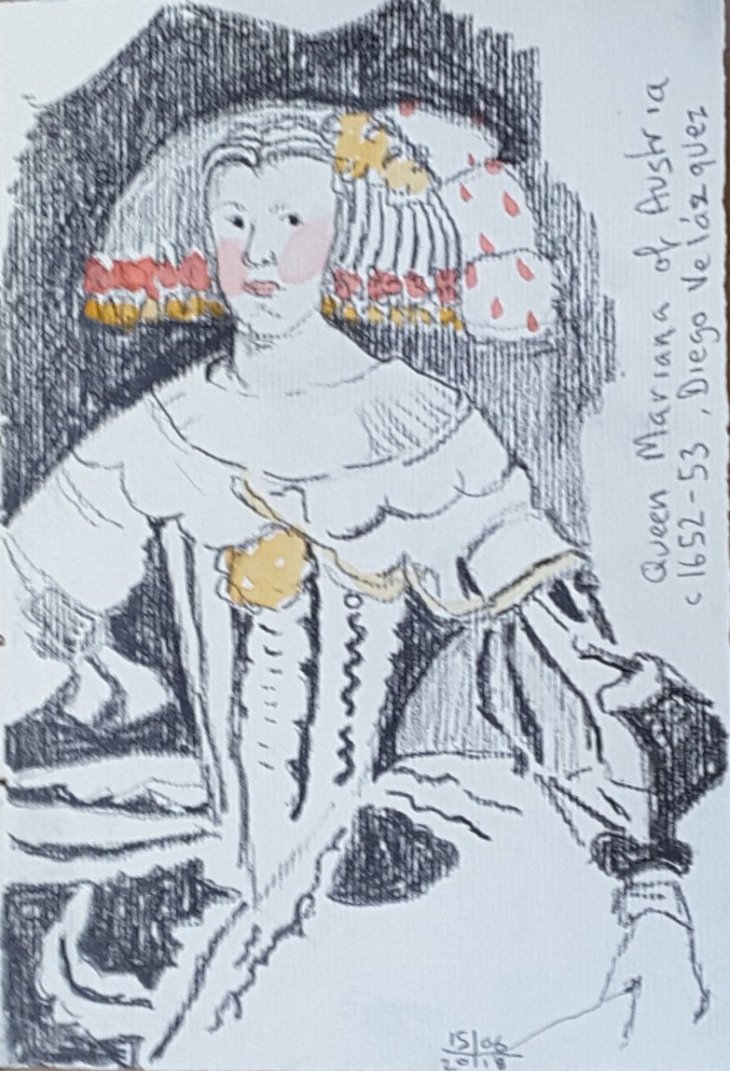
I completed all these sketches in the Prado, but I later added some watercolor to highlight certain elements of the paintings.

In his portrait of Queen Mariana of Austria, Velasquez lines up her very prominent pink cheeks with the red ribbons in her hair and the plume at the side of her wig. The Queen’s gown is a study of black and grey. The painting on the whole has a very restricted palette which results in emphasising the highly formal nature of this work.

After Velasquez, Queen Mariana of Austria, c 1652-1653, graphite
The Infanta Margarita of Austria, here painted by Jaun Bautista Martinez del Mazo, is the same little girl that Velasquez painted in his most famous painting Las Meninas, which hangs only a few metres away from this portrait. Del Mazo’s portrait was painted several years after the Valasquez portrait when the Infanta was betrothed to the Emperor Leopold of Austria (who she married in 1666). Del Mazo was Velasquez’s son-in-law and was appointed court painter after Velasquez death.
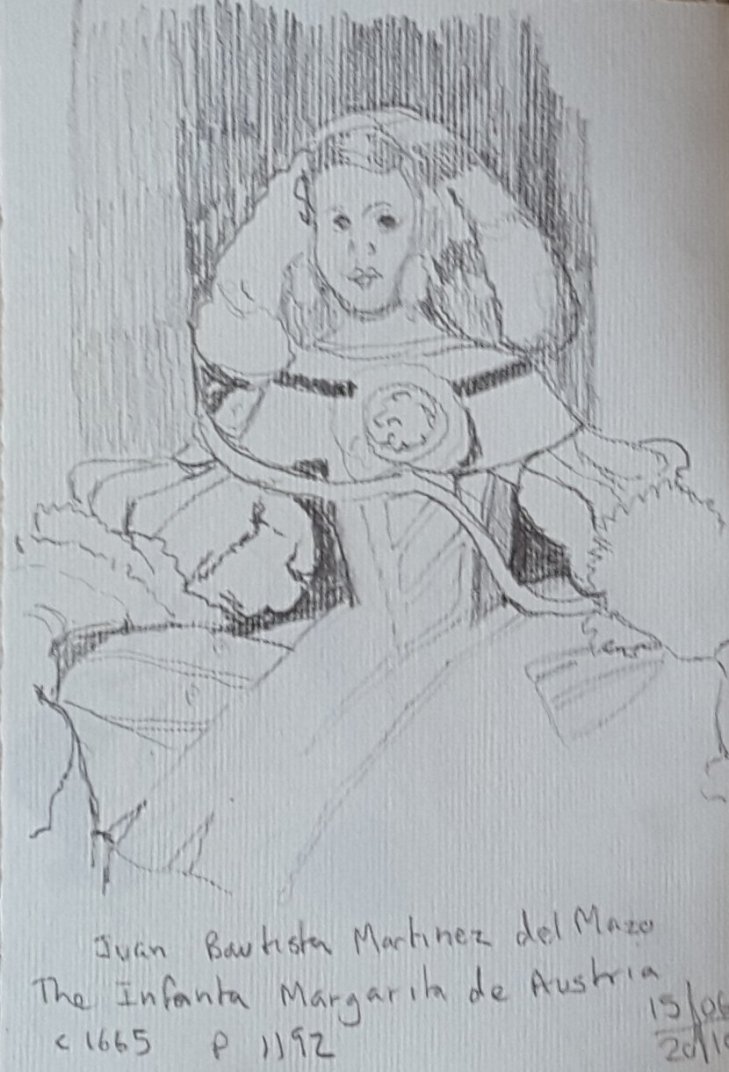
After Jaun Bautista Martinez del Mazo, the Infanta Margarita of Austria, c 1665, graphite

In his portrait del Mazo also uses the colour red to great effect. The background is treated with a range of warm-hued browns and reds and the result is far more tender than the portrait of her mother, Queen Mariana.

After del Mazo, The Infanta Margarita of Austria, graphite and watercolour, added later

The other sketch I drew was one of Goya’s ‘black’ paintings. These were originally painted on the walls of his house and later transferred onto a backing so they could be hung. These are strange and disturbing works. Their meanings have been the subject of some pretty varied interpretations over the years since they were made public.

The sketch I made is of a painting called Atropos, or the Fates (I assume that the titles were post-Goya as he didn’t intend for thees works to be public). Four dark figures float above the yellow-toned landscape, appearing to hold scissors and other attributes of the mythological Fates who were thought to control human destiny.

After Francisco Goya, Atropos, or The Fates, detail, pencil on Fabriano paper

I found this a compelling work, the sort you can’t quite look away from, but wish you could. The floating figures were quite convincing which is rather a contradiction as they are also malevolently manifest and solid. Many of the other works in this series really creeped me out. If I have to spend a night at the museum I bags NOT staying in this room.
Urban Sketches – Madrid

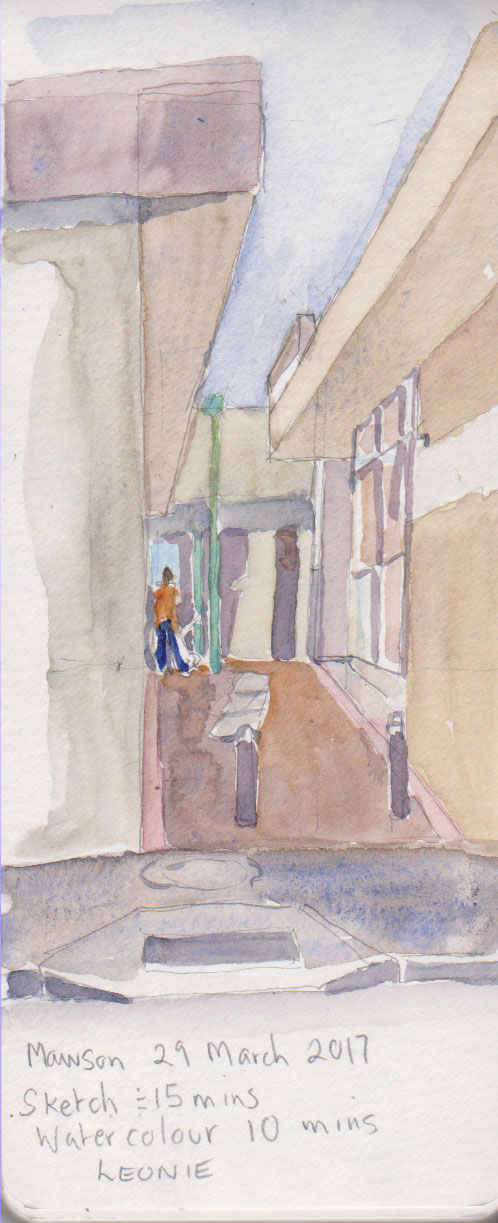
I realised that I have a stack of sketches from my travels that I haven’t shared on my blog. My street sketches in Madrid came to a grand total of two. Mainly we spent most of our time in the museums, I will be sharing some sketching from of those visits in other posts.

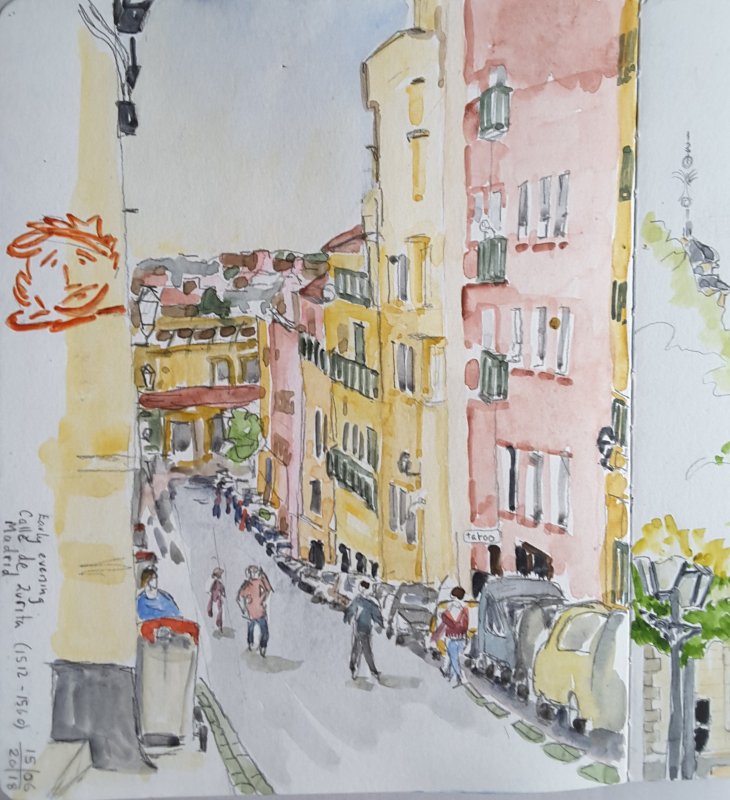
Early evening, Calle de Zurita, Madrid, watercolour and pencil.

We painted in the Calle de Zurita the night of the first World Cup game between Spain and Portugal. Needless to say there were loud cheers and groans coming from the nearby bars. After sketching we went and joined the locals to watch the rest of the match.

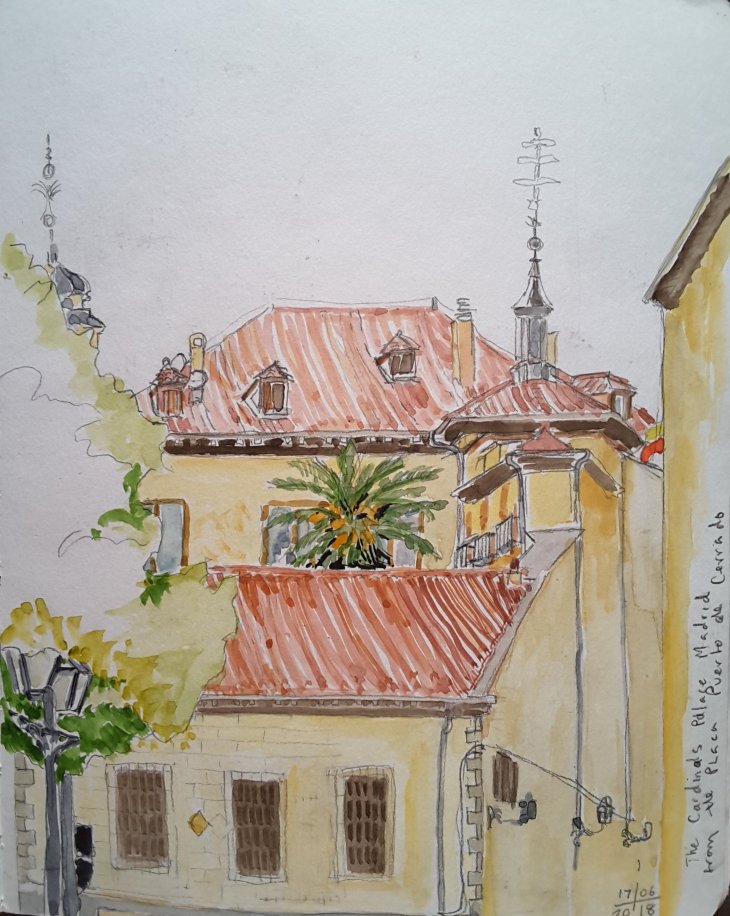
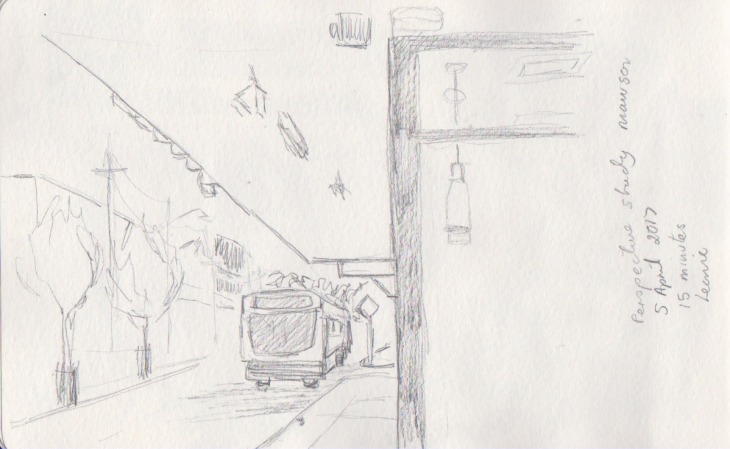
My second sketch was of a building that I thought had an interesting roofline and I also liked the way the date palm appeared out of the courtyard. I was sketching, perched on a security block next to a bus-stop. An older couple stopped to explain that I was drawing the back end of the Cardinal’s Palace. They also mentioned that a famous painter was born there. When I walked up to look at the historic marker I could see that the artist was Claudio Coello, appointed to the court of Carlos II. Coello was born at the in 1642. I have no idea why he was born in the Cardinal’s Palace, but his dad was a sculptor so maybe he was working there at the time – this is purely speculation on my part.

The Cardinal’s Palace Madrid, from the Place Puerto de Cerrada, pencil and watercolour.

The Cardinal’s Palace, the plain end, watercolour and pencil.

Drawing the Exhibition – Ruebens, Painter of Sketches

One of the current temporary exhibitions at the Museo del Prado is Reubens, Painter of Sketches, by which they mean oil sketches, works on canvas or panel made in preparation for other finished works.

Reubens did, of course, use other drawing media for preparatory works. I struggle with the high finish of his completed canvasses, so the lively brushstrokes he employs in these compositional studies proved much more to my taste.

One of the Victories, part of a sketch on the unity of England and Scotland intended for the Guild Hall, London

His figures, particularly those suspended in mid air, such as the Victory above, or other contorted poses, provide a demonstration of his mastery of human anatomy and are excellent models for copying. I doubt even the most skilled life model could pull this pose off.

It was also a lovely touch for me to see Reubens quoted talking about drawing antique statues. “Artists should use Ancient statues as models, but the figures based on them should be painted to look like flesh not stone.” Included in the exhibition is a study for Prometheus, based on pen and ink studies he made of the Farnese Hercules.

The works on display show a range of ‘finish’. A series of very small studies for decorations of a house (a pretty palatial one) at the end of the exhibition particularly caught my eye. In the Triumph of Bacchus, 1636, the rather corpulent god is supported by a faun while he gropes a nearby young lady.

The Triumph of Bacchus, 1636, oil on panel. My sketch graphite on paper.

I was genuinely engaged by this exhibition and would recommend it to anyone who will be in Madrid before it closes on the 5th of August 2018. NB temporary exhibitions are not accessible during the free access hours at the museum.

Language lessons

It’s pretty obvious when you cross a border that the language might change and you will have to brush up on your new vocabulary. It may be obvious, but I didn’t think that it would apply to my sketching.

One of the staircases inside Sagrada Famila, watercolour and graphite

We have moved on from Paris and it’s neo-classical buildings, where under those twidly bits, was a regular and reliable structure you could ‘lean on’ to support your drawing. Way further south and east, in the city of Barcelona, there are no such certainties.

The Art Nouveau roofline of 582 Gran Via, Barcelona, which I can see from our hotel.

Moderniste, Art Nouveau and Gaudi, who speaks an architectural dialect all his own, have my sketches grasping for the new vocabulary. I am stumbling along not quite ‘getting’ the local lingo just yet.

From the street, sketching the facade of La Pedrera, also known as Casa Mila.

Finally getting somewhere, sketching the ‘guardians’ on the roof of La Pedrera, Barcelona. Water-soluble graphite, watercolour.