Rest Area, Lake George

The other day I had to drive up to Goulburn to collect my work that was in the Goulburn Art Award. Half way between Goulburn and Canberra lies Lake George. While the lake’s comings and goings have been of interest for many years, the current ‘big issue’ are the numerous wind turbines that have been installed on the south-eastern side of the lake. I thought it was about time that I stopped at one of the rest areas on the lake shore and did some drawings of the turbines.

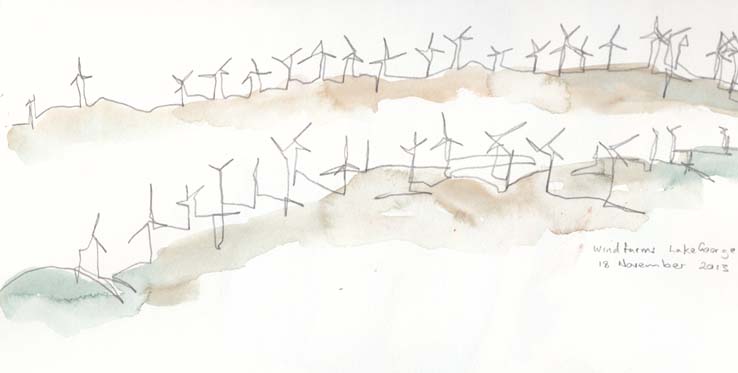
Horizon line and wind turbines, Lake George, 18 November 2013.

Horizon line and wind turbines, Lake George, 18 November 2013.

My first sketch showed me that this was perhaps more challenging than I had imagined. The two lines of wind turbines, drawn above, represented all the turbines I could see. I broke the line in two to fit them all on the page. Scale is clearly an issue. I really need to get closer to the turbines to be able to draw them as more than  stars on sticks. And the wretched things kept moving all the time! Anyway a bit of research on the web has revealed that this wind farm holds open days so I’ve signed up to join a tour at some unspecified time in the future. Further wind turbine drawings will wait.

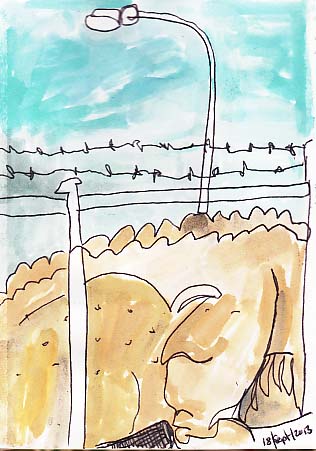
We’d packed a picnic lunch for our little excursion so while I was eating I turned my back on the turbines and looked at what was in front of me. Here I was on more familiar territory, a carpark!

Escarpment and carpark, Lake George, 18 November 2013.

Escarpment and carpark, Lake George, 18 November 2013.

And better still, an overflowing rubbish bin.

Garbage bin, Lake George, 18 November 2013.

Garbage bin, Lake George, 18 November 2013.

Such are the inspirations of the everyday artist.

Cafe Wednesday Catch Up

I haven’t been to our local cafe much recently, but managed to make it both this week and last week.

When I checked back through my sketchbook I found my drawings from early August. So here they are earliest first.

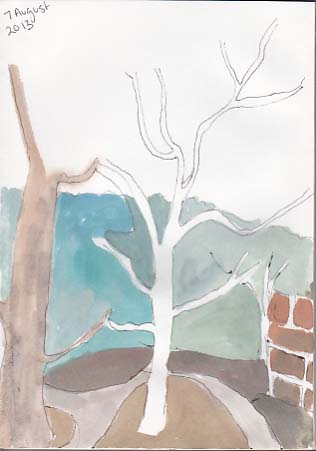
Cafe Wednesday 7 August 2013

Cafe Wednesday 7 August 2013

Cafe Wednesday 14 August 2013

Cafe Wednesday 14 August 2013

The dinosaur’s back.

Cafe Wednesday 18 September 2013

Cafe Wednesday 18 September 2013

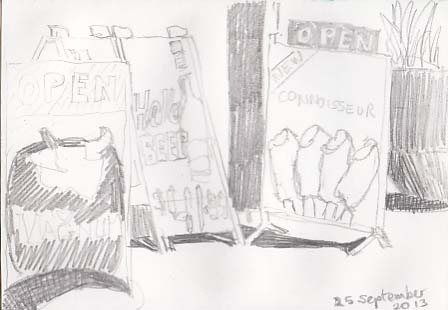
This week I did a pencil sketch of the signs outside the convenience store.

Cafe Wednesday 25 September 2013

Cafe Wednesday 25 September 2013

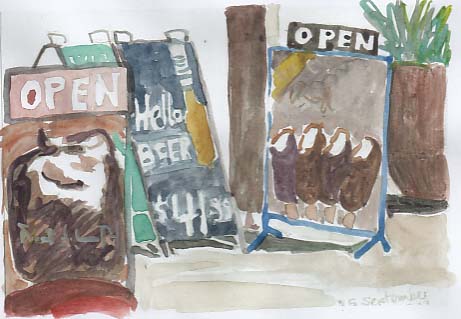
I wanted to put some colour in but was reluctant to work on the original drawing. Thankfully we now have scanning and printing so here is a coloured version of the sign drawing.

Watercolour over a scanned copy of my pencil drawing for 25 September 2013

Watercolour over a scanned copy of my pencil drawing for 25 September 2013

Practice

At the Turner watercolour workshop Toni urged us to keep practising what we had learned to embed it into our skill set. So I’ve been working away on pages of small works.

Practice sheets of small watercolours focussing on the changing light on a nearby hill. # August 2013

Practice sheets of small watercolours focusing on the changing light on a nearby hill. The starting point was the three rapid sketches at the top of the page. 3 August 2013

I also painted two views of Mt Tennant experimenting with warm and cool compositions and some lifting techniques.

Two views of Mt Tennant using warm onto a cool background (l) and cool onto a warm background (r). 3 August 2013

Two views of Mt Tennant using warm onto a cool background (l) and cool onto a warm background (r). 3 August 2013

Then I tried some imagined landscapes and weather effects, with varying degrees of success.

Playing with light effects and imagined landscapes. 3 August 2013

Playing with light effects and imagined landscapes. 3 August 2013

Turner watercolour workshop, Day 2

Day 2 took off at a similar pace to the first day of the class. Toni started by walking us through some ways of making sketches. According to Turner’s contemporaries Turner carried a rolled up sketchbook in his pocket and drew with his pencil as if writing. By leaving the pencil on the surface of the paper the pencil moves easily over the paper and delicate lines can be drawn, which may readily be painted over later. You can draw this way quite quickly and if you have the time additional detail can be added. Another method, even quicker still, is to do a ‘thumbnail’ sketch just getting the most basic shapes in, using the lightest tones at the back and darkest tones at the front. Here is my sample of these two approaches. The top sketch formed the idea for the first colour work below.

Two sketching techniques. The top a pencil moves quickly and lightly over the surface. The lower two are fast thumbnail sketches.

Two sketching techniques. The top a pencil moves quickly and lightly over the surface. The lower two are fast thumbnail sketches.

Turner was able to do 10 to 15 sketches in the time he could do one colour study. If you look at Turner’s sketchbooks you can see the numerous quick sketches that he he made while traveling by carriage through Europe. Once he was settled into his overnight accommodation Turner could then add colour to these studies or further work up his sketches or colour studies.

Toni then demonstrated how to use normal cartridge paper for watercolour studies without having to tape the paper down. The way you do this is to wet both sides of your cartridge paper and place it on a smooth surface, such as a piece of glass or plastic and then the cohesion of the water molecules will hold it in place. Of course you do need to work wet into wet using this approach.

cartridge paper wet of wet technique

Cartridge paper wet of wet technique. The darker lines are made using the end of my brush and the ‘lifted’ area in the upper right is made by flicking my fingernail up the wet paint.

I was really happy with this as a way of doing quick studies. Here is another one.

Waterscape on cartridge paper

Waterscape on cartridge paper

The main drawback with using cartridge paper is that you are pretty limited with the sort of ‘lifting’ techniques you can use. Wiping with a tissue works, but the creating the sun in the image above actually tore into the paper.

After lunch we had a lecture by Dr Joyce Townsend on Turner’s materials. I think that the most amazing aspect of her talk was her obvious delight at being able to actually use Turner’s original pigments, that were left in his studio at his death (part of the Turner Bequest), to paint samples demonstrating the colours he used.

Turner's studio materials: madders of different shades,  on 19th century Whatman paper, painted by Joyce Townsend.

Turner’s studio materials: madders of different shades, on 19th century Whatman paper, painted by Joyce Townsend.

It was then up to us to bring together what we had learned to develop a final work on BFK Rives paper. While this paper is made as a printmaking paper Toni said he had found it to be the best paper to allow working, re-working and lifting techniques including scraping with a knife. Here is my final piece.

Watercolour on BFK Rives paper 31 July 2013

Watercolour on BFK Rives paper 31 July 2013

From my perspective, the quick sketching and fast ways to work up colour studies are the main things I have taken from this workshop. That and the need to get out and apply what I’ve learned over these two days.