Voyage around a loungeroom

In 1790 Xavier de Maistre took a journey around his bedroom, during which he locked his door, put on some pyjamas and examined his room in detail. Last week, without the pyjamas, I traveled to a house in a nearby suburb where, along with 11 other people, I undertook a big journey into a range of ideas about making art. We made our journey through reading and discussion and we even made some art!

One of the most interesting aspects of the week was the shared library. Everyone attending was asked to bring several books that were favourites. We ended up with two bookcases just about full. Those who couldn’t bring books from their own library borrowed books from the local public and university libraries. This allowed us to be inspired by a range of artists and writers who we may not have encountered before. Ruth Hadlow, the workshop convenor also suggested ways in which we could use these books for inspiration, and to help develop new ideas to use in our work.

One artist whose book of sketches is one I’ll be tracking down to add to my library is Kevin Connor. Connor sayswhen you are up against a brick wall or in doubt, draw!”  – he also suggests that the best place to draw from is with your back to a wall, preferably in a friendly coffee shop or bar, so no one can look over your shoulder! Inspired by the intense lines in Connor’s drawings I took up my own pen to make this quick sketch of my coffee mug.
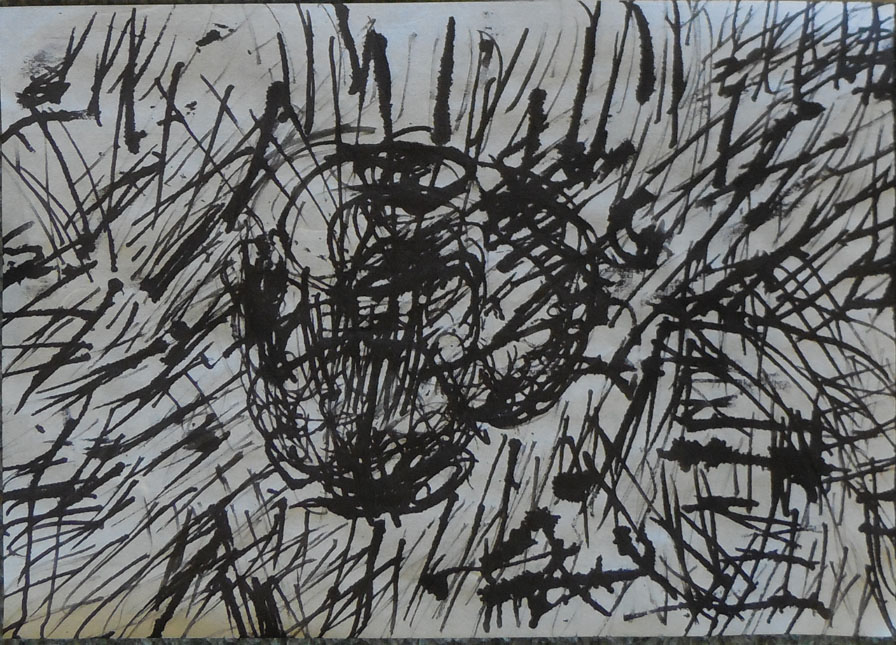
mug, ink with two feathers held together, 28 January 2015

mug, ink with two feathers held together, 28 January 2015

I used a small piece of Japanese writing paper, which I’d already used to blot some other pieces of work. To make the marks I held the shafts of two feathers together and worked directly from my bottle of ink.

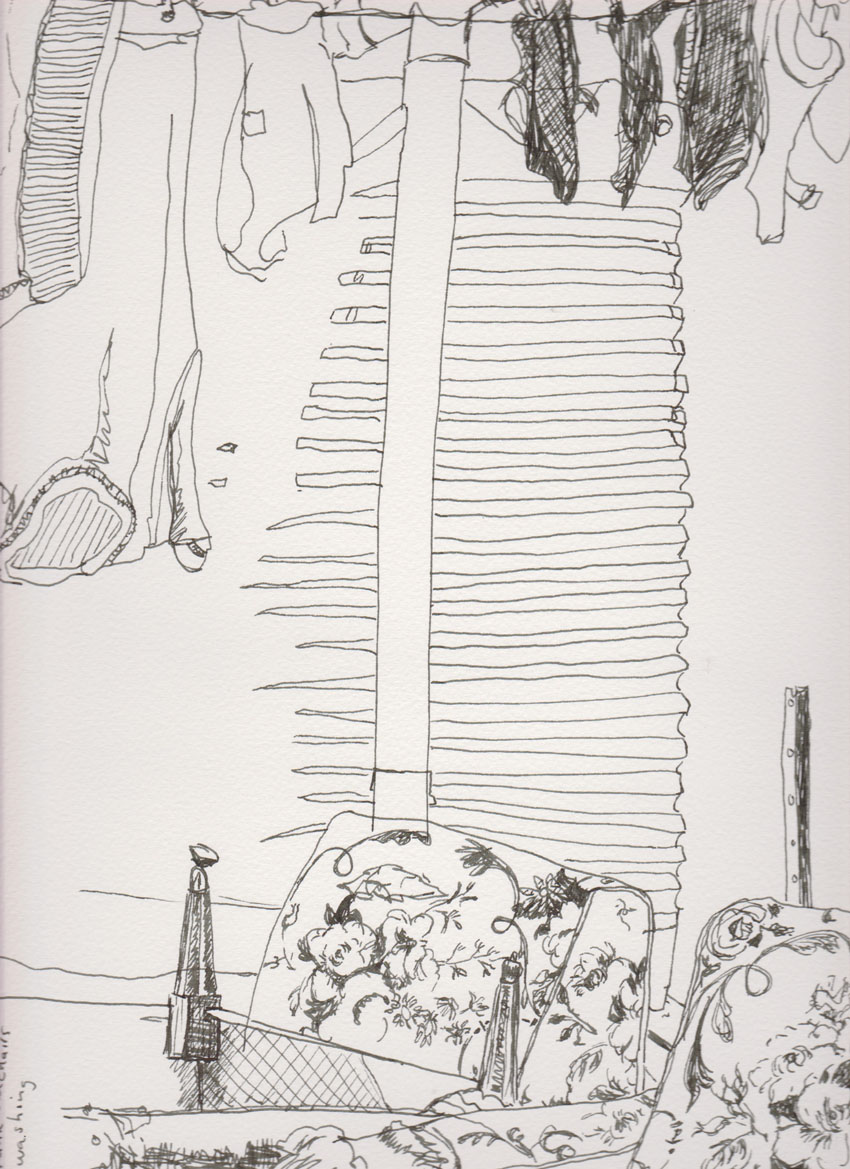
A few days later I decided to draw a piece of clothing, one of the items we’d been asked to bring to the workshop. To get a piece of paper large enough to work on I roughly glued two long narrow sheets together. Without giving it too much thought I grabbed a sheet of newspaper I’d been using to catch spills and tore it roughly into the shape of my garment. I slapped the newspaper onto the backing paper with a mix of PVA glue thinned with water. I didn’t know whether this would work or not, but I knew I had nothing to lose. Once again I took my feathers and started drawing. It was interesting to see the difference between the areas of paper that had glue on it and that without glue. I also used the soft end of one feather to make larger marks.
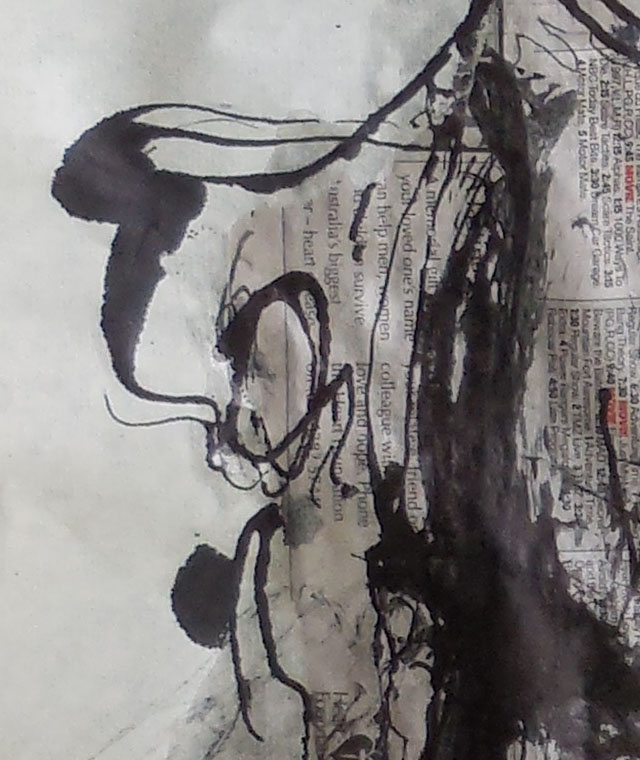
Different textures on paper with and without PVA. The ink blooms on the untreated paper

Different textures on paper with and without PVA. The ink blooms on contact with the untreated paper.

The completed work was really lively and suggests some interesting strategies for making future work.

The finished drawing, ink on newsprint and Japanese paper.

The finished drawing, ink on newsprint and Japanese paper.

It is difficult to describe just exactly what I did during the past week. It was mentally exhausting, but I produced useful ideas for new work and had a ball making new drawings. What could be better than that!


New Year’s Day Breakfast

Happy New Year! We have a long established tradition of breaking bread with our friends and family for our first meal of the new year. Today was no exception. We gathered at our favourite barbeque spot at Lake Tuggeranong and proceeded to eat bacon and eggs, home-made bread and baked beans, some bubbles coffee tea and fruit.

Part of our festive New Year's breakfast, pen and ink and watercolour, 1 January 2015

Part of our festive New Year’s breakfast, pen and ink and watercolour, 1 January 2015

The weather was perfect and everyone had a great time.

Family and friends at Lake Tuggeranong, 1 January 2015, pen and ink and watercolour

Family and friends at Lake Tuggeranong, 1 January 2015, pen and ink and watercolour

At the Australian War Memorial

The Australian War Memorial is the most visited tourist destination in Canberra but it has been some time since I last went there. While we were actually taking a visitor to see the Memorial I realised that it would also be a great place to do some sketching. Following the advice to practice drawing people where they are likely to be doing similar things so you can build up a composite picture, I found a bench in the WWI gallery and started drawing.
image

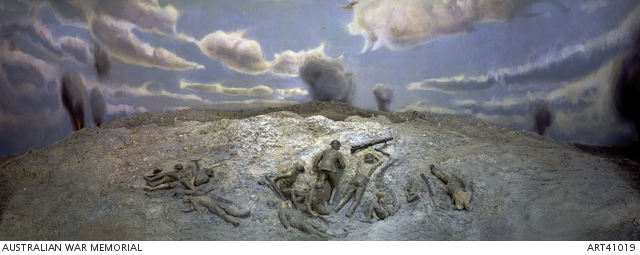
The Poziere diorama
Sculpture: Frank Lynch
Painting: Louis McCubbin, Murray Griffin

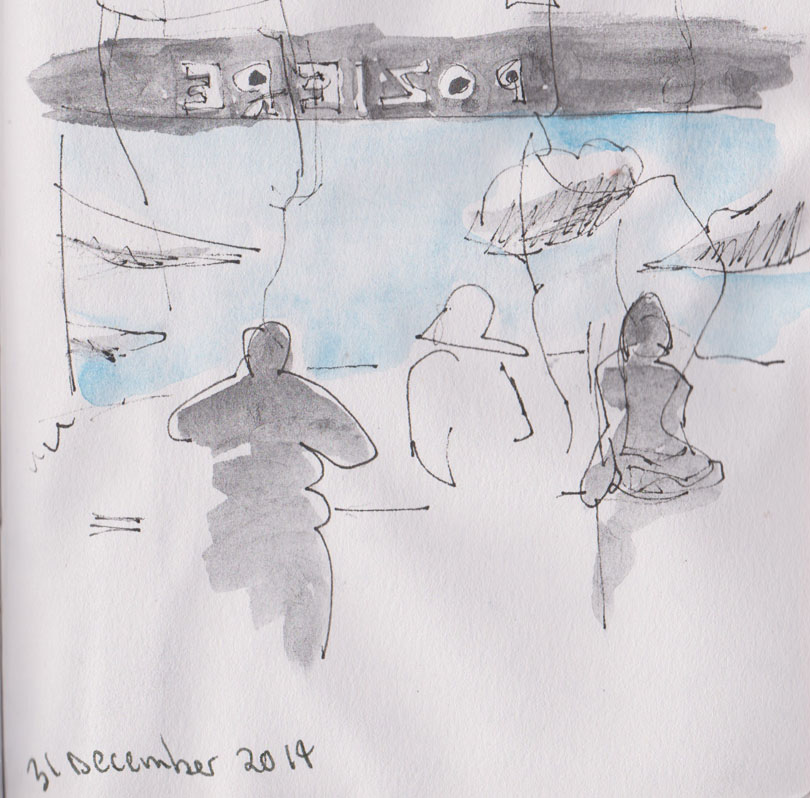
I actually had my back to the Poziere diorama when I realised that the shiny partition in front of me reflected the people looking at the diorama, so I could draw them without having to look directly at anyone.

People looking at the Poziere diorama, Australian War Memorial, Copic Multiliner, graphite and watercolour, 31 December 2014

People looking at the Poziere diorama, Australian War Memorial, Copic Multiliner, graphite and watercolour, 31 December 2014

Things were going swimmingly until a guide brought his tour group between me and the partition. Then someone noticed my drawing and started apologising for being in my way, then the next person also apologised – I knew it was time to move on.

After a break we moved down into ANZAC Hall where I found plenty of space to sit and draw next to the remains of the Japanese Midget submarines that attacked ships in Sydney Harbour in 1942. The low angle allowed me to draw the somewhat dramatic view past a gun from the SMS Emden, (the target of an attack by HMAS Sydney in November 1914), up to the next level and the Landing Place Cafe.

Gun from the SMS Emden and the Landing Place cafe, Australian War Memorial, 31 December 2014, pen and ink, graphite and watercolour.

Gun from the SMS Emden and the Landing Place cafe, Australian War Memorial, 31 December 2014, pen and ink, graphite and watercolour.

We glanced out one of the windows and noticed a ship’s bridge and gun sitting in the courtyard (as you do). So we had to check it out before we left. It turned out to be what remains of the HMAS Brisbane, which was in service from 1966 up until the 1990’s. Not surprisingly this is the largest naval relic in the Memorial’s collection.

The bridge and gun 52 of the HMAS Brisbane, Australian War Memorial 31 December 2014, pen and ink

The bridge and gun 52 of the HMAS Brisbane, Australian War Memorial 31 December 2014, pen and ink. Also an unrelated sketch of several visitors looking down into ANZAC Hall pen and ink and graphite

Our visit today reminded me of what a wealth of interesting subjects could be found at the War Memorial. I’m planning on re-visiting it during the coming year.

Cafe Wednesday triple play

Its nearly Christmas and the family is visiting from interstate. We went up to our local cafe during the week, but instead of just me, there were three of us drawing. It all became a bit self-referential as we drew each other’s books into our own drawings!

Triple play drawings at the cafe, 17 December 2014

Triple play drawings at the cafe, 17 December 2014

For the record here’s my offering.

Cafe setting 17 December 2014, pen and ink

Cafe setting 17 December 2014, pen and ink

Another fine line

I love serendipity – I’ve just started reading the catalogue that accompanies the Chuck Close exhibition I saw last week and there in the introductory essay is Close being quoted on crosshatching. The comment is in response to Close’s early study of Albrecht Dürer’s prints that are held in Yale University’s fine print collection.

“In those Dürer prints I saw that the artist had done what was easiest for him. He glued a piece of paper to a woodblock and drew with a pen. The easiest way to draw tonal gradations with a pen is to make a crosshatch stroke. The hardest thing for a printer who must follow the artist’s drawing to do is cut a crosshatch, because you have to go in and cut out the little spaces in between. If Dürer had to cut his own block, he would have made only one crosshatch drawing and then said, “Hey, wait a minute, what am I doing? I have made something so difficult” He would have immediately abandoned crosshatching. But because other people cut the block he could go ahead and draw whatever he wanted, and it became their problem.”

This makes me think that further variations of the water tank drawing could involve using techniques that could be printed in various formats. By looking at the water tank over the course of the day I have realised that I can use the shadows cast onto the tank can help me define it’s shape, without resorting to cross-hatching. Here is the second drawing, which I did a few days ago using my Lamy Safari pen.

Water tank with old chairs, pen and ink, 12 December 2014

Water tank with old chairs, pen and ink, 12 December 2014