Drawing the Exhibition – Myth + Magic 2

The 16th of September was Papua New Guinea’s Independence Day, so what better way to celebrate than return to the Myth + Magic exhibition at the National Gallery of Australia. This time I also managed to drag some friends along, as well as my partner, so we all set about sketching.

My first target was the Orator’s Stool from the East Sepik. I started with the face and enjoyed working with the deep shadows cast by the dramatic lighting.
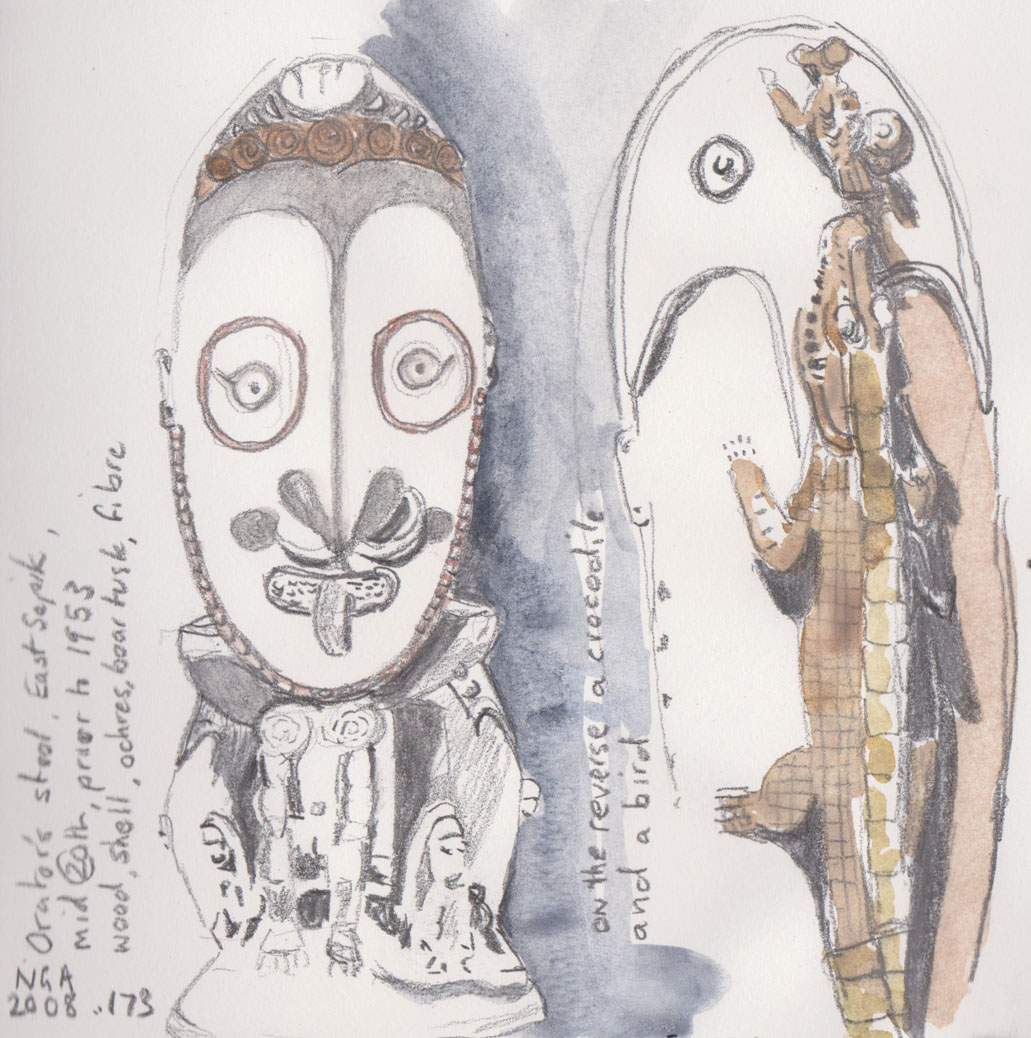
Orator's Stool, East Sepik, PNG, study in graphite pencil with watercolour added later, 16 September 2015

Orator’s Stool, East Sepik, PNG, NGA 2008.173, mid 20th cent. prior to 1953, study in graphite pencil with watercolour added later, 16 September 2015

It was only after I’d finished this first drawing and went to record the details of the work, that I found the carvings of the crocodile and bird on the reverse of the stool.

I still had some 20 minutes before our meet-up time so I went and did a ‘quick’ study of this ancestor plaque.
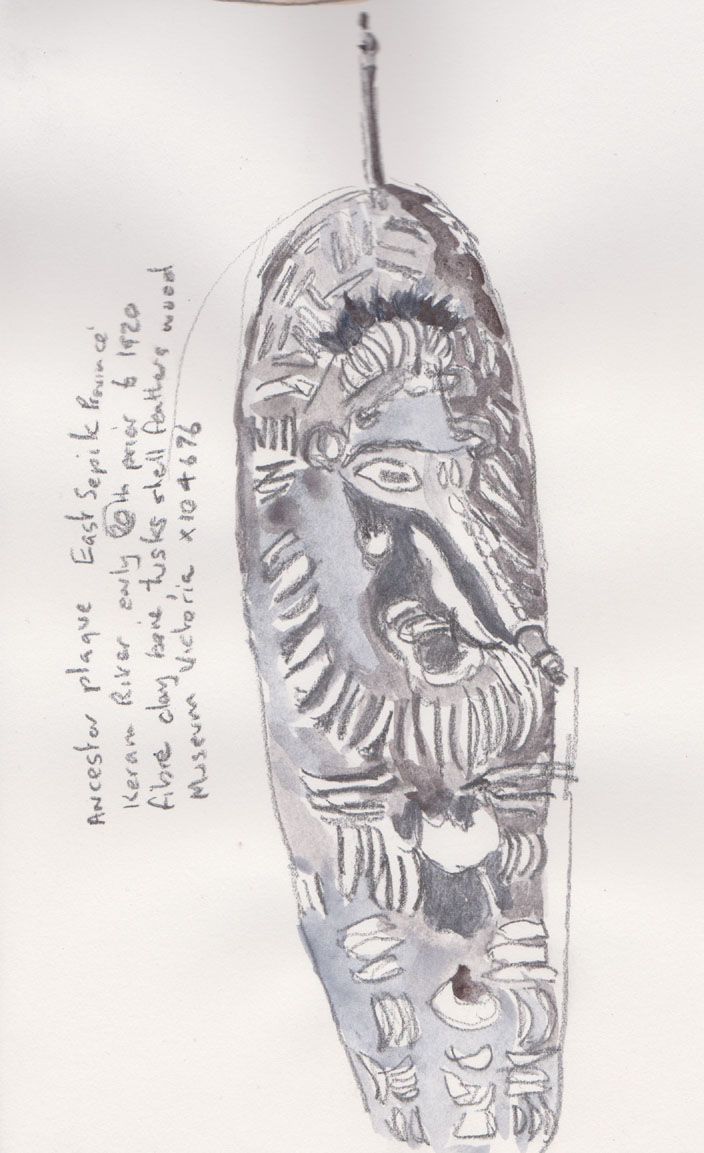
Ancestor Plaque, East Sepik Province, Keram River, early 20th cent. prior to 1920, Museum Victoria X104676, graphite, with added watercolour, 16 September 2015

Ancestor Plaque, East Sepik Province, Keram River, early 20th cent. prior to 1920, Museum Victoria X104676, graphite, with added watercolour, 16 September 2015

This work has a very strong presence. It is made of fibre, largely for the backing and is covered with thick grey mud. It is decorated with lots of embedded pig tusks and shells. The image wears a headband of cassowary feathers. I haven’t captured much of its ‘presence’ so I will try to return and focus on this piece again.

After the drama of the exhibition space it was somewhat of a relief to retreat to the airy lightness of the Members Lounge for lunch. Afterwards, our friends decided that they wanted to look at the Aboriginal and Torres Strait galleries so we headed off there for a final sketch. I sat out near the entrance to draw the giant, 12 metres long, fish trap, that hangs above the gallery foyer.
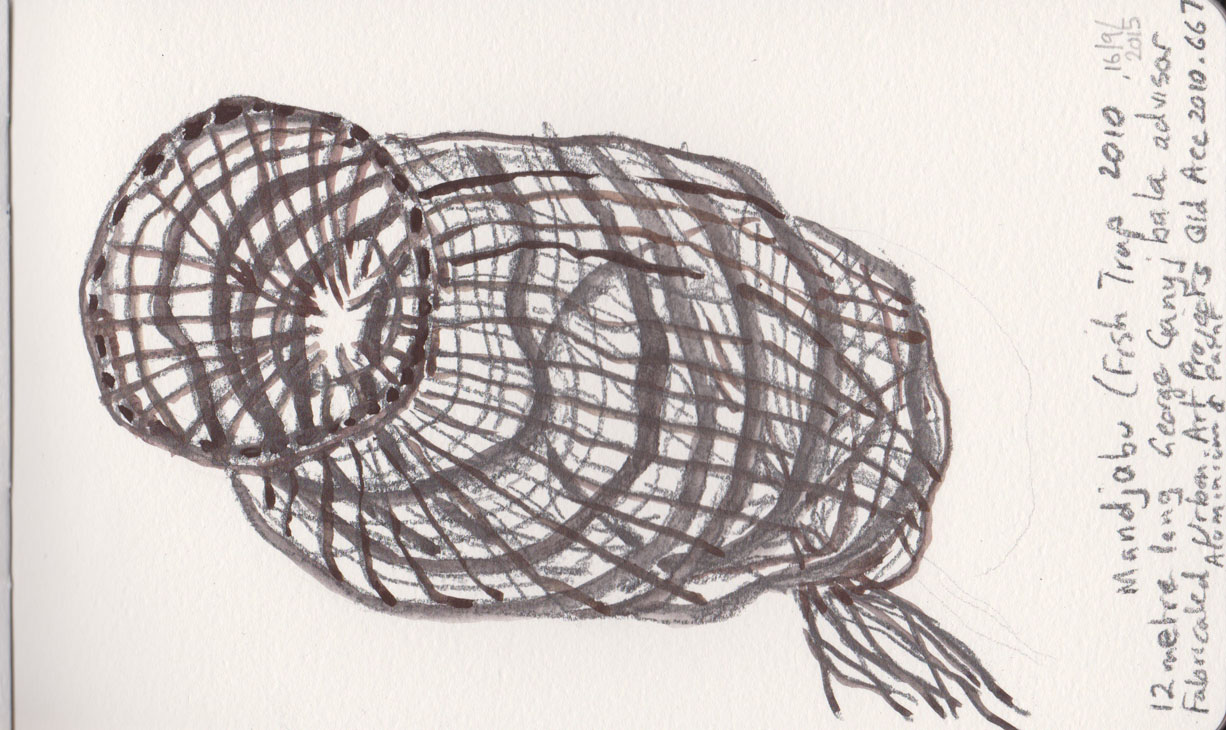
Mandjabu (Fish Trap), 2010, created with assistance from George Ganyjbala, fabricated in aluminium and paint by Urban Arts Projects, Acc2010.667, graphite with added watercolour, 16 September 2015

Mandjabu (Fish Trap), 2010, created with assistance from George Ganyjbala, fabricated in aluminium and paint by Urban Arts Projects, Acc2010.667, graphite with added watercolour, 16 September 2015

I didn’t realise that I was being observed, but this photo gives you an idea of the scale of the work.

The loneliness of the long-distance sketcher, 16 September 2015, National Gallery of Australia

The loneliness of the long-distance sketcher, 16 September 2015, National Gallery of Australia

Drawing the Exhibition – Myth + Magic

Myth + Magic, Art of the Sepik River, Papua New Guinea, is the current featured exhibition at the National Gallery of Australia (NGA). The art works on display are predominantly sculptural and relate to the spiritual practices of the people who live along this major river system of Papua New Guinea. The works are quite dramatic and often have a visceral quality which derives both from their subject matter and also from the materials they are made from – wood, shell, pig tusk, fibre fur, hair and mud. This sense of drama is enhanced by the display of these items in largely darkened rooms set off by tightly focused spotlights.
There are a plethora of interesting subjects to draw. I was intrigued by these two large figures which are costumes worn during initiation ceremonies. They represent spirits or awan, that “frighten harass and bully” young initiates during their period of seclusion. Like many other pieces on display, these items were collected in 1916, when Australian forces entered the Sepik River to wrest control of the territory from Germany, as an extreme outlying action of the First World War.

Two awan (spirit) costumes, East Sepik River, before 1916 collected by Captain Walter Balfour Ogilvy, from the collection of the Museum of Victoria. Water soluble graphite

Two awan (spirit) costumes, East Sepik River, before 1916 collected by Captain Walter Balfour Ogilvy, from the collection of the Museum of Victoria. Water soluble graphite, 17 August 2015

These costumes are constructed of fibre, the bodies are woven from plant material and are decorated with clay, shell hair and ochre. The figure to the rear has a head dress made of densely packed cassowary feathers. When the costumes are worn all that can be seen are the wearers feet (there is a photograph of similar costumes being worn, in the exhibition catalogue). The wearer can look through the mouth opening of the nearest figure and the second figure has two eyeholes in the chest to see through.

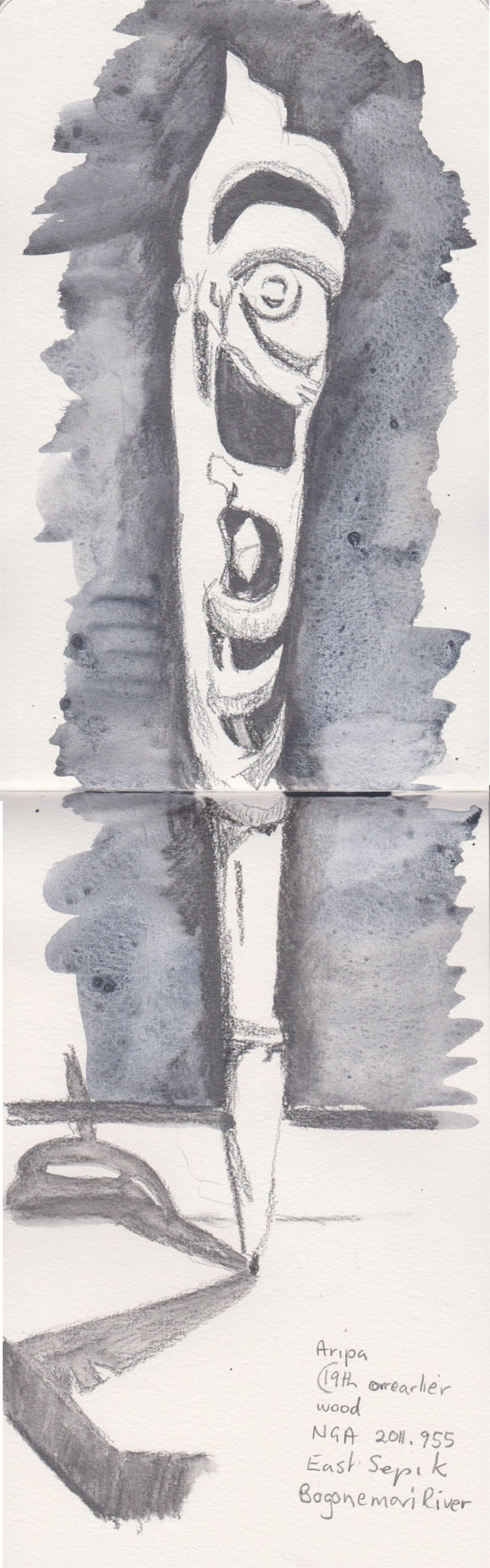
In each room there were astonishing items to see. In the last room, apart from the massively carved crocodile sculpture on loan from the Museum of Papua New Guinea, are several aripa, or hunting helpers. These aripa are an abstracted human figure, sublimed to a most minimal form, ‘standing’ on their one foot. To quote from the website “If the spirit [aripa] has been correctly appeased it will track down and kill the desired prey’s spirit so it will show itself to the hunter to be killed easily. It was believed the soul (tite) of the aripa spirit being, not the artist, was responsible for the creation of their physical bodies.”

Aripa, 19th century or earlier, wood, Bogonemori River, east Sepik, collection of the National Gallery of Australia, Water soluble graphite and watercolour (added later), 17 August 2015

Aripa, 19th century or earlier, wood, Bogonemori River, east Sepik, collection of the National Gallery of Australia, Water soluble graphite and watercolour (added later), 17 August 2015

While we were in the gallery my partner commented on how the sculptures felt somehow familiar – even though we hadn’t seen them previously. We concluded that this sense came not from these figures per se, but from the inclusion of tribal art or the influence of similar works from Africa and elsewhere in the globe, into ‘modern’ art of the early 20th century. We had seen the reflection and now we were seeing the ‘real thing’.

The exhibition is on until 1 November 2015 at the National Gallery of Australia in Canberra. It will not be touring. Well worth a visit if you are in the area.

… meanwhile back at the ranch

So here we are back home after our fantastic holiday and the question is how to keep up the drawing momentum and not forget the lessons we learned at the Urban Sketchers symposium. OK we all know the answer, just keep drawing!

Last Sunday we took off down to the edge of Lake Burley-Griffin to draw in the warm winter sunshine. I selected the High Court, with the flags of the world in front and just a bit of the fairly-recently opened NGA Contemporary gallery.

NGA Contemporary and the High Court, watercolour and brush pen, 9 August 2015

NGA Contemporary and the High Court, watercolour and brush pen, 9 August 2015

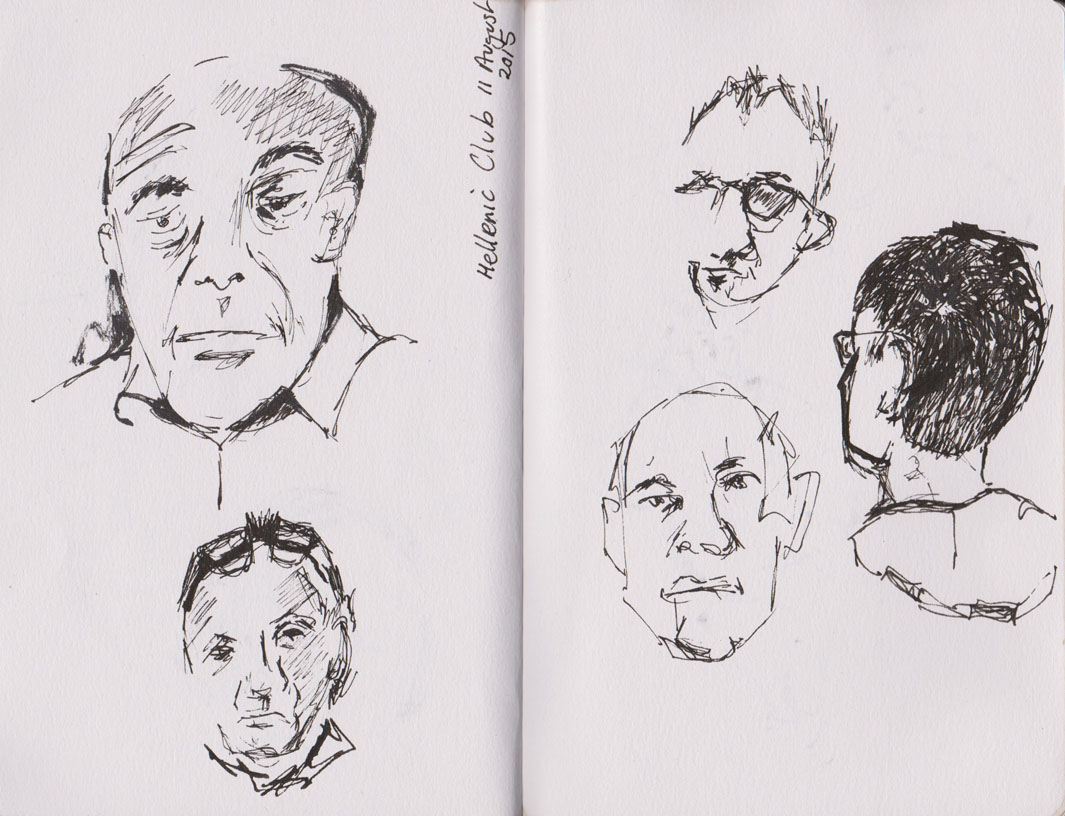
Drawing landscapes is what I like doing, drawing people is my weak spot. Now it’s back to the cafes with a purpose. I aim to make at least one and preferably several sketches, each time I’m having my coffee. I’ve also realised that our pub trivia venue is a good place to capture faces and figures as people tend to sit still, or at least still-er while the quiz is underway. There’s only one ‘ax-murderer’ in this lot – I must be learning something!

Some faces at last week's pub quiz, pen and ink and brush pen, 11 August 2015

Some faces at last week’s pub quiz, pen and ink and brush pen, 11 August 2015

We also came back from Singapore groaning under the weight of new art supplies. Not only were the symposium sponsors extremely generous (thanks to Moleskine, Leuchtturm, Creatacolor, Caran D’Ache, Pen Up, Shop Oryx, ShinHanart, Super5, Stillman & Birn, Art Friend, Worther, Arters, Straits Arts, Bynd Artisan and Laloran); we bought lots of supplies at Art Friend and the small but beautifully formed Straits Arts (so much cheaper than in Australia); and we also scored some great prizes in the mega raffle. To add to the haul I also received a very delayed parcel of art supplies from a local supplier in my mail when I got home!

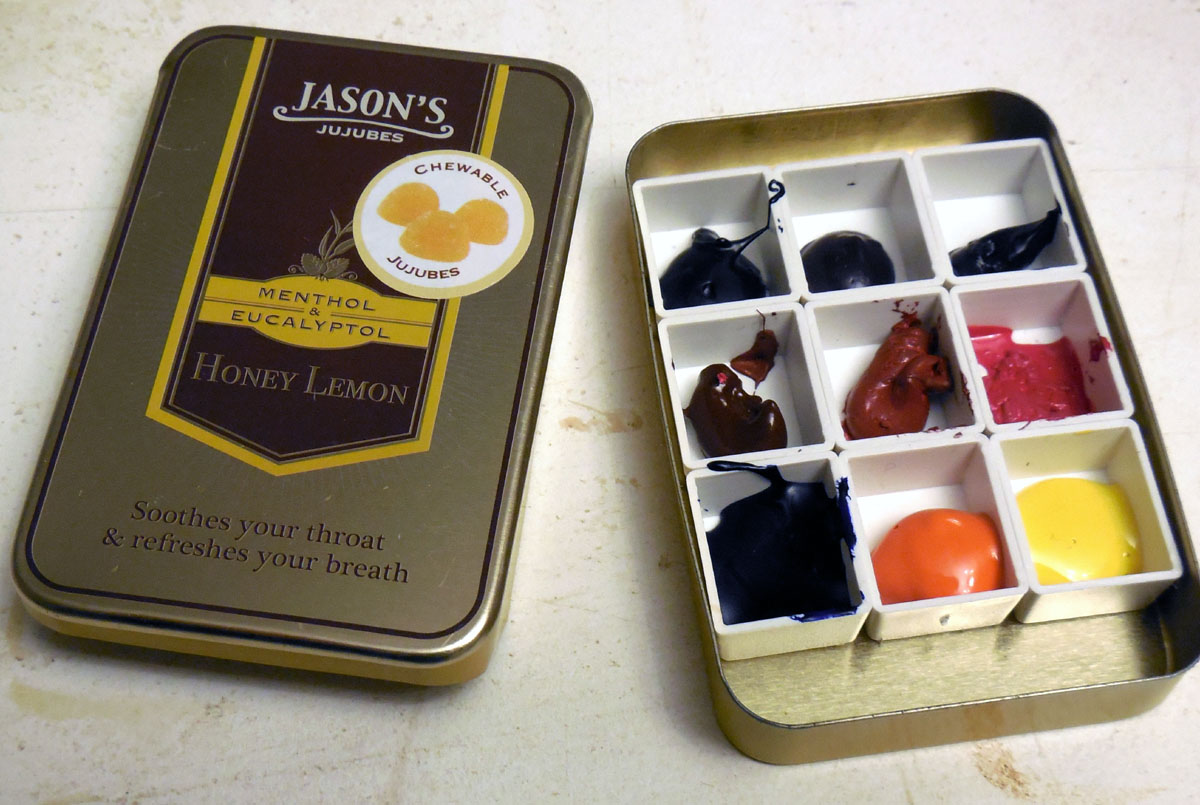
One of our purchases in Singapore was lots of empty half-pans (only to find another 50 in my parcel on my return!). My partner has also been on the lookout for some small metal tins, to make some very compact watercolour sets, (Altoids not being commonly around in Australia). Anyway, we found these tins in Bangkok and they are just right for 9 half pans. At 5 cms x 7.5 cms they are very compact. Given that one of the prizes my partner scored was a set of 32 tubes of watercolour paint we have almost endless colour options to choose from.

Home made compact watercolour set

Home made compact watercolour set


Dr Sketchy and the blue woman

Last week we went to our second Dr Sketchy event at the National Gallery. It seems odd that such an event takes place withing the formality of Gandel Hall, however everyone enjoys themselves, the burlesque is well done and the art making fun.

This time we had two male models which provided different body shapes and poses to come to terms with.

Three two minute poses, graphite, 2 July 2015

Three two minute poses, graphite, 2 July 2015

We worked up from two and five minute poses to longer poses at the end of the evening.

Two, five minute poses, graphite, 2 July 2015

Two, five minute poses, graphite, 2 July 2015

And then there was the blue woman. Two of the models were covered in body paint and despite the colour, or perhaps because of it, I found it much easier to come to grips with the shape of their bodies when I drew them. One of the women was painted blue (not Yves Klein blue I hasten to add) and wore a white wig. I really enjoyed drawing her.

Five minute pose, graphite, 2 July 2015

The Blue Woman, five minute pose, graphite, 2 July 2015

Per usual the gallery restriction on media meant I was limited in how I could respond to the colourful models. One of the other people at our table gave me some chalk pastels and pastel paper which allowed me to make a more colourful drawing.

The Blue Woman, chalk pastel, 2 July 2015

The Blue Woman, chalk pastel, 2 July 2015

I enjoy these evenings as I come away with a sense of having had a really good artistic workout.

Bye bye Betty

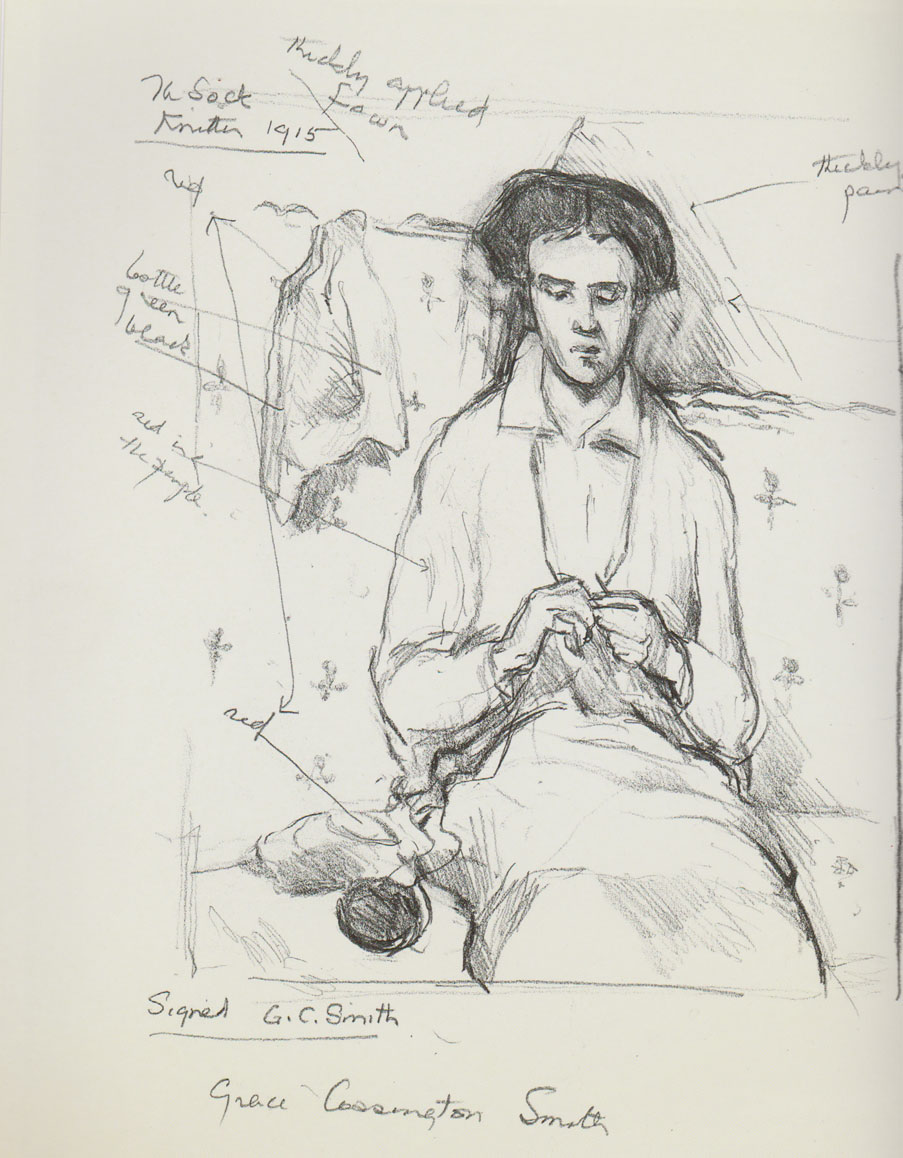
There was sad news today that Betty Churcher, to date still the only woman to be the head of the National Gallery of Australia, died earlier this week at the age of 84. It was a cruel irony that, prior to her death, this champion of the visual arts was losing her sight, because of a melanoma in one eye and to macular degeneration in the other.

What will stick in my mind is her commitment to sharing her knowledge of art with the broader Australian public and her commitment to drawing. On realising that her eyesight was failing, Churcher determined to visit her favourite works of art both in Australian and international galleries. The result are two stimulating books, Notebooks and Australian Notebooks which include her drawn studies of works of art. Her studies were made with such close observation that her drawings often reveal elements of extremely well-know paintings that I for one have totally missed.

She was truly a national treasure. So so long Betty, we’ll miss you!

Betty Churcher's drawing of The Sock Knitter by Grace Cossington Smith, 1915 in the collection of the Art Gallery of New South Wales

Betty Churcher’s drawing of The Sock Knitter by Grace Cossington Smith, 1915 in the collection of the Art Gallery of New South Wales