All the uni students are out and relaxing on the street.

Guilin is warm (28C) and a bit humid. We are off to see the cormorant fishing this evening. Should be fun.
All the uni students are out and relaxing on the street.
Guilin is warm (28C) and a bit humid. We are off to see the cormorant fishing this evening. Should be fun.
I entered the central garden area of the Suzhou Museum and immediately this wonderful architectural space gave me the strong sensation of stopping and taking a deep breath.
Designed by the internationally renowned architect IM Pei, the museum was completed in 2006 and is said to be his last design.
I only got to visit because I pleaded with my guide to let me off the leash while the rest of our group went to the Humble Administrators garden next door to the Museum. I got 45 minutes to look before I had to rejoin my group.
While I seriously considered spending all of my short time at the museum sitting and looking at Pei’s rock garden I dragged myself away and did what would have to be one of the fastest museum ‘crawls’ on record.

Thankfully I had left my camera on the bus so I had to draw to if I wanted to record anything. Here are the two items I drew. Firstly a stone in the Song Pavillion, a reconstruction of a scholars’ room. It came mounted on its own completely made to measure stand.
In the Neolithic section a sand cast ‘tripod’ ceramic pot which had a wonderful surface texture and a compelling shape.
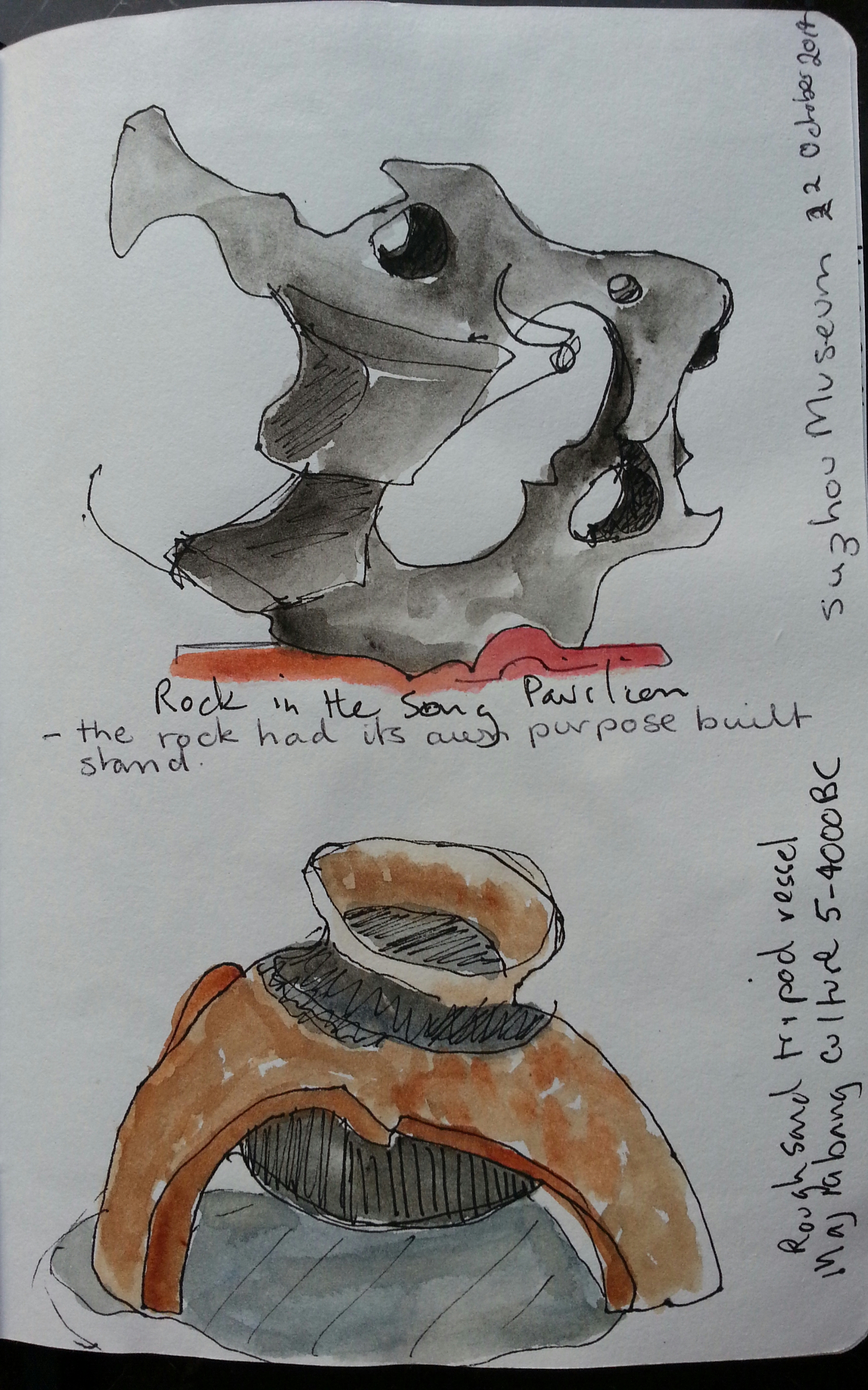
Finally I returned to the garden and spent my remaing 10 minutes drawing part of the rock garden.
Not surprisingly all the colour on these drawings was added after I returned to the hotel.
I would have loved to spend more time here, but at least I got there in the end. If you ever get the chance to visit please go.
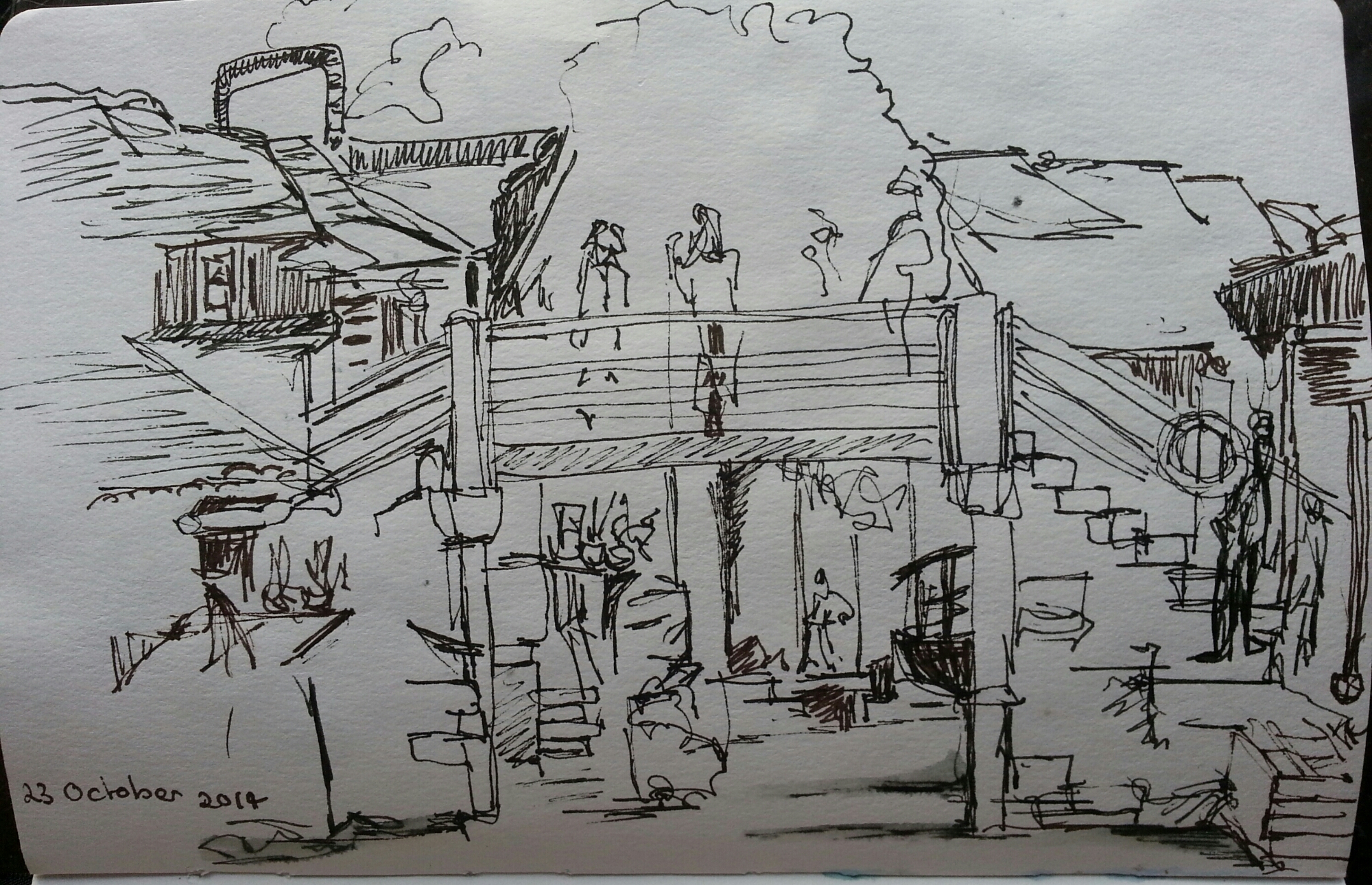
Today (23October)we spent a lot of time on the road. The driving was divided in two by spending several hours in Wuzhen, a small gem of a town, albeit stuffed full of tourists. The ‘town’ consists of several twisting narrow streets lined with old wooden houses either side of a section of canal. I took a camera battery’s worth of architectural details, wooden doorways and canal views. After lunch we had some free time so I sketched the canal with one of the stone bridges that cross it.
A major retrospective of Arthur Boyd’s work is currently on show at the National Gallery of Australia. Drawing largely on the donations of work that the artist made to the gallery in 1975, the show includes works in a range of media, from pen and ink, oil, oil and tempera, pastel and tapestry.
With a show of such magnitude I can only touch on a few points I found of interest. Firstly I agree with the friend who commented on the wide range of styles that Boyd employed or reflected over the years. To my mind Boyd’s early works went from reflections of the Heidelberg School (Australian Impressionism), then to a strong influence of the artist Albert Tucker. At the same time his drawings in pen, ink and wash have a decided renaissance feel to them, possibly enhanced by their mythological and biblical themes. By the time he gets to England you can see strong influences of Turner, particularly in his landscapes.
I also felt that the hanging series of work, such as the Nebuchadnezzar paintings and the ‘caged painter’ series, reset my response to many of the individual paintings I had previously seen. The Nebuchadnezzar series, depicts episodes in the wanderings of Nebuchadnezzar and includes quite lyrical works which I was unfamiliar with.

Arthur Boyd, Nebuchadnezzar’s dream of the tree 1969 oil on canvas 174.5 h x 183.0 w cm, National Gallery of Australia, 1975.3.95
My favourite work was an oil, painted in 1979-80, titled A Skate in a Merric Boyd Pot. In this work a skate, an image which Boyd has painted many times, is merged with and is emerging from the type of pot that characterised the work of his father, the studio potter, Merric Boyd.

Skate in a Merric boyd Pot, pencil and watercolour, 15 October 2014
I spent a lot of time looking at the many examples of drawing displayed throughout the exhibition. Boyd showed the same facility with drafting, as did the young Picasso, then proceeded to refine and simplify his style as he grew more experienced.

Arthur Boyd, Figure in a fountain with watching figures 1944-1949 ink; paper , drawing in pen, brush and black ink 38.0 h x 56.0 w cm, national Gallery of Australia, 1975.3.1381
In his later works, the figures emphasise hands and feet, and faces are represented by blots for eyes and nostrils and small lines for mouths. These are no less powerful works for their brief notations. I tried to capture this focus in the quick study of the hands in one of the works in the St Francis tapestry series.
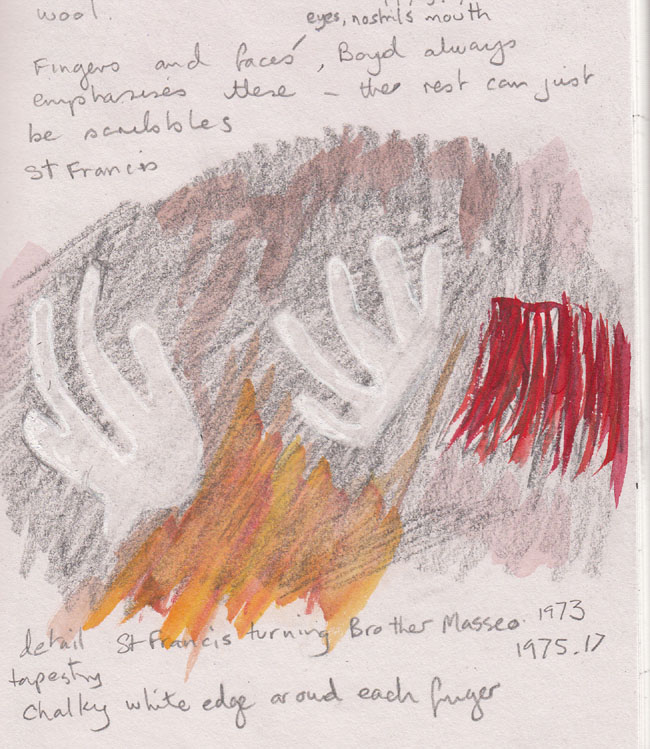
A detail of St Francis Turning Brother Masseo, pencil, eraser and watercolour, 15 October 2014
This final room is a fitting conclusion to the exhibition, showing nine of the 17 St Francis tapestries, designed by Boyd and superbly woven in Portugal at the Tapapecarias de Portalegre. As you approach, the works appear, glowing, quite literally with the strong colours Boyd used in his pastels, translated into the very large woollen tapestries.
For locals there are still another few weeks to see the exhibition, which runs until 9 November. Don’t be put off by the introduction of paid parking at the National Gallery. Visitors can validate their parking ticket at the cloak desk and will get free parking for 3 hours.

It’s spring and the umbrellas are out again!, pen and ink and acrylic paint maker, 16 September 2014
In the final weeks before my show I’ve been drawing, but haven’t had time to post. In the main I’ve been taking my cafe breaks (and even fitting in the gym!) so I don’t injure myself with all the repetitive stitching that goes into my exhibition work. So here they are, several more weeks of cafe drawings.

The curbside at Biginelli’s Cafe, pen and ink, 17 September 2014
Back at Biginelli’s and drawing faster, just like Jo suggested!

At Biginelli’s again, a week later, pen and ink, 24 September 2014
A not so quick drawing, mixing blind drawing and a more ‘observational’ approach.
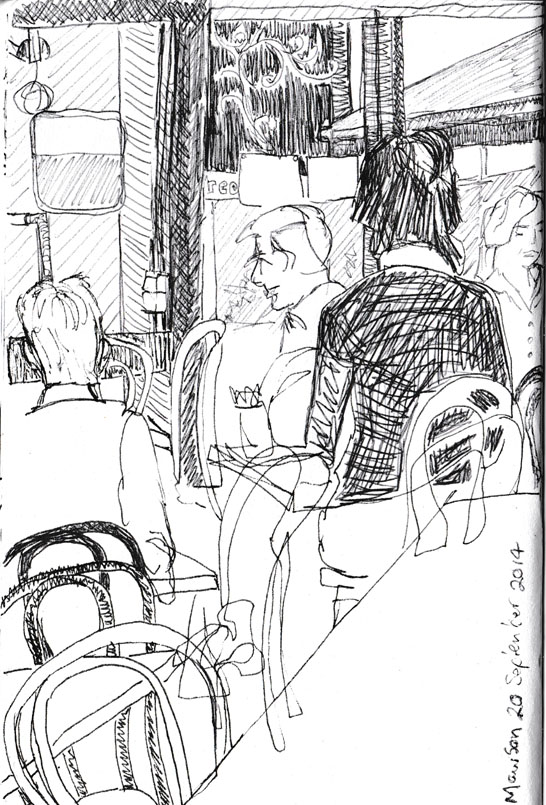
The Italian Bakery, pen and ink, 20 September 2014
I’m still working on drawing people. Strangely, to me at least, getting a rough idea of the hairstyle seems to help with the drawing.

Group sitting at the Italian Bakery, pen and ink and acrylic marker, 27 September 2014
Finished at last, a celebratory coffee with a passionfruit and polenta cake!

My Cafe at Manuka with umbrella and a man on the phone, pen and ink and acrylic marker, 1 October 2014

