Material concerns

Sketching materials often cause me a dilemma. Like many sketchers I run the risk of paralysis from too much choice. When I made my trip to Brisbane last week I decided on one sketchbook – a grey-tone Strathmore and a limited selection of pens/pencils. My main pencils were Koh-i-noor Magic pencils, so I couldn’t ‘control’ to any extent  the colours that came out. I didn’t know whether I could do it! Indeed I did resort to one digital drawing.

Brisbane River Bridges, digital drawing on PS Touch app (for Android)

Brisbane River Bridges, digital drawing on PS Touch app (for Android)

Despite this small detour I did get back on track.This sketch uses only coloured pencil and white chalk. I used several types of the Magic pencils: Original, Fire and America.

Late afternoon sun on the Storey Bridge Brisbane, coloured pencil, white chalk, 20 January 2016

Late afternoon sun on the Storey Bridge Brisbane, coloured pencil, white chalk, 20 January 2016

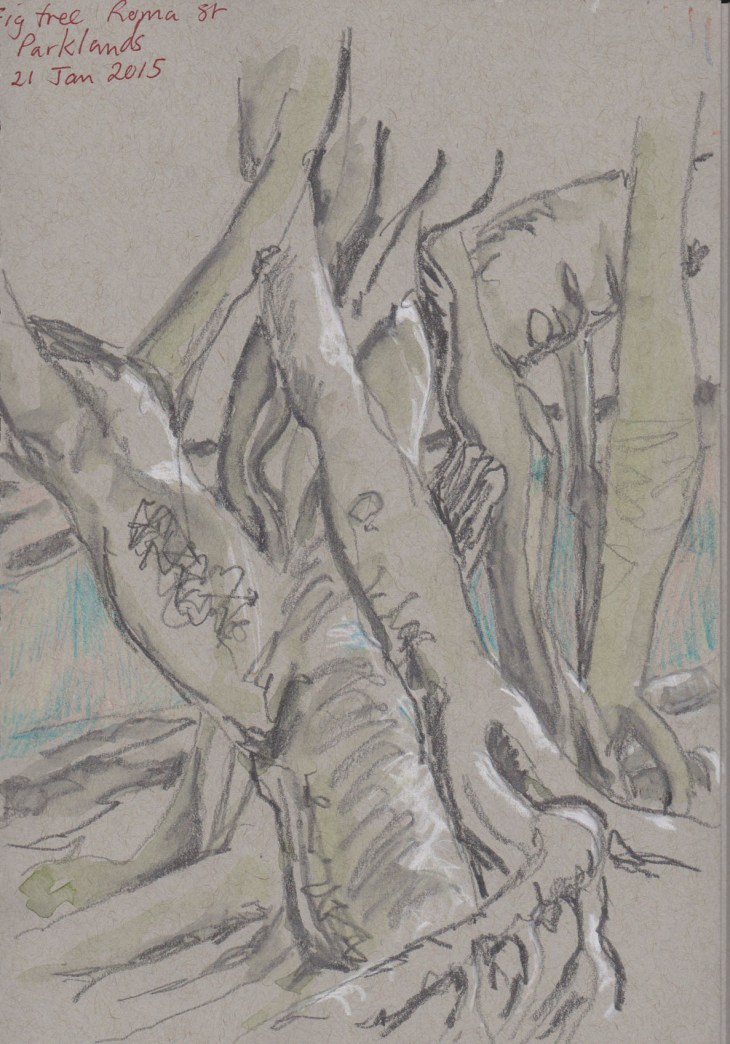
The next day we took our sketch books up to the Roma St Parklands where the twisting shapes of the Moreton Bay figs captured my attention.

Fig tree, Roma Street Parklands, white chalk, graphite and coloured pencil, 21 January 2016

Fig tree, Roma Street Parklands, white chalk, graphite and coloured pencil, 21 January 2016

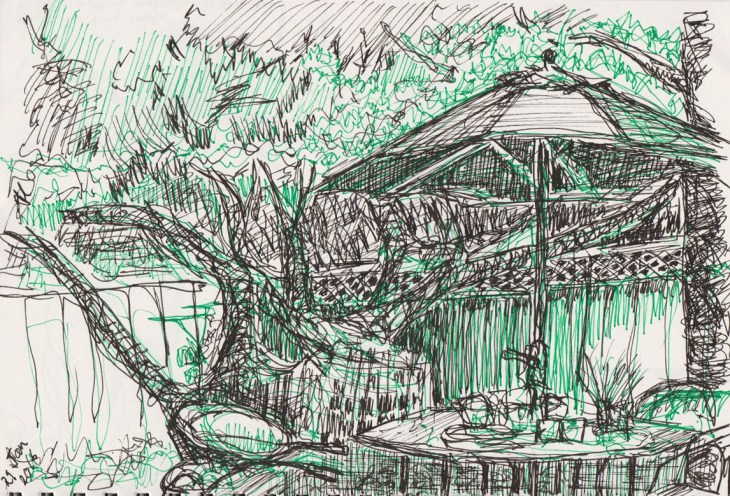
Back home I realised that I hadn’t picked up a pencil in days so I grabbed what was to hand, a green Artline fibre pen and my black ink pen and got down to it.

Backyard, green fineline pen and ink, 29 January 2016

Backyard, green fine line pen and ink, 29 January 2016

It can be a challenge just getting past that ‘perfection’ monkey, but it’s always worth getting out and just drawing.

Taking the line to the landscape

Following on from my ‘two pencil’ practice in my last post, I decided to try the technique out on some nearby landscapes.  We are down at the coast for a week. At one end of the beach are some small but interesting cliffs, full of bulges and striations, layers and different colours.

image

The cliff at the northern end of Long Beach, near Bateman's Bay, NSW. Graphite, coloured pencil, gel pen and watercolour

I had so much fun working on this piece. As I was by myself I had plenty of time to fill the whole page with colour.  In trying to keep the loose approach I applied my paint with some small sticks I picked up on the sand.
I’ve done two more drawings since, but I haven’t had as much time to work on them.

image

Snapper Island from Surfside. Graphite, colour pencils, gel pen and watercolour.

The bay and nearby coast provide plenty of subjects to sketch. My most recent one is a bit further down the coast at Guerrilla Bay, one of the most popular dive and snorkeling sites around. Jimmy’s Islet protects the bay from the worst of the weather.

image

Jimmy's Islet in Guerilla Bay NSW. Watercolour, ink, graphite and coloured pencils


We’ve snorkeled here for the past two days. The variety and number of fish and the size of the various seashells makes you realise just how degraded many coastal areas are. This bay is part of a marine park so we have had some great experiences particularly spotting Banjo Sharks on both days.

Drawing the exhibition – Masterpieces from the Hermitage

It’s getting close to the end of the latest Winter Masterpieces show at the National Gallery of Victoria, Masterpieces from the Hermitage, so four of us decided to hop on a plane and head to Melbourne to spend a day with some of Catherine the Great’s collection, now housed at the Hermitage in St Petersburg. Catherine certainly collected a lot of art and other things in her time and lets face it, she had a lot of walls she could fill. So this exhibition is only a small sample of what she owned.
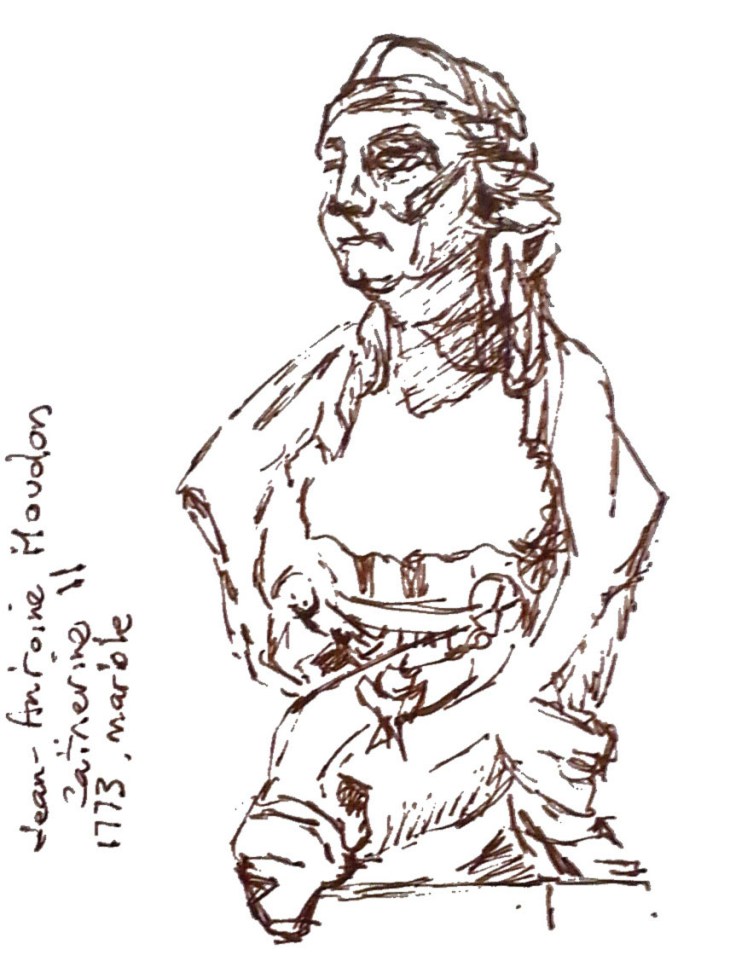
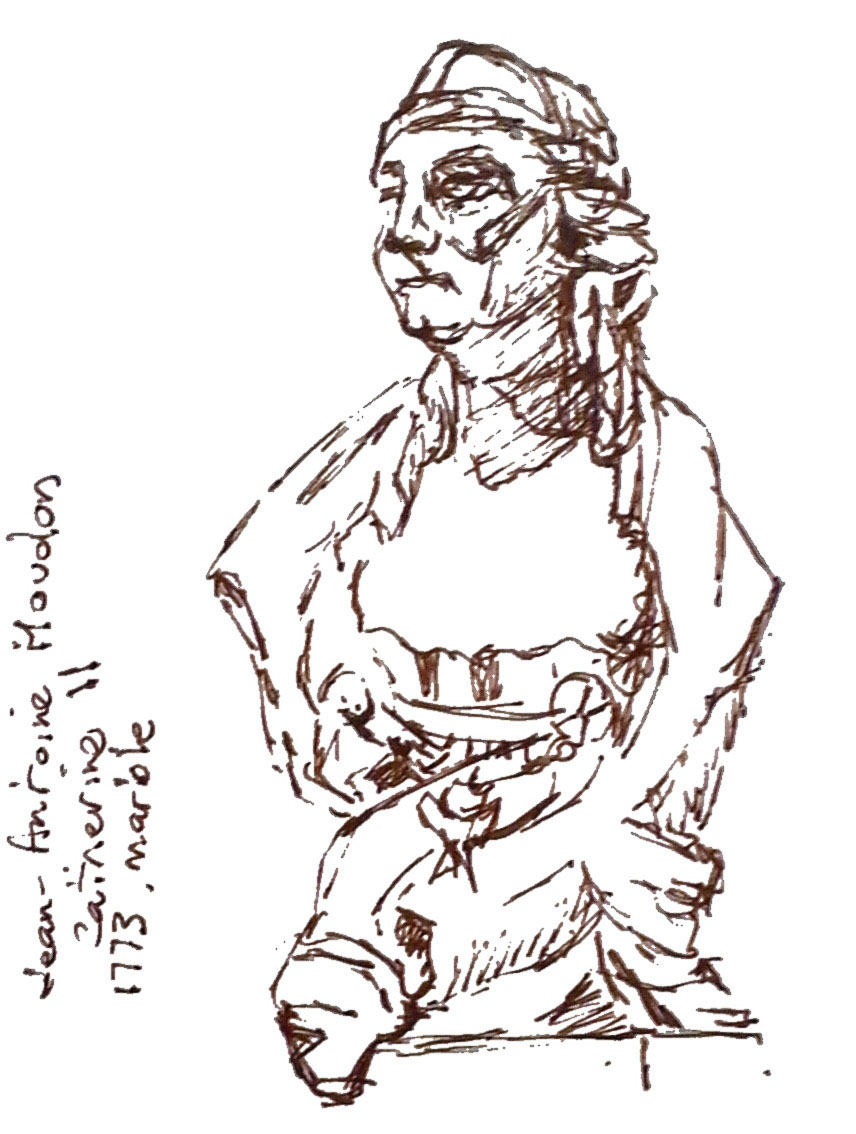
Catherine II (the Great), by Jean-Antoine Houdon, 1773 marble, pen and ink

Catherine II (the Great), by Jean-Antoine Houdon, 1773, marble, my sketch in pen and ink

I’m always interested in what will catch my attention at this type of exhibition and here it was resoundingly the Flemish works and particularly those of Sir Anthony van Dyck. Per usual I chose to draw a number of works in the exhibition. In a situation when you are exposed to so many works of high quality it gives you some space to just sit and ‘be’ with a work, at least somewhat longer than the nominal art gallery average of 10 seconds per painting.

However in my hurry to refill my pens prior to leaving for Melbourne, I accidentally filled them with ink that does not really work with my Lamy,  so apologies in advance for some scratchy pen work.

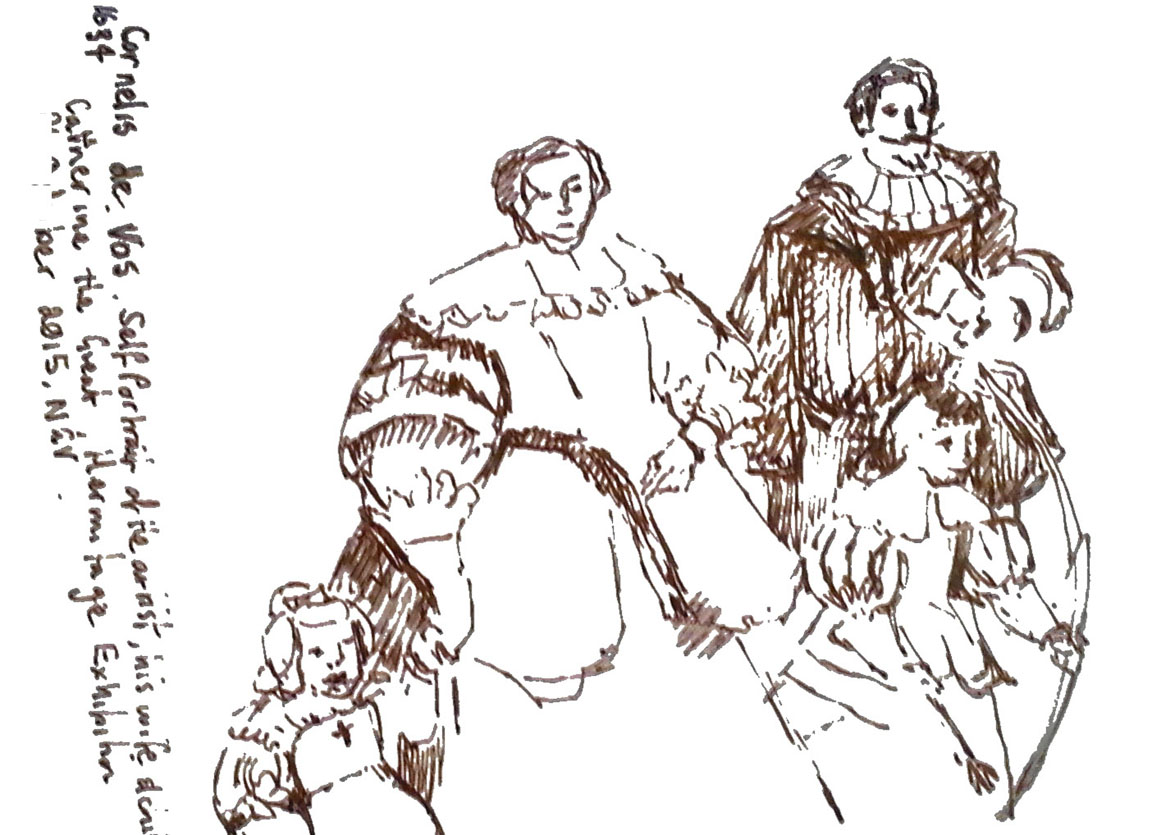
The first work to catch my attention was a family grouping by Cornelis de Vos, Self-portrait of the artist with his wife Suzanne Cock and their children.
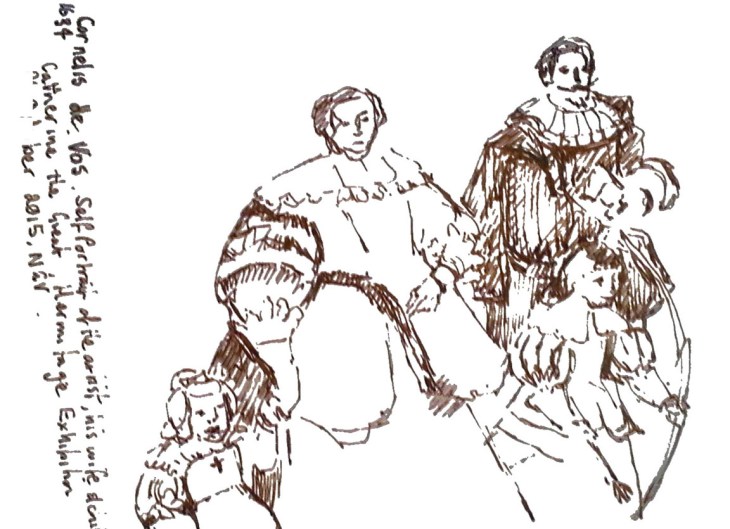
Self-portrait of the artist with his wife Suzanne Cock and their children, c1634, oil on canvas, pen and ink

Self-portrait of the artist with his wife Suzanne Cock and their children, c1634, oil on canvas, my sketch in pen and ink

My study doesn’t capture the older children of the family, just the two youngest, one holding a bow and arrow and the youngest on leading reins. In the original the parent’s clothes form large dark masses against which their faces and those of their children are naturally highlighted. From the quality and amount of lace, fine silk and jewellery being worn by the family you get the distinct impression that the art business was good for de Vos. I found his depiction of his young children particularly charming.

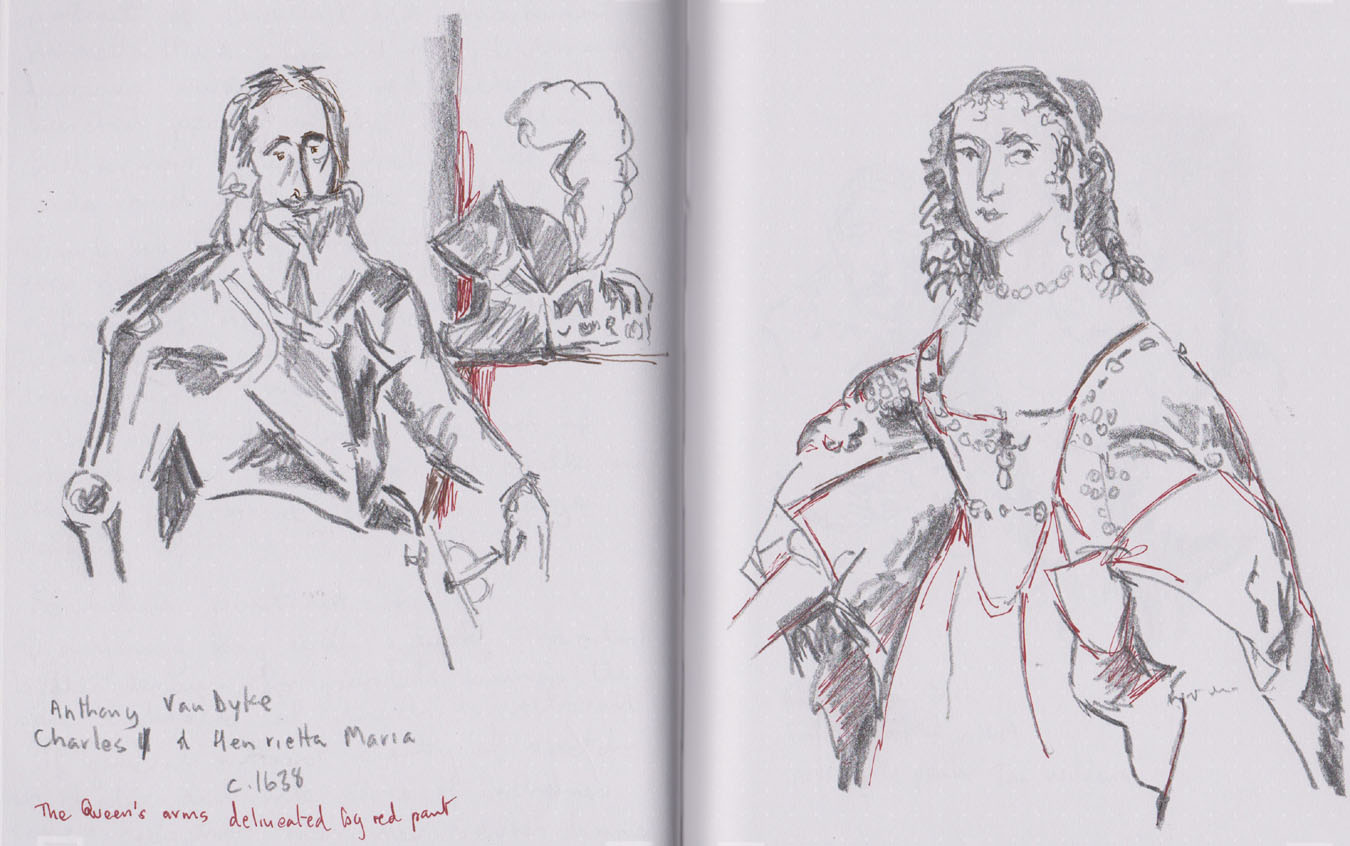
A large leap up the social ladder from the wealthy merchants that de Vos painted are Sir Anthony van Dyck’s paired portraits of Charles I of England and his Queen Henrietta-Maria. At over 2 metres in height they dominated the room they were hung in. The refinement of their faces, the lustre of the armour, silk and pearls made them hard to look away from, as was no doubt intended.
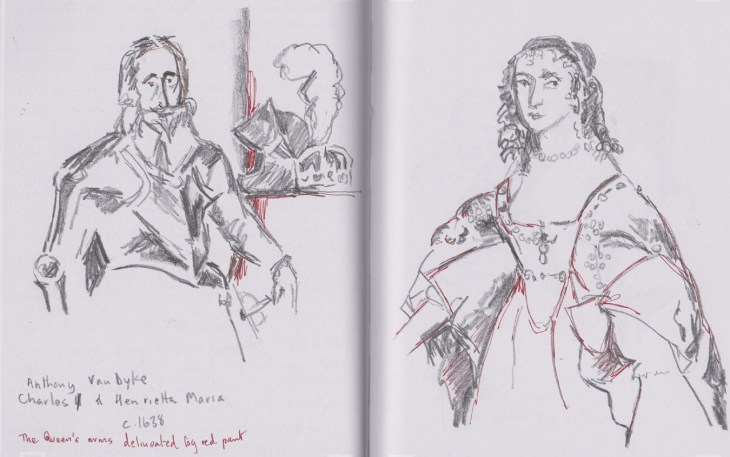
Study of King Charles I and Queen Henrietta-Maria, c 1638, graphite and gel pen

Study of King Charles I and Queen Henrietta-Maria, c 1638, graphite and gel pen

The flattery of van Dyck’s paintings was such that when Sophia, later Electoress of Hanover, first met Queen Henrietta Maria, in exile in Holland in 1641, she wrote: “Van Dyck’s handsome portraits had given me so fine an idea of the beauty of all English ladies, that I was surprised to find that the Queen, who looked so fine in painting, was a small woman raised up on her chair, with long skinny arms and teeth like defence works projecting from her mouth…”

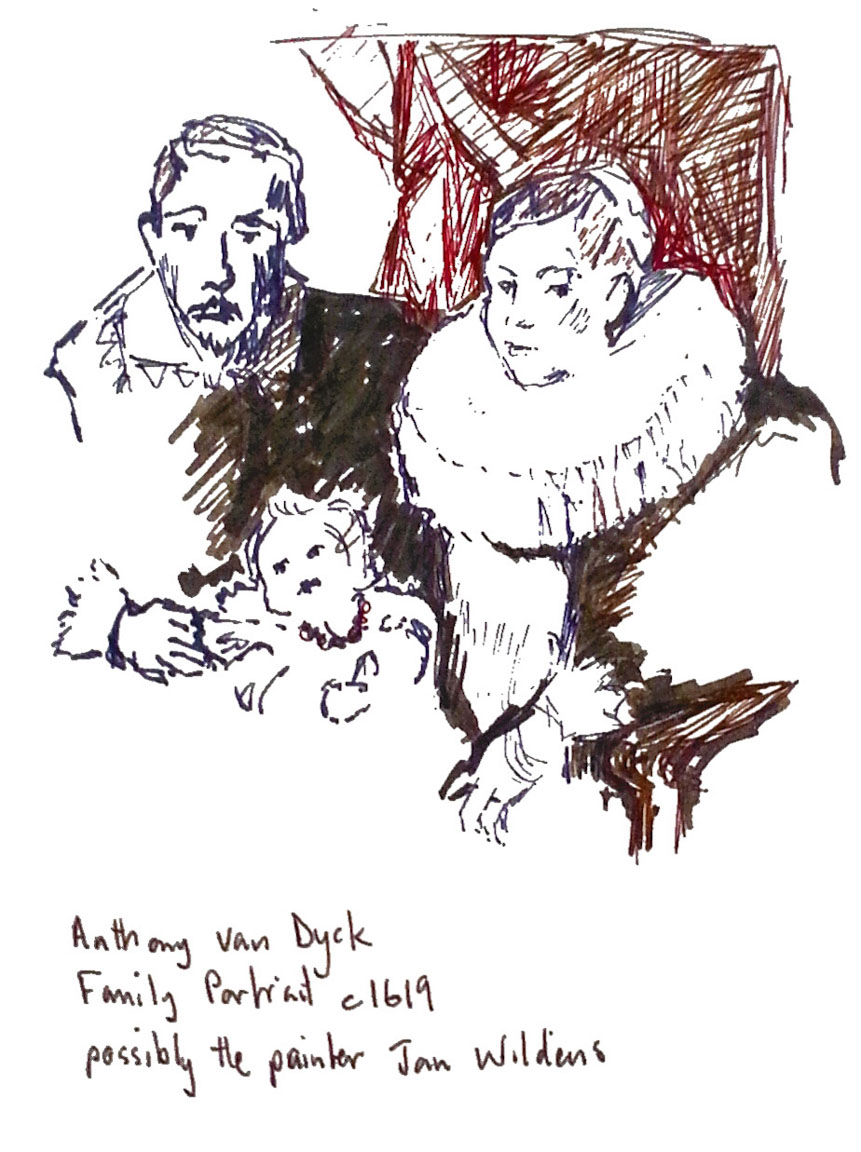
Perhaps truer to life was a smaller portrait that van Dyck made in 1619, the year after he was admitted to the Guild of St Luke as a free master painter. The Family Portrait, is thought to be of another artist, possibly Jan Wildens (in an interesting link, Wilden’s half sister, Suzanne Cock was the wife of Cornelis de Vos). His attractive young wife sits next to him while their young child, sits in his/her father’s lap looking upwards.
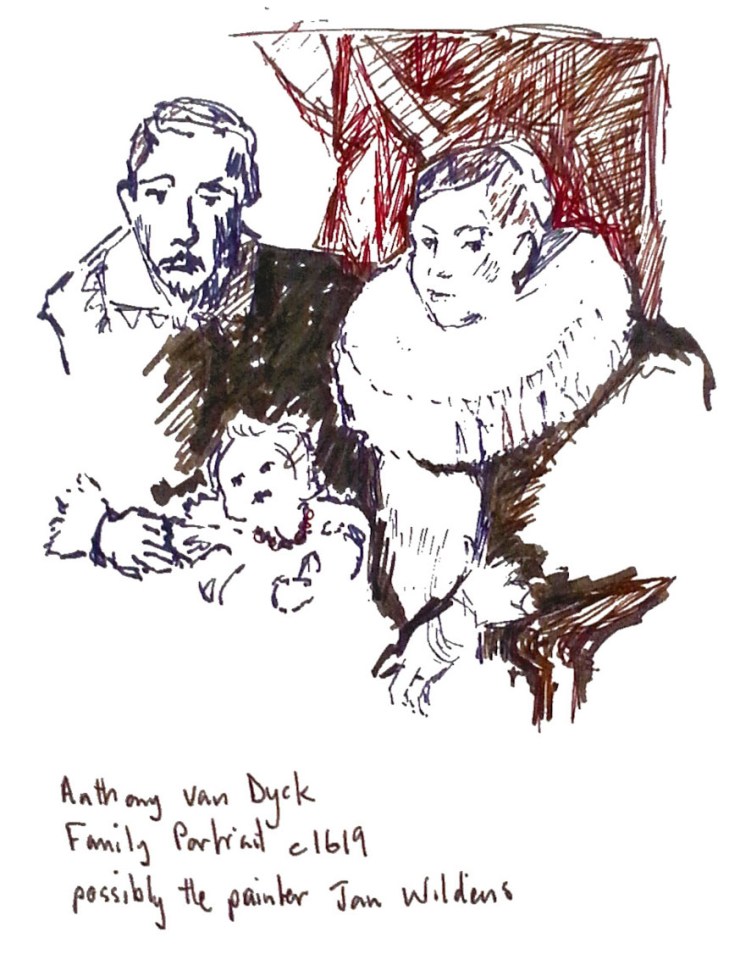
Study of Family Portrait, by Anthony van Dyck, pen and ink, brush pen and gel pen

Study of Family Portrait, by Anthony van Dyck, pen and ink, brush pen and gel pen

As you can see from the above study by this time I was resorting to every pen I could find in my bag just to complete the study. I’d spent most of the day in the exhibition, with a break for lunch and I was pretty exhausted. I staggered out of the gallery to have a restorative cup of coffee and lemon curd tart. Since checking up on the details for this post I have realised that there were any number of works I would have liked to go back and study in greater detail and some I managed to miss altogether.

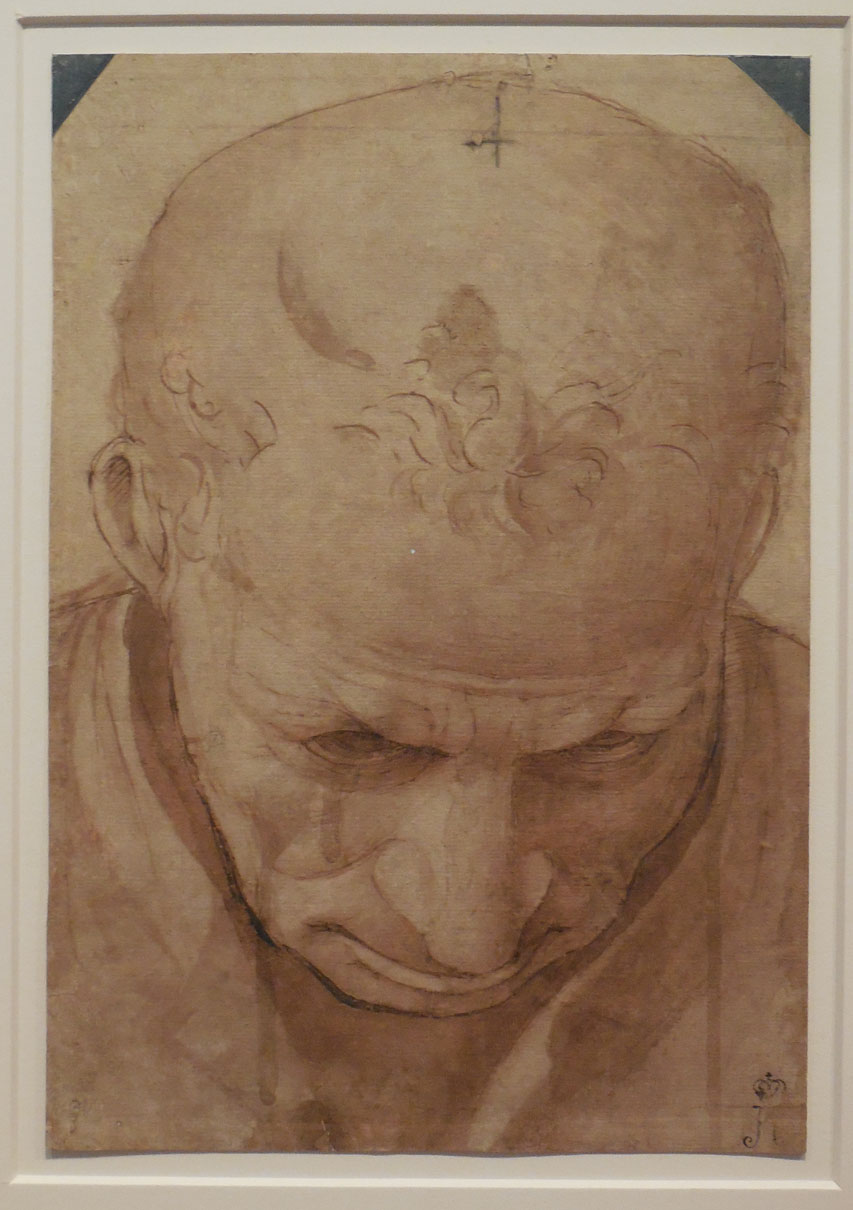
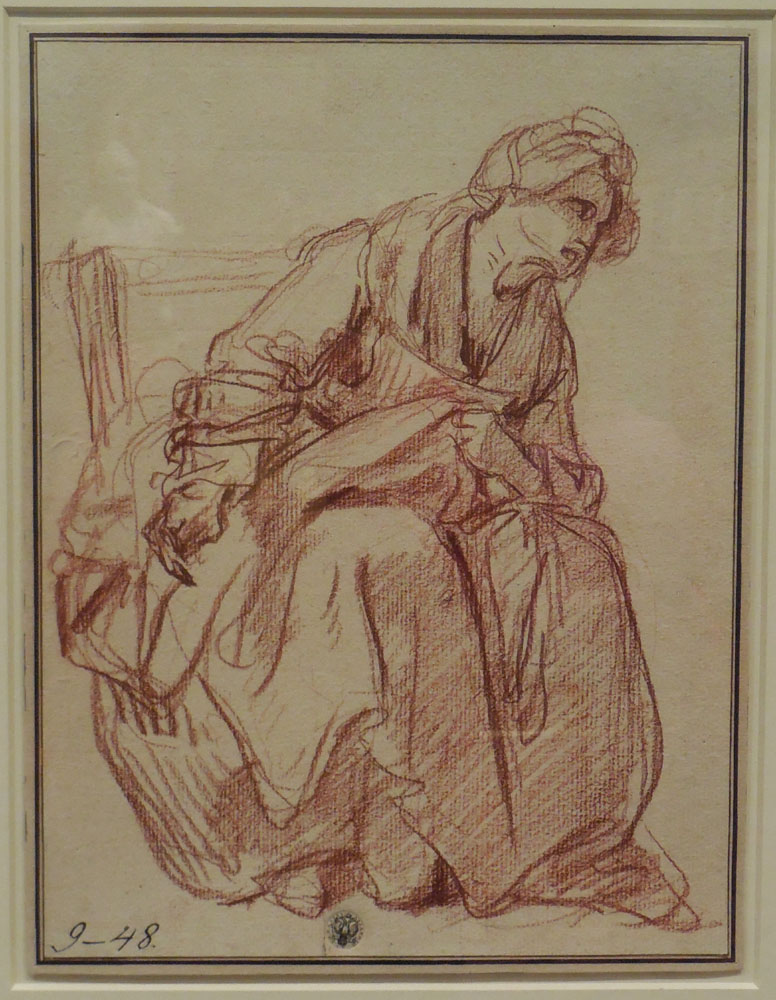
Here are two of the many amazing sketches that also caught my eye on the day.
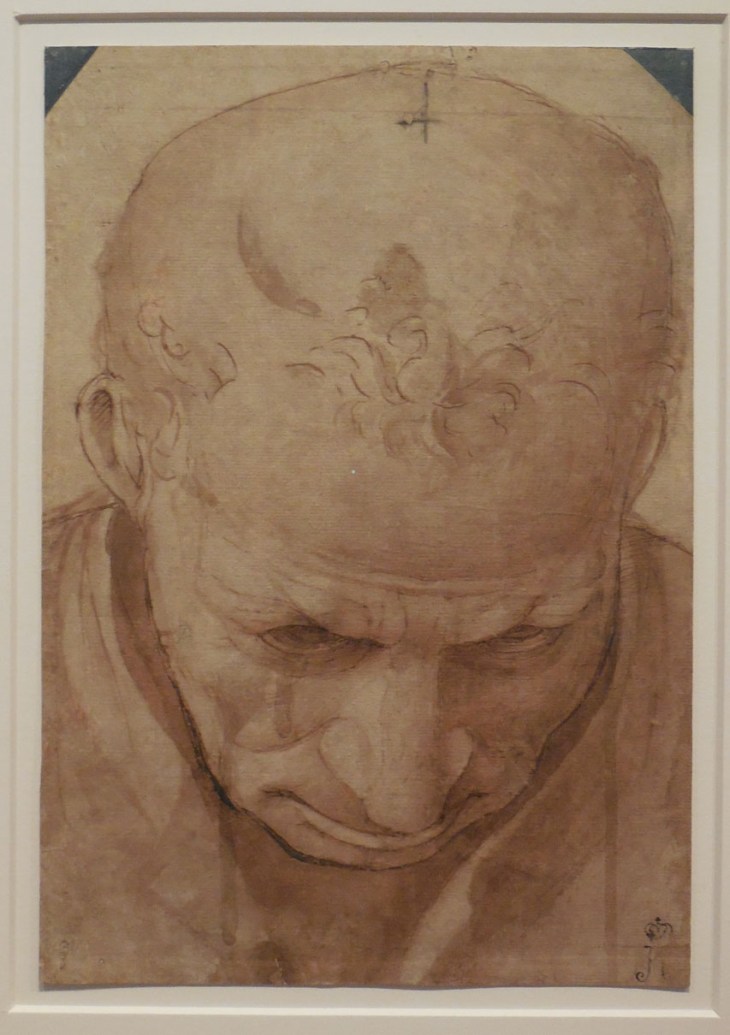
Luca Signorelli, c1480, study of the head of an elderly man, pen and brown ink and wash, State hermitage Museum, St Petersburg

Luca Signorelli, c1480, study of the head of an elderly man, pen and brown ink and wash, State Hermitage Museum, St Petersburg
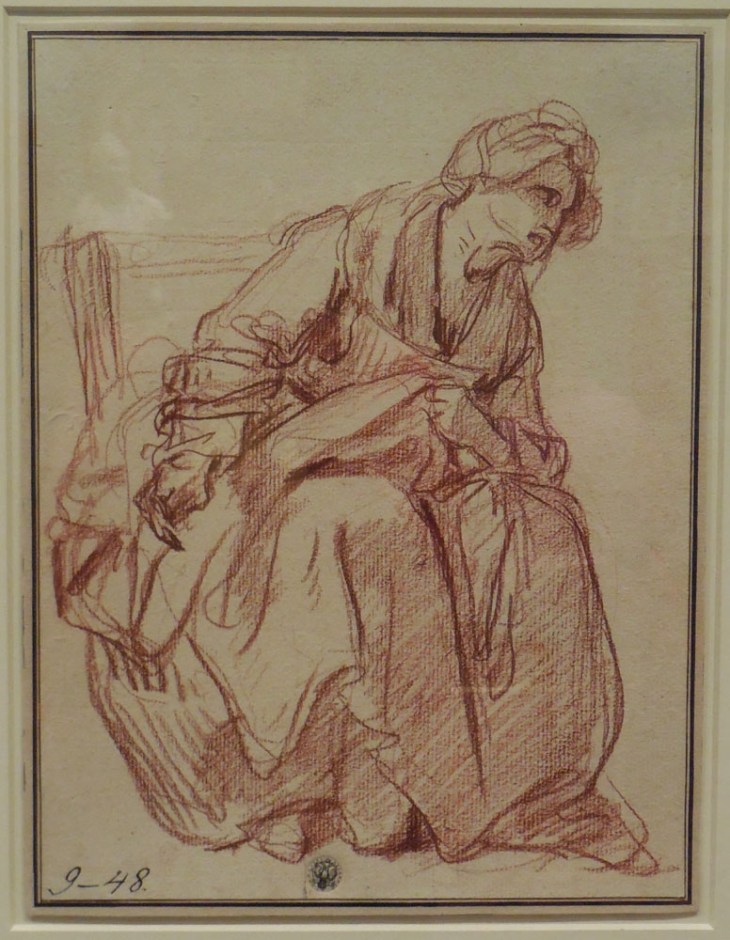
 

Jean-Baptiste Greuze, 1760's, Study of a seated woman (the paralytic's wife), red chalk State hermitage Museum, St Petersburg

Jean-Baptiste Greuze, 1760’s, Study of a seated woman (the paralytic’s wife), red chalk State Hermitage Museum, St Petersburg

Monga National Park

Last Friday we drove about an hour and a bit east of Canberra to visit the Monga National Park, a patch of wet sclerophyll forest on the escarpment above the south coast of New South Wales. We had hoped to find some Monga waratahs (Telopea mongaensis) in flower, but we were at least a month too early.

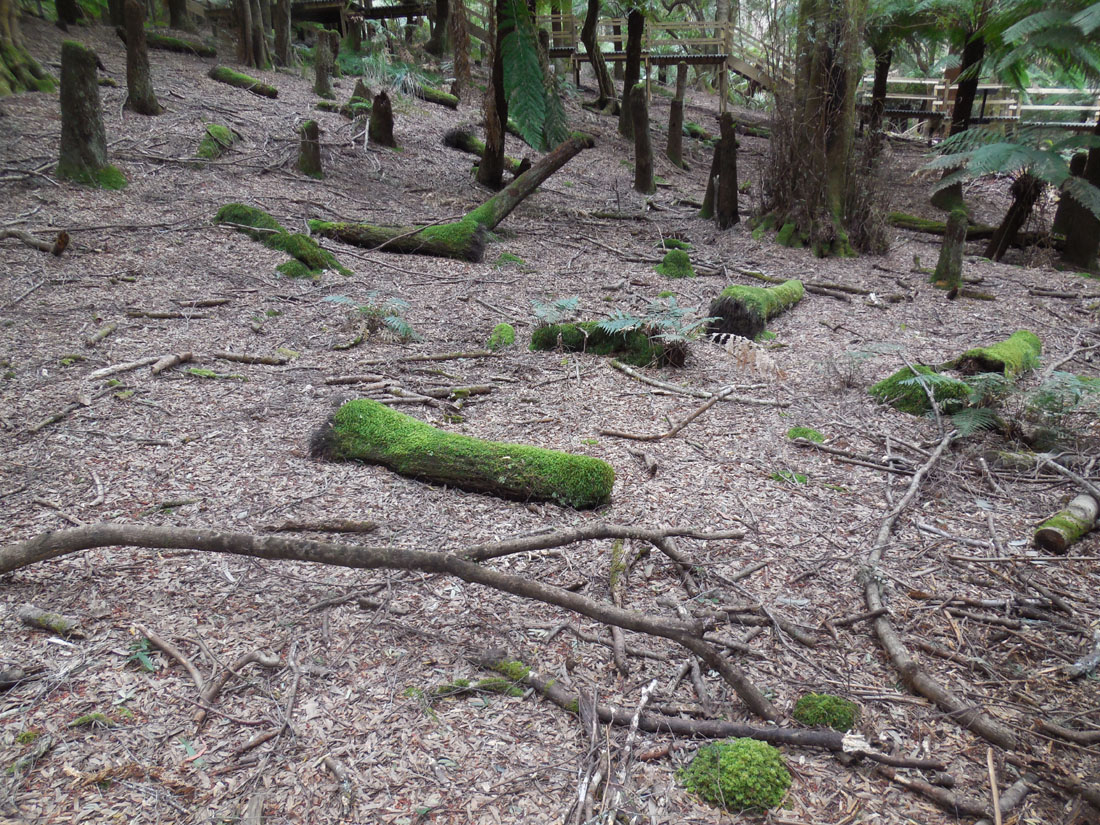
We did visit  Penance Grove, where in the 1980’s, prior to the forest being declared a National Park, some sad and selfish individual came in and cut out the tops of many of the tree ferns growing in this remnant rainforest glade. The tops of tree ferns will re-grow from their trunks, but the section left behind just dies. These protected plants are stolen for illegal sale to gardeners or nurseries. Even today, 30 years later, the devastation is there for all to see.

Penance Grove, Monga National Park, what's left 30 years after the tree ferns were stolen, 18 September 2015

Penance Grove, Monga National Park, what’s left 30 years after the tree ferns were stolen, 18 September 2015

In some ways it would have made an excellent subject to paint, but I found it all too painful and depressing.

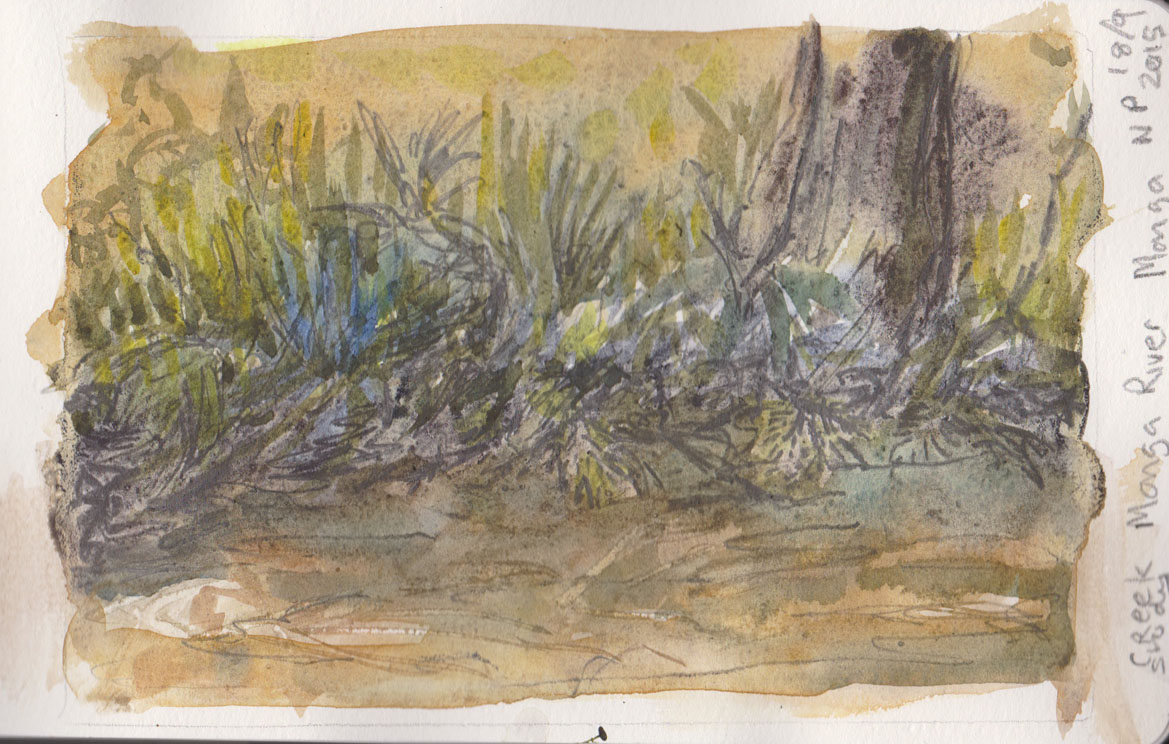
We decided to move to the nearby picnic ground where we had some lunch. While we were eating we were visited by several flibertigibbet Grey Fantails. After we walked down to the Mongarlowe river, along a track that promised waratahs at the right time of the year. At the water’s edge the vegetation was growing thickly and I had quite a fiddle to find a spot where I could set up my stool without being stabbed by stray lomandra leaves (a spiky tipped sedge-like plant). I managed a perch in the end, but failed to capture a good likeness of the far bank of the river. My attempt at wet into wet paint became such a soggy mass that the super ‘darks’ I wanted to put under the vegetation just kept blending into the areas above. Drying time was not optimal, as our earlier sunny day had, by this time, settled into a dull overcast.

Bank of the Mongarlowe River, Monga National Park, graphite and watercolour, 18 September 2015

Bank of the Mongarlowe River, Monga National Park, graphite and watercolour, 18 September 2015

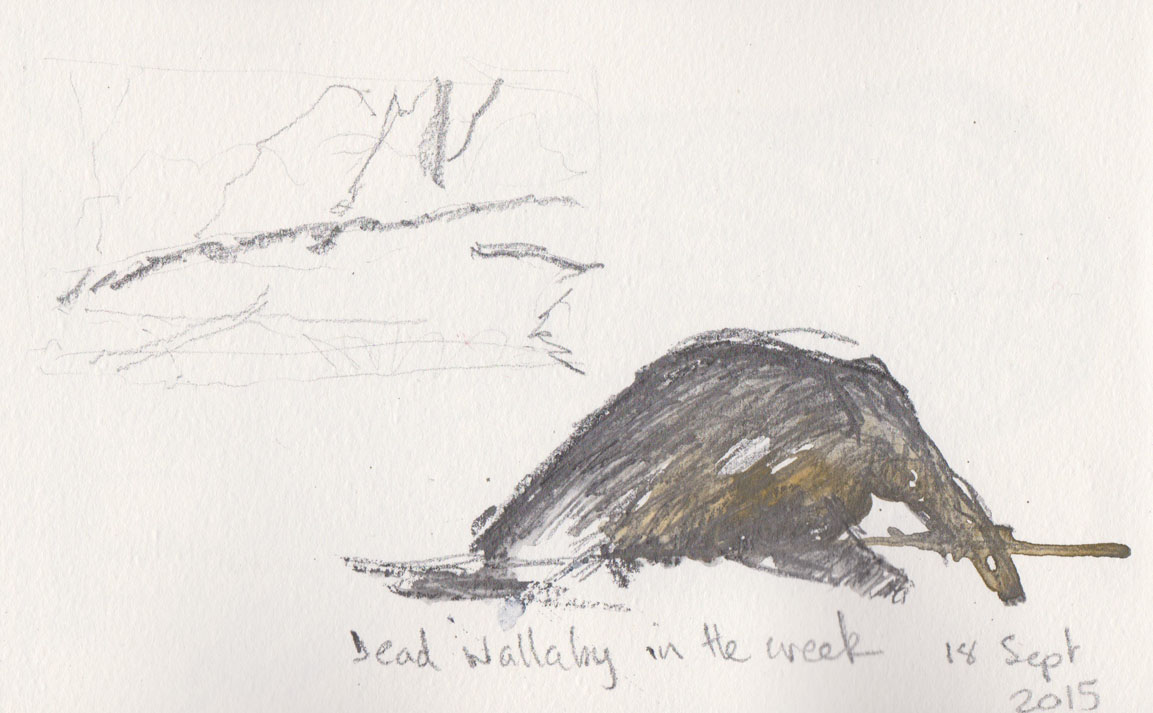
I was also trying to avoid looking at what was in the water just below me, the carcass of a dead wallaby. Thankfully odourless, as the fast-running water was washing the smell away, I didn’t really want to look at the remains of this once beautiful creature. In the end I decided to make a quick sketch of it and though the subject matter was rather grim I think it was a better outcome than my overworked riverbank.

Dead wallaby in the river, watercolour and graphite, 18 September 2015

Dead wallaby in the river, watercolour and graphite, 18 September 2015

I guess this just proves that not every sketching expedition pans out the way you expect.


Drawing the Exhibition – Myth + Magic 2

The 16th of September was Papua New Guinea’s Independence Day, so what better way to celebrate than return to the Myth + Magic exhibition at the National Gallery of Australia. This time I also managed to drag some friends along, as well as my partner, so we all set about sketching.

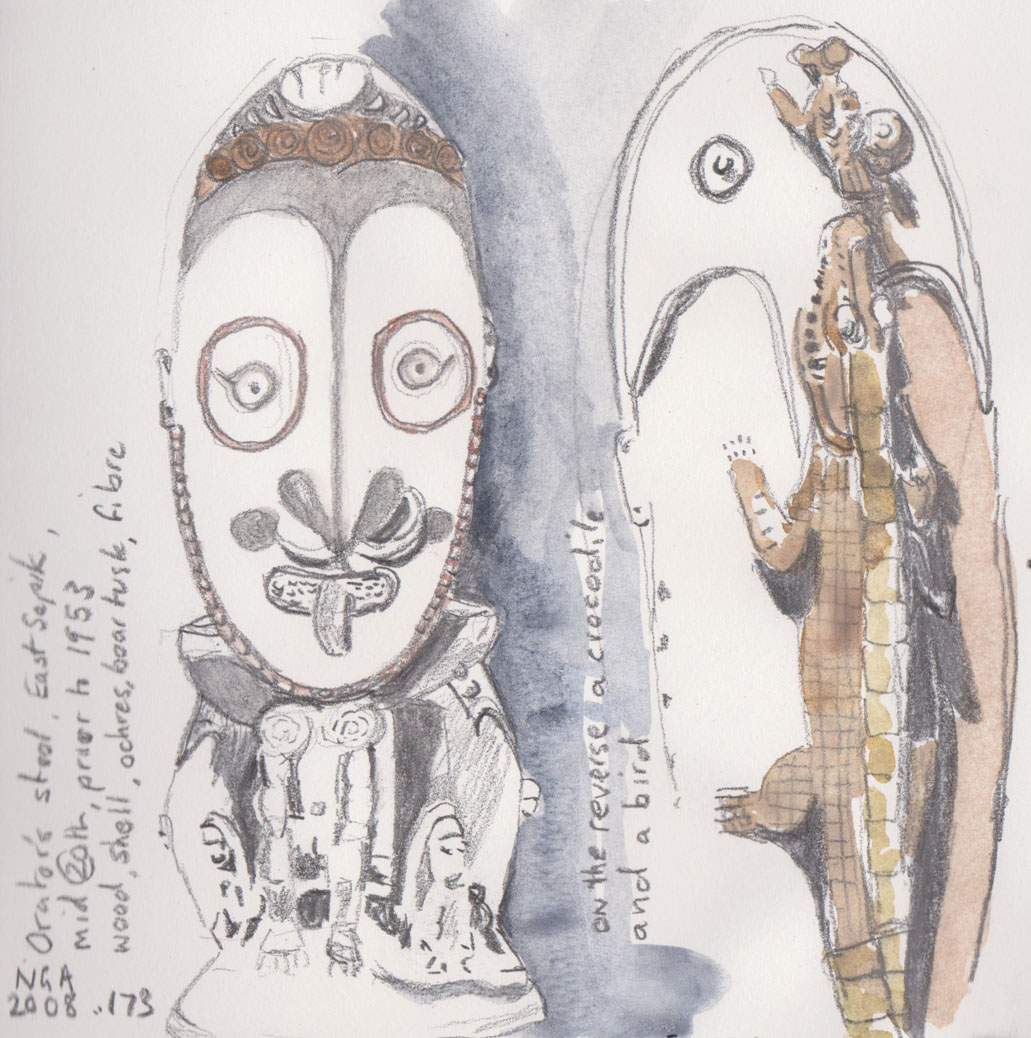
My first target was the Orator’s Stool from the East Sepik. I started with the face and enjoyed working with the deep shadows cast by the dramatic lighting.

Orator's Stool, East Sepik, PNG, study in graphite pencil with watercolour added later, 16 September 2015

Orator’s Stool, East Sepik, PNG, NGA 2008.173, mid 20th cent. prior to 1953, study in graphite pencil with watercolour added later, 16 September 2015

It was only after I’d finished this first drawing and went to record the details of the work, that I found the carvings of the crocodile and bird on the reverse of the stool.

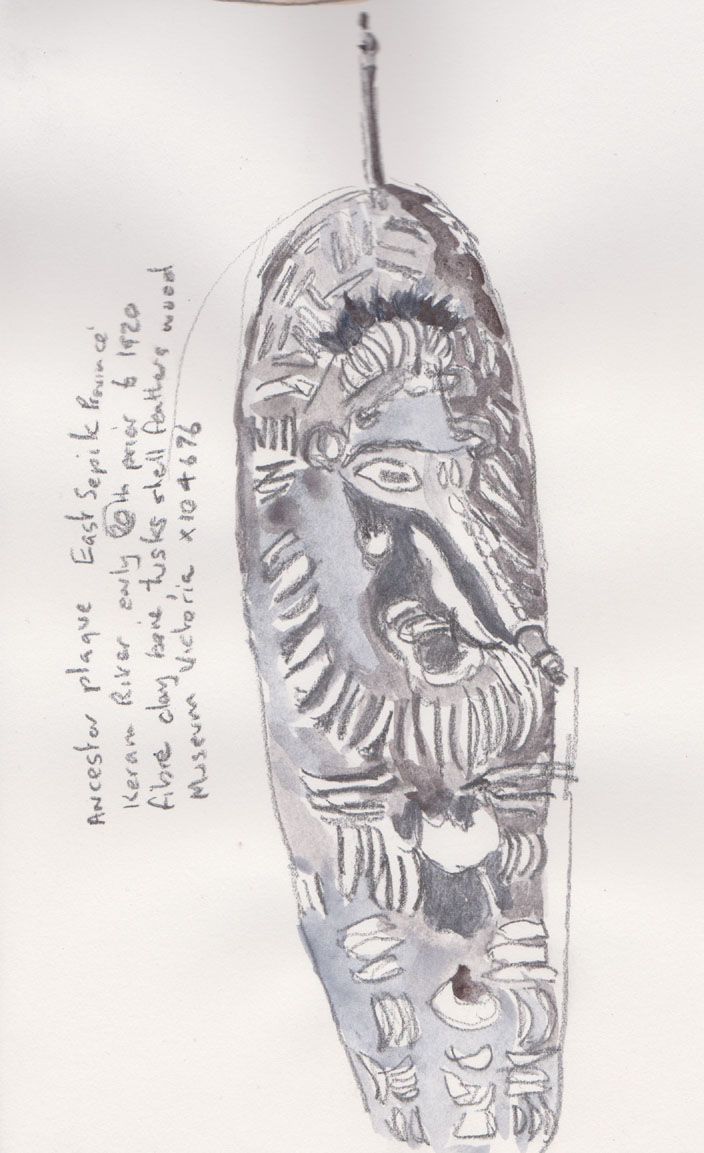
I still had some 20 minutes before our meet-up time so I went and did a ‘quick’ study of this ancestor plaque.

Ancestor Plaque, East Sepik Province, Keram River, early 20th cent. prior to 1920, Museum Victoria X104676, graphite, with added watercolour, 16 September 2015

Ancestor Plaque, East Sepik Province, Keram River, early 20th cent. prior to 1920, Museum Victoria X104676, graphite, with added watercolour, 16 September 2015

This work has a very strong presence. It is made of fibre, largely for the backing and is covered with thick grey mud. It is decorated with lots of embedded pig tusks and shells. The image wears a headband of cassowary feathers. I haven’t captured much of its ‘presence’ so I will try to return and focus on this piece again.

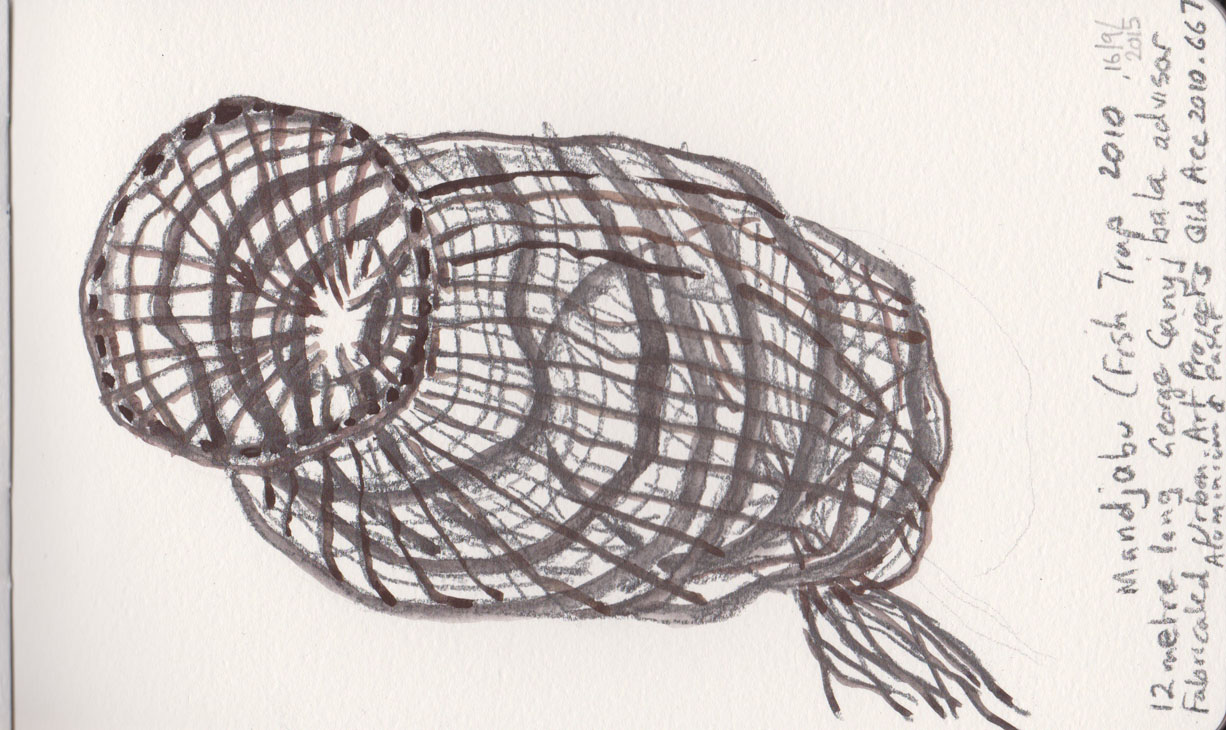
After the drama of the exhibition space it was somewhat of a relief to retreat to the airy lightness of the Members Lounge for lunch. Afterwards, our friends decided that they wanted to look at the Aboriginal and Torres Strait galleries so we headed off there for a final sketch. I sat out near the entrance to draw the giant, 12 metres long, fish trap, that hangs above the gallery foyer.

Mandjabu (Fish Trap), 2010, created with assistance from George Ganyjbala, fabricated in aluminium and paint by Urban Arts Projects, Acc2010.667, graphite with added watercolour, 16 September 2015

Mandjabu (Fish Trap), 2010, created with assistance from George Ganyjbala, fabricated in aluminium and paint by Urban Arts Projects, Acc2010.667, graphite with added watercolour, 16 September 2015

I didn’t realise that I was being observed, but this photo gives you an idea of the scale of the work.

The loneliness of the long-distance sketcher, 16 September 2015, National Gallery of Australia

The loneliness of the long-distance sketcher, 16 September 2015, National Gallery of Australia