Rosalie Gascoigne

For those of you who’ve read this blog for a while the name Rosalie Gascoigne might be familiar. I have written about her work here previously.

Gascoigne was born in New Zealand 1917 and died in Australia in 1999, (she lived in Australia from 1943). Gascoigne is, arguably, the greatest Australian landscape artist of the late 20th century. The earliest part of her time in Australia was spent at Mt Stromlo Observatory, where her husband Ben, worked as an astronomer.  It was an isolated place at the time, just outside Canberra,  the capital of Australia (now on the suburban edge of the city).

Early days at Mt Stromlo c. 1944, photgraph by Ben Gascoigne

Originally Gascoigne found expression through collecting and arranging pieces of wood and feathers as she walked around the mountain. Most memorably, at a talk of hers I went to at the National Gallery of Australia,  she showed a photo of an early work made, quite literally of rabbit droppings glued to a piece of cardboard!

Later she undertook the practice of Sogetsu Ikebana, but found it ultimately limiting. She turned to using found materials, that she often collected from country rubbish tips around Canberra, as material for her constructions.
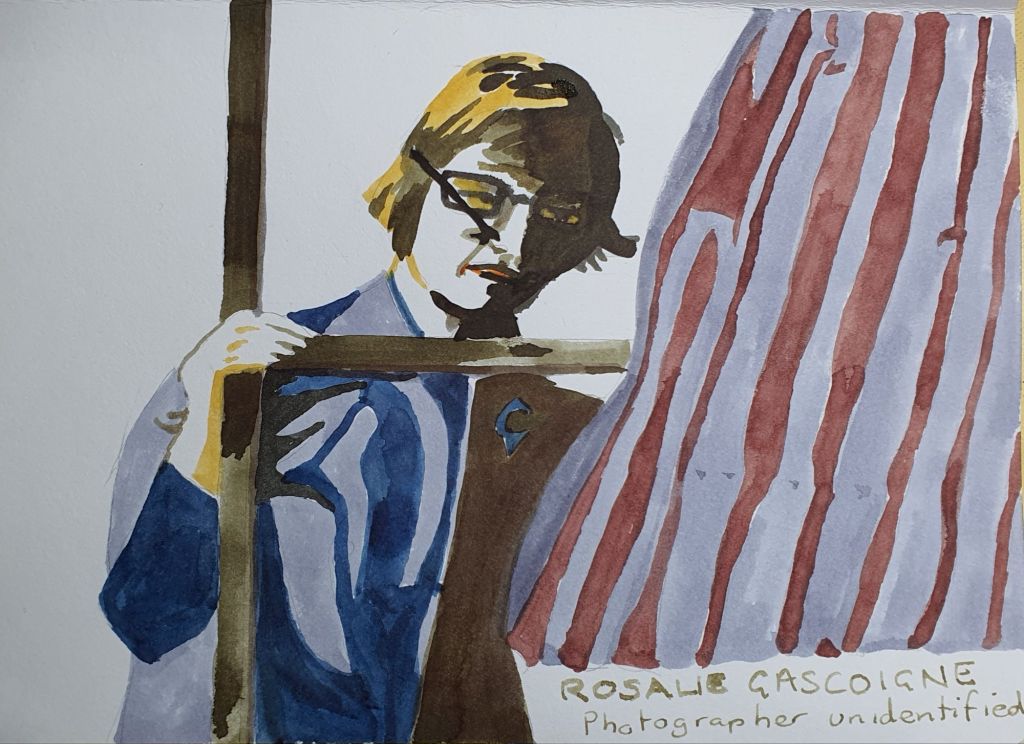
Gascoigne with her work Clouds 1, made from a found window frame and a piece of corrugated iron. Photographer unidentified.

Major works of hers are now held by the National Gallery of Australia and other state and regional institutions.
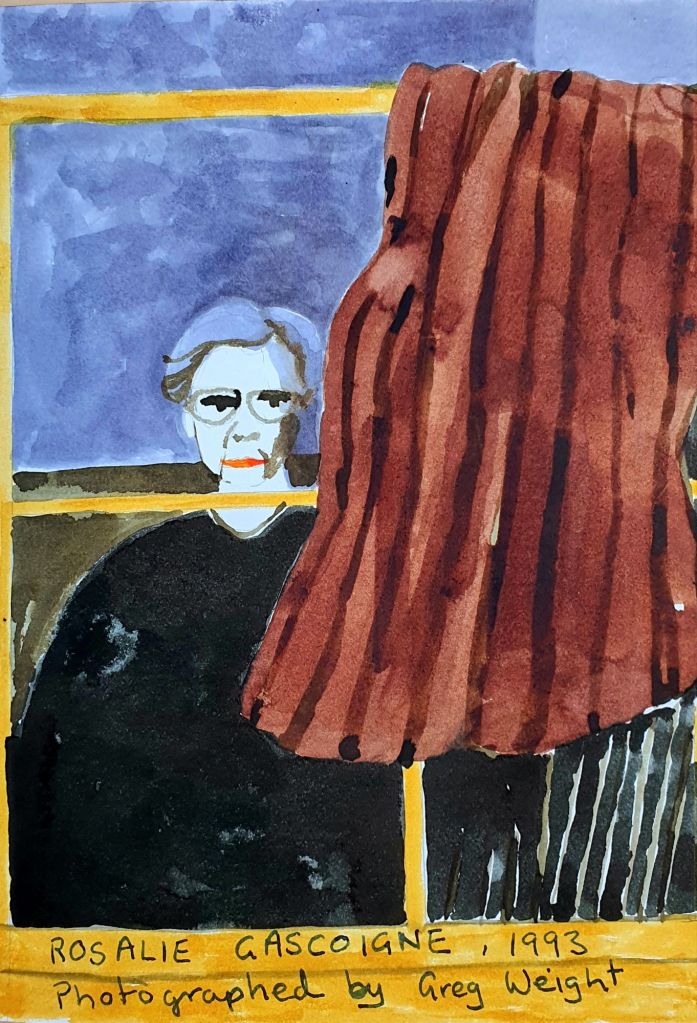
Gascoigne in 1993, photographed by Greg Weight, who clearly referenced the earlier photo of her with Clouds 1.

I recently visited the Art Gallery of New South Wales,  where I saw Gascoigne’s installation of found domestic enamel ware. This sketch is the top section of that work (in reality the cup and long handle are suspended from the top of the work’s frame).

Detail from Gascoigne’s installation,
Enamel Ware, 1976

Drawing the exhibition: Porosity Kabari

Porosity Kabari (Nishi Gallery, New Acton, Canberra) is a collaboration between Trent Jansen, Richard Goodwin and Ishan Khosla. The trio “investigates the cycle of use, re-use (and further re-use) – and how we can, simply, use one thing to make another thing.” Using only materials and skills sourced from the ‘Chor Bazaar’ (Thieves Market) and the Dharavi slum in Mumbai, the outcome is a series of objects that fascinated me with their detail and juxtapositions, and showed an enjoyable lack of concern for ‘perfect’ functionality.

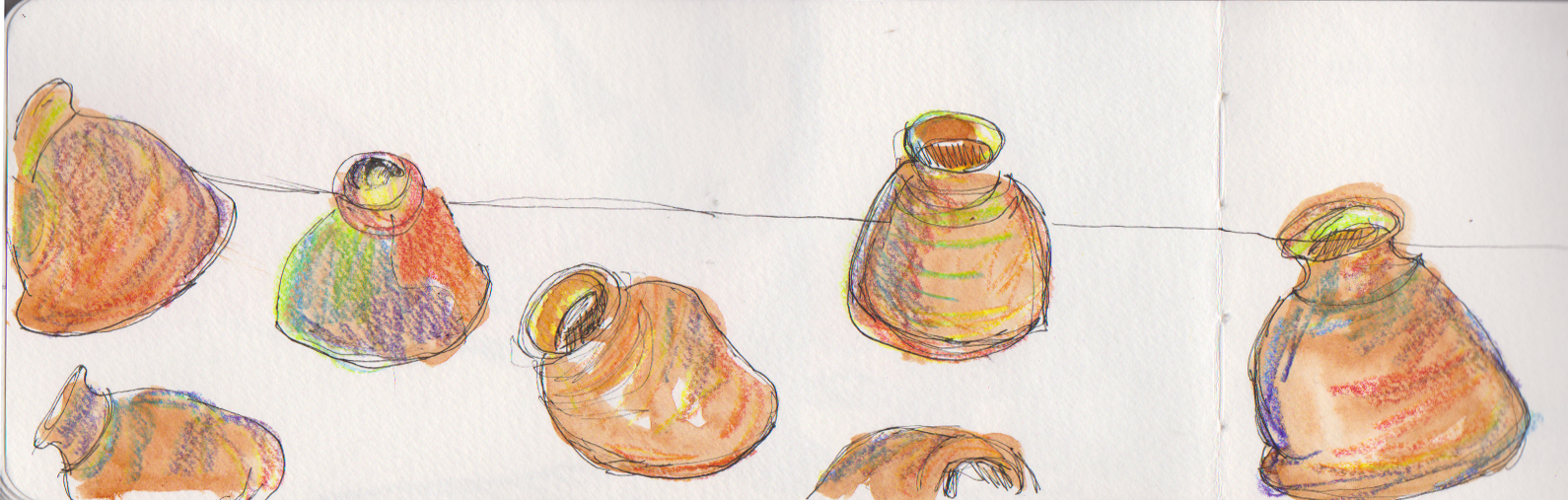
My first sketch was of Trent Jansen’s ‘Dropping a Kumbhar Wala Matka Vessel’, 2016. This work is composed of three photographs of the potter Abbas Galwani dropping ones of his pots on the ground, along with a number dropped pots that have subsequently been fired with all their distortions and cracks. Jansen’s work is a riff on Ai Wei Wei’s 1995 work ‘Dropping a Han Dynasty Urn’. (Ai Wei Wei’s work gives me the same squirmy sensation as fingernails scraping on a blackboard). But Jansen is drawing a different observation on ‘value’. These pots are in widespread use but their makers gets little respect for their skills and only minimal financial returns for their labour.

30Jun2017a

Dropped Jugs, from Dropping a Kumbhar Wala Matka Vessel’, 2016. by Trent Jansen. My sketch, pen and ink, coloured pencil and watercolour

The second sketch is of one of Ishan Khosla’s ‘Constructed-Deconstructed-Constructed’ series, 2016. These works are made from scavenged wood and odd bits of old furniture. Either a stool or a table, take your pick, these pieces have their own aesthetic which Khosla calls “do first think later”‘

30Jun2017b

‘Constructed-Deconstructed-Constructed’ , 2016, by Ishan Khosla. My sketch pen and ink

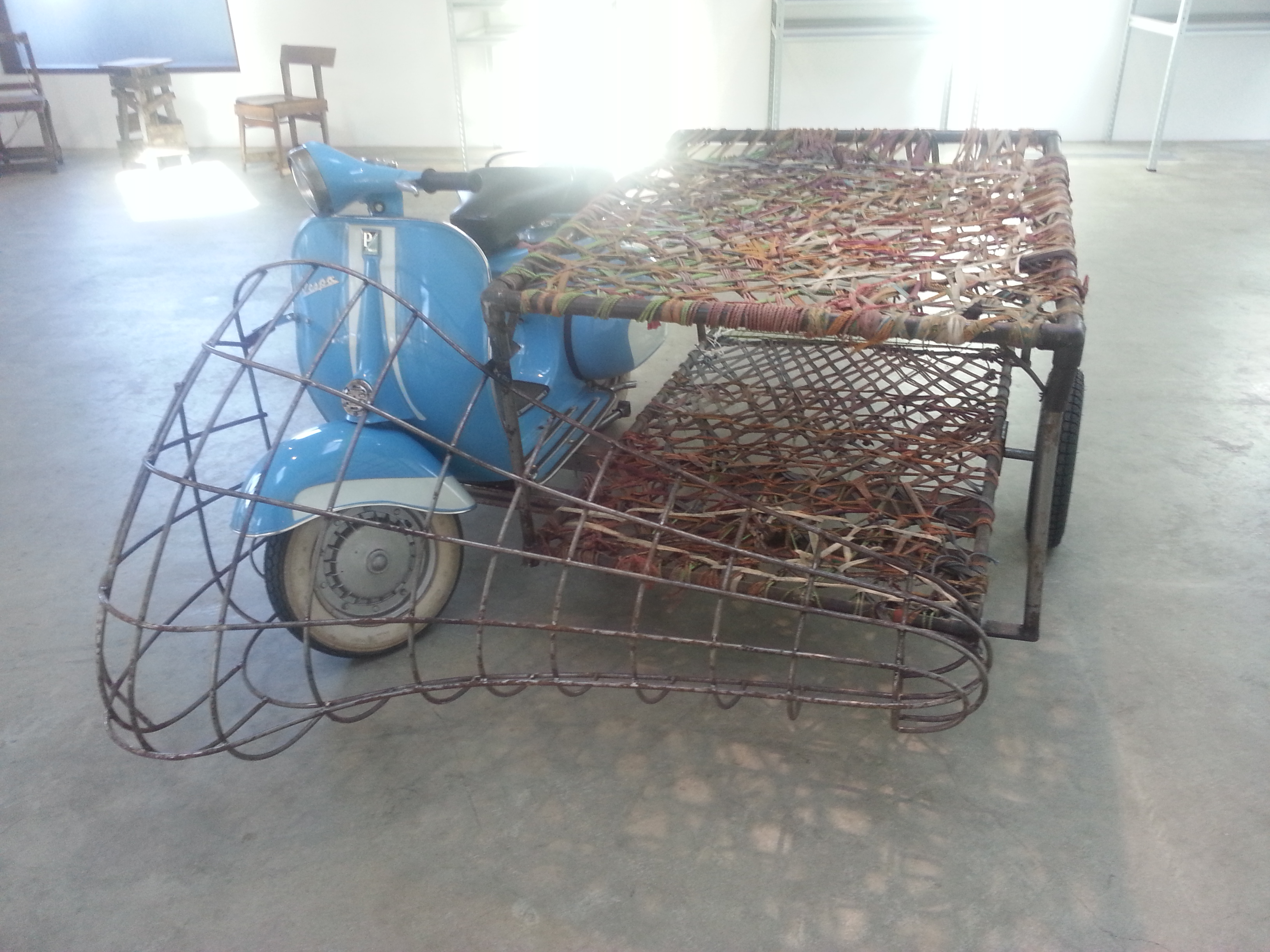
Two sketches was as much as I could manage while standing up to draw, (no stools were available). So I will finish off with photos of two pieces that I really responded to by Richard Goodwin.Twin Charpai Exoskeleton for Mumbai, 2016, Richard Goodwin

This final piece really spoke to my own explorations of stitch, and I always enjoy a good wrapped object!

Klein Chair, 2016, Richard Goodwin

The exhibition finishes on 9 July, at the Nishi Gallery, New Acton, Canberra.


Just because

I am currently working through some fairly tedious passages of mark making on one of my pieces, so yesterday I decided to give myself a break and have a play.

Stitching on a piece of bubble-wrap envelope presented itself. Apart from using different colours of thread, the other change I made between the two pieces was to have one that was stitched in a fairly regular pattern and one which was stitched as randomly as I could manage.