Non-dominant hand

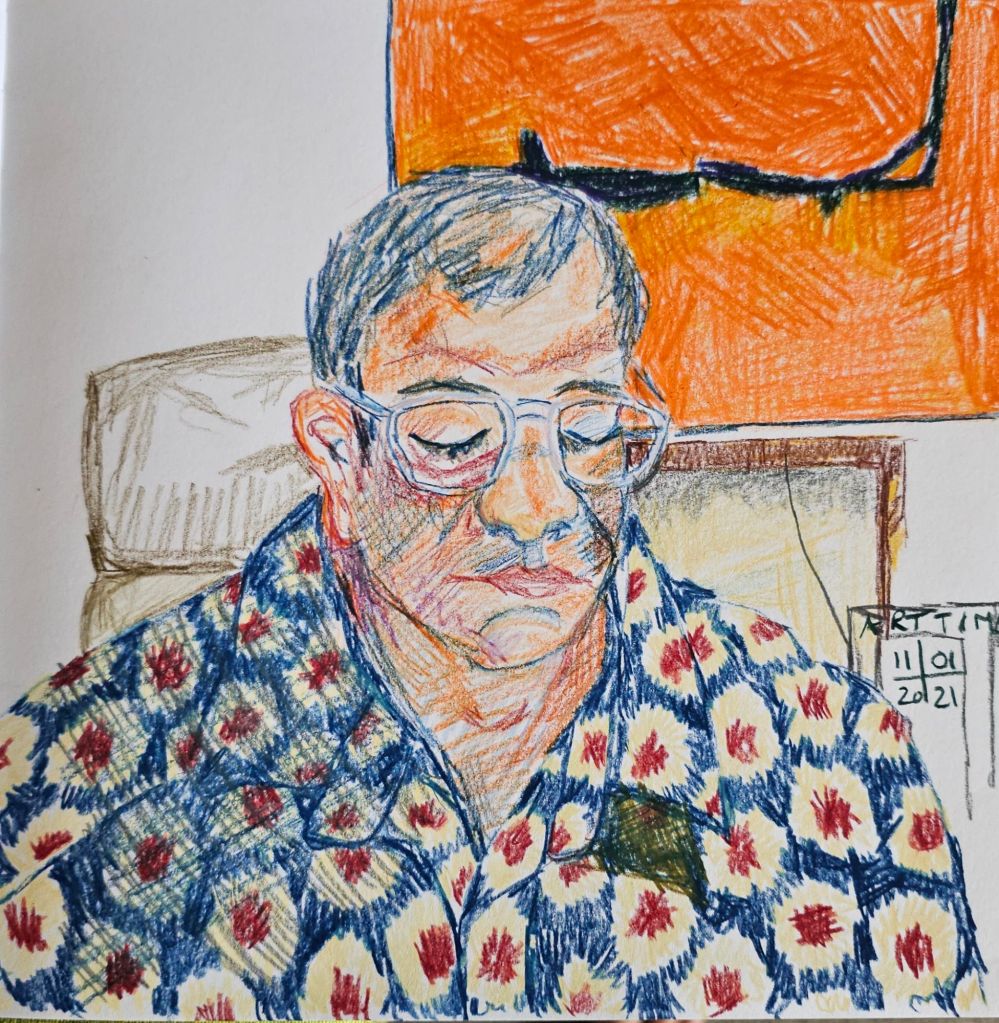
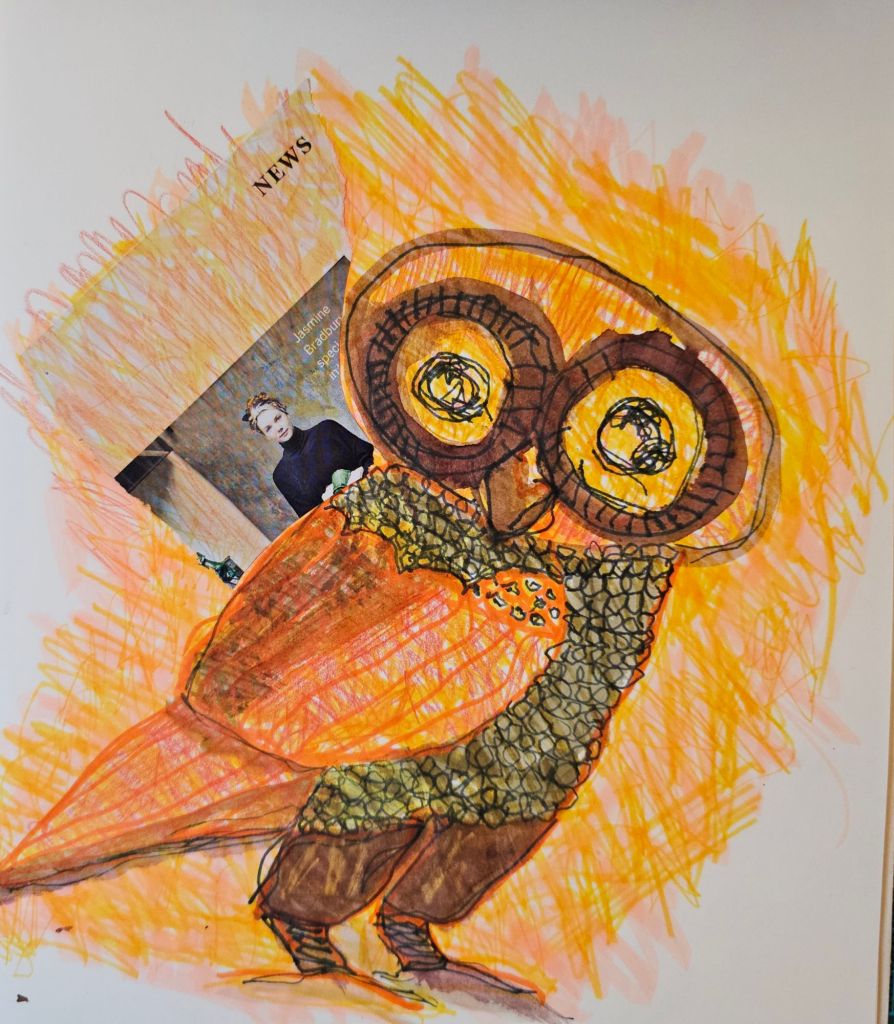
I was about to start a drawing session with friends when I accidently got in the way of some steam from the kettle – burning my hand in the process (thankfully not a major burn). It was enough to drive me to use my other hand to draw with while my dominant hand stayed wrapped in a cool damp cloth

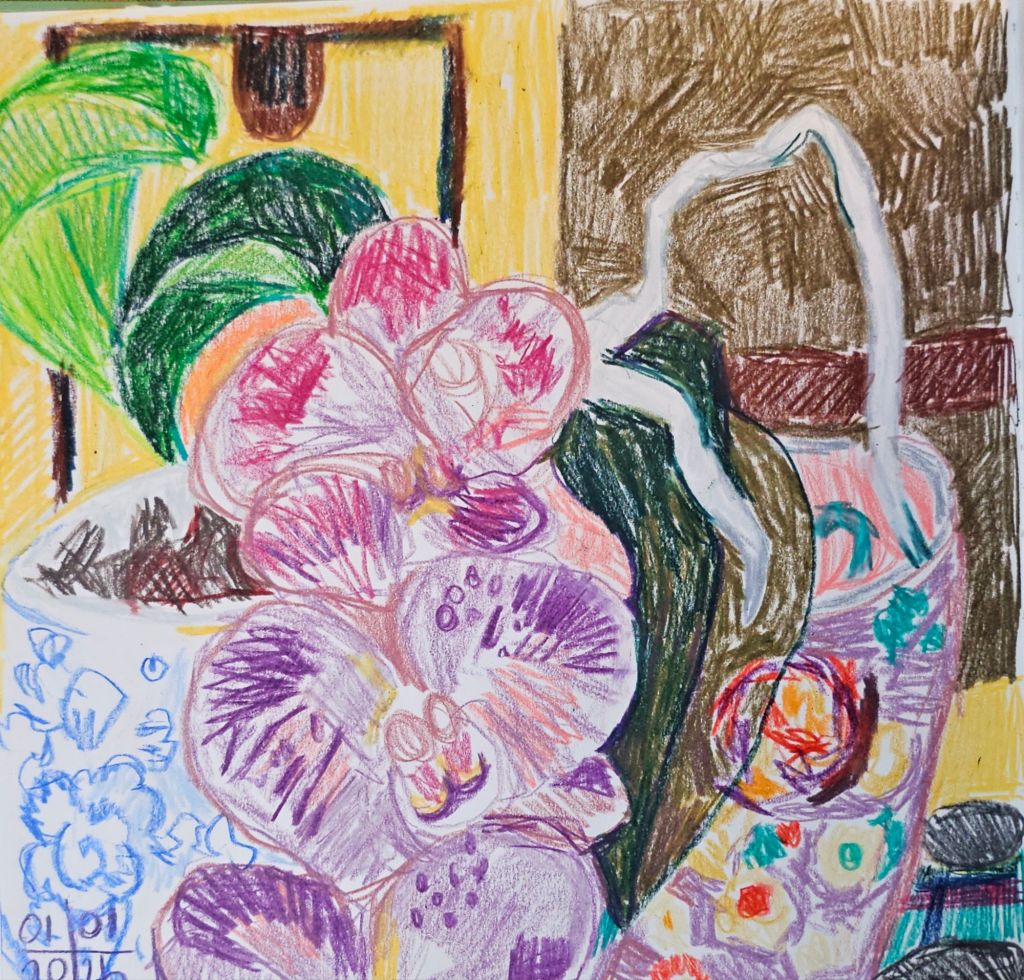
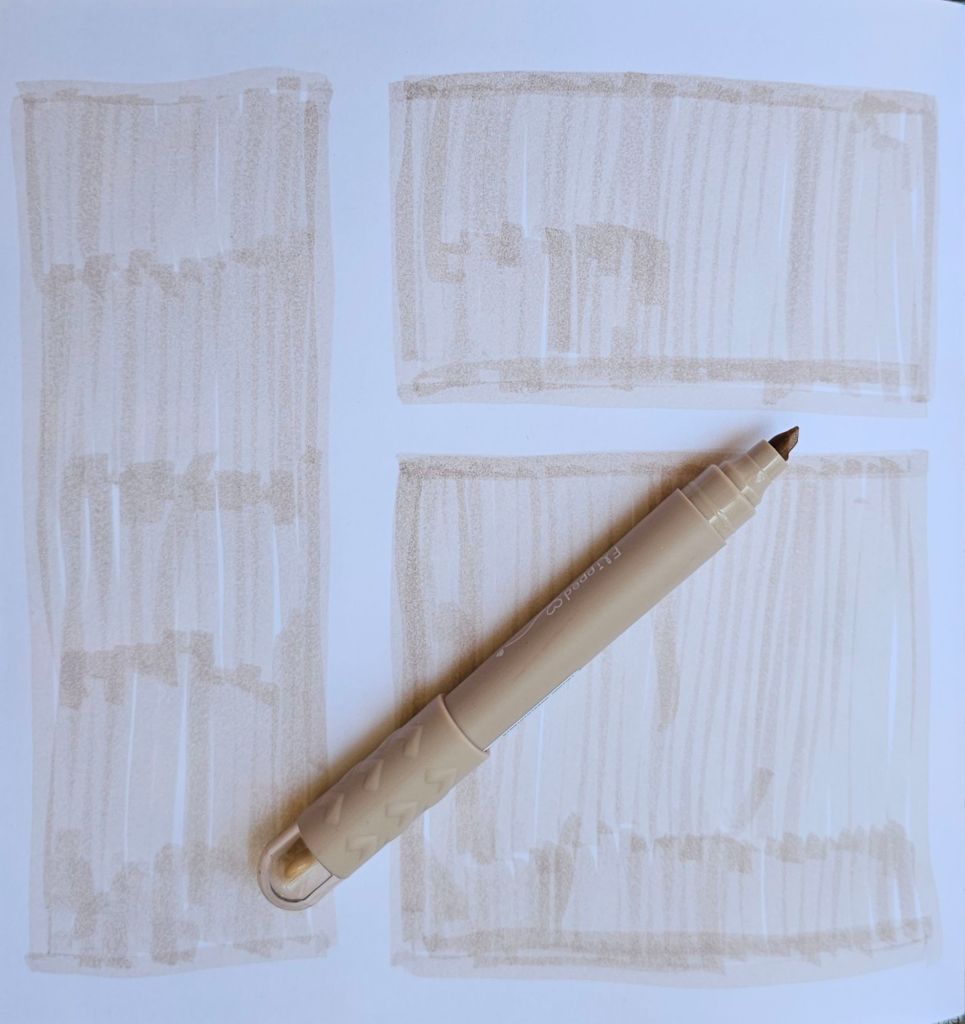
I just picked from a variety of markers and pencils already on my table and one of my fountain pens. 

Markers, coloured pencil and fountain pen with collage

I really like the result! Nothing too fussy. My inspiration was this replica of a Roman Owl brooch that was found in the city of Bath in the UK. I didn’t resist adding a touch of collage when I found this tiny scrap on my table as well.

A copy of a sacrifice to the goddess Sulis-Minerva

Pauline Boty

Pauline Boty, (1938-1966), was an English artist and sole female member of the British pop art movement. Boty came to prominance through unlikely paths. Initially she studied stained glass and then collage at the Royal College of Art. She had wanted to join the painting department but was dissuaded from applying because of the low success rate of applications by female students.

Drawn from a still from the film Pop Goes the Easel by Ken Russell, 1962

Boty’s good looks attracted attention, earning her the nickname of ‘the Wimbledon Bardot’ referring to her likeness to the French film star. Her appearance in the Ken Russell documentary Pop Goes the Easel, in 1962,  gave rise to a series of roles on the TV and stage and one in the film Alfie.

Pauline Boty, 1963 from a photograph by Lewis Morley

In 1959 three of Boty’s works were selected for the Young Contemporaries exhibition and in 1960 one of her stained glass works was selected for an Arts Council exhibition Modern Stained Glass. You can see her stained glass self portrait in the National Portrait Gallery London.

Throughout her studies and in addition to her acting, Boty continued working on her paintings, first showing her work in a small group show in 1961. My favourite painting of hers is The Only Blonde in the World, 1963, a portrait of Marilyn Monroe, is in collection the Tate Gallery.

Pauline Boty, 1964, from a photograph by David Bailey.

Boty married Clive Goodwin in 1963. In 1965 she became pregnant, but during an examination it was discovered that she had an aggressive cancer. Boty decided to forgo treatment as there could be no guarantee that her unborn child would survive. Her daughter, called Boty, was born in February 1966. Pauline Boty died of cancer in July of the same year.

Nora Heysen, “Girl Painter”

Nora Heysen (1911-2003), was the first Australian woman to win the prestigious Archibald Prize for portraiture in 1938, for her portrait of Mme Elink Schuurman. At age 27 she was and remains, the youngest ever winner of the Archibald Prize. The Australian Women’s Weekly subsequently summarised this landmark achievement with an article entitled “Girl Painter Who Won Art Prize is also Good Cook”.

Nora Heysen, c. 1930s

Despite underwhelming assessments like that, Heysen was more than capable of holding her own when it came to making art. The daughter of one of Australia’s most popular landscape artists, Hans Heysen, she began her formal art training at the age of 15 and by the age of 20 had her work in the collection of three State galleries. 

Sales from her first solo exhibition in 1933 funded further study in London (1934-37).

In 1944 Heysen made another breakthrough when she became the first Australian woman appointed as an Official War Artist*. In addition to her honorary rank as Captain, she was, with persistence and backing,  even paid the same rate as male war artists!

Captain Nora Heysen in Papua New Guinea in 1944. Collection of the Australian War Memorial

One of my favourite portraits of her war service is of WAAAF cook, Corporal Joan Whipp.

Heysen married in 1953, but found her practice was disrupted. She and her husband divorced in 1976. By then her portraits and still life subjects had fallen out of fashion and her work was not recognised.

Later, while researching work on some of her father’s paintings, curator Lou Klepac saw her work, and recognised it’s quality. He mounted a major exhibition of Nora’s work in 1989. In conjunction with the National Library of Australia, Klepac held another successful exhibition of her work in 2000.

Heysen at age 92, at the Art Gallery of South Australia,  standing in front of one of her father’s paintings.

Unlike so many other female artists Heysen did live to see her work regain it’s prominence. She died after a short illness in 2003.

*Both Iso Rae and Jessie Traill documented the First World War in France, but neither were given official status as Government appointed war artists.

Amazing Grace

Next up is Australian artist Grace Cossington-Smith, (1892-1984), whose early works showing the domestic life of Australia during the first World War brought her to prominence.

From a family photograph taken in 1915

Post WWI her bold use of colour shone in such works as The Laquer Room, 1936.

Cossington Smith is remembered for her light filled domestic interiors that became a feature of her later years.

Grace Cossington Smith, 1937 detail from a family photo, Art Gallery of New South Wales collection.

She had a major retrospective at the Art Gallery of New South Wales in the early 1970’s, then ceased painting. She died in 1984.

Cossington Smith captured by a street photographer, c. 1930-40. Collection of the Australian War Memorial.

.

Rosalie Gascoigne

For those of you who’ve read this blog for a while the name Rosalie Gascoigne might be familiar. I have written about her work here previously.

Gascoigne was born in New Zealand 1917 and died in Australia in 1999, (she lived in Australia from 1943). Gascoigne is, arguably, the greatest Australian landscape artist of the late 20th century. The earliest part of her time in Australia was spent at Mt Stromlo Observatory, where her husband Ben, worked as an astronomer.  It was an isolated place at the time, just outside Canberra,  the capital of Australia (now on the suburban edge of the city).

Early days at Mt Stromlo c. 1944, photgraph by Ben Gascoigne

Originally Gascoigne found expression through collecting and arranging pieces of wood and feathers as she walked around the mountain. Most memorably, at a talk of hers I went to at the National Gallery of Australia,  she showed a photo of an early work made, quite literally of rabbit droppings glued to a piece of cardboard!

Later she undertook the practice of Sogetsu Ikebana, but found it ultimately limiting. She turned to using found materials, that she often collected from country rubbish tips around Canberra, as material for her constructions.

Gascoigne with her work Clouds 1, made from a found window frame and a piece of corrugated iron. Photographer unidentified.

Major works of hers are now held by the National Gallery of Australia and other state and regional institutions.

Gascoigne in 1993, photographed by Greg Weight, who clearly referenced the earlier photo of her with Clouds 1.

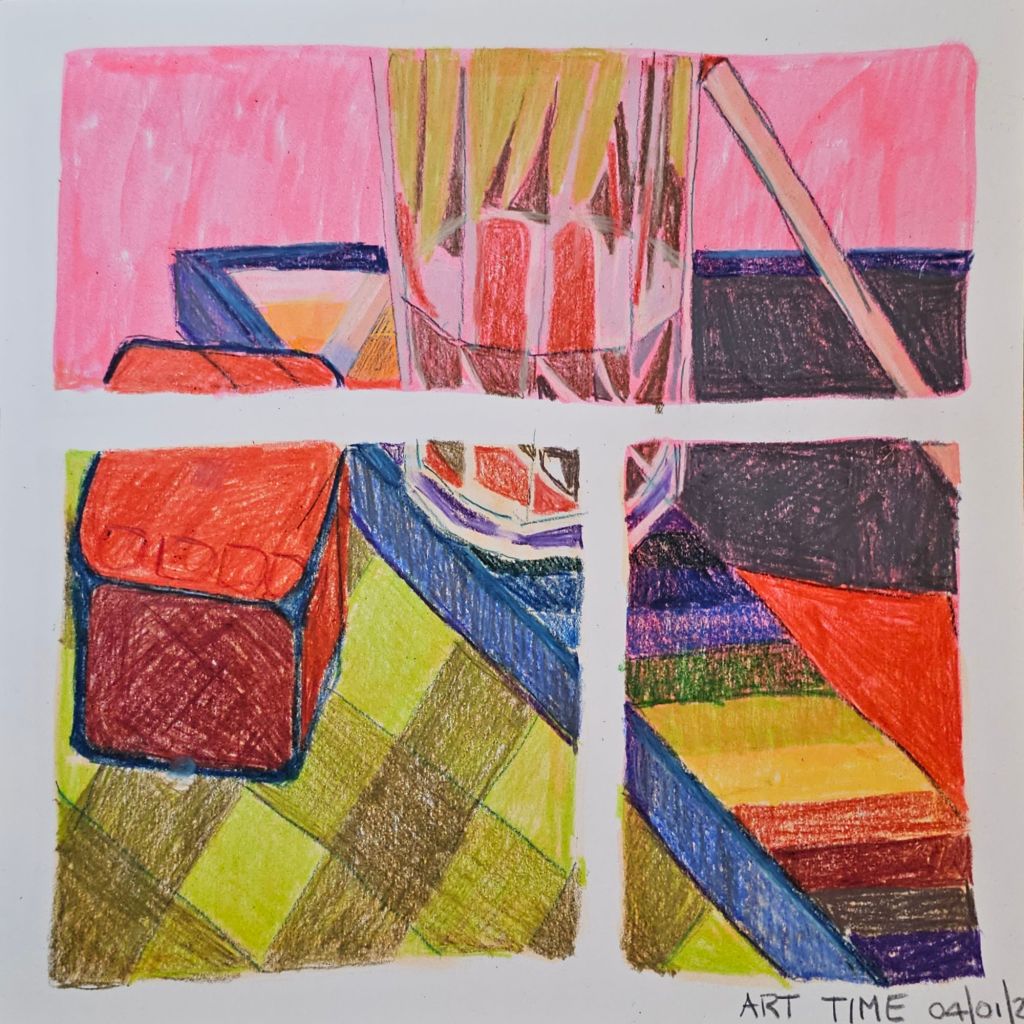
I recently visited the Art Gallery of New South Wales,  where I saw Gascoigne’s installation of found domestic enamel ware. This sketch is the top section of that work (in reality the cup and long handle are suspended from the top of the work’s frame).

Detail from Gascoigne’s installation,
Enamel Ware, 1976