Resolution

It’s New Year so of course I got asked about my new year resolutions, umm, aaah. The best I can come up with is to make fewer cafe drawings (they’ll never stop completely) and spend more time getting out to specifically draw some of the sights around Canberra. I’ll also try and steer clear of the obvious tourist shots and give you some new perspectives on our country’s capital.

So off we go to Parliament House, where we enjoyed a small, but interesting exhibition Namatjira to Now — Five Generations of Watercolours from the Central Desert, its on until 15 February so if you are nearby it’s worth taking a look at. Apart from all the individual artists there is a most amazing collage of watercolour paintings, which, as Lenie Namatjira said

“We started off with magazines, then watercolours. We picked quick ones, not good ones. Then we cut them, then stuck them on one long piece of paper, so they would be big country, all western country – west of Alice Springs – the country of my grandfather Albert Namatjira.”
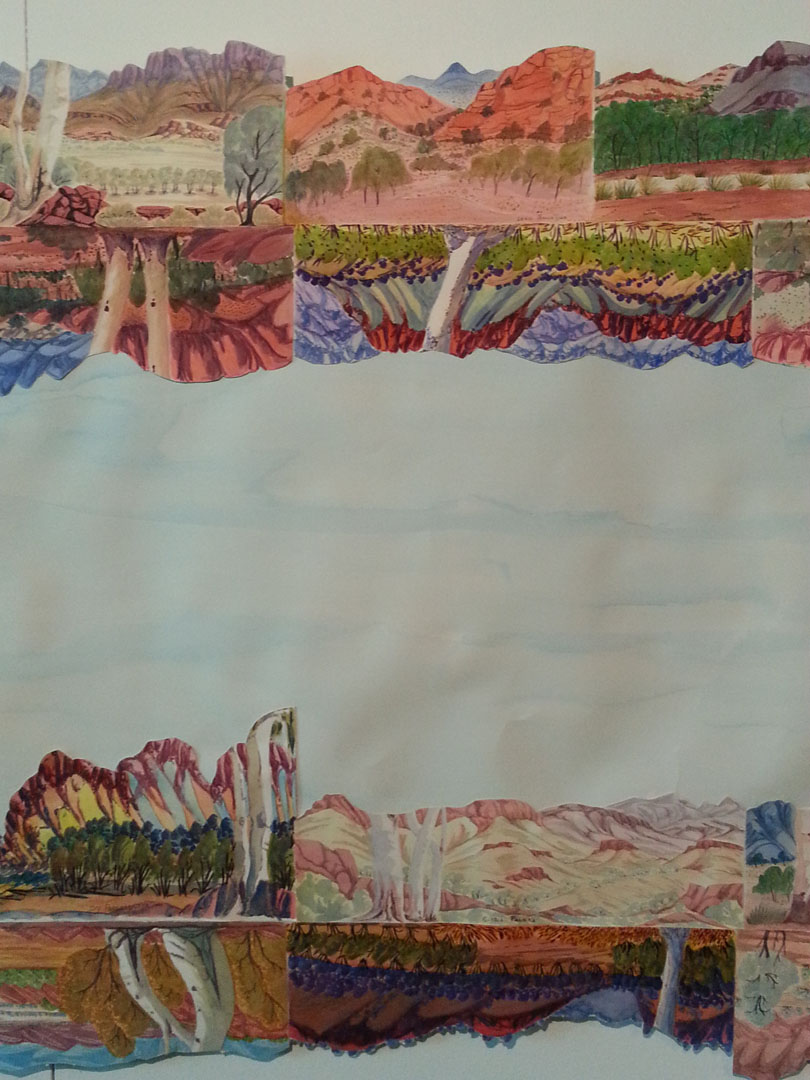
Knara, Nunaka Tywerewtye, Our Big Country: The West MacDonald Ranges The Big Picture, Collaboration with Collage, watercolour, Gloria Pannka, Kevin Wirri, Rienhold Inkamala, Lenie Namatjira, Ivy Pareroulta' Selma Coulthard Nunay with Rolande Souliere

Knara, Nunaka Tywerewtye, Our Big Country: The West MacDonald Ranges
The Big Picture, Collaboration with Collage,  Gloria Pannka, Kevin Wirri, Rienhold Inkamala, Lenie Namatjira, Ivy Pareroulta’ Selma Coulthard Nunay with Rolande Souliere

The exhibition is located near the Members Hall, (if you check out the link above there is a picture of this space from the ground floor level, 3rd small image down). This Hall is the central space in the Parliament building and goes from ground level through all floors of the building to a skylight sited directly under the flagpole. The walls are lined with Australian timbers and the vertical white columns surround the central open space.

The Members Hall, Parliament House, Copic multiliner and watercolour (added later), 2 January 2014

The Members Hall, Parliament House, Copic multiliner and watercolour (added later), 2 January 2014

I’m off to a good start so I’ll keep sharing with you where my drawing takes me.

New Year’s Day Breakfast

Happy New Year! We have a long established tradition of breaking bread with our friends and family for our first meal of the new year. Today was no exception. We gathered at our favourite barbeque spot at Lake Tuggeranong and proceeded to eat bacon and eggs, home-made bread and baked beans, some bubbles coffee tea and fruit.

Part of our festive New Year's breakfast, pen and ink and watercolour, 1 January 2015

Part of our festive New Year’s breakfast, pen and ink and watercolour, 1 January 2015

The weather was perfect and everyone had a great time.

Family and friends at Lake Tuggeranong, 1 January 2015, pen and ink and watercolour

Family and friends at Lake Tuggeranong, 1 January 2015, pen and ink and watercolour

At the Australian War Memorial

The Australian War Memorial is the most visited tourist destination in Canberra but it has been some time since I last went there. While we were actually taking a visitor to see the Memorial I realised that it would also be a great place to do some sketching. Following the advice to practice drawing people where they are likely to be doing similar things so you can build up a composite picture, I found a bench in the WWI gallery and started drawing.
image

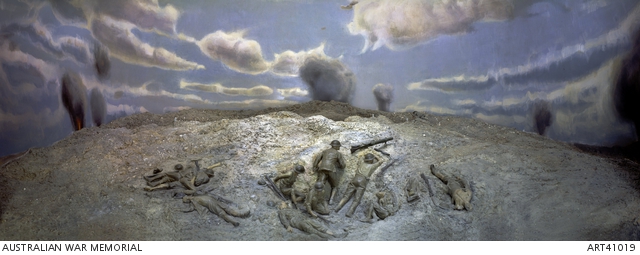
The Poziere diorama
Sculpture: Frank Lynch
Painting: Louis McCubbin, Murray Griffin

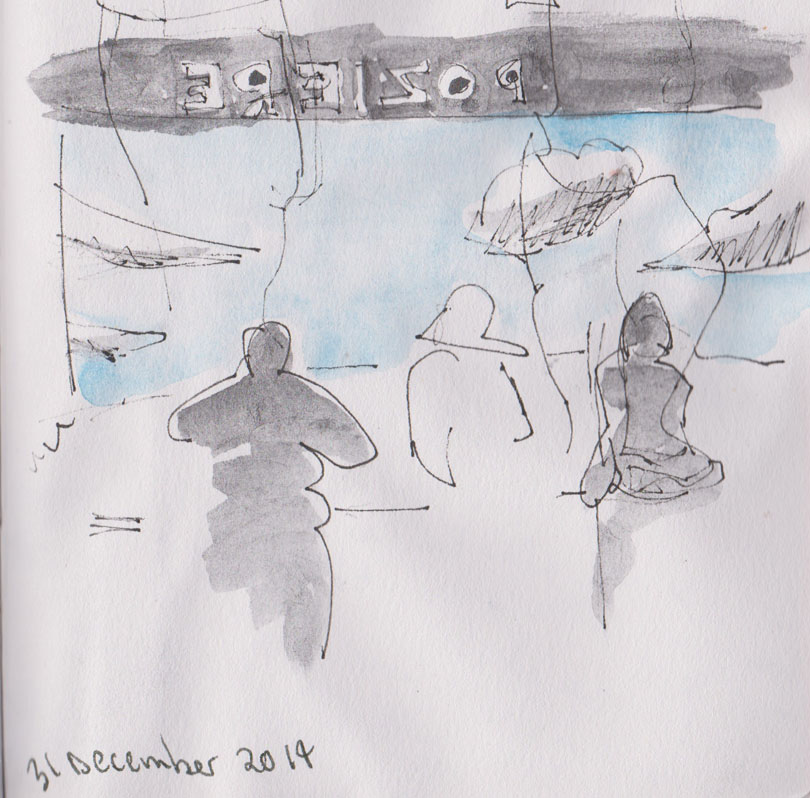
I actually had my back to the Poziere diorama when I realised that the shiny partition in front of me reflected the people looking at the diorama, so I could draw them without having to look directly at anyone.

People looking at the Poziere diorama, Australian War Memorial, Copic Multiliner, graphite and watercolour, 31 December 2014

People looking at the Poziere diorama, Australian War Memorial, Copic Multiliner, graphite and watercolour, 31 December 2014

Things were going swimmingly until a guide brought his tour group between me and the partition. Then someone noticed my drawing and started apologising for being in my way, then the next person also apologised – I knew it was time to move on.

After a break we moved down into ANZAC Hall where I found plenty of space to sit and draw next to the remains of the Japanese Midget submarines that attacked ships in Sydney Harbour in 1942. The low angle allowed me to draw the somewhat dramatic view past a gun from the SMS Emden, (the target of an attack by HMAS Sydney in November 1914), up to the next level and the Landing Place Cafe.

Gun from the SMS Emden and the Landing Place cafe, Australian War Memorial, 31 December 2014, pen and ink, graphite and watercolour.

Gun from the SMS Emden and the Landing Place cafe, Australian War Memorial, 31 December 2014, pen and ink, graphite and watercolour.

We glanced out one of the windows and noticed a ship’s bridge and gun sitting in the courtyard (as you do). So we had to check it out before we left. It turned out to be what remains of the HMAS Brisbane, which was in service from 1966 up until the 1990’s. Not surprisingly this is the largest naval relic in the Memorial’s collection.

The bridge and gun 52 of the HMAS Brisbane, Australian War Memorial 31 December 2014, pen and ink

The bridge and gun 52 of the HMAS Brisbane, Australian War Memorial 31 December 2014, pen and ink. Also an unrelated sketch of several visitors looking down into ANZAC Hall pen and ink and graphite

Our visit today reminded me of what a wealth of interesting subjects could be found at the War Memorial. I’m planning on re-visiting it during the coming year.

Christmas Flowers

Each year I indulge my childhood memories by buying myself a bunch of New South Wales Christmas Bush (Cerapetalum gummiferum), to display on my festive table. This plant was grown around my family home in Sydney, but is too frost sensitive to last in Canberra’s icy winters – I know I’ve killed two plants already. This year I fleshed out the display with some other Australian daisies, the drumstick-like Billy Button (Crasspedia sp.) and another with chalky whitish green flowers, which I don’t recognise, but I assume is from Western Australia. At the last moment my partner added in a large branch of his Holly Oak (Quercus ilex) which lent quite a dramatic diagonal to the ‘arrangement’.

Once again I was practising my sight measurement and angle checking. I made a light pencil outline then worked, fairly freely over this with my Copic Multiliner.

Initial ink sketch with Copic Multiliner, 29 December 2014

Initial ink sketch with Copic Multiliner, 29 December 2014

I knew I wanted to add watercolour to the drawing so I set out to do this as simply as possible.

A Christmas arrangement, pen and watercolour, 29 December 2014

A Christmas arrangement, pen and watercolour, 29 December 2014

I am pleased with a finished result but again would like to re-visit the subject matter without using a sketch outline. Unfortunately I’ll have to rely, in part, on photos as the Christmas Bush is now way past it’s best.

Draped

Today I got to play, at last, with my newest sketching ‘toy’, a tin of Art Graf watercolour  graphite. And I think I’m in luuurve. I first heard about this product over at parkablogs review. He suggested using this for tonal studies and I had the perfect subject – the dark cloth that I use to hang my works in progress on. We’d hung the cloth up out of the way so we could get a light background behind the vase of Christmas flowers that we were painting (more of that later), those drapes just begged to be painted.

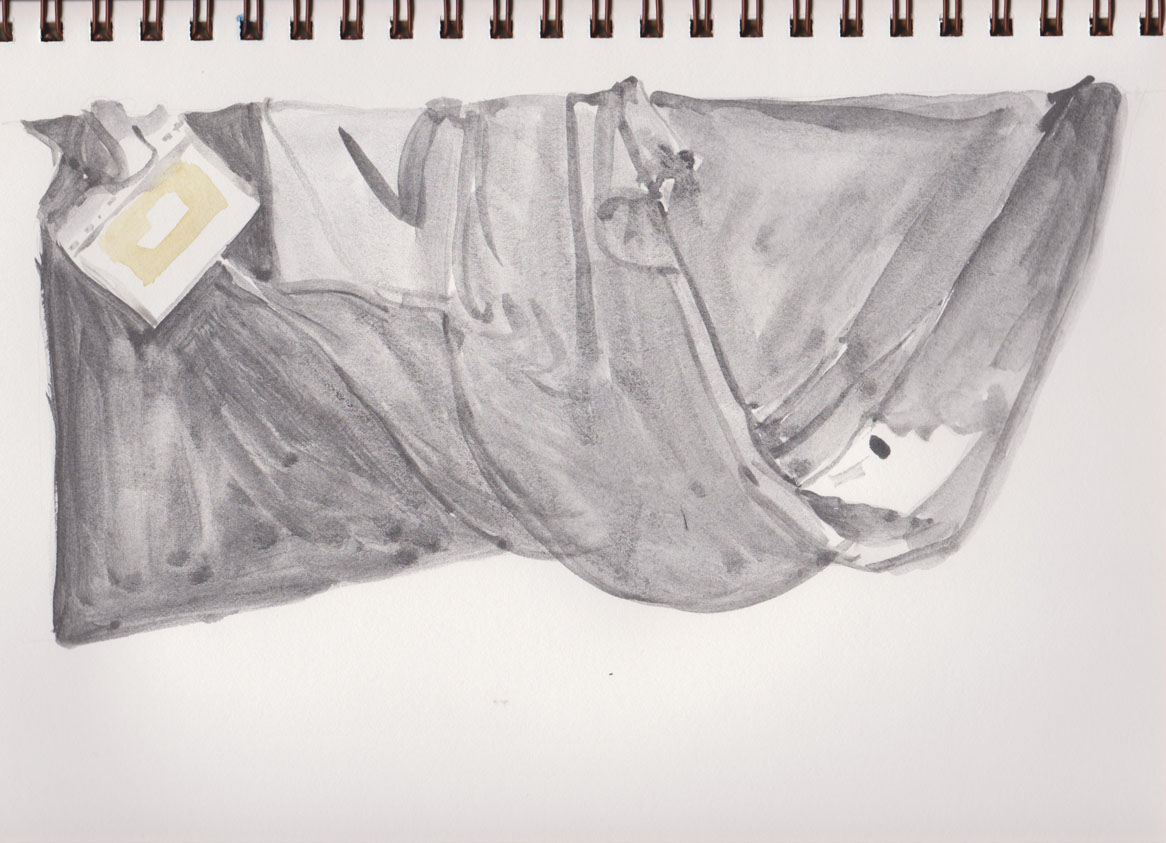
After an initial pencil outline I just started laying in the graphite, working with fairly light washes to start off with.

Some light washes get the shaping underway, Art Graf water soluble graphite

Some light washes get the shaping underway, Art Graf water soluble graphite

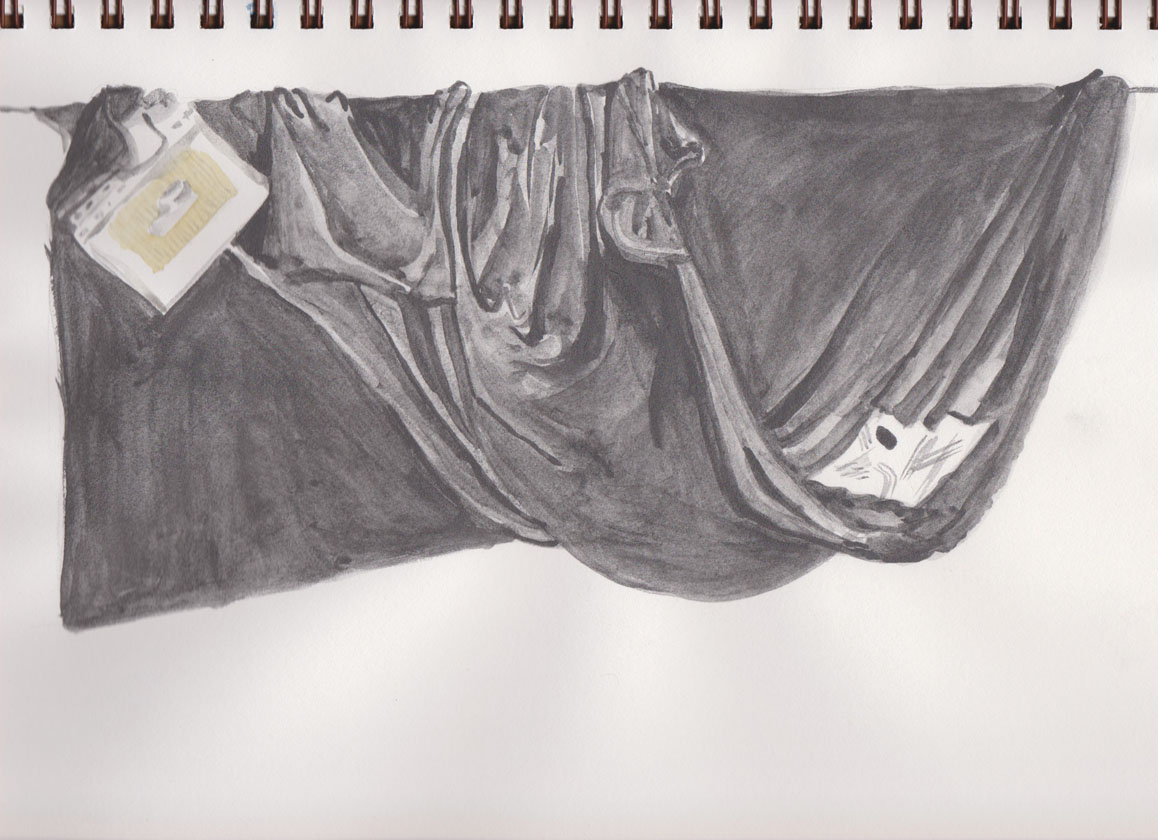
It’s quite easy to build up the layers, allowing it to dry in between. I was pleasantly surprised that I could use the graphite directly from the tin onto the page as it was fairly easy to get the tone I was after by controlling the amount of water on my brush. Here is the result after a number of layers.

Final version of the tonal drapery study, Art Graf soluble graphite, 30 December 2014

Final version of the tonal drapery study, Art Graf soluble graphite, 30 December 2014

Parkablogs suggests mixing the graphite separately on a palette to get an even tone. I personally like the texture the graphite can leave on the page. There are also possibilities for getting interesting textures from a dry-er brush application which I plan to explore in due course. He also suggests using a fixative on the final work and while  I didn’t notice any obvious smudging on my page this seems to be a sensible precaution.

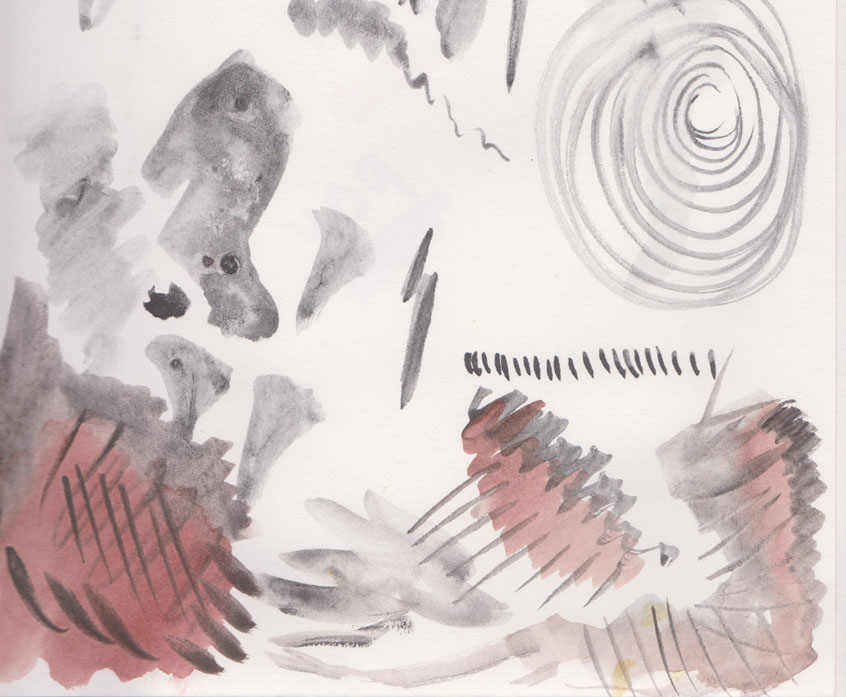
Another aspect I’m interested in exploring is the interaction between the watersoluble graphite and watercolours. I’ve only made the most basic samples so far, but I do like that the graphite keeps it’s line over damp watercolour, see the sample on the left. The graphite only seems to move easily when it crosses another area of still wet graphite, see sample on the right.

Watersoluble graphite over watercolour, 30 December 2014

Watersoluble graphite over watercolour, 30 December 2014

Obviously there is lots more to explore with this medium. If you are a fan of watercolour you may also enjoy using this product. You can buy a tin of Art Graf in either 20 or 60gram sizes. I sourced my Art Graf through Eckersley’s (for Aussie sketchers) and I presume it’s readily available in Europe as it is made in Portugal.