My Pretty Little Art Career

This is a ‘drawing the exhibition’ post but between my title and that of Grayson Perry’s exhibition at the Museum of Contemporary Art in Sydney I thought you might lose interest before you even started.

We went to see My Pretty Little Art Career on the day it opened. This is the largest retrospective of Perry’s work which has been seen to date and it doesn’t disappoint. If Perry is unfamiliar to you then it’s probably easier to let him introduce himself. anybody can enjoy art and anybody can have a life in the arts – even me! For even I, an Essex transvestite potter, have been let in by the artworld mafia.”

Perry has a broad career spanning his initial work making ceramics and sculptural works up to his recent appearances on television where he has produced machine-woven ‘tapestries’ based on the English class system, and a series on the contemporary portrait. If you are a fan of the shows then the pieces you see on the TV are all here, as well as more recent works.
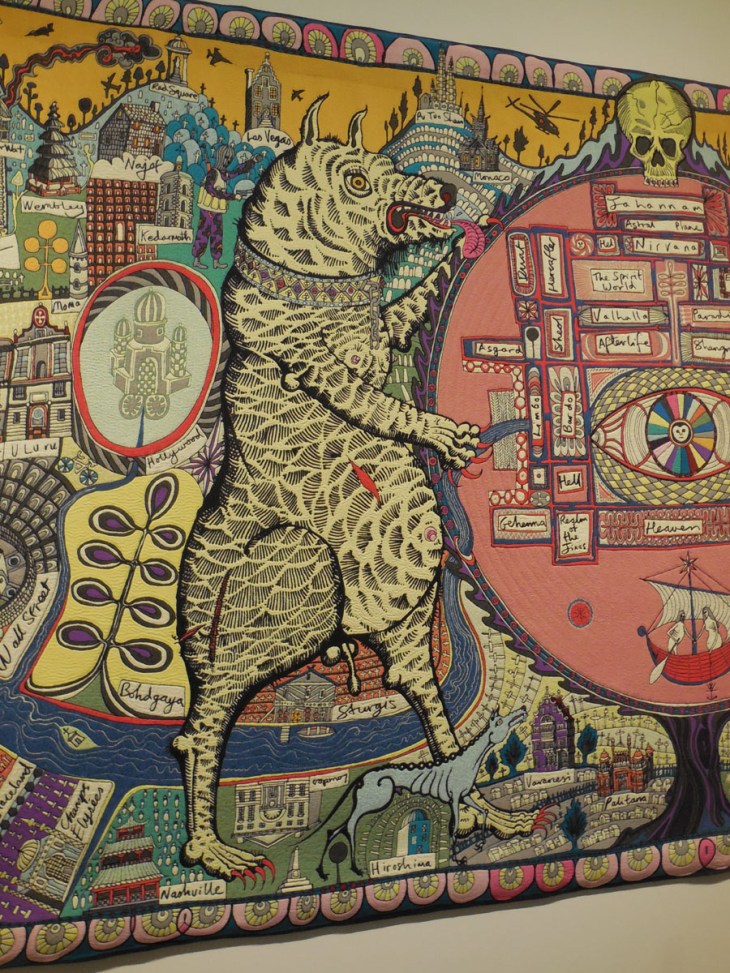
Map of truths

detail, Map of Truths and Beliefs, 2011, tapestry, 290 x 690 cm

What I really wanted to see are the pots that Perry makes. Subversive and sometimes shocking in their explicit language and images, they transcend the stereotype of a ‘decorative’ pottery and are a deliciously pointed response to people who look askance at the ‘minor’ arts. (Apologies for all the quotes, but this is a man / transvestite who likes to demolish art world stereotypes).

Precious Boys

detail, Precious Boys, glazed ceramic 53 x 53 cms

I was thrilled to see one of my all-time favourites,  Dolls at Dungerness in the room. There is also a place where you can watch a time-lapse sequence of Perry hand building and decorating a number of these pots. I liked that he had a small sign sitting next to his wheel reminding him to turn the camera on.

I was disappointed that there were no places to sit in the early rooms of Perry’s work, because I had to skip drawing those pots so artfully arranged in their individual display cases. There wasn’t enough room to move other than to circle around each cabinet to read all the details incised or printed on the pot’s surfaces.

The one place you can get a seat is in the large tapestry rooms. One of these rooms included a very large pot called What’s Not to Like, on which Perry’s teddy, Alan Measles, glazed in gold, surmounts a pot covered with a plethora of desirable consumer goods.
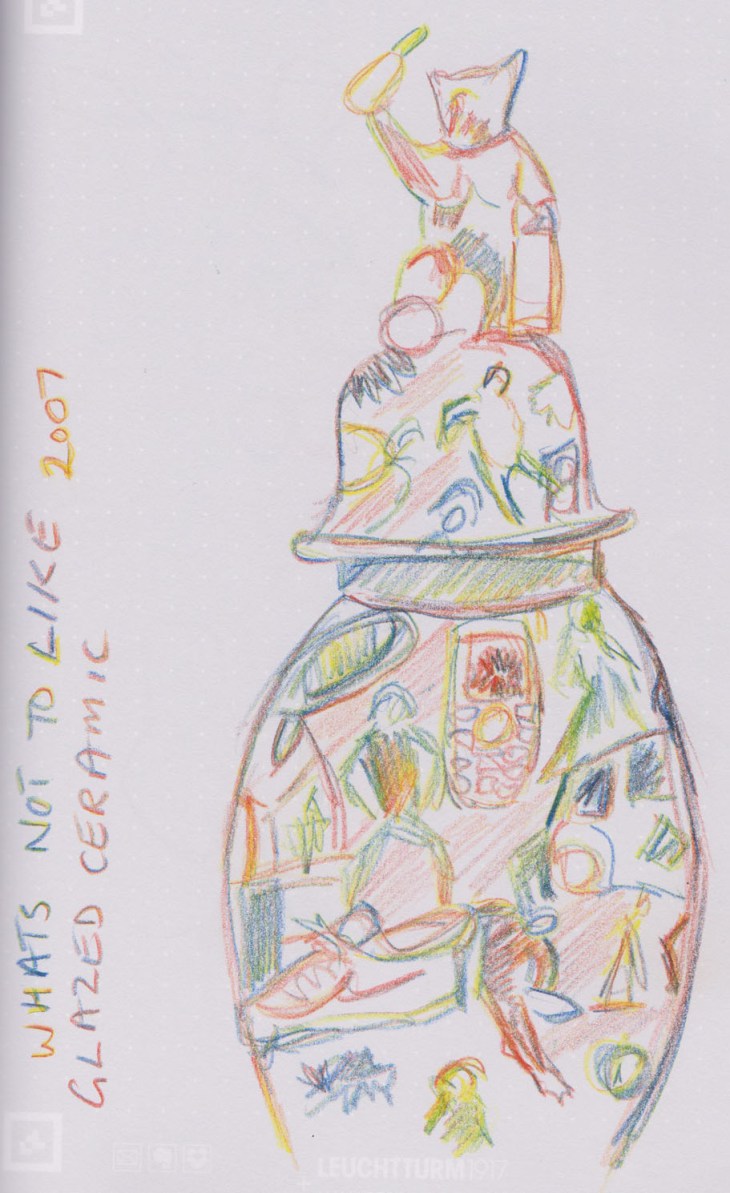
What's not

What’s Not to Like, glazed ceramic, 2007, pot 0 x 60 x 90 cms , lid 40 x 40 x 62 cms. My sketch Koh-i-noor Magic pencil on Leuchtturm 1917 Whitelines Link book

As always I really enjoy seeing an artist’s sketchbooks and process displayed. Perry’s notebooks were fascinating to look at. Here’s just one page.
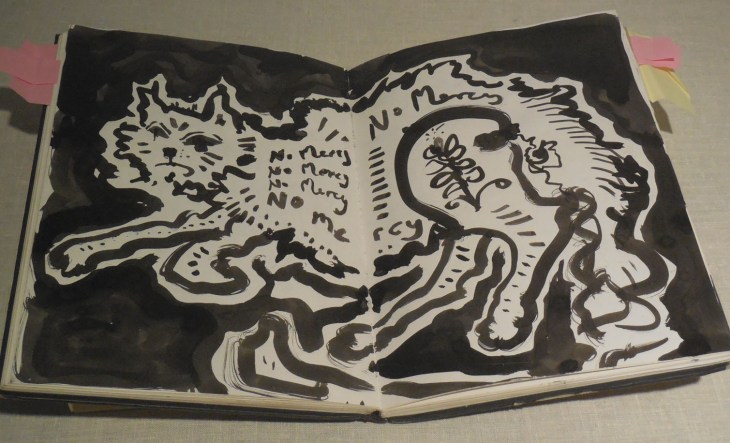
sketchbook

Sketchbook, Grayson Perry

Perry says of his sketchbooks that “Drawing in my sketchbook is an almost daily activity …. When I put an idea down I take it very seriously. I don’t waste ideas and there will come a point when I will make a work from the drawing. I have a backlog of categories of objects I want to make.” I look at my own practice and think about this statement. I have many sketchbooks and rarely re-visit them. How many of my ideas are going to waste? All guilty parties please raise their hand.

Perry’s teddy, Alan Measles and his alter-ego Claire appear in many works. I was particularly taken by these two small sculptures.

Alan Gold

Prehistoric Gold Pubic Alan Dogu, 2007, glazed ceramic, two parts; left 12.5 x 10.5 x 5.5 cm and; right 12.8 x 10 x4 .8 cm

And just because I can here is the X-92 that Claire has been photographed with.
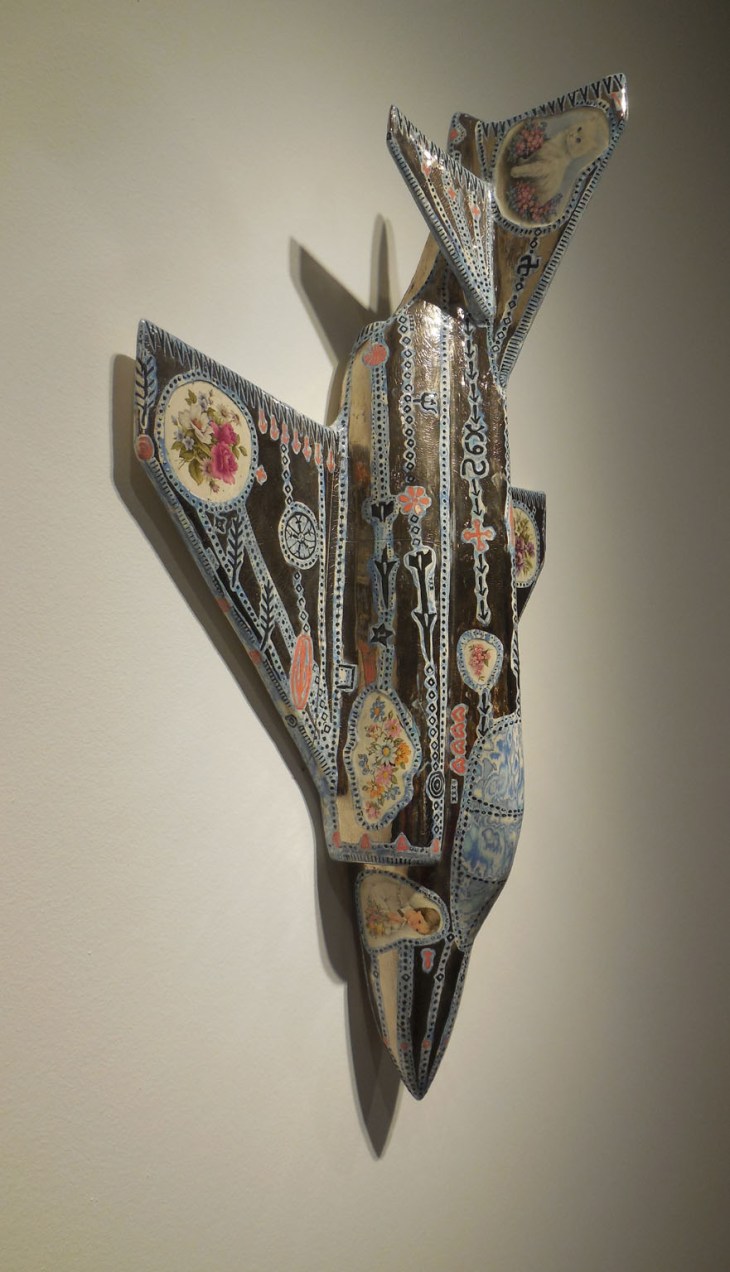
X92

X-92, glazed ceramic, 1999, 84 x 58 x 18 cms

This exhibition is highly recommended as is the accompanying catalog . (Rest assured I’ve given up rote buying of exhibition catalogs).

If you would like to read some other views of the exhibition I can recommend Paint Later’s post. If you want to read some more you can read Jacky Klein’s 2009 monograph Grayson Perry, (Thames and Hudson).

An imagination of Nasturtiums

Some weeks back I was chatting with Drawing Connections about nasturtiums. We were talking about memories of seeing these plants in the Himalayas. I have since pulled out my photos that I took of the nasturtiums twining up wires at the Kumbun in Gyantse, in Tibet.

Nasturtiums in Gyantse

Nasturtiums in Gyantse

Now I haven’t quite got around to making a painting of that scene, but I did get inspired to drag out my Japanese paints, which sit in their box from year to year – too good to use, you know – and make this picture of nasturtiums, using all the colours in my paint box.

Spoiler alert, nasturtiums don’t naturally occur in all these colours.

Nasturtiums, Japanese watercolour paints

Nasturtiums, Japanese watercolour paints

Fun, fun, fun

I was at the Beach Boys concert Friday night, I’ve turned into such a rabid sketcher that I even took my small sketchbook along. Before the show started I drew some backgrounds in so I only had to add the figures when the time came.

I managed this sketch, from the side of the theatre. The watercolour was added afterwards.

The Beach Boys on stage, pen and ink and added watercolour,13 November 2015

The Beach Boys on stage, pen and ink and added watercolour,13 November 2015

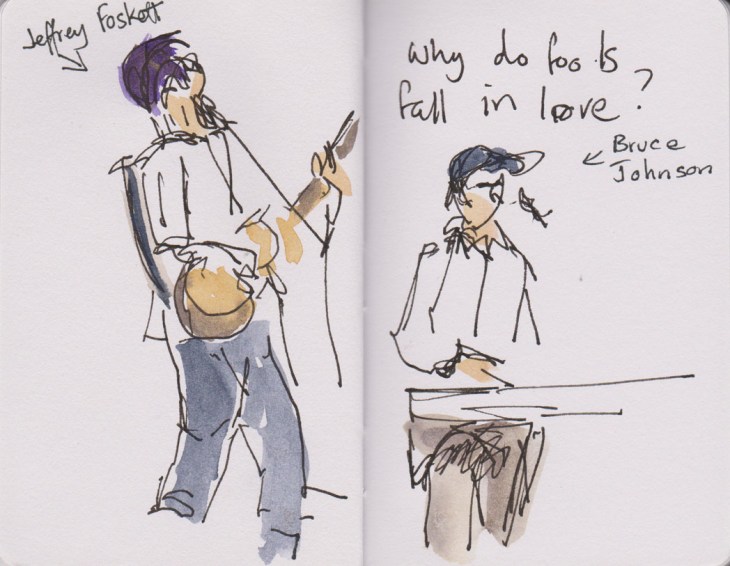
I even managed a second drawing of two of the band, Jeffrey Foskett a band regular and Bruce Johnson, who joined the Beach Boys in 1965.

Beach Boys concert, pen and ink and added watercolour, 13 November 2015

Beach Boys concert, pen and ink and added watercolour, 13 November 2015

So my figures are turned out more ‘stick’ than realistic but hey its hard to dance and draw at the same time.

My biggest regret was that this version of the band doesn’t include Brian Wilson or Alan Jardine – but we had fun nonetheless. The music was great and the musicians were all really good. John Cowsill (of the ’60’s pop group, yes those Cowsills) was a total crazy man on the drums and he’s nearly 60! No time for further drawing I just had to dance for the rest of the concert!

Urban Sketchers Canberra at the National Library of Australia

On Sunday we had our first official outing as Urban Sketchers Canberra, a goal we have been working towards since our sketching group started meeting in February this year. We had 15 people come along, including two people joining us for the first time.

With a bad weather forecast we had to do a last minute change from our planned outside venue to one that offered indoor drawing opportunities. So it was off to the National Library of Australia (NLA). As luck would have it the rain held off for a bit so many of us took the opportunity to draw outside the building.

Spot the non-sketcher, USk Canberra takes to the National Library of Australia

Spot the non-sketcher, USk Canberra takes to the National Library of Australia

I decided to tackle a part of the building that I must say I haven’t paid much attention to before, the large sculpture above the entrance to the library. The work is called Knowledge and was designed by Tom Bass, who is probably better known to most Canberrans as the designer of the sculpture of Ethos in Civic Square. Commissioned in 1966 the work was installed on the building in 1968. At just over 21 metres in length, 2 metres in height and projecting nearly 2 metres from the wall this is a complex piece of work. Indeed I didn’t really consider how complex until I tried to sketch the projecting elements of the work.

Part of the sculpture, Knowledge, at the National Library of Australia, watercolour and brush pen, 1 November 2015

Part of the sculpture, Knowledge, at the National Library of Australia, watercolour and brush pen, 1 November 2015

I managed to get through to the start of the watercolour when it began to rain. I retreated to the portico along with most of the other sketchers to complete adding the colour to my sketch.

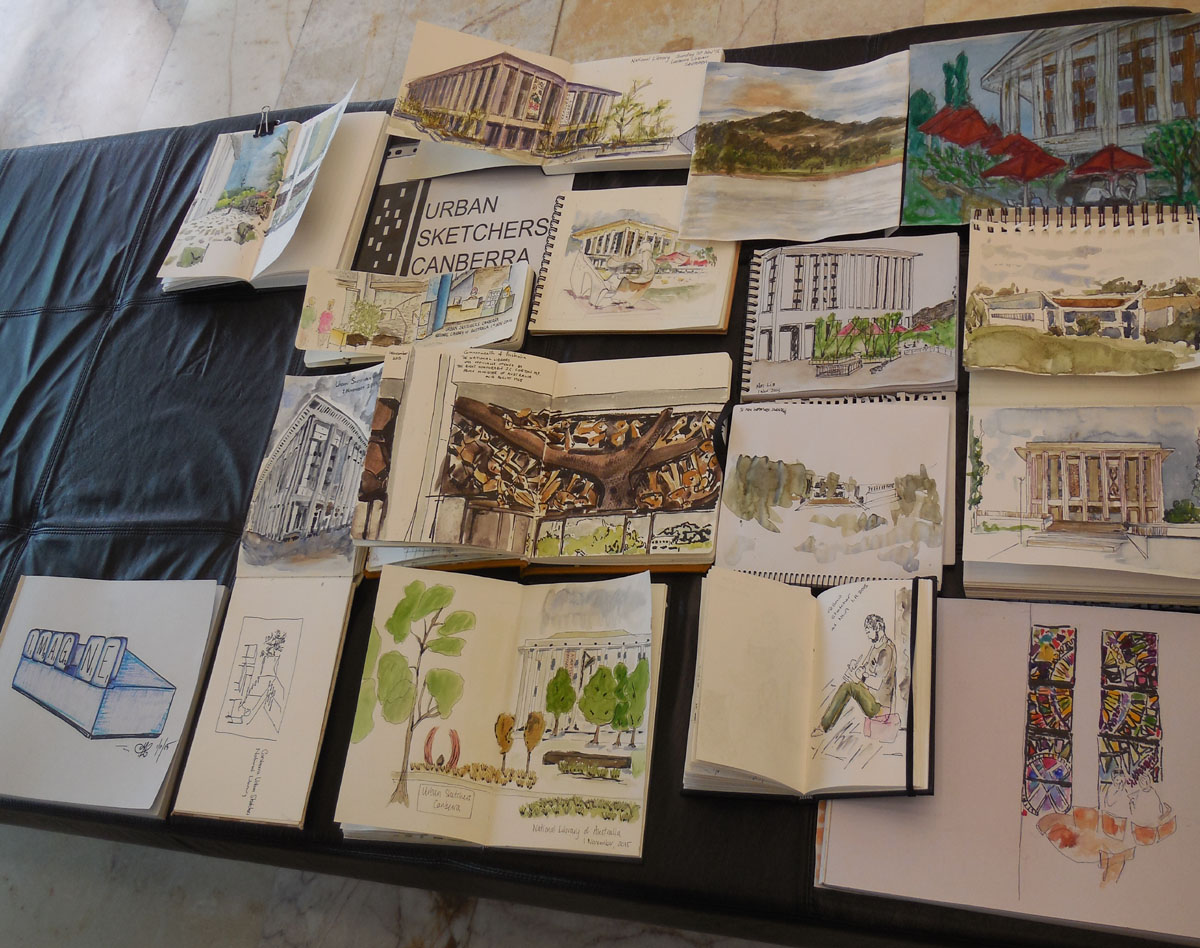
As is traditional we met up at the end of our two hours of sketching to compare our efforts. As always the  subjects and approaches were quite varied.

Some of our final works on the day

Some of our final works on the day

Discussions of the day’s work continued over coffee and lunch in the Library’s cafe. Some of us also looked at the exhibition of work of William Strutt currently on display in the Library. Strutt’s ability as a draftsman really stood out and we were in awe of his fine pencil sketches.

Studies of two male figures and a woman's head, William Strutt, c. 1860, pencil (PIC R3339 LOC1132/F), collection of the National Library of Australia

Studies of two male figures and a woman’s head, William Strutt, c. 1860, pencil (PIC R3339 LOC1132/F), collection of the National Library of Australia

The next meeting of Urban Sketchers Canberra will be on 5 December, at the Australian National Botanic Gardens. You can find details of events and more pictures on the group’s Facebook page, or contact us directly at urbansketcherscanberra@gmail.com

The Historic Hunter

Several weeks ago I was in the Hunter Valley which has many towns dating back to the 19th century. (A very short time period compared to the thousands of years of Aboriginal ownership of the land). In the larger centres the original facades of the 19th century buildings are visible rising above the ground floor of contemporary shops.

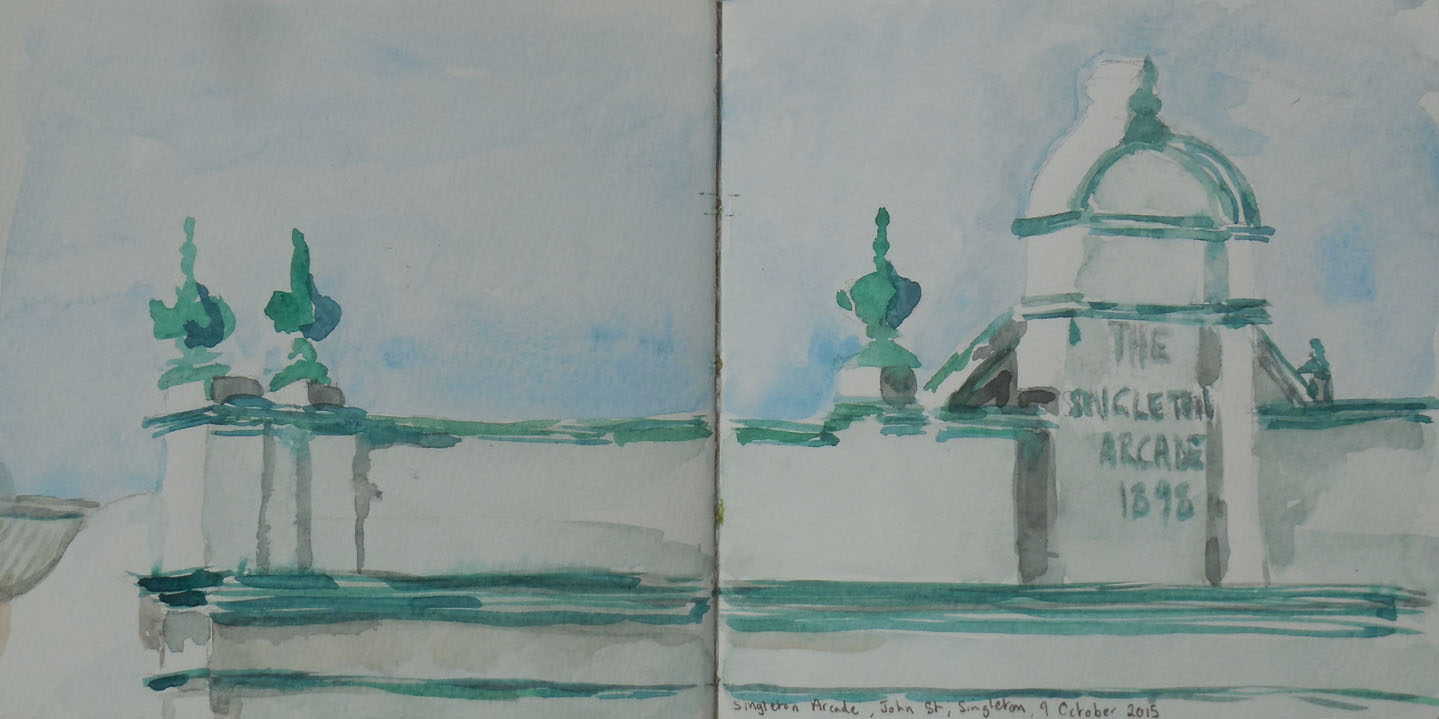
Here are two such facades. The first is in Singleton, located on John St, built in 1898.

The facade of the Singleton Arcade, watercolour, 9 October 2015

The facade of the Singleton Arcade, watercolour, 9 October 2015

When I moved around to the front of the building I could see this interesting chimney, to the rear of the facade.

Chimney detail, the Singleton Arcade, pen and ink, 9 October 2015

Chimney detail, the Singleton Arcade, pen and ink, 9 October 2015

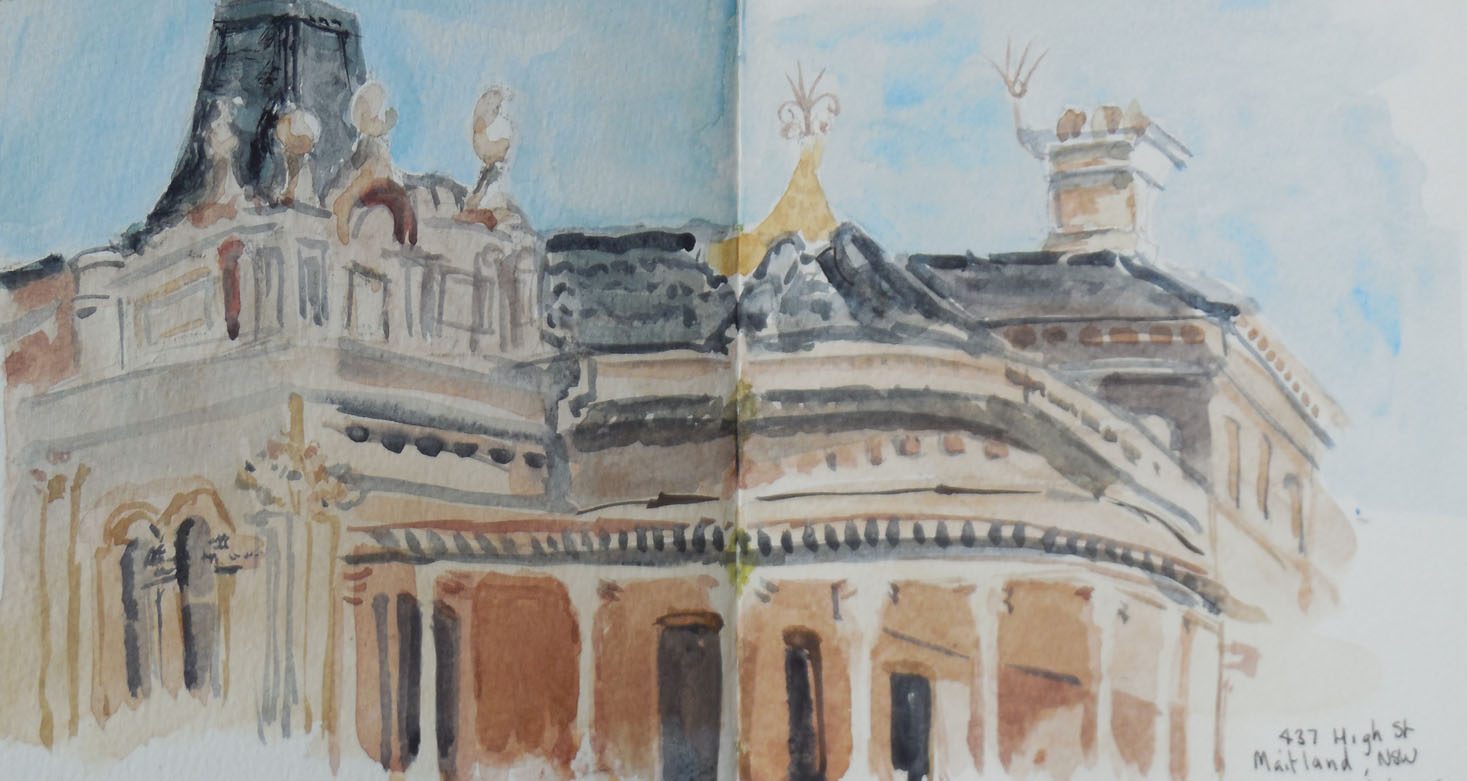
Several days later I visited Maitland. The long main street here is also full of interesting buildings. 437 High St is now the home to up-market boutiques and gift shops. I was surprised to find out that it was even older than the Singleton Arcade. This building, originally built for the Australasian Bank (through subsequent transmogrifications becoming the ANZ Bank), was completed in 1869 and opened the following year. Its French styling and rounded ist floor balcony  takes advantage of it’s corner location. This is a real stand-out among the other nearby buildings.

The first floor of 437 High St, Maitland, watercolour, 12 October 2015

The first floor of 437 High St, Maitland, watercolour, 12 October 2015