The Big Draw

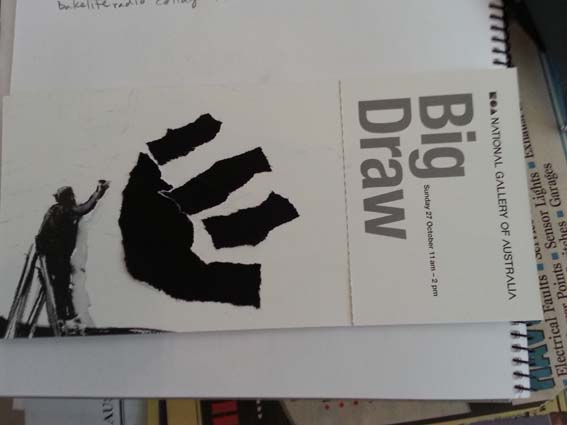
The Big Draw, my postcard for the postcard swap.

The Big Draw, my postcard for the postcard swap.

The Big Draw was held at the National Gallery of Australia last Sunday. In the very short period of 3 hours participants had the opportunity to explore 10 different areas to work in. I made it to 6.

I started off fairly conventionally with my preferred ‘blind drawing’ of models from the Canberra Institute of Technology, wearing garments designed by current students.
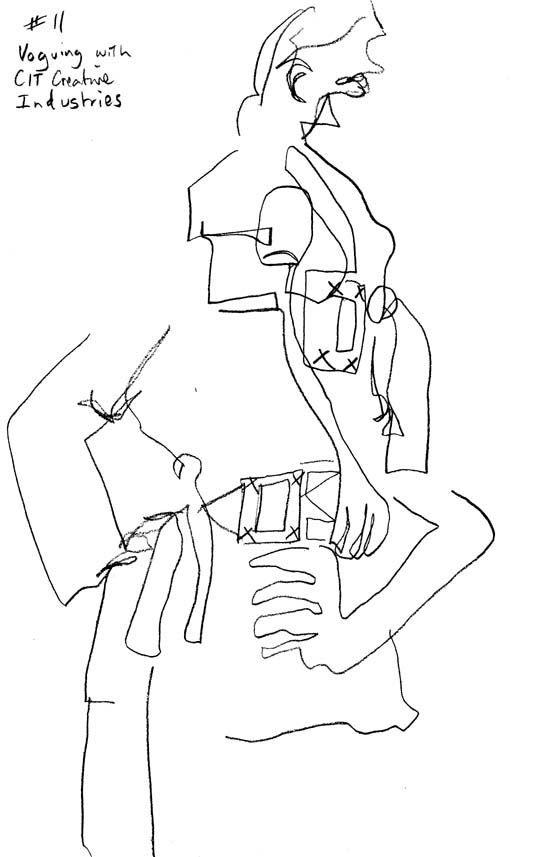
Two sketches 'Voguing' with the CIT students.

Two sketches ‘Voguing’ with the CIT students.

I then headed around to ‘Altered  Books’, outside the William Kentridge exhibition where participants were encouraged to use pages from books as the basis for drawing and collage.

Two drawings, one with collage elements, at 'Altered Books'.

Two drawings, one with collage elements, at ‘Altered Books’.

What I really liked here were the lovely charcoal pencils we were given to draw with. I also discovered that the waxy Lyra pencils we had also provided a great resist to the charcoal. My next drawing took advantage of these properties.

Cat drawn in charcoal over a Lyra pencil background.

Cat drawn in charcoal over a Lyra pencil background.

I then went into the most exciting station ‘Drawn to Move’, inside the Kentridge show, where I-pads had been set up with a stop animation app that allowed you to capture your image as you drew. You could then send the animation to yourself. Alas my animation never made it home (I’m not sure why), but I’ve since found a similar app for my android phablet that I’ll demonstrate in a future post.

By the time I made it to ‘What do you see?’ a large group participation work on the floor in front of Jackson Pollock’s Blue Poles, I was starting to flag. I moved fairly quickly onto ‘Exquisite Corpses’, that favourite Surrealist parlour game where I ran into my life drawing teacher from university. It was good to see you again Tess!

Time was running out so I made a dash past ‘Balcony Blueprints’ and headed into ‘Stick with it’  and ‘Paperscapes’ in the Aboriginal and Torres Strait Islander galleries. These stations were lots of fun and very inventive and thankfully didn’t require any major effort to participate in. Playing a very clever riff on ‘dot’ painting ‘Stick with it’ used an office-workers trove of coloured adhesive dots to make patterns on a large circle of cardboard taped to the floor. There was plenty of space for everyone to join in.

Part of the 'Stick to it' work.

Part of the ‘Stick to it’ work.

I moved on to ‘Paperscapes’ for my last piece of work. I was all ‘drawn out’ by this stage so I stuck to using large pieces of coloured paper to make a collage inspired by the striping of the Bungle Bungle ranges, very apt in this room of inspired landscapes.

'Paperscapes' in the Aboriginal and Torres Strait Islander galleries.

‘Paperscapes’ in the Aboriginal and Torres Strait Islander galleries.

After three hours it was all I could do to stagger to the information desk and hand in my postcard, to be swapped sometime in the future, with one from another participant.

I really enjoyed myself last Sunday, but I came away pondering who the target audience was for this event. The obvious answer was that everyone was the audience and people of all ages were participating. My corollary to that was that I saw few ‘solo’ adults participating in the activities. Most adults appeared to be there as adjuncts to children and weren’t actively engaged on their own behalf, which I thought was a shame. I think this reflects the feeling that art is for ‘artists’ or something only permissable for children to enjoy.  I’m reminded of one of my favourite quotes from Art & Fear (David Bayles & Ted Orlando, Capra Press, 1993):

“When my daughter was about seven years old she asked me one day what I did at work. I told her I worked all day at college – that my job was to teach people how to draw.

She stared back at me, incredulous, and said, “You mean they forget?” – Howard Ikemoto”

Within Without (James Turrell)

One of the highlights of the renovation of the National Gallery of Australia a few years back was the installation of a major artwork by James Turrell called Within Without. If you are familiar with his work you will know that he likes to use light and optical illusions in his space/sculptural works. In this case a domed room has been enclosed inside a truncated pyramid, with both the pyramid and room open to the sky (if you follow the link you can get a sense of the space). It’s a nice space to sit in during the day, but at dawn and dusk there is a special lightshow that really makes the work quite magical. If you live in Canberra, or visiting, I would highly recommend that you experience this amazing artwork.

experiencing WithinWithout at the National Gallery of Australia.

Experiencing Within Without at the National Gallery of Australia.

After the last day of the watercolour workshop we were just there at the right time to see the lightshow. I was amazed and hope you will be too. Just remember that the ‘circle’ you see in the following series of images is a hole in the roof of the building. The colour surrounding the hole is projected onto the rooms white walls. The apparent colour changes of the ‘circle’ are in fact an optical illusion. These images were taken over a period of 40 minutes using my camera phone (much better than my old pocket digital camera!).

This slideshow requires JavaScript.

How Turner, the brilliant colourist, would be working if he was alive today was discussed during our workshop. I think he might have been working like James Turrell.

Toulouse-Lautrec

Finally got to the Toulouse-Lautrec exhibition at the National Gallery of Australia today. Somewhat of a celebration of my rapidly recovering knee which allowed me to get around the show without falling over.

A very impressive show. I particularly enjoyed seeing his oil paintings on cardboard where he allowed so much of the substrate to show through. His draftmanship was evident in his ability to depict his subject with apparently effortless strokes, with no need to work the whole surface. Here is a small example from his work Woman curling her hair of 1891.

Tlscan

The oil was thinned with turpentine to promote rapid absorption into the cardboard. When i first saw these works I thought they were pastels. I presume that, amongst other things, this technique made it very easy for him to carry his work around, particularly when he was painting in the brothels.

Of equal interest to me were his smaller lithographs using crayon, where again fine and delicate lines were all he needed to convey the subject.

The exhibition runs until 2 April 2013.

Matisse

During August I read Hilary Spurling’s biography of Matisse, Matisse: The Life, (Penguin Books 2009, the cut down version not the two volume job). It’s taken time to work through it because alongside it I’ve had open my catalogue from the 1995 Matisse exhibition that toured Australia, so I could see more of the works that Spurling covers in her book.

The day I finished reading the book I went to the NGA and drew various elements from Oceania, the Sea. This work was inspired by Matisse’s visit to Tahiti in 1930, but remained unrealised until 1946 when he made the work as a paper cut out, which was subsequently printed on linen in 1948.

As I got rather carried away by drawing various elements of this work, (13 pages of drawings of which12 are double pages), subsequently painted in gouache, I’ve made some composite images of my efforts.

Oceaniacomposite2lr

Spurling write’s about Matisse’s visit to Tahiti and the lagoon of Fakarava where Matisse

experimented with focus, depth and angle, staring down from above into the green floor of the lagoon, looking up from below at a watery ceiling opaque and wavery as medieval glass, plunging repeatedly between the two, schooling the retina to compare the different luminosities of sky and sea.“( p 401). 

Oceaniacompositelr

The National Gallery of Australia also owns the companion piece, Oceania, the Sky. The NGA’s curator Lucinda Ward takes up the story.

When Zika Ascher visited Matisse in Paris in 1946, he found an assistant pinning cut-out paper shapes to the walls. Matisse, a virtual invalid since 1941, worked from bed and had adopted decoupage. Silhouettes of fish, birds, jellyfish and coral, the life of sea and sky, were arranged from dado to cornice on two adjacent walls, and the challenge was to translate this flimsy maquette into more durable form. The London-based textile designer worked to Matisse’s exacting standards. Linen was dyed to match the colour of the apartment walls—an off-white fashionable in the 1920s and 1930s, which had become, with the patina of time, a light beige. The shapes were printed using opaque white ink.”

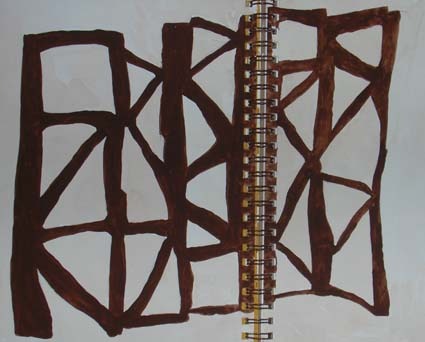
I found a resonnance between the Matisse cut-outs and Kelly’s shadow drawings. Simplified forms, set against a plain background. I also found a similar response in the work of Branda Kesi’s Siechoutie – muddy bark, 2009, a stitched and painted bark cloth, that I also recorded on the same day.

Brenda_kesi