Pauline Boty

Pauline Boty, (1938-1966), was an English artist and sole female member of the British pop art movement. Boty came to prominance through unlikely paths. Initially she studied stained glass and then collage at the Royal College of Art. She had wanted to join the painting department but was dissuaded from applying because of the low success rate of applications by female students.

Drawn from a still from the film Pop Goes the Easel by Ken Russell, 1962

Boty’s good looks attracted attention, earning her the nickname of ‘the Wimbledon Bardot’ referring to her likeness to the French film star. Her appearance in the Ken Russell documentary Pop Goes the Easel, in 1962,  gave rise to a series of roles on the TV and stage and one in the film Alfie.

Pauline Boty, 1963 from a photograph by Lewis Morley

In 1959 three of Boty’s works were selected for the Young Contemporaries exhibition and in 1960 one of her stained glass works was selected for an Arts Council exhibition Modern Stained Glass. You can see her stained glass self portrait in the National Portrait Gallery London.

Throughout her studies and in addition to her acting, Boty continued working on her paintings, first showing her work in a small group show in 1961. My favourite painting of hers is The Only Blonde in the World, 1963, a portrait of Marilyn Monroe, is in collection the Tate Gallery.
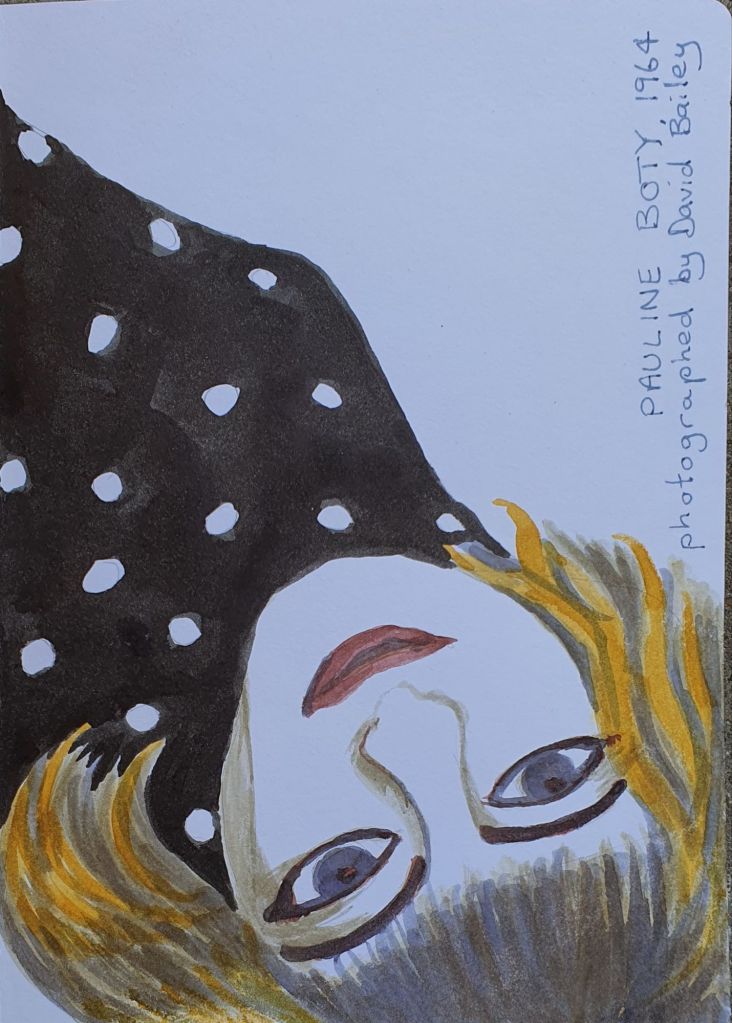
Pauline Boty, 1964, from a photograph by David Bailey.

Boty married Clive Goodwin in 1963. In 1965 she became pregnant, but during an examination it was discovered that she had an aggressive cancer. Boty decided to forgo treatment as there could be no guarantee that her unborn child would survive. Her daughter, called Boty, was born in February 1966. Pauline Boty died of cancer in July of the same year.

Clarice Beckett

It is an all too common trope, that women in the arts are neglected in their lifetime,  forgotten when they die, only to have their work resurrected decades after their death. Clarice Becket is the “poster child” for this worn out story.

The daughter of a Bank Manager,  you can imagine, looking at her at age 18, the expectations for a young woman of her social class.

She studied art with leading Australian artist Frederick McCubbin from 1914-16 and later with ‘Tonalist’ painter Max Meldrum. By 1926, she was creating landscapes unprecedented in Australian art for their “radical simplicity”, and from 1930, she experimented further with a broader colour palette and more challenging compositions.

Clarice in 1931

In 1935, while painting the sea off Beaumaris during a winter storm, Beckett contracted pneumonia and died four days later, aged 48. (Wikipedia)

You can read and see more about her work in an earlier post of mine here.

Clarice painting at Beaumaris

I didn’t have much luck finding photos of Clarice to work from. This one, which I’m guessing is from the late 1920’s early 1930’s, at least shows her in her preferred occupation,  painting at Beaumaris, where so much of her work was made.

Rosalie Gascoigne

For those of you who’ve read this blog for a while the name Rosalie Gascoigne might be familiar. I have written about her work here previously.

Gascoigne was born in New Zealand 1917 and died in Australia in 1999, (she lived in Australia from 1943). Gascoigne is, arguably, the greatest Australian landscape artist of the late 20th century. The earliest part of her time in Australia was spent at Mt Stromlo Observatory, where her husband Ben, worked as an astronomer.  It was an isolated place at the time, just outside Canberra,  the capital of Australia (now on the suburban edge of the city).

Early days at Mt Stromlo c. 1944, photgraph by Ben Gascoigne

Originally Gascoigne found expression through collecting and arranging pieces of wood and feathers as she walked around the mountain. Most memorably, at a talk of hers I went to at the National Gallery of Australia,  she showed a photo of an early work made, quite literally of rabbit droppings glued to a piece of cardboard!

Later she undertook the practice of Sogetsu Ikebana, but found it ultimately limiting. She turned to using found materials, that she often collected from country rubbish tips around Canberra, as material for her constructions.

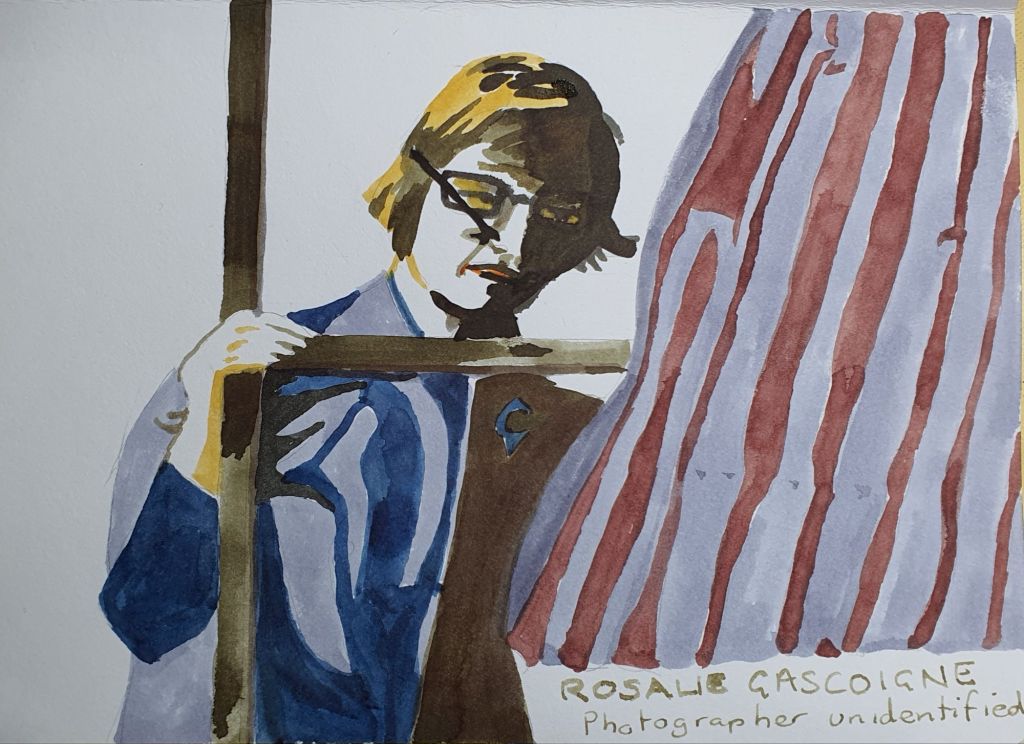
Gascoigne with her work Clouds 1, made from a found window frame and a piece of corrugated iron. Photographer unidentified.

Major works of hers are now held by the National Gallery of Australia and other state and regional institutions.

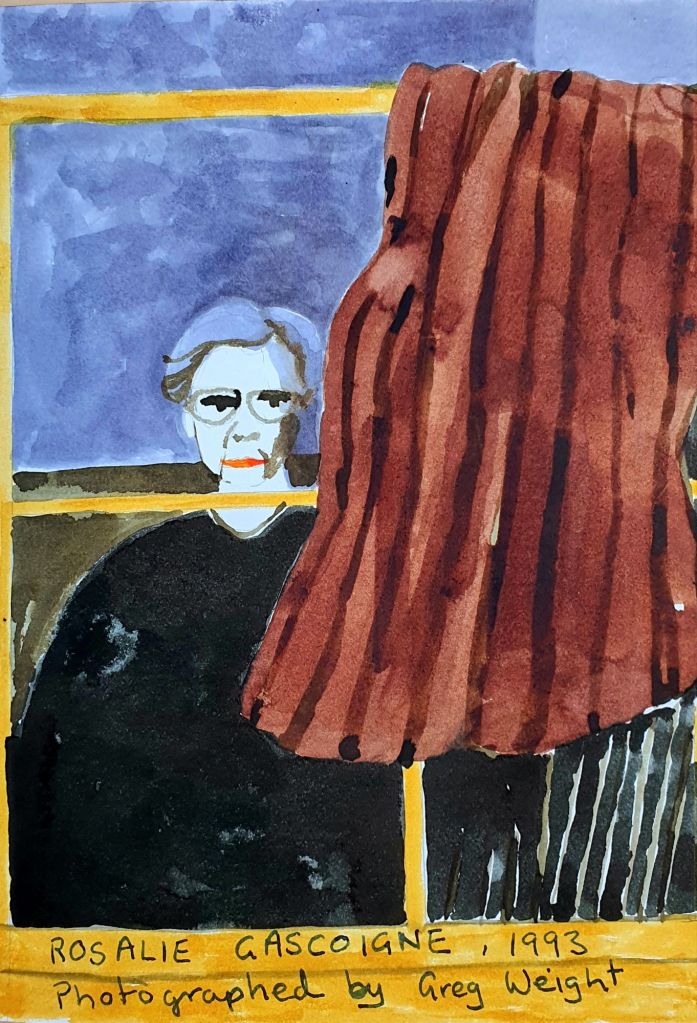
Gascoigne in 1993, photographed by Greg Weight, who clearly referenced the earlier photo of her with Clouds 1.

I recently visited the Art Gallery of New South Wales,  where I saw Gascoigne’s installation of found domestic enamel ware. This sketch is the top section of that work (in reality the cup and long handle are suspended from the top of the work’s frame).

Detail from Gascoigne’s installation,
Enamel Ware, 1976

Joan Mitchell, (no not the singer).

The 3rd artist I am sketching during Inktober is American artist Joan Mitchell (1925-1992), who is associated with the abstract expressionist movement. An excellent starting place to read about Mitchell and a whole slew of women working in mid-century New York, is the book Ninth Street Women, I can’t recommend it highly enough.

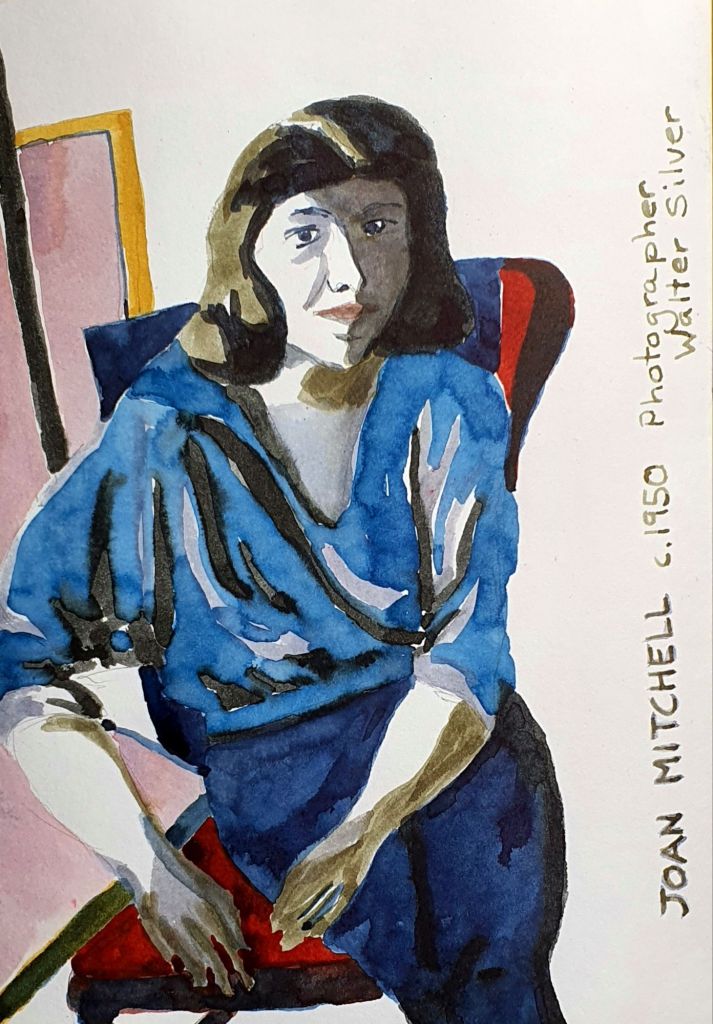
Joan Mitchell c. 1950

Mitchell spent a large part of her career working in France, moving there permanently from America from 1959.

Based on a photo from the Joan Mitchell estate.

In 1967 Mitchell inherited money from her mother’s estate which allowed her to purchase a property in Vértheuil, close to Monet’s house at Giverny. She lived there for the remainder of her life.

Joan Mitchell,  from a photo by Timothy Greenfield-Sanders

Mitchell worked on a large scale, painting abstract landscapes. She was, most famously to have said to art critic Irving Sandler, “I carry my landscapes around with me.”

Eva Hesse, sculptor?

The next artist on my list of subjects I an drawing for the Inktober 2024 challenge, is Eva Hesse (1936-1970). Definitely one of those “if only …” artists.

Hesse explored so many new materials and ideas in the very short life she had. I was introduced to her work when I studied art as a mature age student and while her sculptures continue to engage me, I have also become a massive fan of her drawings. If you want to see what she could do I highly suggest you look for a copy of the book Eva Hesse Oberlin,  which catalogues her work  held by Oberlin College. Given this book weighs just shy of 3 kgs (2.971kgs to be precise), you may have to prepare in more ways than one to tackle her body of work.

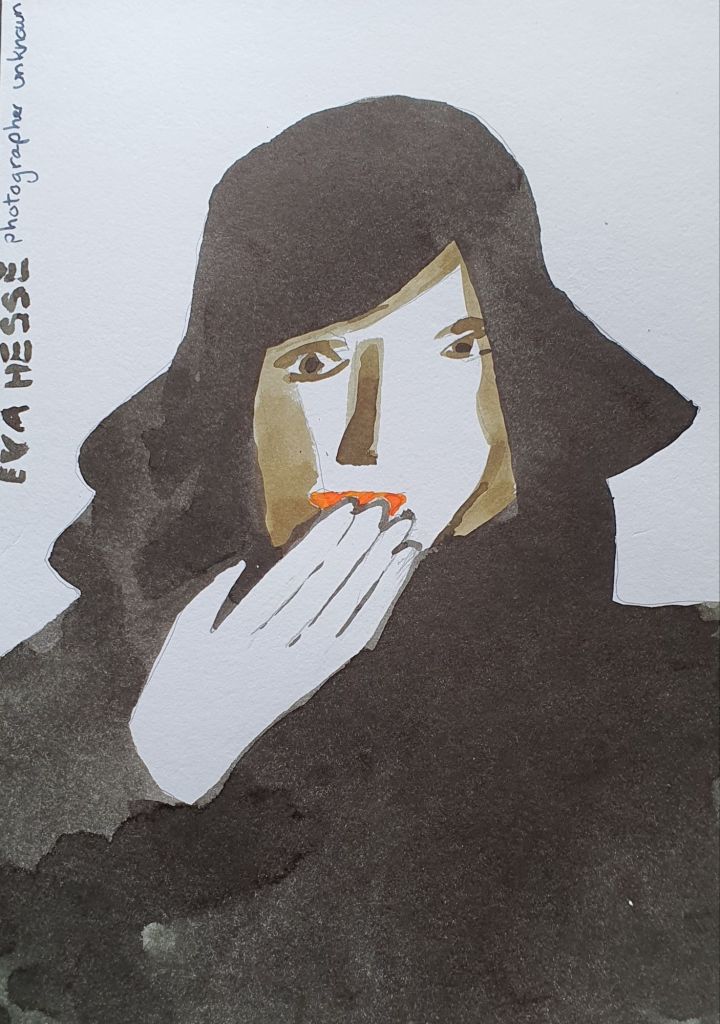
Eva Hesse, 1963,
from a photograph by Barbara Brown.

I noticed quite a different approach in the photos of Hesse, compared to those of Lee Kranser. I can’t decide if it was to do with the age she was living in, or the age of the sitter. I also felt drawn to adding some warmer tones to these drawings.

Eva Hesse c.1959,
from a photograph by Stephen Korbet