Cafe Wednesday panorama

I had so much fun with last week’s panorama that I decided to go with the same format again this week.

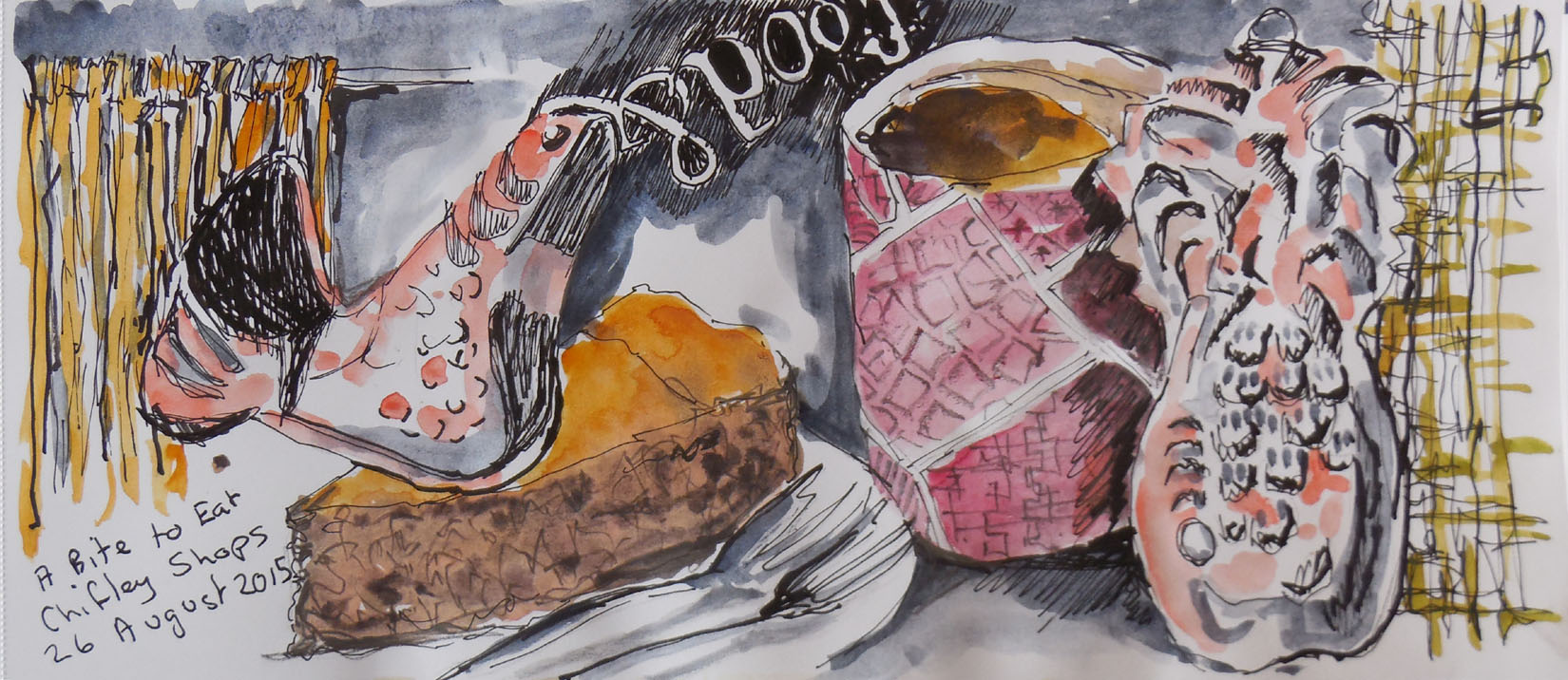
The weather was vile with a cutting icy wind so instead of our regular cafe which has very little by way of wind-free tables we decided to try somewhere else with indoor seating. Our choice was A Bite to Eat at the Chifley shops. In Canberra most of the good and quirky cafes are hidden in otherwise unremarkable suburban shopping precincts. The Bite has a retro vibe with lots of anodised food molds on the wall and large laminex topped tables I could easily spread my book and paints out on. And the Persian Spice cake was really yummy too!

A Bite to Eat, watercolour, pen and ink and graphite, 26 August 2015

A Bite to Eat, watercolour, pen and ink and graphite, 26 August 2015

Cafe Wednesday combo

Post overseas travel and we are finally getting back to our routines. This week we have made it back to our regular Wednesday cafe. To hang onto that holiday magic just a bit longer I decided to use the Derwent Panoramic book which I won in the final raffle at the Urban Sketchers International Symposium in Singapore. The paper format is 420x 180 mms and weighs in at 165 GSM. This paper is designed for pencil and light watercolour wash.

I wanted to use the extended panorama format to bring a more interesting compositional approach to this very familiar subject. I had in mind the workshop I did on Day 1 with Inma Serrano and Miguel Herranz where we were working on capturing a complex scenes in a series of images on the one page.

At Biginelli's along with the dinosaur, watercolour and watersoluble graphite, 19 August 2015

At Biginelli’s along with the dinosaur, watercolour and watersoluble graphite, 19 August 2015

I knew I was pushing the paper’s limits with the amount of water I added to the paper, but it seems to have held up quite well to the watercolour, although there was buckling. The elastic strap on the book has helped tame the ‘buckle’ factor. I also intend using this book for pen and ink and brush pen sketches and plan to take it along to some of the other events we attend such as Drawn In and Dr Sketchy where I feel the large format will enable me to make a montage of images. We will see.

PS I’m not sure what the current availability of this book is. I have seen it on offer at various websites, but I couldn’t find it on Derwent’s home page product list. If you want to try this format you might need to get one sooner rather than later.

Drawing the Exhibition – Myth + Magic

Myth + Magic, Art of the Sepik River, Papua New Guinea, is the current featured exhibition at the National Gallery of Australia (NGA). The art works on display are predominantly sculptural and relate to the spiritual practices of the people who live along this major river system of Papua New Guinea. The works are quite dramatic and often have a visceral quality which derives both from their subject matter and also from the materials they are made from – wood, shell, pig tusk, fibre fur, hair and mud. This sense of drama is enhanced by the display of these items in largely darkened rooms set off by tightly focused spotlights.

There are a plethora of interesting subjects to draw. I was intrigued by these two large figures which are costumes worn during initiation ceremonies. They represent spirits or awan, that “frighten harass and bully” young initiates during their period of seclusion. Like many other pieces on display, these items were collected in 1916, when Australian forces entered the Sepik River to wrest control of the territory from Germany, as an extreme outlying action of the First World War.

Two awan (spirit) costumes, East Sepik River, before 1916 collected by Captain Walter Balfour Ogilvy, from the collection of the Museum of Victoria. Water soluble graphite

Two awan (spirit) costumes, East Sepik River, before 1916 collected by Captain Walter Balfour Ogilvy, from the collection of the Museum of Victoria. Water soluble graphite, 17 August 2015

These costumes are constructed of fibre, the bodies are woven from plant material and are decorated with clay, shell hair and ochre. The figure to the rear has a head dress made of densely packed cassowary feathers. When the costumes are worn all that can be seen are the wearers feet (there is a photograph of similar costumes being worn, in the exhibition catalogue). The wearer can look through the mouth opening of the nearest figure and the second figure has two eyeholes in the chest to see through.

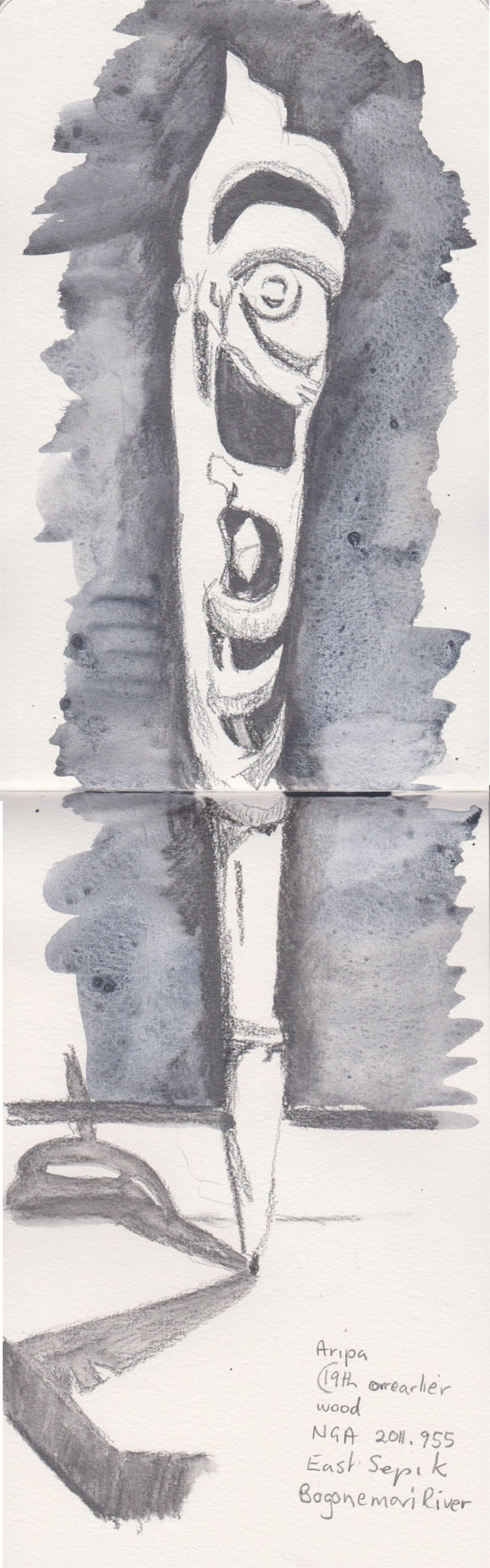
In each room there were astonishing items to see. In the last room, apart from the massively carved crocodile sculpture on loan from the Museum of Papua New Guinea, are several aripa, or hunting helpers. These aripa are an abstracted human figure, sublimed to a most minimal form, ‘standing’ on their one foot. To quote from the website “If the spirit [aripa] has been correctly appeased it will track down and kill the desired prey’s spirit so it will show itself to the hunter to be killed easily. It was believed the soul (tite) of the aripa spirit being, not the artist, was responsible for the creation of their physical bodies.”

Aripa, 19th century or earlier, wood, Bogonemori River, east Sepik, collection of the National Gallery of Australia, Water soluble graphite and watercolour (added later), 17 August 2015

Aripa, 19th century or earlier, wood, Bogonemori River, east Sepik, collection of the National Gallery of Australia, Water soluble graphite and watercolour (added later), 17 August 2015

While we were in the gallery my partner commented on how the sculptures felt somehow familiar – even though we hadn’t seen them previously. We concluded that this sense came not from these figures per se, but from the inclusion of tribal art or the influence of similar works from Africa and elsewhere in the globe, into ‘modern’ art of the early 20th century. We had seen the reflection and now we were seeing the ‘real thing’.

The exhibition is on until 1 November 2015 at the National Gallery of Australia in Canberra. It will not be touring. Well worth a visit if you are in the area.
The bigger pictures

Some of the sketches I did on holidays proved to be too big for my scanner, so its taken some time, not to mention a bit of fiddling in photoshop to get them to a state where I can post them.

Here are three drawn in Thailand in date order.

The Reclining Budhha, Ayutthaya, Thailand, watercolour, 30 July 2015

The Reclining Budhha, Ayutthaya, Thailand, watercolour, 30 July 2015

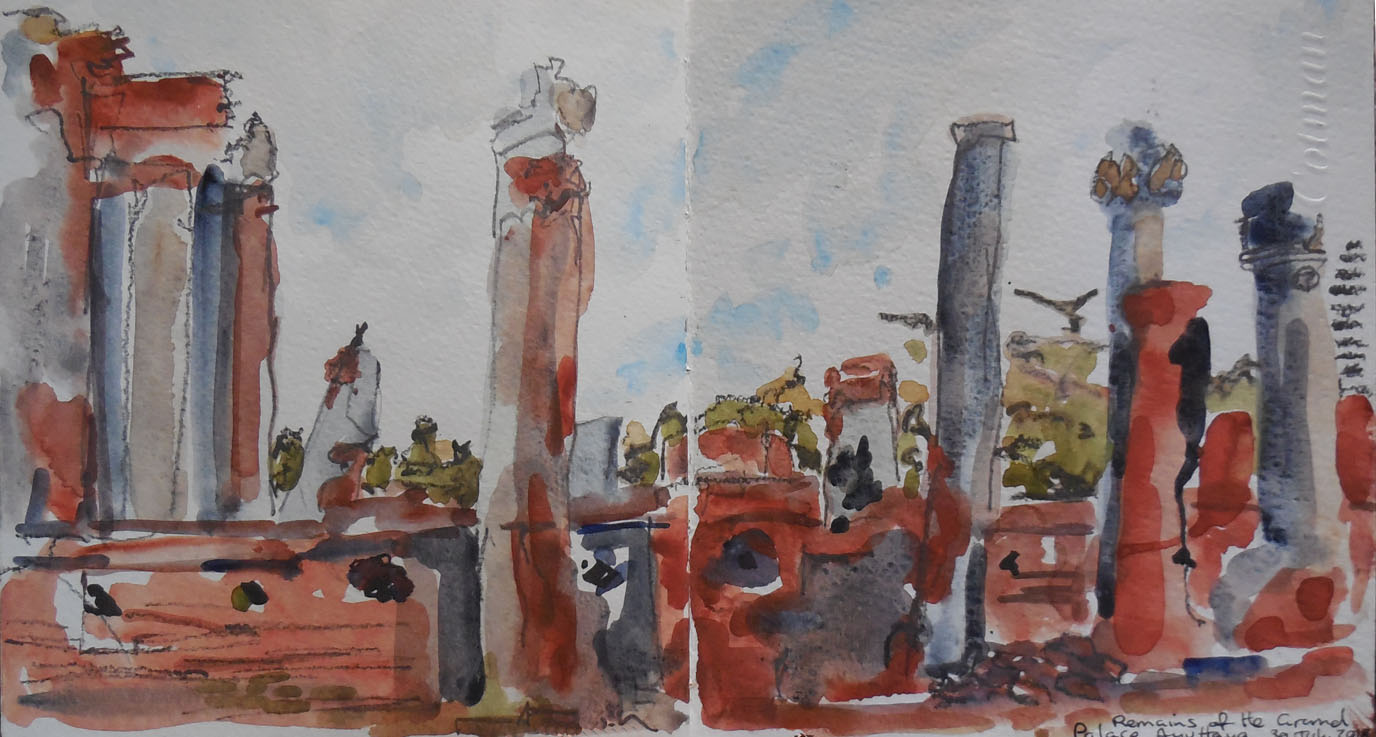
Remains of the Palace Ayutthaya

Remains of the Palace Ayutthaya, watercolour and graphite, 30 July 2015

Inside the Grand Palace Bangkok, pen and ink 2 August 2015

Inside the Grand Palace Bangkok, pen and ink 2 August 2015


Free the people

I’ve been working on drawing people for some months now. I don’t find it easy and I might easily persuade myself to draw something else but I am persisting with it. To try and improve the outcomes – in my eyes at least – I’ve been trying out some different techniques.

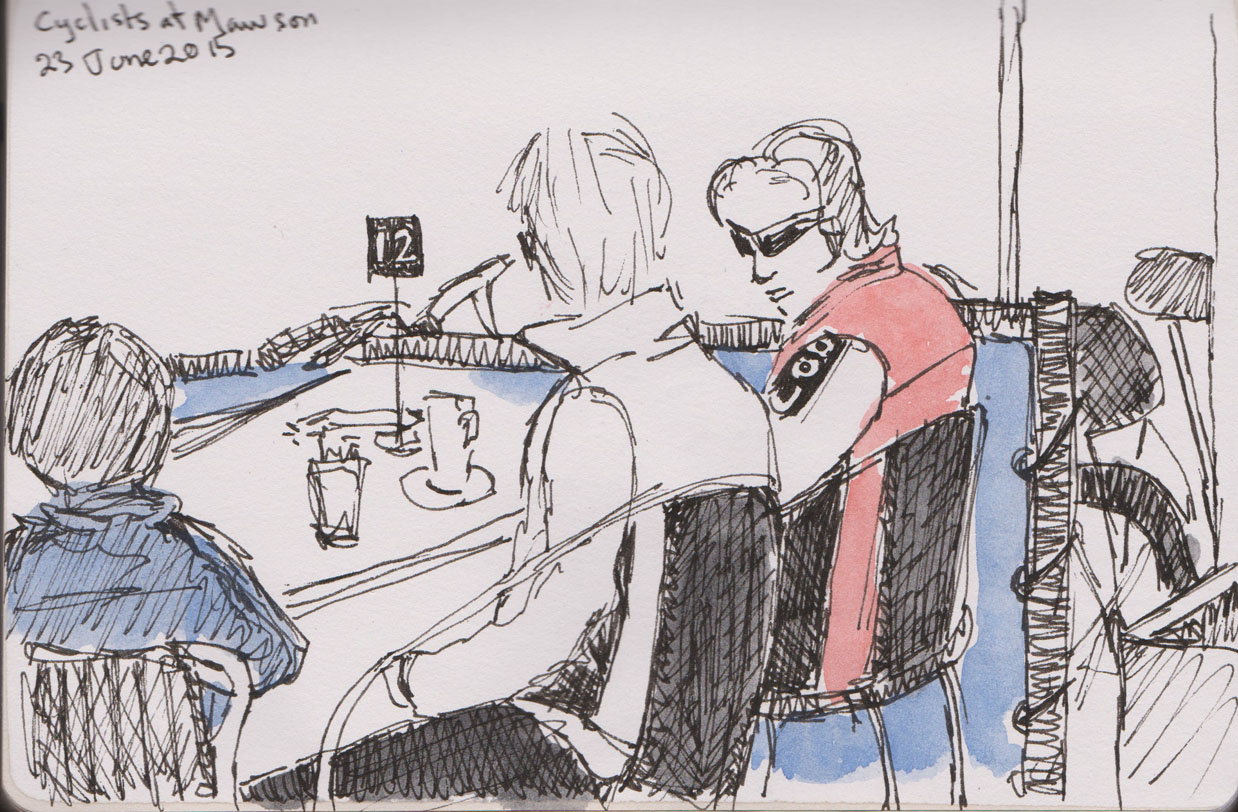
My default position to date has been a fairly realistic approach which relies on hoping my subjects are wearing sunglasses so I don’t have to draw tricky eyes and noses. Most of these drawings work, but the result is that my city appears to be occupied by shady characters at best and the random, deranged-looking person at worst.

Cyclists, pen and ink and wash, 23 June 2015

Cyclists, pen and ink and wash, 23 June 2015

I’ve been tossing around some options for changing my approach to drawing people. I was much happier with the quick sketches I did at the beach earlier this year, where I used a quick wash of watercolour that I quickly sketched into. So over the past few weeks I’ve been working on this as a new approach to people sketching in cafes.

Trying a new approach, watercolour and graphite, 24 July 2015

Trying a new approach, watercolour and graphite, 24 June 2015

I’ve mainly used a watercolour graphite pencil to add detail, I’m also trying using my pen and ink.

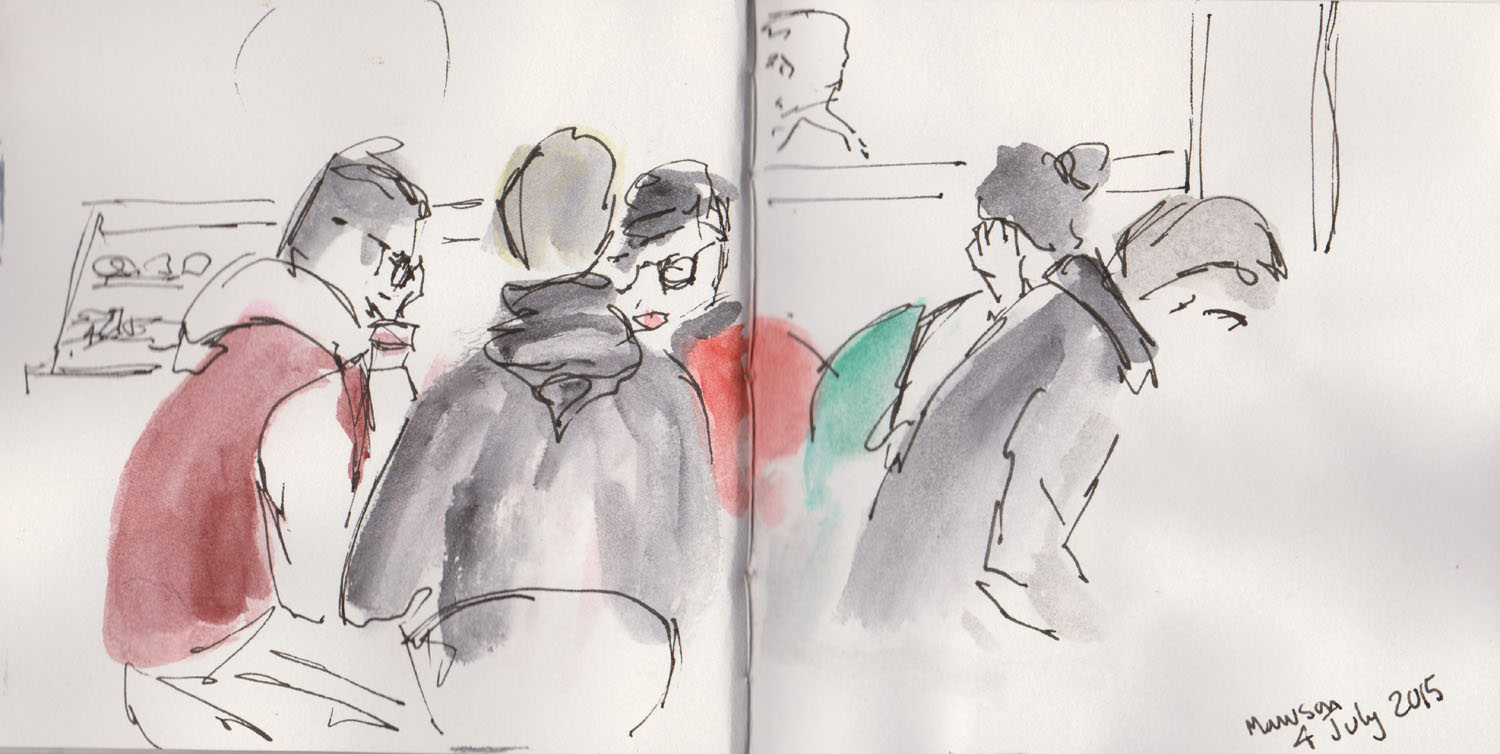
Busy Saturday, watercolour and pen and ink, 4 July 2015

Busy Saturday, watercolour and pen and ink, 4 July 2015

I’ve also found that if I put down a light wash that I can also quickly add some shadows and contours with subsequent washes.

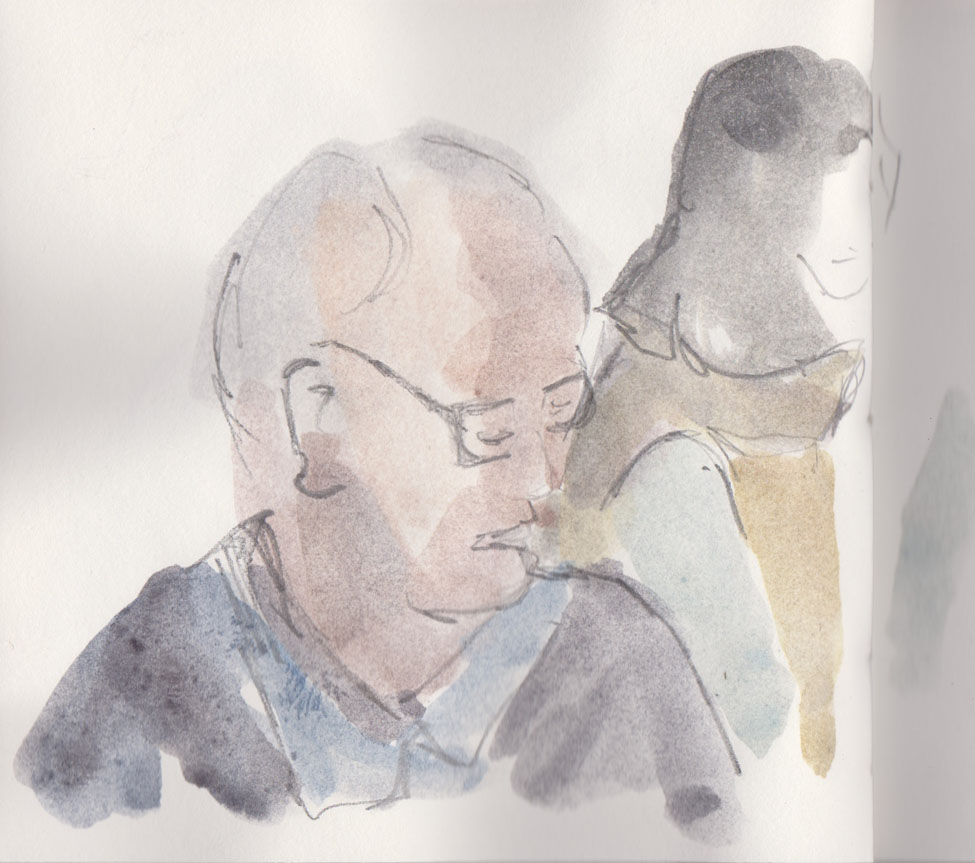
Man reading, watercolour and graphite, 27 June 2015

Man reading, watercolour and graphite, 27 June 2015

And while it might seem obvious it has also dawned on me that if I am working on a small piece of paper it is actually harder to get a well drawn face because I don’t have enough space to capture the details I want, duh!

There’s no doubt that I’m still better at capturing body shapes than faces,

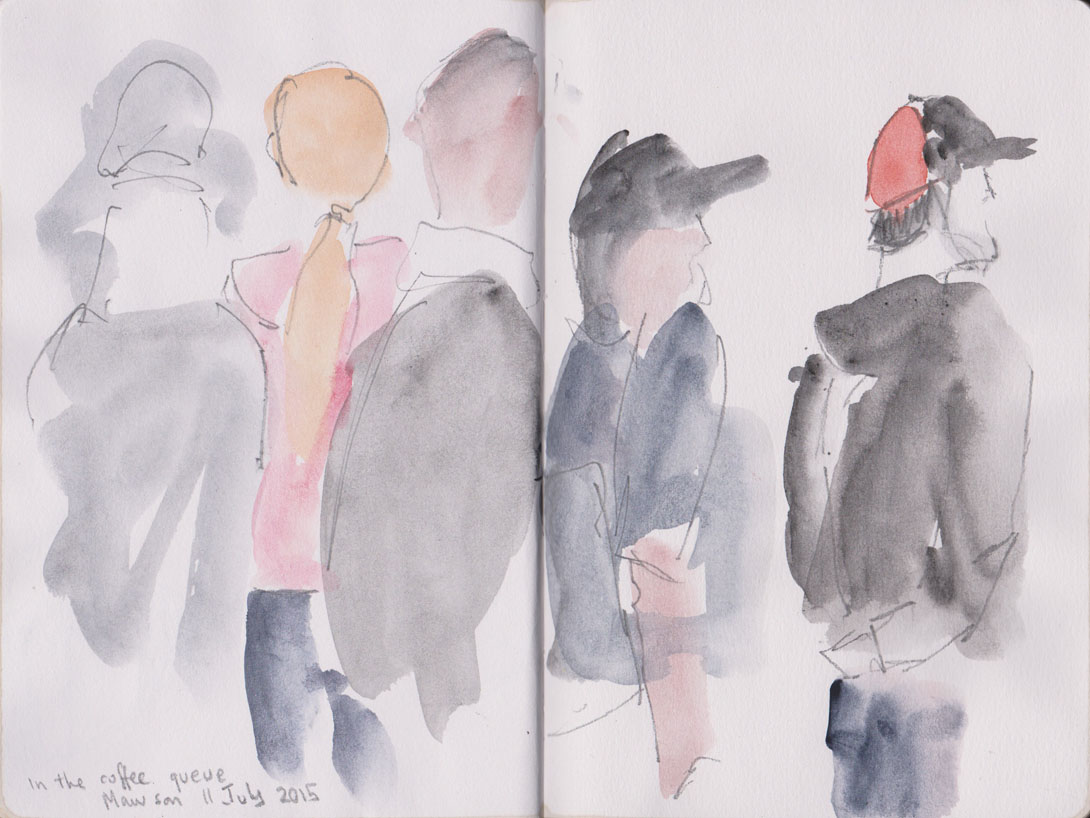
The coffee queue, watercolour and grapjite, 11 July 2015

The coffee queue, watercolour and grapjite, 11 July 2015

but I am keeping on with this approach.

Two people , quick sketch, watercolour and graphite, 11 July 2015

Two people , quick sketch, watercolour and graphite, 11 July 2015