Drawing the exhibition – Masterpieces from the Hermitage

It’s getting close to the end of the latest Winter Masterpieces show at the National Gallery of Victoria, Masterpieces from the Hermitage, so four of us decided to hop on a plane and head to Melbourne to spend a day with some of Catherine the Great’s collection, now housed at the Hermitage in St Petersburg. Catherine certainly collected a lot of art and other things in her time and lets face it, she had a lot of walls she could fill. So this exhibition is only a small sample of what she owned.
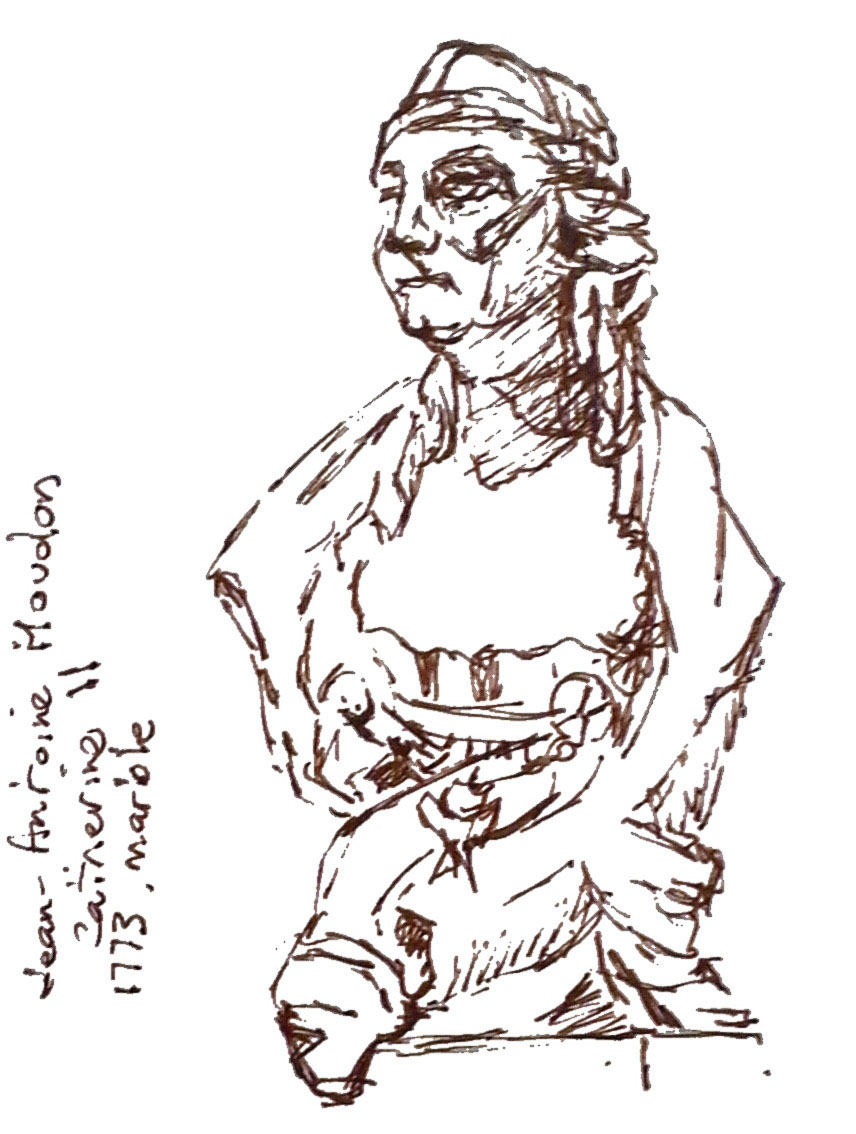
Catherine II (the Great), by Jean-Antoine Houdon, 1773 marble, pen and ink

Catherine II (the Great), by Jean-Antoine Houdon, 1773, marble, my sketch in pen and ink

I’m always interested in what will catch my attention at this type of exhibition and here it was resoundingly the Flemish works and particularly those of Sir Anthony van Dyck. Per usual I chose to draw a number of works in the exhibition. In a situation when you are exposed to so many works of high quality it gives you some space to just sit and ‘be’ with a work, at least somewhat longer than the nominal art gallery average of 10 seconds per painting.

However in my hurry to refill my pens prior to leaving for Melbourne, I accidentally filled them with ink that does not really work with my Lamy,  so apologies in advance for some scratchy pen work.

The first work to catch my attention was a family grouping by Cornelis de Vos, Self-portrait of the artist with his wife Suzanne Cock and their children.
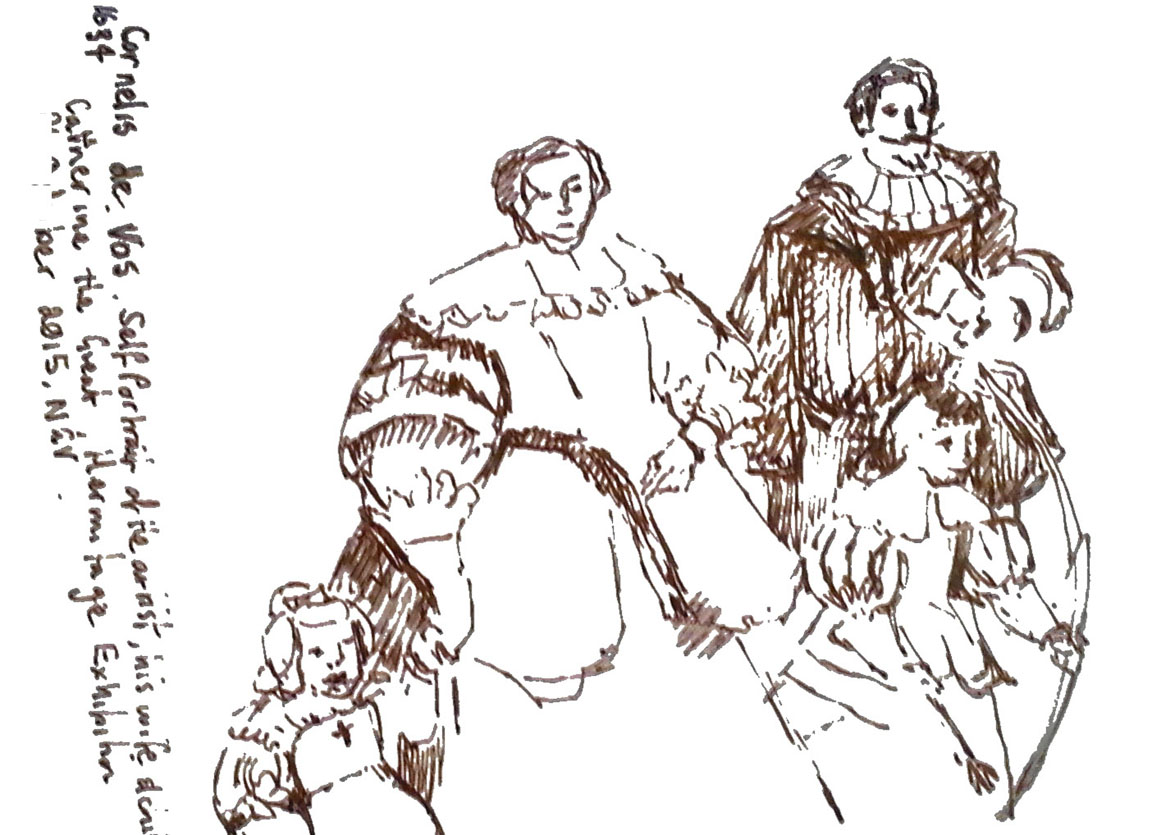
Self-portrait of the artist with his wife Suzanne Cock and their children, c1634, oil on canvas, pen and ink

Self-portrait of the artist with his wife Suzanne Cock and their children, c1634, oil on canvas, my sketch in pen and ink

My study doesn’t capture the older children of the family, just the two youngest, one holding a bow and arrow and the youngest on leading reins. In the original the parent’s clothes form large dark masses against which their faces and those of their children are naturally highlighted. From the quality and amount of lace, fine silk and jewellery being worn by the family you get the distinct impression that the art business was good for de Vos. I found his depiction of his young children particularly charming.

A large leap up the social ladder from the wealthy merchants that de Vos painted are Sir Anthony van Dyck’s paired portraits of Charles I of England and his Queen Henrietta-Maria. At over 2 metres in height they dominated the room they were hung in. The refinement of their faces, the lustre of the armour, silk and pearls made them hard to look away from, as was no doubt intended.
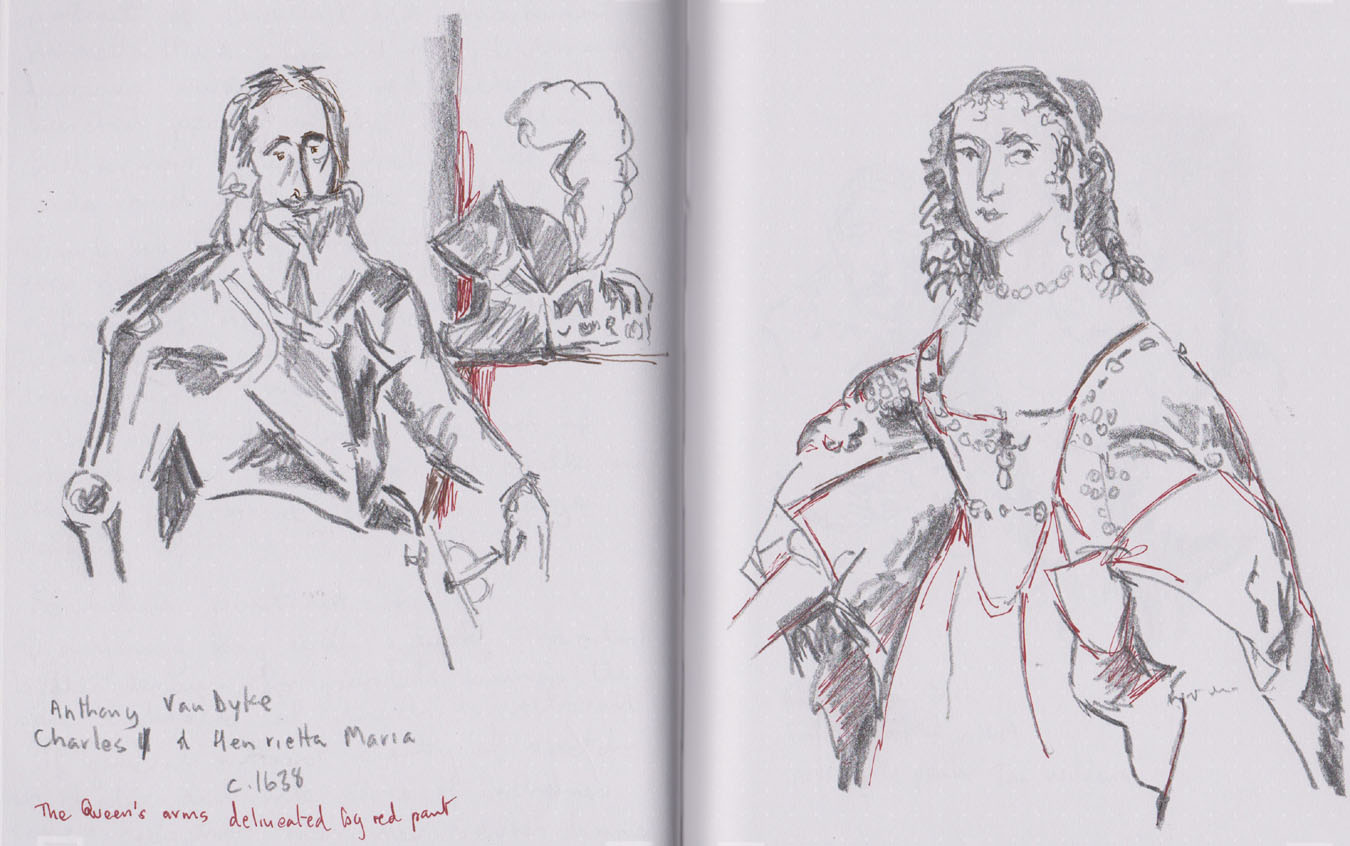
Study of King Charles I and Queen Henrietta-Maria, c 1638, graphite and gel pen

Study of King Charles I and Queen Henrietta-Maria, c 1638, graphite and gel pen

The flattery of van Dyck’s paintings was such that when Sophia, later Electoress of Hanover, first met Queen Henrietta Maria, in exile in Holland in 1641, she wrote: “Van Dyck’s handsome portraits had given me so fine an idea of the beauty of all English ladies, that I was surprised to find that the Queen, who looked so fine in painting, was a small woman raised up on her chair, with long skinny arms and teeth like defence works projecting from her mouth…”

Perhaps truer to life was a smaller portrait that van Dyck made in 1619, the year after he was admitted to the Guild of St Luke as a free master painter. The Family Portrait, is thought to be of another artist, possibly Jan Wildens (in an interesting link, Wilden’s half sister, Suzanne Cock was the wife of Cornelis de Vos). His attractive young wife sits next to him while their young child, sits in his/her father’s lap looking upwards.
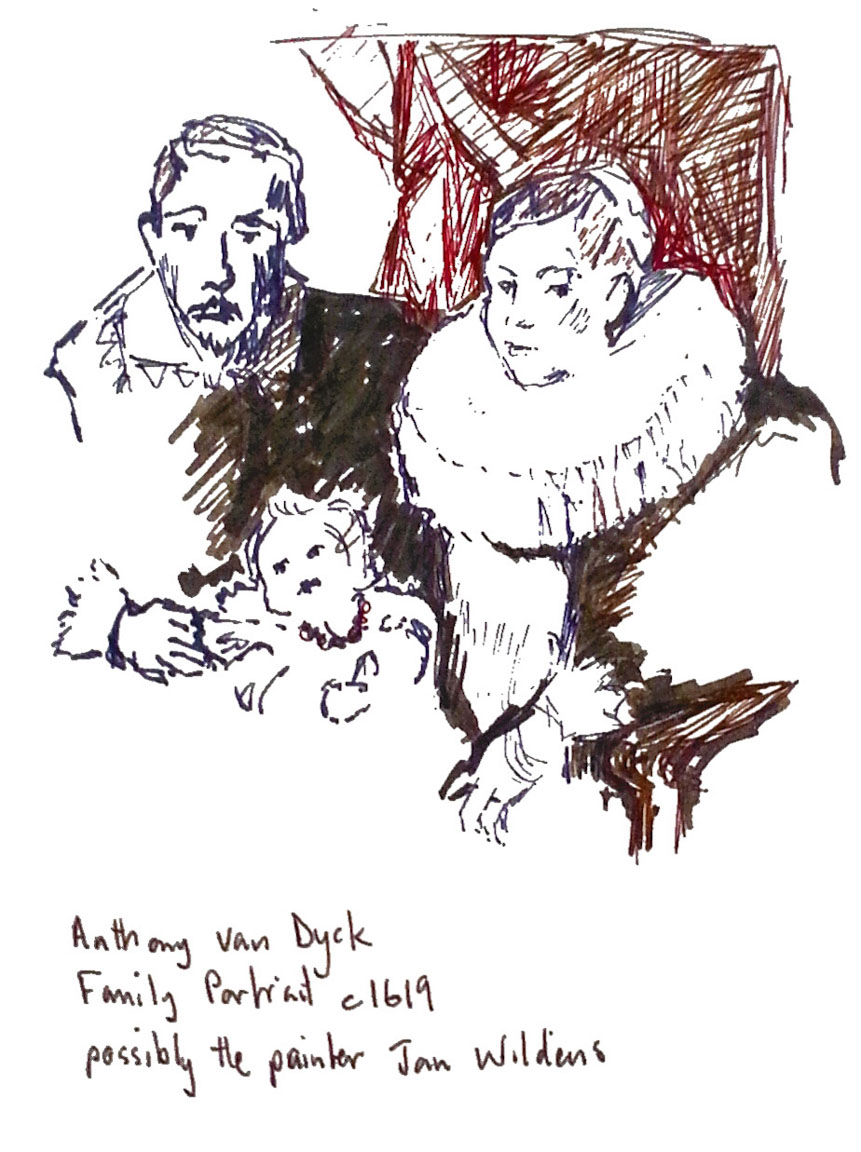
Study of Family Portrait, by Anthony van Dyck, pen and ink, brush pen and gel pen

Study of Family Portrait, by Anthony van Dyck, pen and ink, brush pen and gel pen

As you can see from the above study by this time I was resorting to every pen I could find in my bag just to complete the study. I’d spent most of the day in the exhibition, with a break for lunch and I was pretty exhausted. I staggered out of the gallery to have a restorative cup of coffee and lemon curd tart. Since checking up on the details for this post I have realised that there were any number of works I would have liked to go back and study in greater detail and some I managed to miss altogether.

Here are two of the many amazing sketches that also caught my eye on the day.
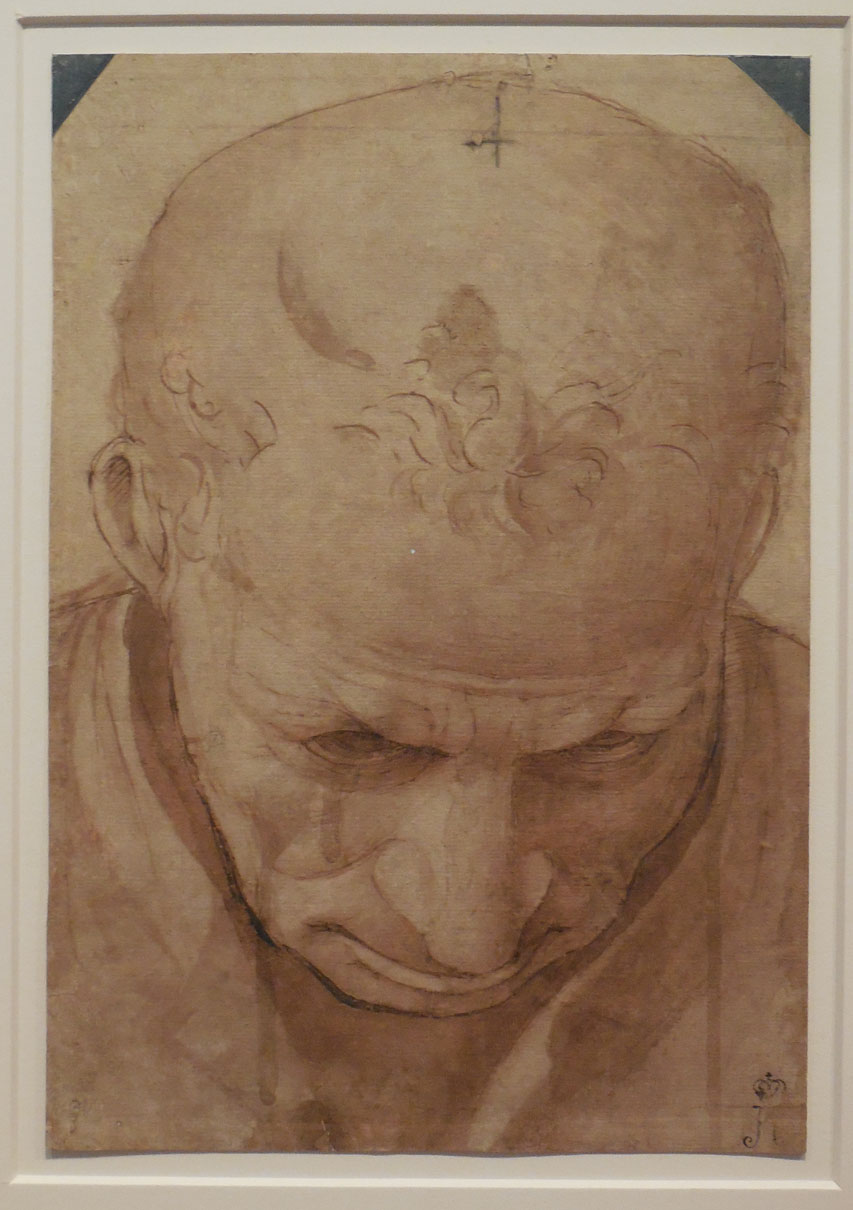
Luca Signorelli, c1480, study of the head of an elderly man, pen and brown ink and wash, State hermitage Museum, St Petersburg

Luca Signorelli, c1480, study of the head of an elderly man, pen and brown ink and wash, State Hermitage Museum, St Petersburg
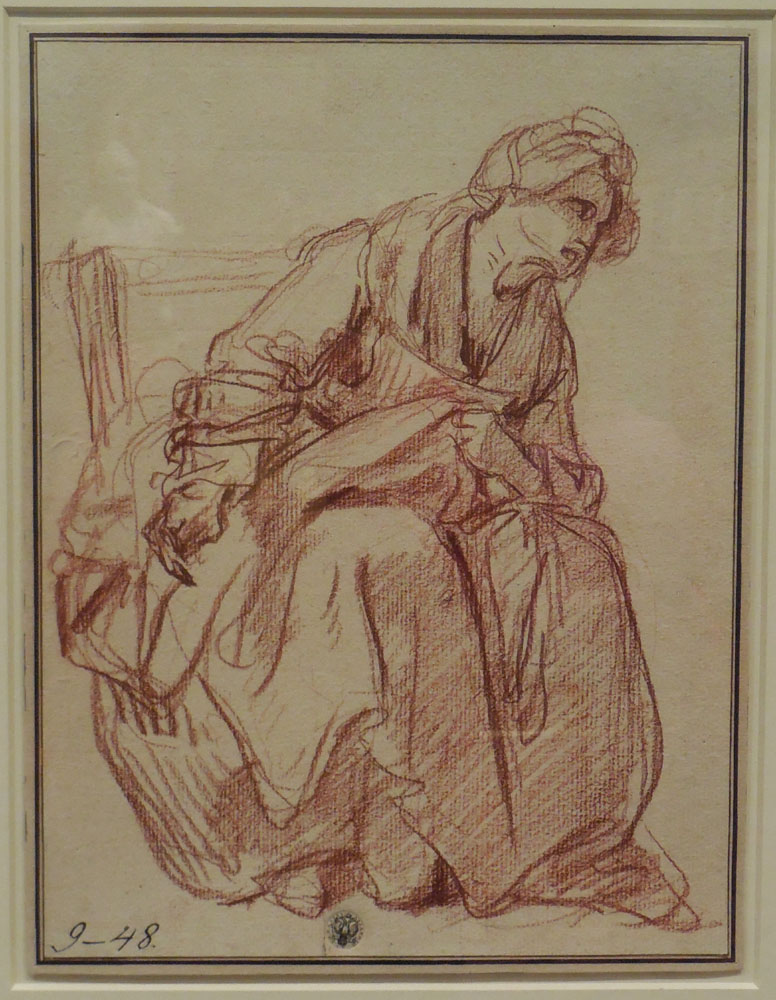
 

Jean-Baptiste Greuze, 1760's, Study of a seated woman (the paralytic's wife), red chalk State hermitage Museum, St Petersburg

Jean-Baptiste Greuze, 1760’s, Study of a seated woman (the paralytic’s wife), red chalk State Hermitage Museum, St Petersburg
Drawing the Exhibition – Myth + Magic 2

The 16th of September was Papua New Guinea’s Independence Day, so what better way to celebrate than return to the Myth + Magic exhibition at the National Gallery of Australia. This time I also managed to drag some friends along, as well as my partner, so we all set about sketching.

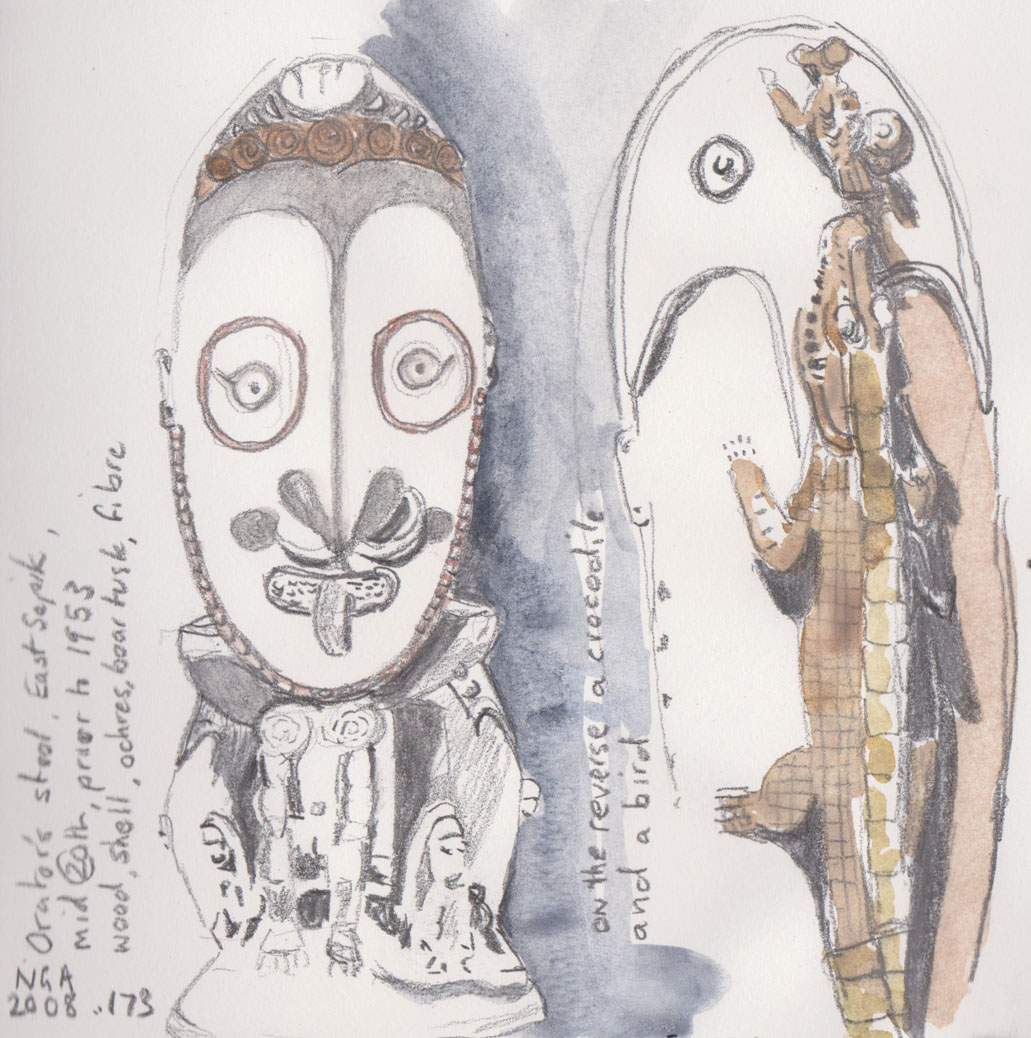
My first target was the Orator’s Stool from the East Sepik. I started with the face and enjoyed working with the deep shadows cast by the dramatic lighting.

Orator's Stool, East Sepik, PNG, study in graphite pencil with watercolour added later, 16 September 2015

Orator’s Stool, East Sepik, PNG, NGA 2008.173, mid 20th cent. prior to 1953, study in graphite pencil with watercolour added later, 16 September 2015

It was only after I’d finished this first drawing and went to record the details of the work, that I found the carvings of the crocodile and bird on the reverse of the stool.

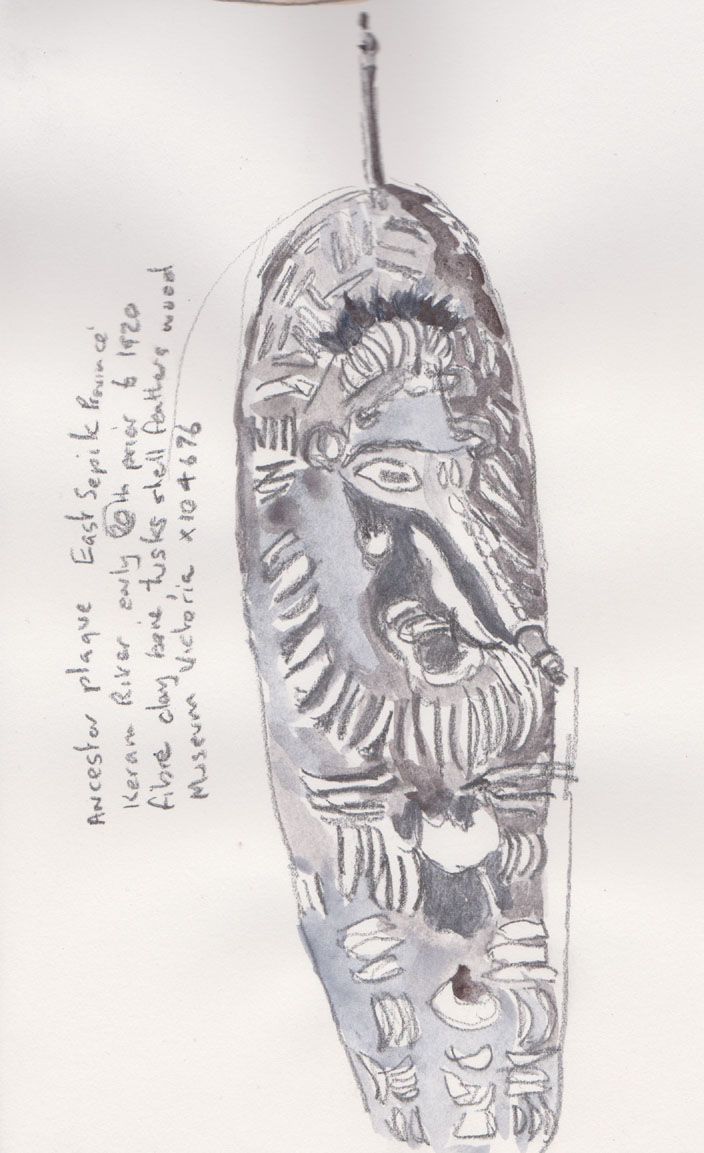
I still had some 20 minutes before our meet-up time so I went and did a ‘quick’ study of this ancestor plaque.

Ancestor Plaque, East Sepik Province, Keram River, early 20th cent. prior to 1920, Museum Victoria X104676, graphite, with added watercolour, 16 September 2015

Ancestor Plaque, East Sepik Province, Keram River, early 20th cent. prior to 1920, Museum Victoria X104676, graphite, with added watercolour, 16 September 2015

This work has a very strong presence. It is made of fibre, largely for the backing and is covered with thick grey mud. It is decorated with lots of embedded pig tusks and shells. The image wears a headband of cassowary feathers. I haven’t captured much of its ‘presence’ so I will try to return and focus on this piece again.

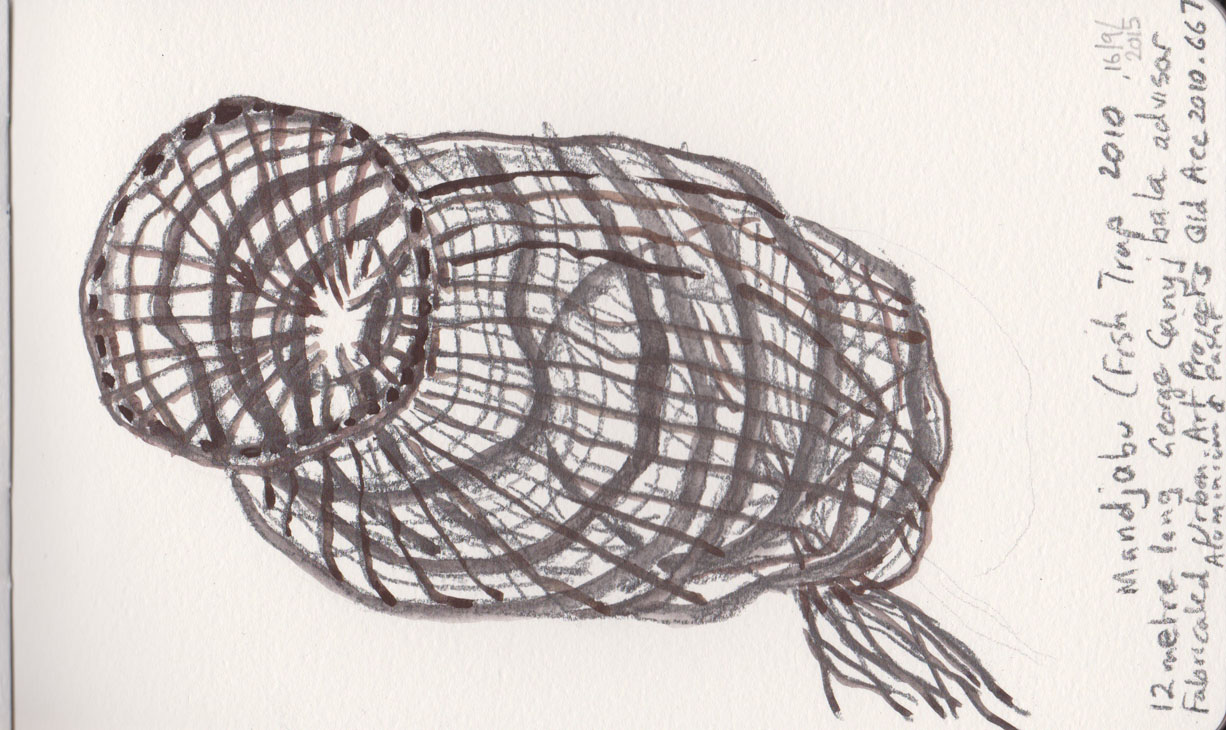
After the drama of the exhibition space it was somewhat of a relief to retreat to the airy lightness of the Members Lounge for lunch. Afterwards, our friends decided that they wanted to look at the Aboriginal and Torres Strait galleries so we headed off there for a final sketch. I sat out near the entrance to draw the giant, 12 metres long, fish trap, that hangs above the gallery foyer.

Mandjabu (Fish Trap), 2010, created with assistance from George Ganyjbala, fabricated in aluminium and paint by Urban Arts Projects, Acc2010.667, graphite with added watercolour, 16 September 2015

Mandjabu (Fish Trap), 2010, created with assistance from George Ganyjbala, fabricated in aluminium and paint by Urban Arts Projects, Acc2010.667, graphite with added watercolour, 16 September 2015

I didn’t realise that I was being observed, but this photo gives you an idea of the scale of the work.

The loneliness of the long-distance sketcher, 16 September 2015, National Gallery of Australia

The loneliness of the long-distance sketcher, 16 September 2015, National Gallery of Australia

Drawing the Exhibition – Myth + Magic

Myth + Magic, Art of the Sepik River, Papua New Guinea, is the current featured exhibition at the National Gallery of Australia (NGA). The art works on display are predominantly sculptural and relate to the spiritual practices of the people who live along this major river system of Papua New Guinea. The works are quite dramatic and often have a visceral quality which derives both from their subject matter and also from the materials they are made from – wood, shell, pig tusk, fibre fur, hair and mud. This sense of drama is enhanced by the display of these items in largely darkened rooms set off by tightly focused spotlights.

There are a plethora of interesting subjects to draw. I was intrigued by these two large figures which are costumes worn during initiation ceremonies. They represent spirits or awan, that “frighten harass and bully” young initiates during their period of seclusion. Like many other pieces on display, these items were collected in 1916, when Australian forces entered the Sepik River to wrest control of the territory from Germany, as an extreme outlying action of the First World War.

Two awan (spirit) costumes, East Sepik River, before 1916 collected by Captain Walter Balfour Ogilvy, from the collection of the Museum of Victoria. Water soluble graphite

Two awan (spirit) costumes, East Sepik River, before 1916 collected by Captain Walter Balfour Ogilvy, from the collection of the Museum of Victoria. Water soluble graphite, 17 August 2015

These costumes are constructed of fibre, the bodies are woven from plant material and are decorated with clay, shell hair and ochre. The figure to the rear has a head dress made of densely packed cassowary feathers. When the costumes are worn all that can be seen are the wearers feet (there is a photograph of similar costumes being worn, in the exhibition catalogue). The wearer can look through the mouth opening of the nearest figure and the second figure has two eyeholes in the chest to see through.

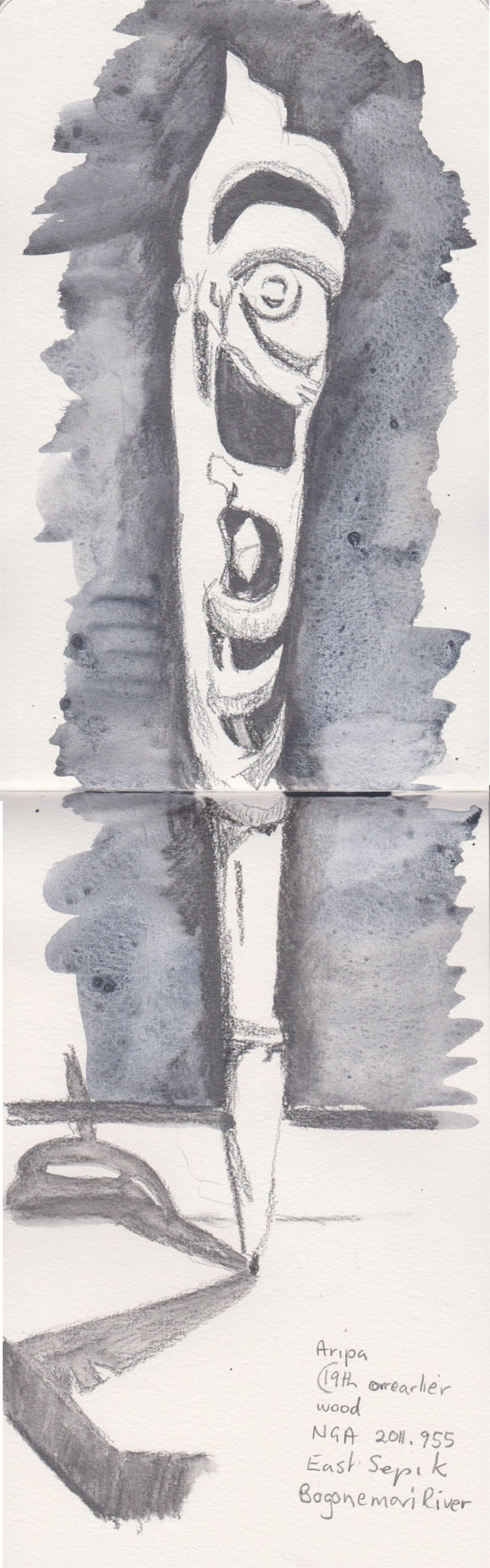
In each room there were astonishing items to see. In the last room, apart from the massively carved crocodile sculpture on loan from the Museum of Papua New Guinea, are several aripa, or hunting helpers. These aripa are an abstracted human figure, sublimed to a most minimal form, ‘standing’ on their one foot. To quote from the website “If the spirit [aripa] has been correctly appeased it will track down and kill the desired prey’s spirit so it will show itself to the hunter to be killed easily. It was believed the soul (tite) of the aripa spirit being, not the artist, was responsible for the creation of their physical bodies.”

Aripa, 19th century or earlier, wood, Bogonemori River, east Sepik, collection of the National Gallery of Australia, Water soluble graphite and watercolour (added later), 17 August 2015

Aripa, 19th century or earlier, wood, Bogonemori River, east Sepik, collection of the National Gallery of Australia, Water soluble graphite and watercolour (added later), 17 August 2015

While we were in the gallery my partner commented on how the sculptures felt somehow familiar – even though we hadn’t seen them previously. We concluded that this sense came not from these figures per se, but from the inclusion of tribal art or the influence of similar works from Africa and elsewhere in the globe, into ‘modern’ art of the early 20th century. We had seen the reflection and now we were seeing the ‘real thing’.

The exhibition is on until 1 November 2015 at the National Gallery of Australia in Canberra. It will not be touring. Well worth a visit if you are in the area.

Drifting in My Own Land – Nalda Searles

Nalda Searles has been one of the major influences in my artistic life, specifically her interest in using what is to hand and encouraging you to spend more time on actually creating work than on going and buying the ‘perfect’ material. I first met Nalda when she stood in for Ruth Hadlow in a class at Geelong Textile Fibre Forum in the early 2000’s.

Her exhibition Drifting in My Own Land has been on show at the ANU School of Art Gallery for the past few weeks. I managed to get just one view of it on my return from Newcastle.

I did two drawings on the day and I’m now kicking myself for not just putting more money in the parking meter and going back to do more.

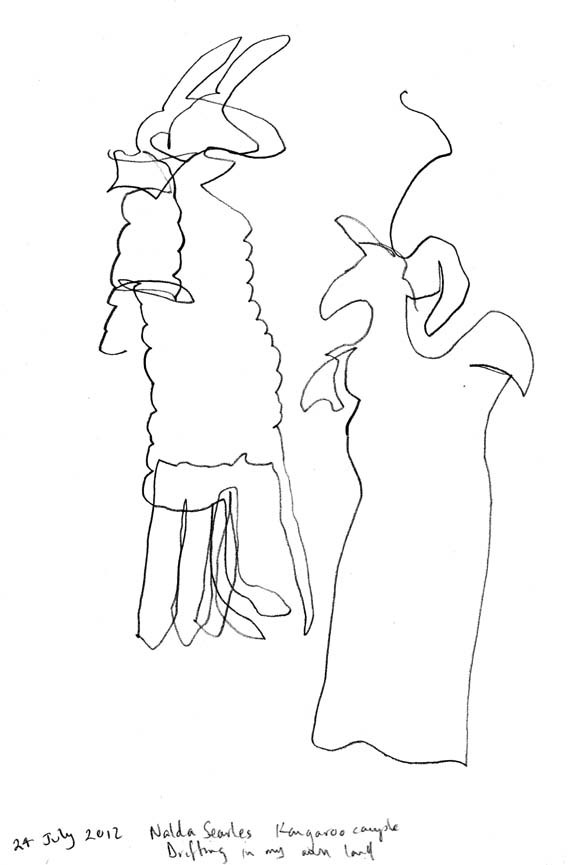
24july12a

Blind drawing of Kangaroo Couple, 1995-2008 (the piece has undergone several transformations to reach it’s current state).

24july12lr

Focus on the two heads of the kangaroos made with fodder grass.

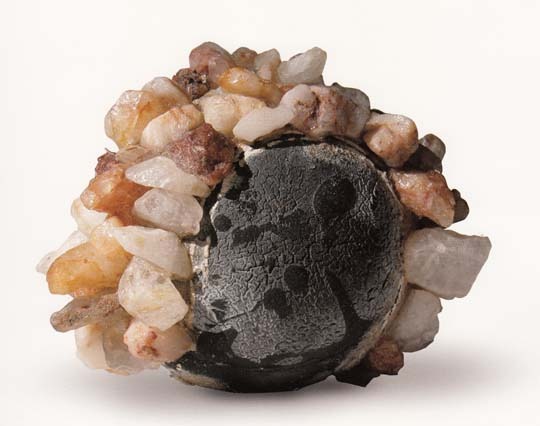
The exhibition was essential Nalda. Sculptural objects and textiles made from disparate materials that are just so ‘right’ when they are brought together. Here is her work Tjunti, 1996, made with a perished tennis ball and quartz stones picked up in the bed of the Tjunti river.

Tjunti

Nalda says “I found these things and put them together.”