This post was originally written in August of 2018, shortly after I had returned from three months of travel in Europe (France, Spain and Portugal). I have no idea why I didn’t post it at the time, however I am interested to see how I wrote about aspects of watercolour painting, that are now part of my regular ‘style’. I have also included my latest cafe sketch at the end to show what I am doing now. Enjoy!
Reading the social media sites, post the Urban Sketchers Symposium held at the end of July 2018 in Porto, I was intrigued to see the number of people,who are reviewing their sketching practices. They have been inspired by the various styles and techniques of other people that they met at the event.
I too have found the approach of a number of other artists has made me re-consider my use of watercolour.
In May 2018 I briefly met Marion Rivolier at a USk (Urban Sketchers) Paris event at the Rodin Museum, (I can even be seen lurking in the photo taken of the event). Subsequently I have been inspired by her loose expressive watercolours. I went to her painting demonstration at the Porto Symposium to see if I could better understand how she was achieving her results. Marion’s advice included both the practical and the personal:
- ‘know your colours so you can sketch fast’ – obvious in one way, but by using a limited number of colours and knowing in advance how they mix, you will speed up your process.
- ‘You don’t have to draw everything you see – select like a stage director’
- ‘[pencil] drawing at the beginning is like creating a prison for colour’. (Not in a good way).
Marion is especially good at capturing people and movement, so that will be an extra challenge for me.

People practice, sketching figures from photos in the weekend newspapers
Another teacher at the Symposium who was gaining a lot of attention was Maru Godas, with her ‘gouache like a child’ workshop. Maru’s advice to simplify and compress, rather than allowing yourself to be lost in detail. This is something I often need reminding about.
I fully appreciate that both these artist’s style has developed over year’s of practice. So, like I am always saying to new sketchers, you need to get “the brush-miles in” to get the result. I have taken out my bigger brushes to work with (makes painting fiddly detail difficult) and I’m on my way with lots of practice.

View into the front garden, with the Ibis sculpture ‘Gordon’ (found at a secondhand shop)

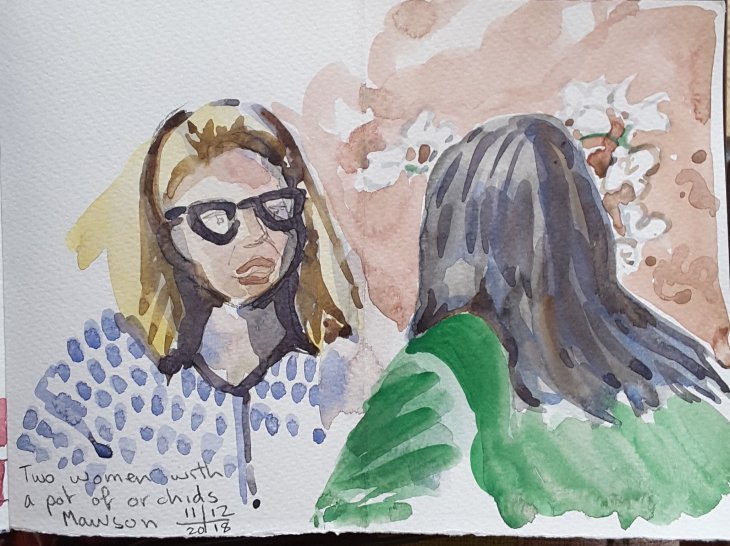
People drinking coffee.
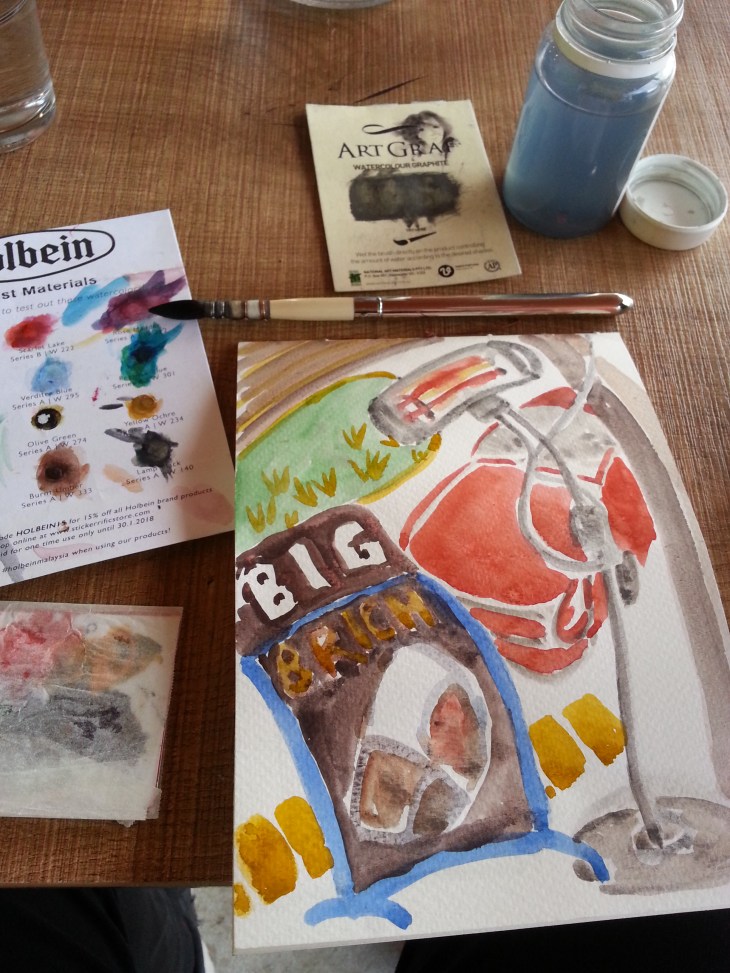
Sketching the scene at the coffee shop.
My latest cafe sketch from June 2021 is here.

Friends chatting over coffee in the winter sunlight. Watercolour, 11 June 2021




 leonieandrews