Cafe Wednesday – Arrangements

This week I’ve been working with my acrylic paint markers again. I like the bolder stroke which, along with the blind drawing approach, acts against making ‘tight’ drawings.

Earlier in the week I drew a coffee shop table arrangement, with just the black marker.

Arrangement of glasses and a bottle of water, acrylic paint marker, 12 August 2014

Arrangement of glasses and a bottle of water, acrylic paint marker, 12 August 2014

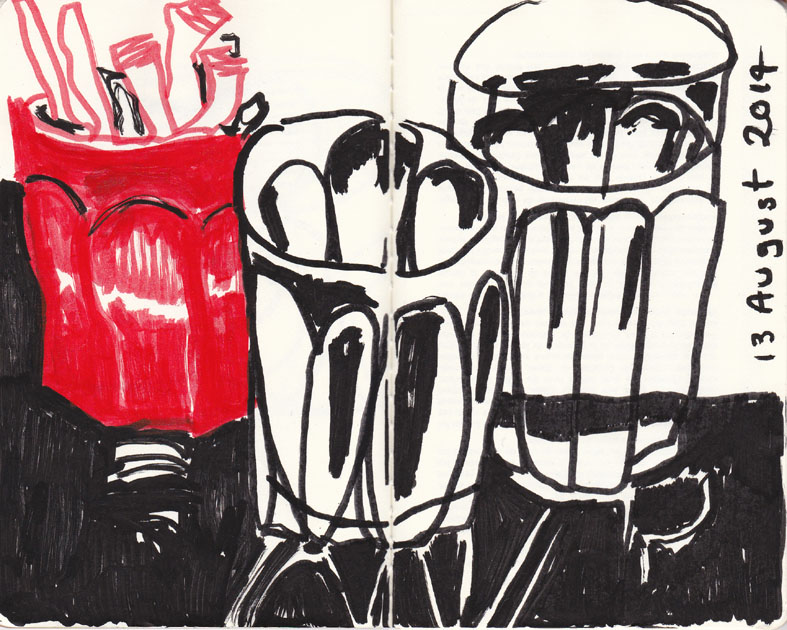
Next up I tried both the black and the red markers, being bold and adding some of the reflections as well.

Glasses and a cup of sugar straws, acrylic paint marker, 13 August 2014.

Glasses and a cup of sugar straws, acrylic paint marker, 13 August 2014.

I can see this style of drawing being easily translated into a lino print. Not that I have been anywhere near the print workshop so far this year.


Blind Drawing

I’ve been making ‘blind drawings’ over the last two weeks. Not many, but some. I’m currently going flat out preparing for an exhibition in October. I’m filling an unexpected vacancy at the Tuggeranong Arts Centre with a solo show of my stitched works, (one of two such centres in the ACT), so most of my attention is going to making work for that show.

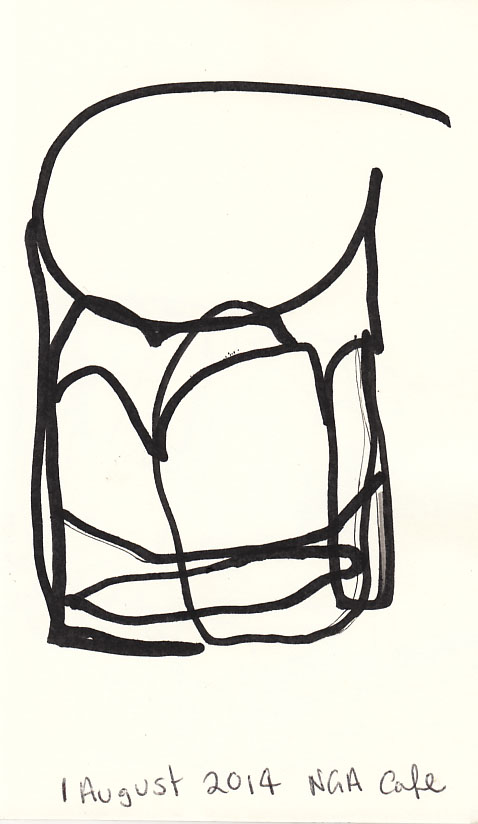
Firstly, using my black Posca acrylic paint marker, I drew another ‘architectural’ glass. I made this drawing at the National Gallery of Australia. I find that after a week bent over my own work I’m needing a major art fix to re-charge my batteries. I’ve recently been to see the NGA show of Robert Motherwell’s prints At Five in the Afternoon (not a reference to the cocktail hour).

An 'architectural' glass at the National Gallery of Australia, acrylic paint marker, 1 August 2014

An ‘architectural’ glass at the National Gallery of Australia, acrylic paint marker, 1 August 2014

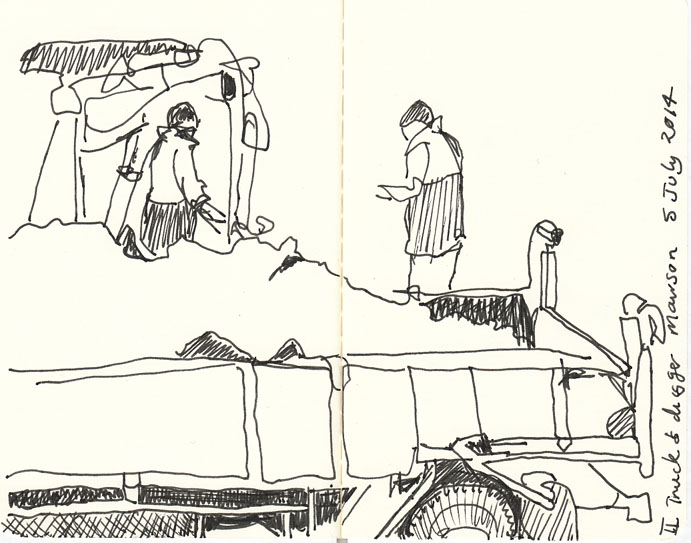
Last week a quiet week day break at our local coffee shop provided the opportunity to draw a truck and small digger working at a building site across the road from where I was sitting. I couldn’t fit it all on one page so it’s over two double spreads of my 3″x5″ sketch book. I’m not sure why, but I get a real buzz out of drawing trucks and construction equipment.

The first half of the truck drawing, pen and ink, 5 August 2014

The first half of the truck drawing, pen and ink, 5 August 2014.

I just noticed that I was more out of it than I realised as I’ve written July, instead of August, for the date of the drawings. Anyway, here is the back half of the vehicle with the digger.

The second part of the truck drawing, 5 August 2014 (not July), pen and ink.

The second part of the truck drawing, 5 August 2014 (not July), pen and ink.

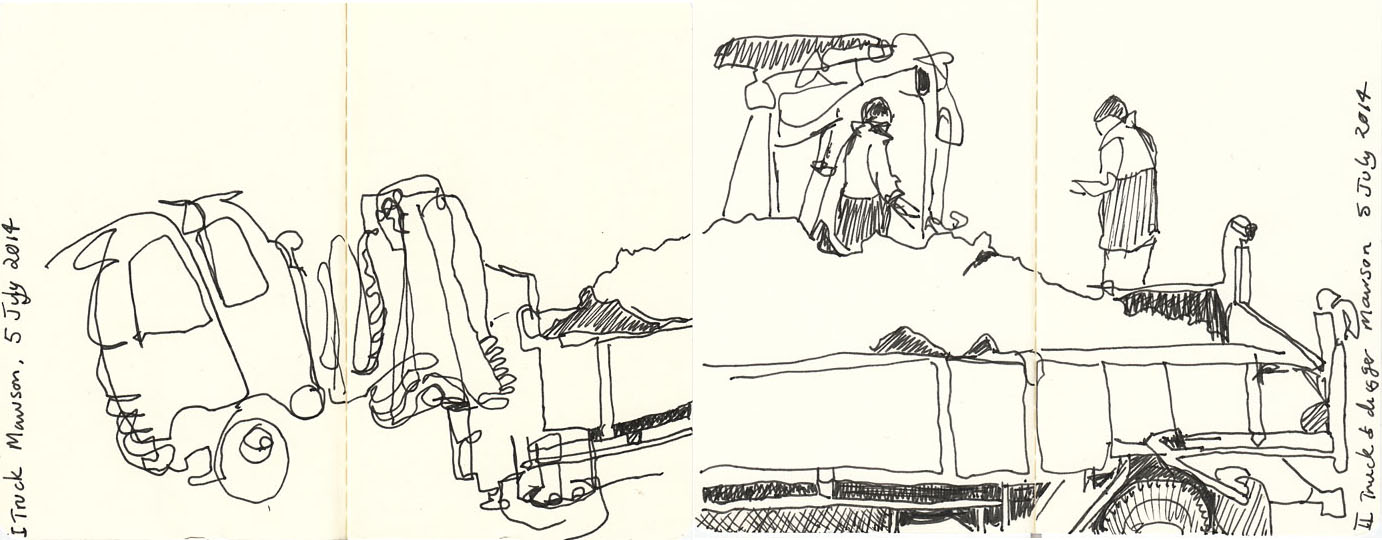
I couldn’t resist putting the two images together.

The two halves of the drawing brought together.

The two halves of the drawing brought together.

Drawn while waiting

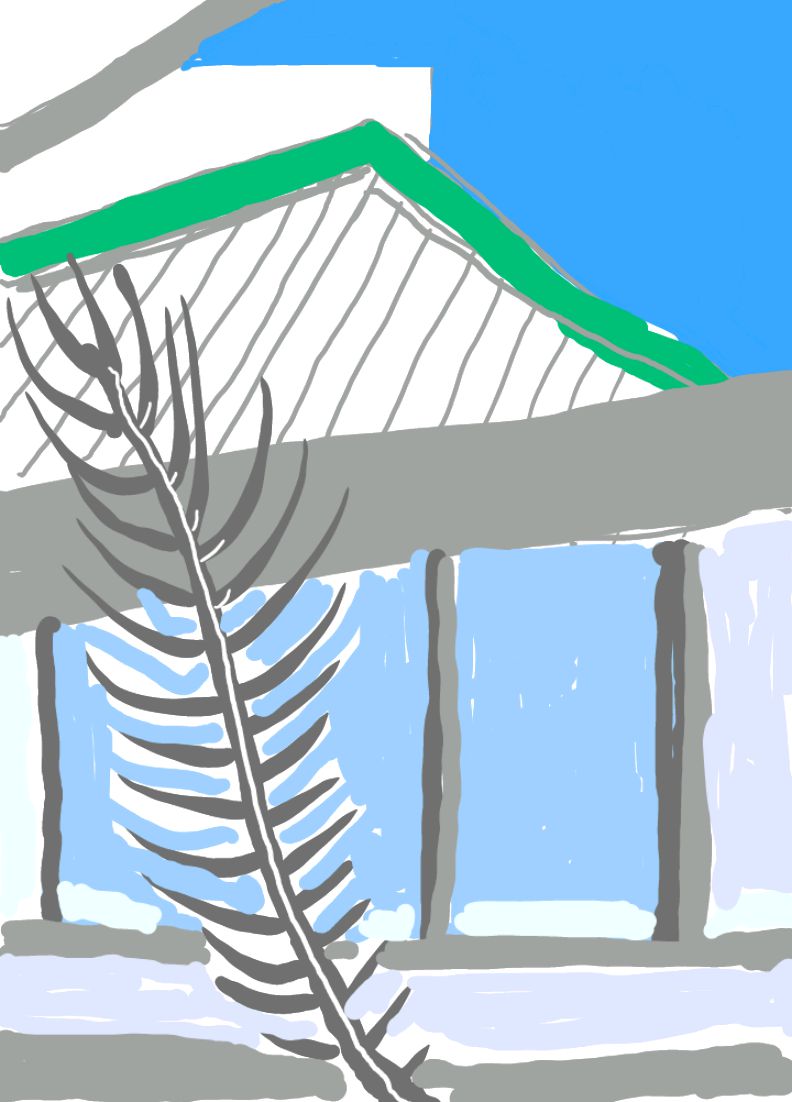
Two e-drawings from the past few weeks.
The first drawn waiting for our friend to arrive at Canberra airport. Part of the drawing includes the sculpture ‘Feather’ by New Zealand artist Virginia King.
image
King says she was inspired by a lyrebird’s feather.
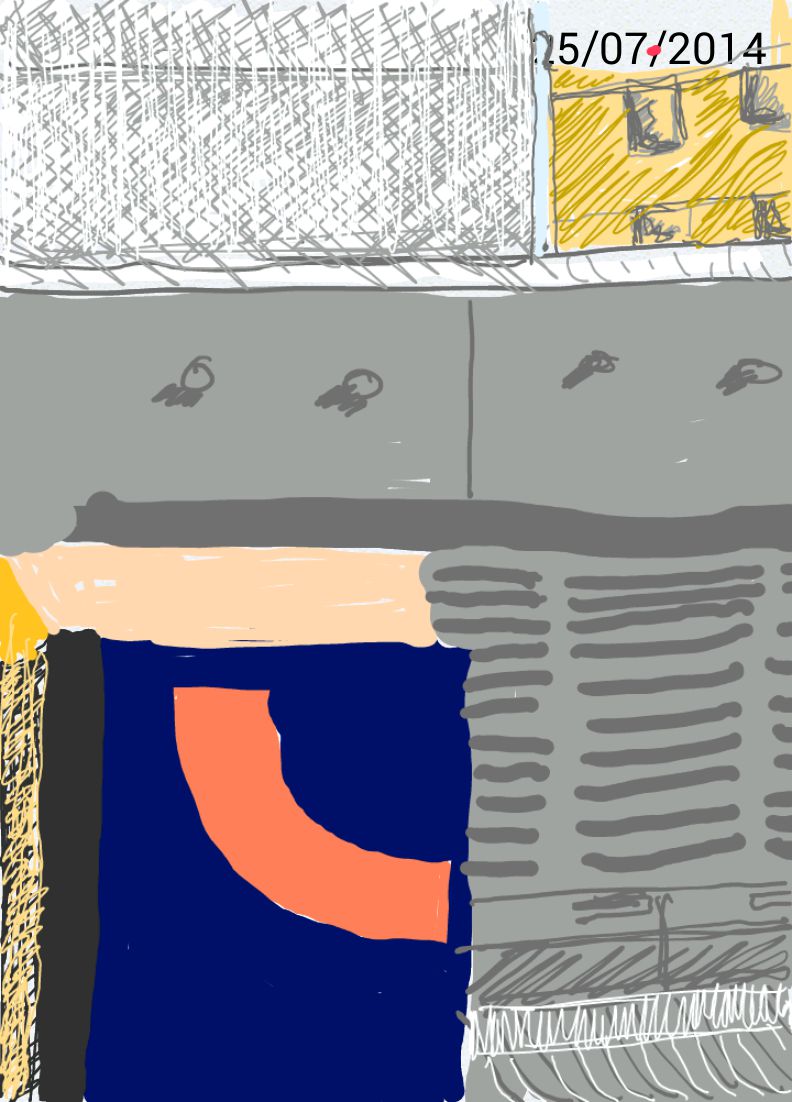
Some what less inspirational was my wait at the physiotherapist’s. The outlook was out to the rather dour police station and the commercial buildings nearby. My eye was captured by the graphic sign for one of the building’s other occupants.
image

Watercolour workshop

On Saturday I had the opportunity to do a one day water colour class with artist Cherry Hood, winner of the 2002 Archibald Prize for her portrait of pianist Simon Tedeschi. While Cherry primarily teaches portrait workshops, the focus of our class was drawing animals – this coincides with the Goulburn Regional Art Gallery’s current exhibition So Much More Than a Big Sheep. For non-locals, the city of Goulburn, in inland NSW has a history as a major centre of merino sheep / wool production. One of it’s most famous tourist ‘attractions’ is a very big concrete merino ram, known to all as Rambo.

I had been rather slack and hadn’t checked out much about Cherry’s work prior to the workshop so when Cherry started talking about her gridding technique for transferring images I wasn’t sure that this was what I was interested in learning. I was soon proven wrong as her shorthand technique for image transfer avoided rulers and an overly tight technical approach. Rather she demonstrated how to transfer from the source material, a photograph, using a simple ratio approach, up to a full sheet of water colour paper.
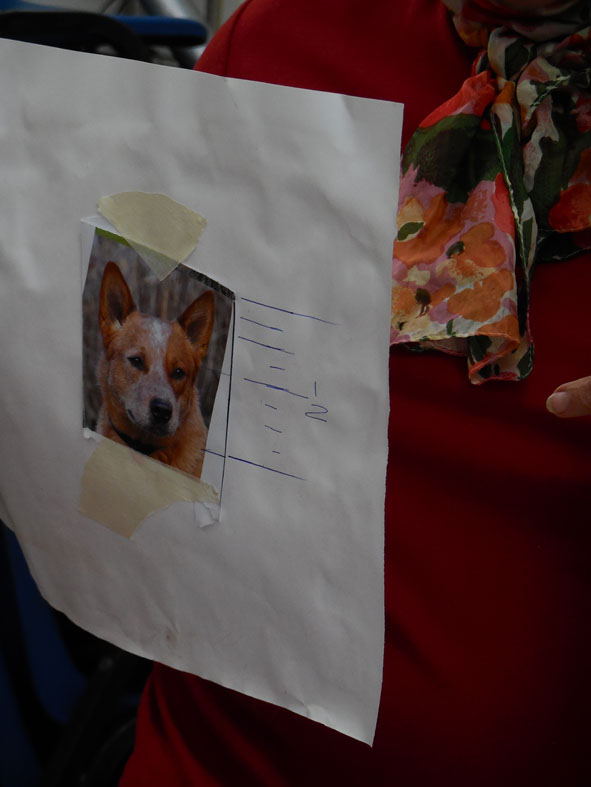
Drawing up an image into sections prior to transferring it to water colour paper.

Drawing up an image into sections prior to transferring it to water colour paper.

Once the features of the face to be drawn are located in the various sections they can be transferred to the larger sheet of paper, which has a corresponding number of sections located on it. A similar process is carried out for the width of the face. Cherry emphasised that it is important to measure the width of the face, animal or human, on the basis of the bone structure of the face, not the width of the fur or hair. It was interesting to see that the relative position of features such as eyes on animal faces is the same as for humans. So now I know that my in my dodgy dog drawing of the other week I had placed the poor animal’s eyes way too high on the head.
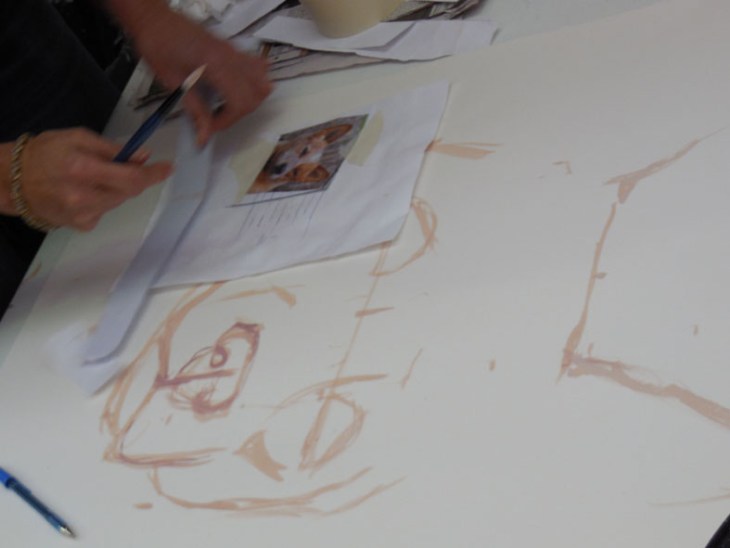
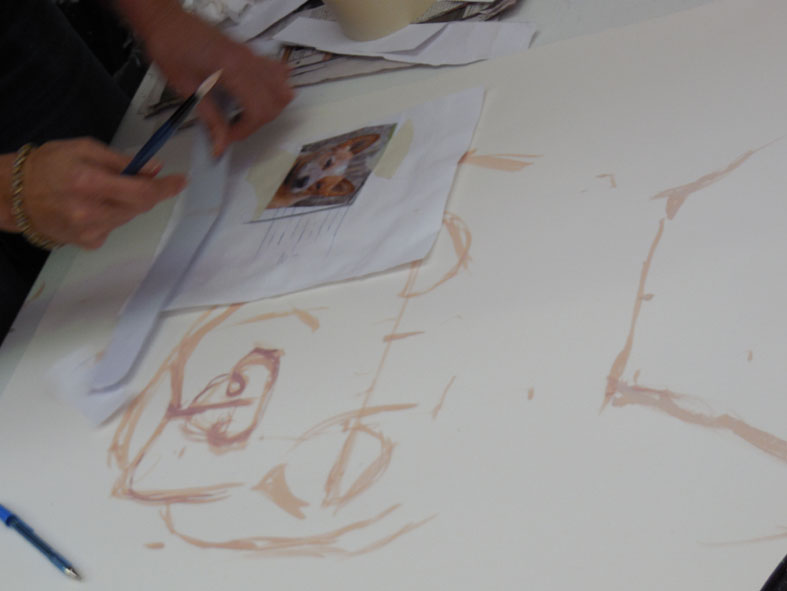
Source material and the full sized sheet with key features sketch-painted in.

Cherry Hood demonstrating working from her source material and the full sized sheet with key features sketch-painted in.

The key features of the subject are marked on the large sheet of paper with a mix of titanium white, tinted with some of the dominant colour of the animals fur. The idea is that these marks are covered by  subsequent painting and / or lifting out of any obvious remaining marks. Cherry adds the final colour by way of large washes with wide flat nylon brushes she buys at the ‘$2 shop’. She carefully manages her edges, keeping them wet with a spray bottle or brushing vigourously to avoid hard edges, which gives a more realistic impression of fur. She is happy for blooms of paint to occur and does final emphasis with fine brushes once the work starts to dry.

The final version of Cherry's painting.

The final version of Cherry’s painting, before it has fully dried.

I was painting an image of my cat, which you can see at the top of my sheet of paper. This was my second go at the painting as where I had originally placed my cat’s head on the paper was well off-centre. Thankfully I could just flip the sheet over and start again (the paper is a full sheet of Cotman cold-pressed 300 gsm water colour paper).

Early stages of painting with some of the underpainted location marks visible.

Early stages of painting with some of the underpainted location marks visible.

Here is the middle stage of the work. At this point I was pretty happy with the upper part of the painting, but I was struggling with the lower part of the face.

In the middle stages of my painting the basic colour washes have been added.

In the middle stages of my painting the basic colour washes have been added.

I subsequently realised that I had forgotten to locate how wide my cat’s lower face was, hence I washed in a chin that was way too narrow.
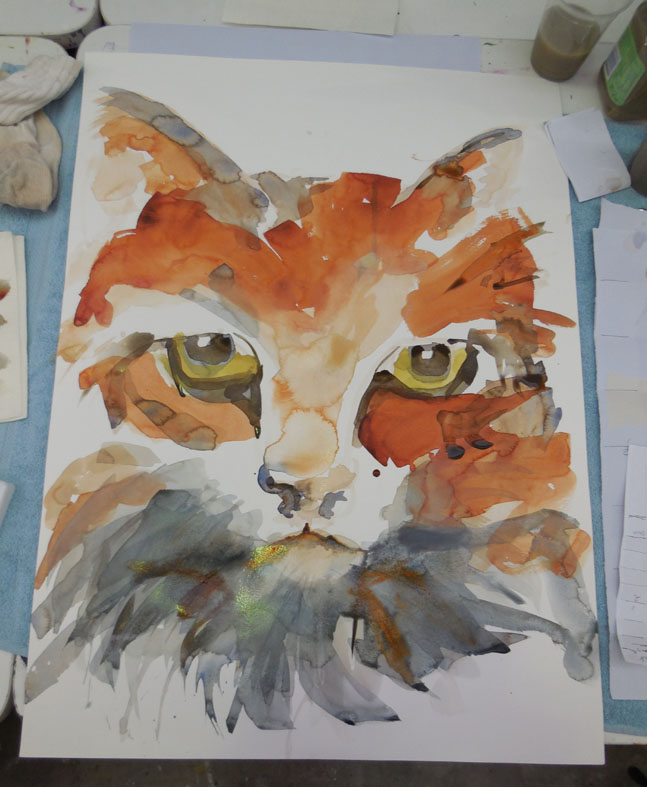
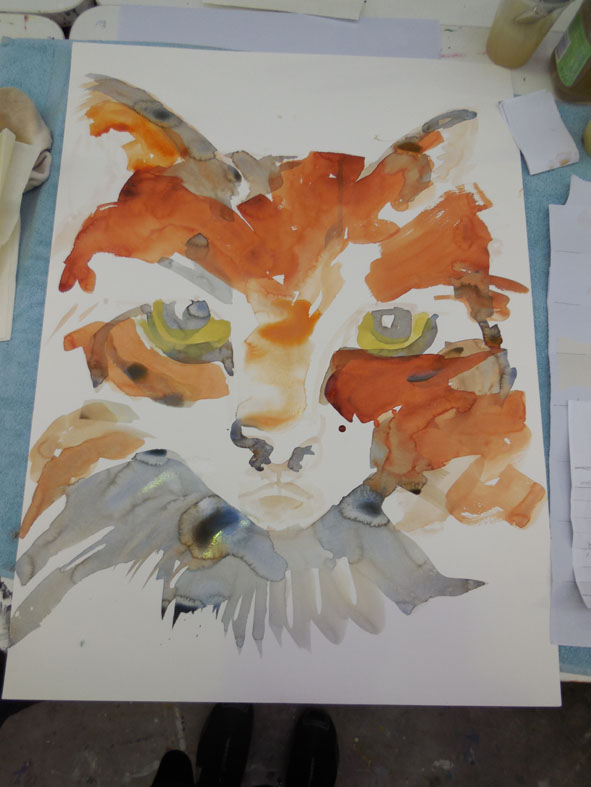
This is definitely my cat when I look at those eyes! Final emphasis is in place.

This is definitely my cat when I look at those eyes! Final emphasis is in place. (The odd colour on the chin is actually a reflection off the wet paint not accurate colour).

In the end I did manage to bring back a chin more in keeping with how my cat actually looks, but as my partner somewhat cuttlingly observed, “our cat doesn’t have a pantomime beard”. I’m really pleased with how the eyes have worked out and I can definitely see my cat looking out at me. Now I’m off for some more practice.

Gods in glass islands

Maybe its a sign of advancing age, but I found myself rather saddened by the display of sacred Polynesian images and objects (atua) in the latest exhibition at the National Gallery of Australia. The quality of the work was so high and as a textile artist I was very impressed by the very finely woven and plaited coconut fibre used in many works. But… Each atua sat on it’s little plinth, mostly is glass boxes, arranged by island group in a sad mockery of the vast Pacific Ocean they came from. While I was in awe of the carving skills displayed in these atua I just kept thinking that they wanted only to be returned to their marae (sacred enclosures). I struggled to feel comfortable drawing them, which was why I went to the exhibition in the first place.

In the end I made these two sketches.

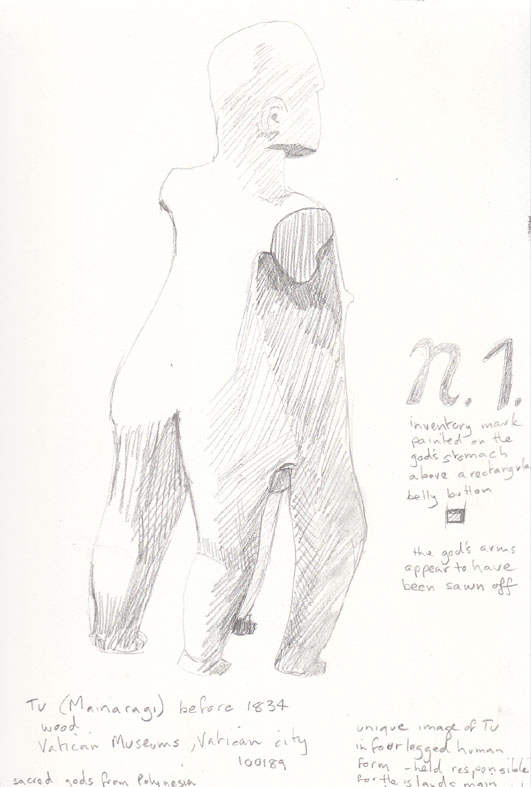
The atua Tu, from the island of Mainaragi. Tu was responsible for the island's main food source, the breadfruit.

The atua Tu, from the island of Mainaragi, before 1834. Tu was the atua responsible for the island’s main food source, the breadfruit.

The large N1 on my page is, what I assume to be an inventory mark painted on the atua’s stomach. This piece is in the collection of the Vatican Museum. I think it is a horrible thing that this sacred image is held by a religious organisation that was/is antipathetical to the island’s religions.

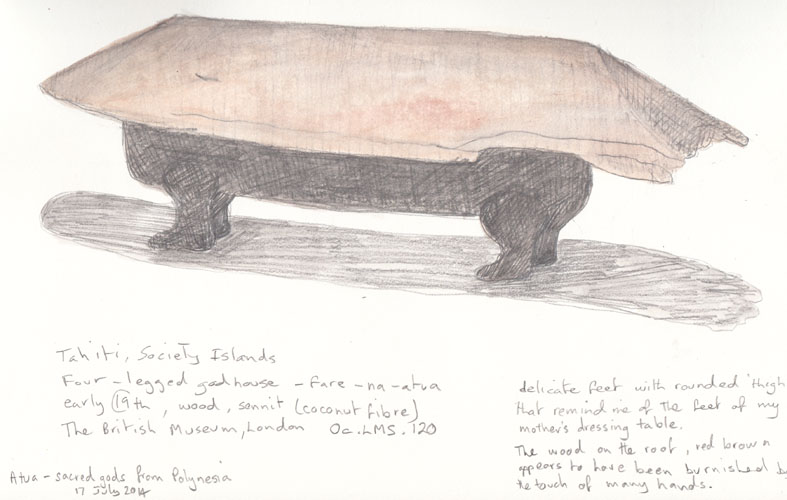
Fare-no-atua (a god house), early 19th century, wood and coconut fibre.

Fare-no-atua (a god house), Tahiti, early 19th century, wood and coconut fibre.

I loved seeing the burnished surface of the wood of this piece. It looked as though many hands had touched it’s surface over a long period of time. This piece is in the collection of the British Museum. I added the colour after I left the gallery.