Brett Whiteley – Drawing is Everything

This week we had a two hour window to see one exhibition in Sydney, before we had to catch our bus back to Canberra. So Brett Whiteley ‘Drawing is Everything’ was the unanimous choice.

Arriving early, before the gallery opened, I took the opportunity to sketch Gilbert Bayes PBRS sculpture ‘The Offerings of Peace’ (1923), from across the road. In honour, no doubt of my artistic endeavours, I was duly shat upon by Pied Currawong sitting in the tree overhead.

AGNSW

The Offerings of Peace, Gilbert Bays, PBRS, 1923

On entering the gallery we were immediately caught up in the vitality of Whiteley’s works, predominantly made with pen and ink and brush an ink. It was fascinating to see how Whiteley intensely studied the works of Van Gogh, Lloyd Rees and other artists as he developed his own style.

The gallery was encouraging visitors to draw while visiting the show, providing pencils and a small A4 folded piece of paper.
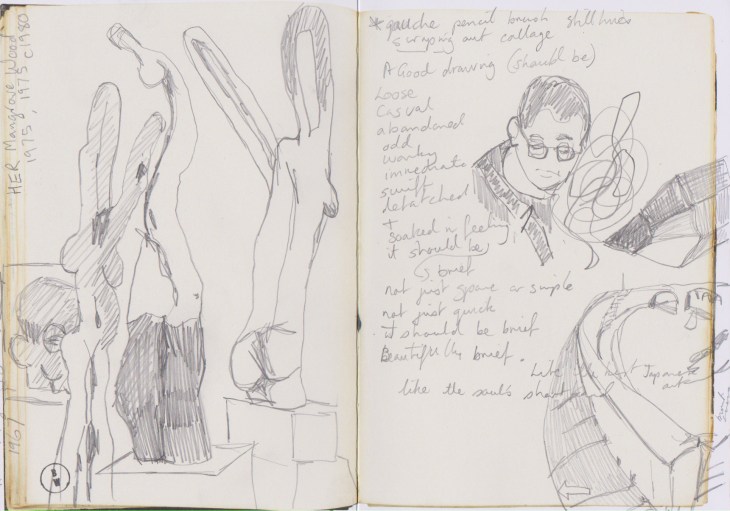
Whiteley2

Her‘, carvings in Mangrove wood, 1975 to c. 1980 (LHS); a quote by Whiteley “A good drawing (should be) loose, casual, abandoned, odd, wonky, immediate,swift, detached, +soaked in feeling, it should be brief, not just spare or simple, not just quick, It should be brief, beautifully brief, like the best Japanese art, like the soul’s shorthand.”

Luckily I also had my own paper as there were several other sketches I wanted to make.

whitely 1

After Brett Whiteley, Wendy Drunk, 1983, original, brush and black and brown ink. My version, pencil on paper.

It was intriguing to see how Whitely playfully amalgamated and created images, such as the following sketch of Matisse, putatively sitting in the Luxembourg Gardens, reading a newspaper.

After Brett Whiteley, Henri Matisse reading a newspaper in the Luxembourg Gardens, 1989 ink and brush. My version pencil on paper with watercolour added later.

Much as I enjoyed sketching in the gallery, the relative stiffness of the pencil sketches, compared to the brush works in particular, was underlined by a quote by Whiteley “Have you ever seen a pencil drawing that isn’t safe?” (p9, Brett Whiteley Drawings, Lou Klepac, The Beagle Press, Sydney, 2014)

Brett Whiteley: Drawing is Everything
Art Gallery of New South Wales, on until 31 March 2019

The Dobell Drawing Prize 2019

I’m thrilled to share the news with you that my work ‘365 Days’ is one of 58 finalists in the Dobell Drawing Prize 2019. The Prize showcases the expanded field of drawing, celebrating innovation, technical skills and diverse media.

The National Art School in association with the Sir William Dobell Art Foundation will present the Dobell Drawing Prize on 28 March 2019.

Over the course of 2017, I used a simple set of rules to generate a work where my hands and my memory made marks, without the intervention of my sight. The rules were stitch daily and stitch with my eyes closed. The year’s marks read as a map of my mind and hands finding their way across a bounded space.

The judges, Michelle Belgiorno, Simon Cooper and Ben Quilty, said of the submissions:

“We were amazed not only by the number of entries, but by their quality and sheer variety of approaches to drawing. It’s clear that today’s artists explore drawing’s full range of possibilities – from sculptural, performative and digital drawings, to extremely skilful works using classic materials such as charcoal and ink. We’re thrilled to see such technical talent and innovation reflected in this year’s shortlist.”

The exhibition of finalist’s works, will be held at the National Art School, running from 28 March – 25 May 2019

National Art School | Forbes St, Darlinghurst NSW

Kusama

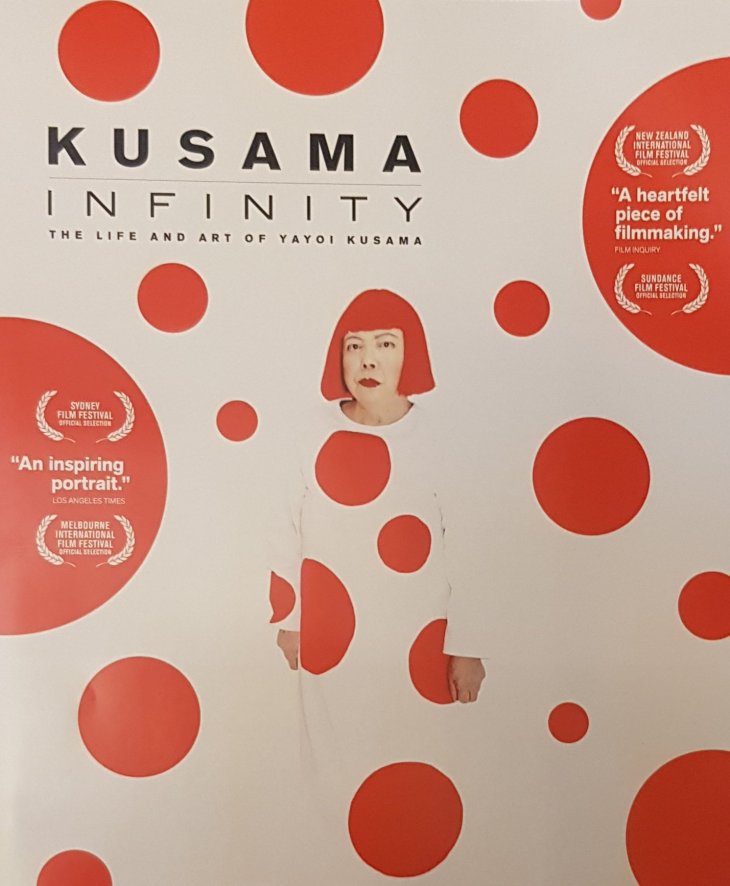
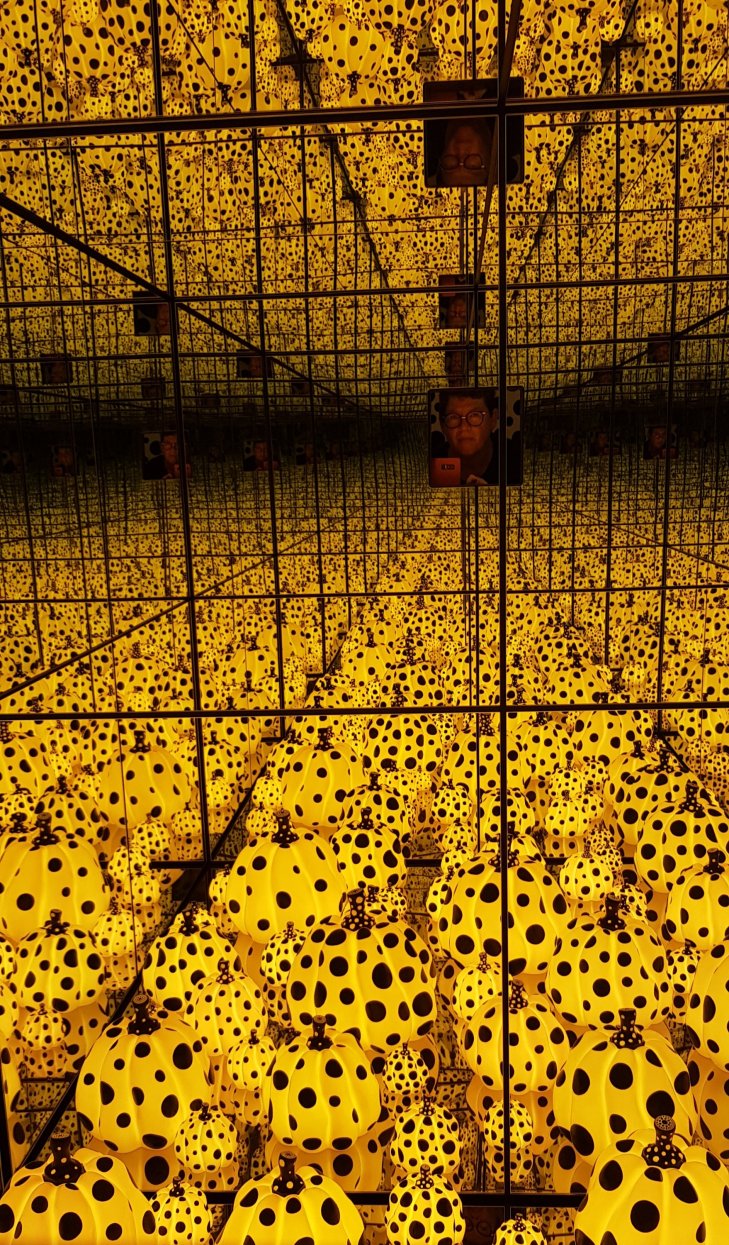
I have long enjoyed seeing the work of Yayoi Kusama and today I got a double shot. We went and saw the documentary about her life and work ‘Kusama-Infinity’ and then drove over to the National Gallery of Australia to see her installation work ‘The Spirits of the Pumpkins Descended into the Heavens.

Highly recommended!

The movie spends some time looking at her early work in America. This was what I found most interesting. Her early work really ‘stands up’, over time. It’s a lot tougher than the brightly coloured work we tend to associate with her today. I also got a better understanding of the misogyny and rip-offs she faced (and other female artists too) during that time. Her resilience is even more remarkable than I had realised.

Back at the National Gallery of Australia we met up with friends and had a look at one of her signature installations. I learned from the documentary that these were originally referred to as “peep shows”, which reflects the tougher work she was making in her younger days.

Pumpkins peep show.