Joan Mitchell, (no not the singer).

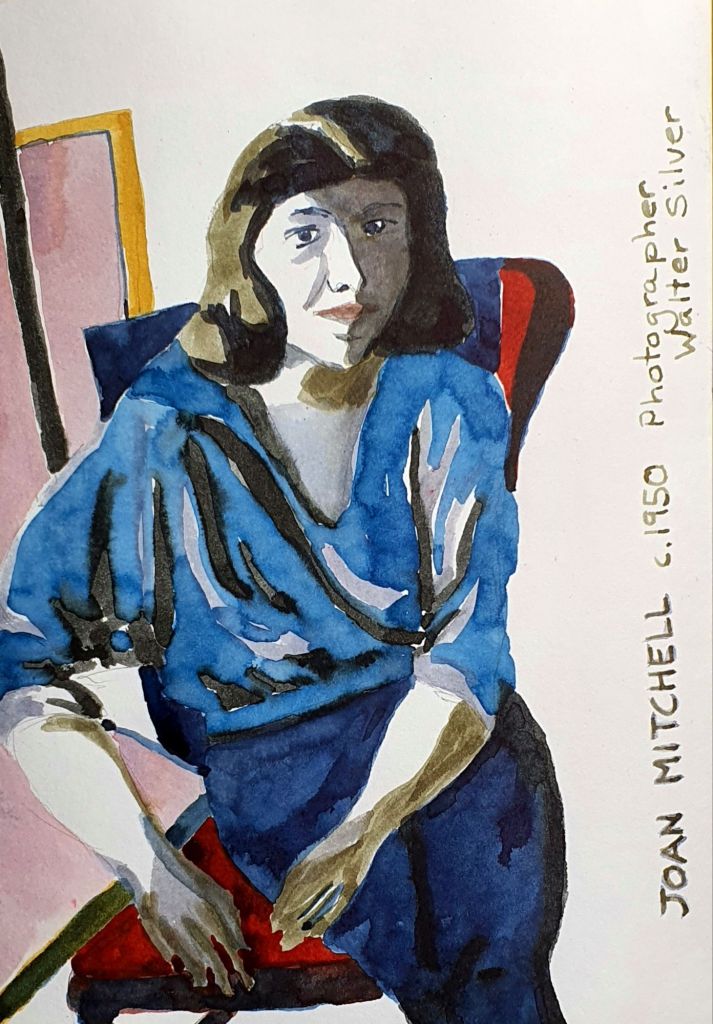
The 3rd artist I am sketching during Inktober is American artist Joan Mitchell (1925-1992), who is associated with the abstract expressionist movement. An excellent starting place to read about Mitchell and a whole slew of women working in mid-century New York, is the book Ninth Street Women, I can’t recommend it highly enough.

Joan Mitchell c. 1950

Mitchell spent a large part of her career working in France, moving there permanently from America from 1959.

Based on a photo from the Joan Mitchell estate.

In 1967 Mitchell inherited money from her mother’s estate which allowed her to purchase a property in Vértheuil, close to Monet’s house at Giverny. She lived there for the remainder of her life.

Joan Mitchell,  from a photo by Timothy Greenfield-Sanders

Mitchell worked on a large scale, painting abstract landscapes. She was, most famously to have said to art critic Irving Sandler, “I carry my landscapes around with me.”

Eva Hesse, sculptor?

The next artist on my list of subjects I an drawing for the Inktober 2024 challenge, is Eva Hesse (1936-1970). Definitely one of those “if only …” artists.

Hesse explored so many new materials and ideas in the very short life she had. I was introduced to her work when I studied art as a mature age student and while her sculptures continue to engage me, I have also become a massive fan of her drawings. If you want to see what she could do I highly suggest you look for a copy of the book Eva Hesse Oberlin,  which catalogues her work  held by Oberlin College. Given this book weighs just shy of 3 kgs (2.971kgs to be precise), you may have to prepare in more ways than one to tackle her body of work.

Eva Hesse, 1963,
from a photograph by Barbara Brown.

I noticed quite a different approach in the photos of Hesse, compared to those of Lee Kranser. I can’t decide if it was to do with the age she was living in, or the age of the sitter. I also felt drawn to adding some warmer tones to these drawings.

Eva Hesse c.1959,
from a photograph by Stephen Korbet

Reboot

Thanks to those of you who helped with my previous posting question.  I feel I am back on track, even if it wasn’t necessarily the track I thought I might be on.

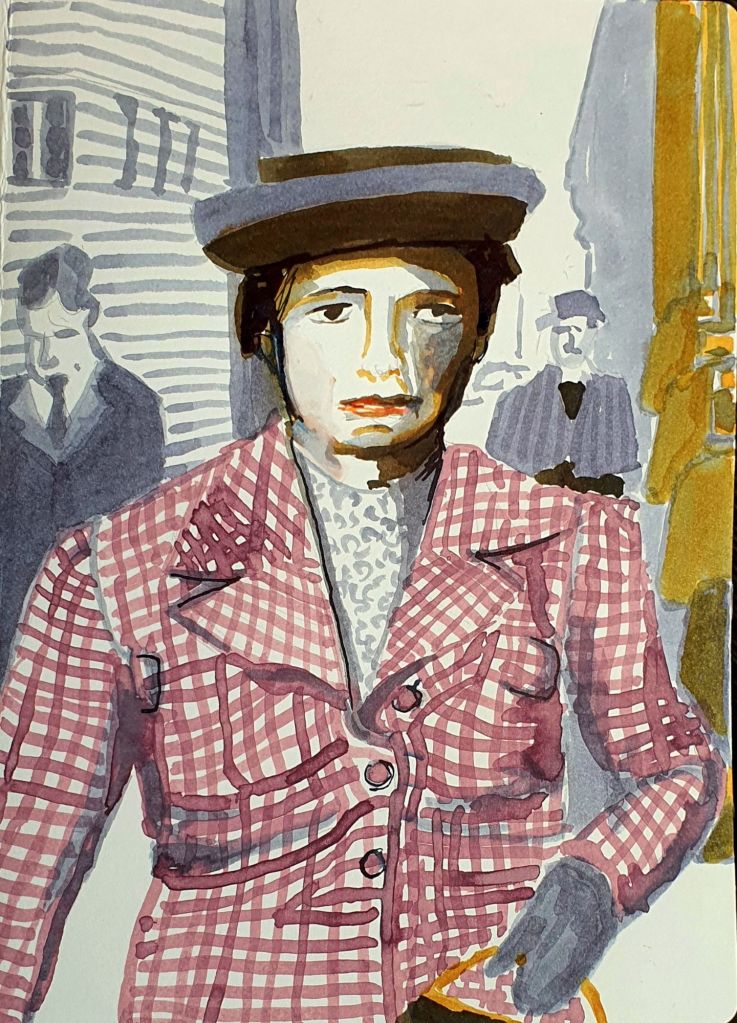
To finish off the Georgette Chen series, I sketched from a photograph of the artist in her later life. It’s so much more relaxed than her earlier studio photos. In it she’s wearing a housecoat over what appears to be an embroidered blouse that might be from one of the Slavic countries.

Georgette Chen, in later life

Chen’s biography in Wikipedia, describes a life of such interest, international travel and melodrama that it deserves a mini-series at least, https://en.m.wikipedia.org/wiki/Georgette_Chen 

I wanted to learn more so I ordered a copy of an oral history interview with Chen, held in the collection of the Singaporean Library and Archive. Alas it didn’t deliver. Chen was very vague, not to say quite inaccurate about a number of things, including where she was born. It’s not clear if it was failing memory or dissembling, but no particularly interesting  anecdotes were forthcoming.

My next subject is a return to the USA and that wonderful artist Eva Hesse. Sad to note that Chen, born some 30 before Hesse, outlived her by over 20 years.

Help wanted …

Is it possible to be ‘too respectful’ to a photograph.  I’m throwing this one open to the collective brains trust!

At the end of my 5th day of Inktober I am already questioning my approach to the photos I’m using as a source material.

I’ll show you today’s drawings/sketches to demonstrate what I mean.

My first sketch today, sticking pretty close to the original photo.

Having reached an end point with that first sketch, the outcome of which I wasn’t completely excited about, I decided to draw a way looser sketch of myself.

Self portrait

After the self-portrait I decided to go back to my previous subject and try to loosen it up. The second version now bears less of a resemblance to the original photo. However, I probably rushed this a bit too much. I would still like to see some resemblance to the source material, but I am feeling that this is probably more ‘authentic to my style’ than the first version.

Am I just copping out with a return to my preferred style? Can you suggest ways of approaching the sketches without becoming  consumed by producing ‘respctful’ likenesses?

The second sketch from the photo. I probably rushed it a bit.
The three sketches in order of drawing

Your thoughts on this matter,whatever they are, would be appreciated.

Day by day, sort of

I’ll spare you the daily photo dump of Inktober drawings. I mentioned previously that I’m drawing from photographs of artists. For each artist I have found several photos, where possible over different times of their lives – although some lives were not long at all.

First up is Lee Krasner. These photos are from the book Lee Krasner, Living Colour, Ed. Eleanor Nairne, Thames and Hudson, 2019. It’s a catalogue for the exhibition of the same name. Krasner has such a bold look, with her striking dark hair, that I found it easy to see how that might be translated into a graphic pen and ink drawing.

Day 1, I drew from an early photo of Krasner , so bold a pose and her eyes blocked out by sunglasses.

A young Lee Krasner c. 1938, Photographer unknown.

I ended up doing 4 drawings of Krasner, because I’m playing a lot with different approaches.

Day 2, I used two different approaches.  The first was all line work with blue and sepia ink. The second with a range of inks all applied by brush. As someone who loves watercolour the 2nd approach is the one  feel most comfortable with.

Day 2, two approaches from the same source photo taken in 1949 by Arnold Newman

For Day 3, I decided to combine line and wash, given how Irving Penn has photographed Kranser’s face surrounded by the upturned collar of her coat. I wanted to capture the dramatic sweep of the collar but to also suggest it’s textured lining.

Lee Krasner, 1972, photographer Irving Penn.