Everyday practice

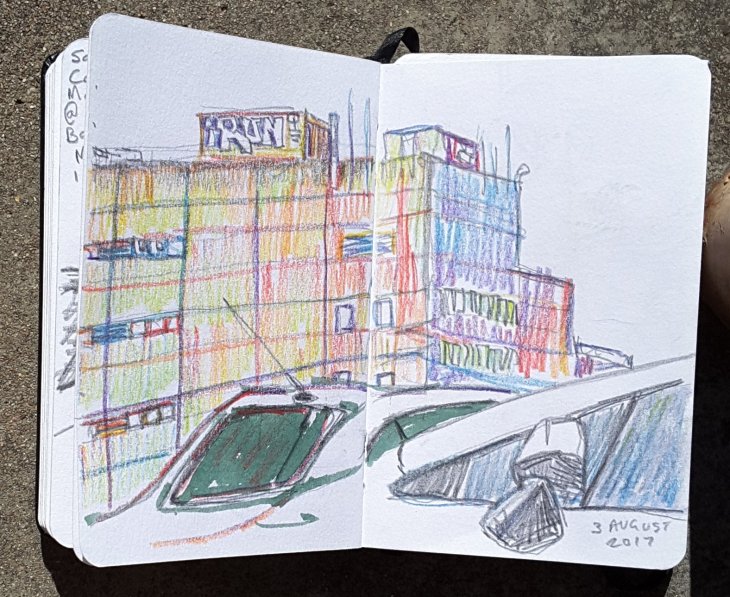
Here are some sketches from my current ‘handbag’ sketchbook. I am trying to use up one of the myriad sketchbooks that seem to spontaneously generate in my spare room. This book isn’t too good with wet media so I mainly try and sketch in pencil. The pencils I am using are a Palomino Blackwing 530 and my el cheapo multicolour pencil I got in Japan at Sekkaido.

In rough date order …

Trying to get some more interesting perspectives into these ‘regular’ events.

From the car in a roof top carpark.

Sketching graffiti from a roof top carpark.

This is a work in progress. I do a bit more every time I stop here to collect the mail.

Again, trying to enliven a cafe sketch. It gets very busy at our local cafe on Saturday morning. There are lots of parents and kids relaxing after the kids football matches.

‘Good Bones’ with Stephanie Bowers

We recently took off to Melbourne for a few days with friends to take a workshop called ‘Good Bones’, with architectural illustrator and urban sketcher Stephanie Bowers. Obviously the desire to learn how to handle perspective and use of water colour for illustration appealed as folks came from as far afield as Brisbane and even Perth to attend the workshop. I’ll spare you the blow by blow description of the workshop because Stephanie teaches these techniques in her online classes.

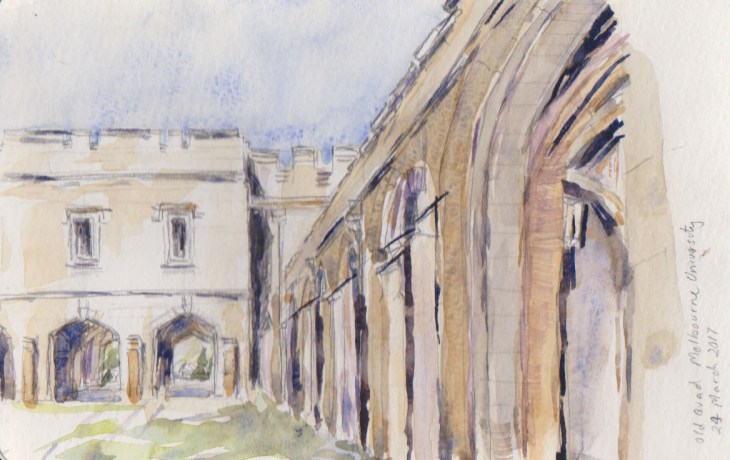
Our base for the two days of the workshop was the ‘Old Quad’ at Melbourne University. The university was founded in 1853 and sought to impress with buildings based on the cloisters and quadrangles of older European institutions. The Quad, with its arcades and arched cloisters certainly was a challenge.

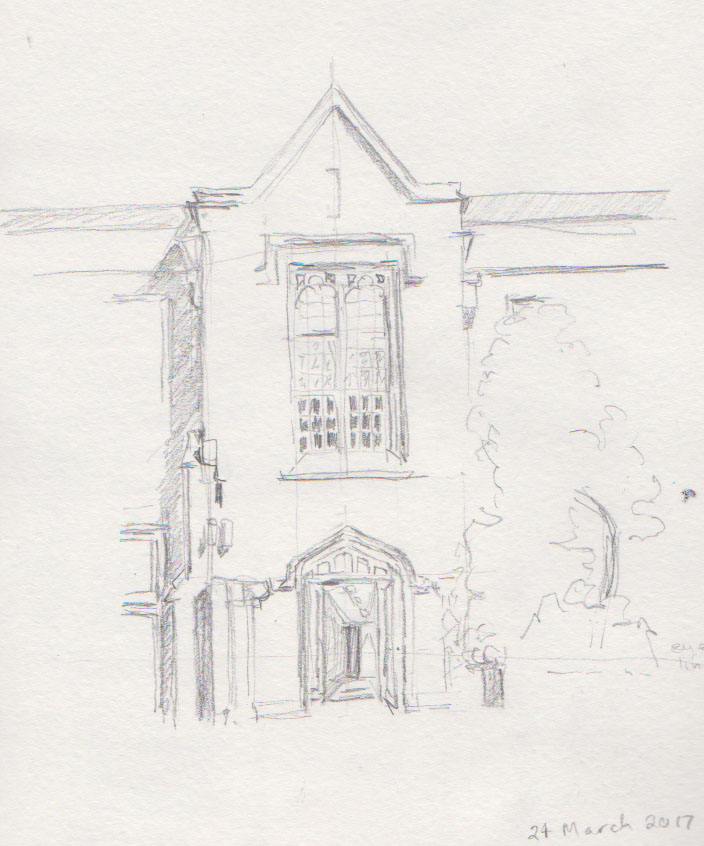
Day one focused on basic instruction and demonstration on single point perspective. Sketches were in pencil with watercolour to follow on Day 2.

24Mar2017a

The Old Arts Building, Cussonia Court, University of Melbourne

Sketching in this much detail in pencil is definitely not my usual approach!

24-25Mar2017b

My second sketch with watercolour added on the following day, the Old Quad, University of Melbourne

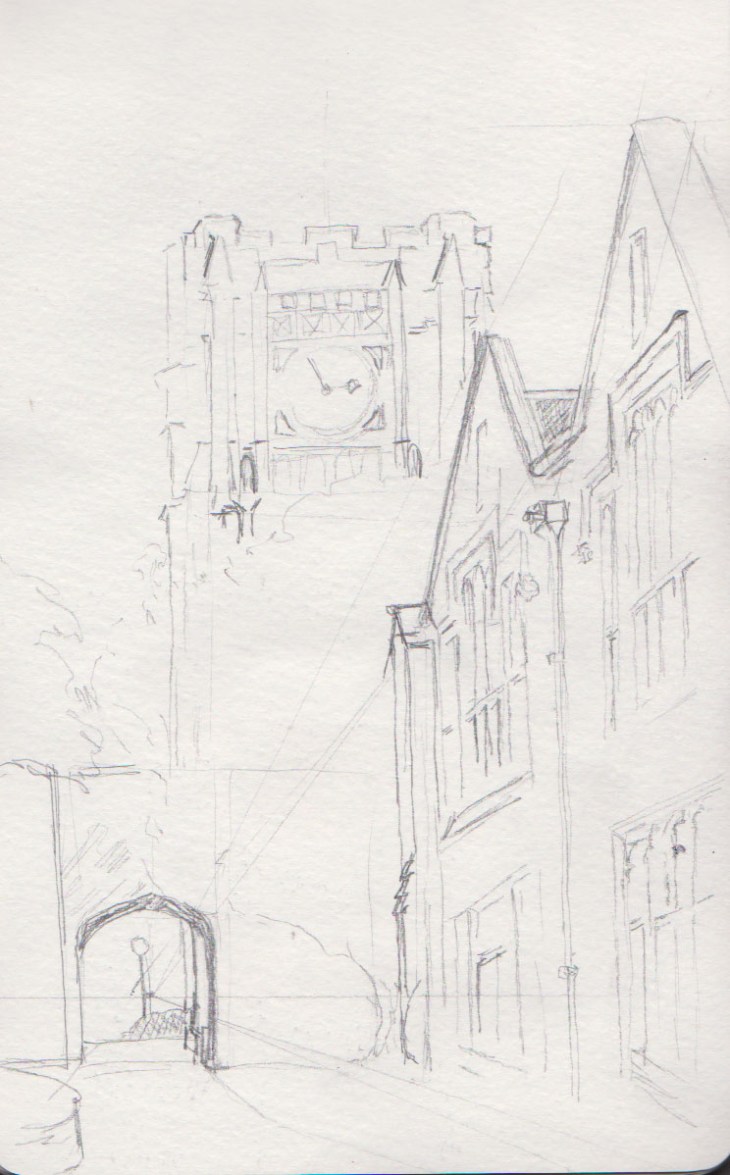
Focused practice is always difficult. Another study in pencil.

24Mar2017b

Finding the perspective lines was challenging and I doubt I would have gotten this far without Stephanie’s expert tuition

After a day of concentration Stephanie had us make two quick 10 minute sketches.

Day 2 was spent trying out colour combinations and practicing our watercolour technique.

Following the workshop we spent a final half day with Urban Sketchers Melbourne. We had the advantage as we stayed at the University. Without the previous two days tuition I would not have had the skills to successfully tackle the design buildings at the university.

26Mar2017

The dramatic extension of the Design Building with the Elisabeth Murdoch Building in the background

I would recommend taking a class with Stephanie, either on-line or in person.

Sunday with the sketchers

Today the Urban Sketchers Canberra group met for its first outing of 2017 at the Mt Stromlo Observatory. I wasn’t sure how many people would come along as the forecast was for 34°C, thankfully it didn’t get that hot while we were there and we had a breeze for a fair part of the morning.

While we were gathering I spotted my first choice for sketching. This fire hydrant is a rather folorn reminder of the devastating firestorm that swept across Mt Stromlo and down into the suburbs of Canberra in 2003.

Fire hydrant remains at Mt Stromlo, watercolour, 8 January 2017

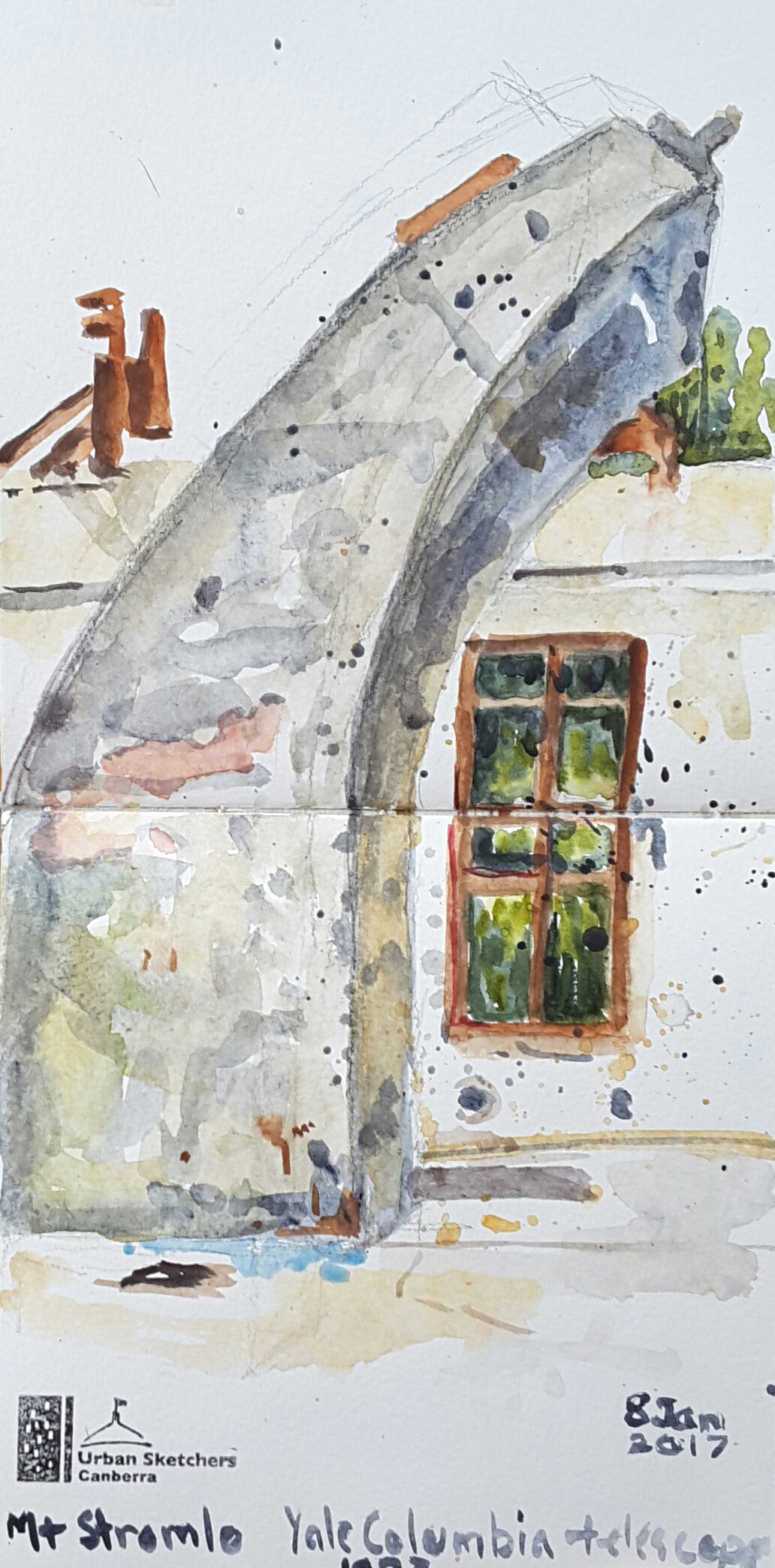
As the morning hotted up and the ants started biting I decided to retreat to another location. I joined one of our other sketchers in the cool shade of the remains of the Yale Columbia telescope (built in 1923).

The ruined mounts for the telescope now make for very dramatic sculptures inside the shell of the building. 

Inside the ruins of the Yale Columbia telescope, Mt Stromlo Observatory, watercolour and graphite pencil, 8 January 2017

The other mount reminded me somewhat of a Dalek, must be that squat shape.

Mount for the Yale Columbia telescope at Mt Stromlo Observatory, watercolour and graphite pencil, 8 January 2017

We were happy to retreat inside to the cafe for our sketchbook ‘throw down’ and compare notes after several hours of sketching.

You can see more sketches from this morning  on the USk Canberra  Facebook page and on this blog by fellow sketcher Michelle.

My previous visit to the observatory can be found here.

Drawing the exhibition – Venetian Renaissance Paintings 

OK I haven’t tallied up just how many exhibitions I saw in my two months in Tokyo, but it was quite a lot. I did try and sketch, where possible, various bits and pieces of works that caught my attention.  

The first exhibition I saw was of Venetian Renaissance paintings from the Gallerie Dell’Accademia in Venice. If nothing else visiting this exhibition made me realise that there is much to learn from any period, and it can be relevant to a contemporary art practice. I suppose the most important thing is to have an open mind. 

The first thing that struck me was realising just how I often make ‘realism’ the compositional basis of my work. In the early rooms I encountered Bellini’s Virgin and Child (Madonna of the Red Cherubs) a piece of Surrealism if ever there was one! What was this man doing? Chanelling more of the medieval approach to compositio than I anticipated, yet painting with a Renaissance appreciation for portraying realistic people and a depth of field.
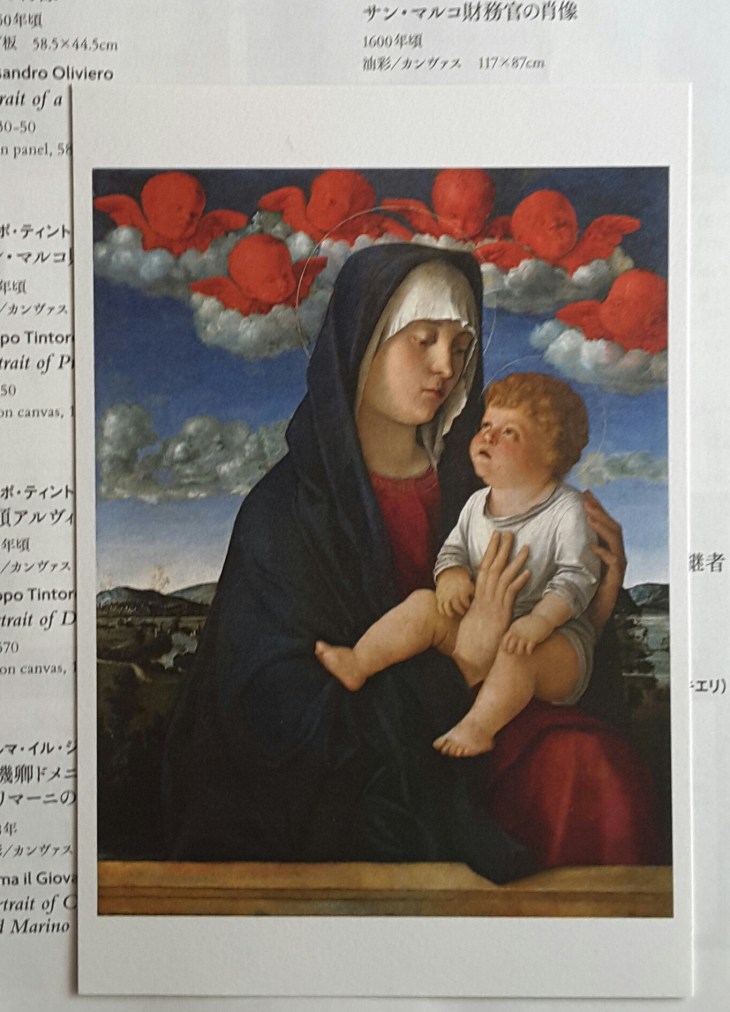
Giovanni Bellini, Virgin and Child (Madonna of the Red Cherubs), 1485-90, oil on panel

Want to get more of the story into your picture, but don’t have enough space on the canvas? Easy stick God and the Holy Spirit framed in a window. Well that what Giovanni Savoldo did with his Annunciation. 

Giovanni Savoldo, Annunciation, c. 1538, oil on canvas
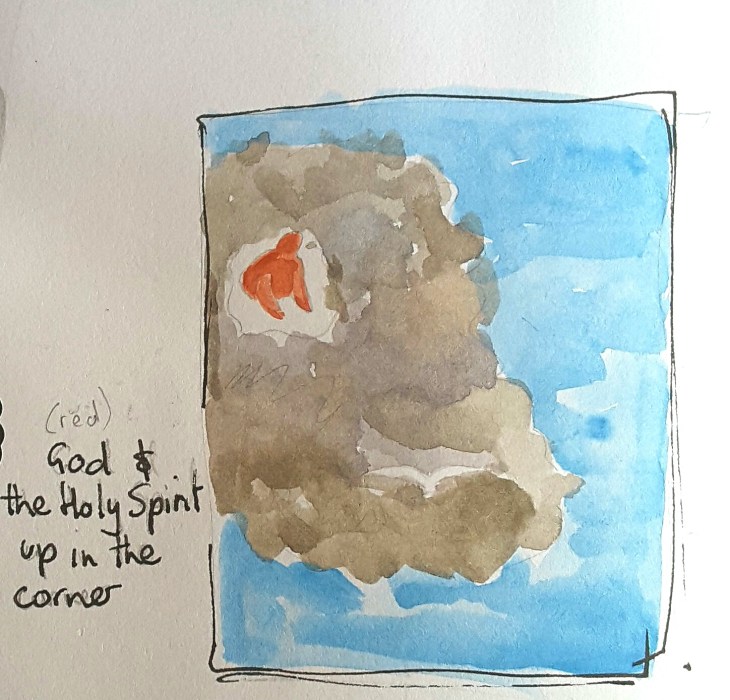
Detail of Savoldo’s Annunciation, c.1538. Pencil sketch in the gallery, with watercolour added later.

This approach might seem a bit old-fashioned, then what did I see today, at The National  Portrait  Gallery (Canberra), but William Robinson’s double self portrait, Town and Country, 1990, where he uses the just the same device to portray different aspects of his life.

In contrast to the dramatic gestures of many works, intended to evoke and reflect religious devotion, one of the strongest works I saw was a painting based on the simplest formats. Attributed to  Francesco Bissolo, The Redeemer’s Head, 1500-10, is a symetrical, frontal portrait painted in an very limited palette.
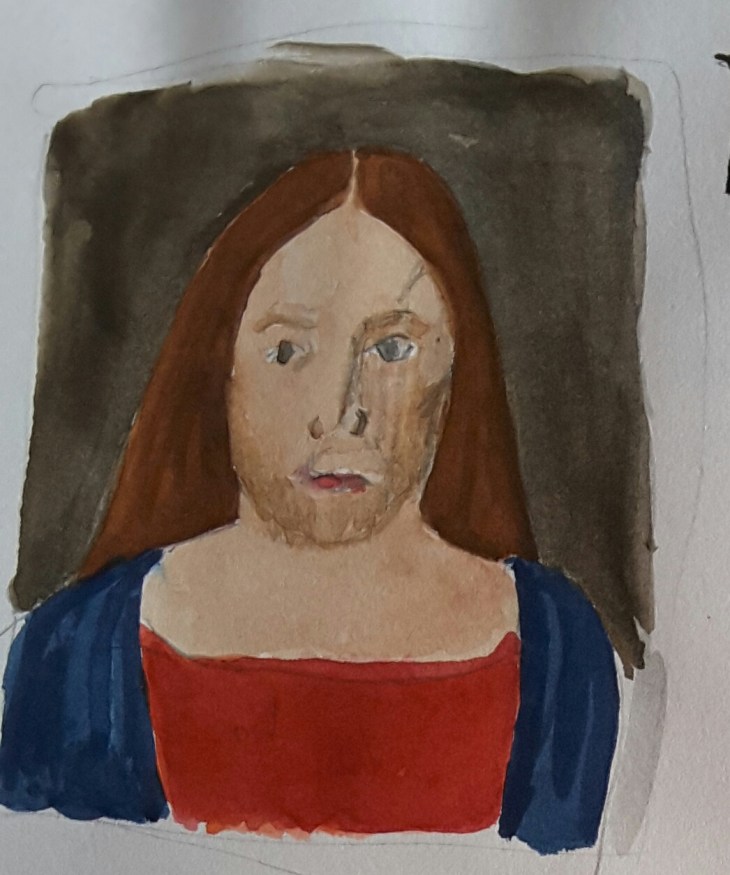
The Redeemer’s Head, 1500-10, attributed to Francesco Bissolo, original tempera on panel. My version pencil with added watercolour.

The highlight of the exhibition was Titian’s Annunciation, from the Church of San Salvador,  1563-65. The large 4 metre plus high oil on canvas was full of interesting details, sure to keep the easily distracted occupied during mass. I sketched two details, firstly the key subject the painting, the angel visiting the Virgin Mary (who has coyly raised her veil to hide herself).

Detail, The Annunciation, 1563-65, Titian, original oil on canvas. My sketch a ‘blind’ drawing in pencil trying to capture the dramatic posture of the angel’s wing.

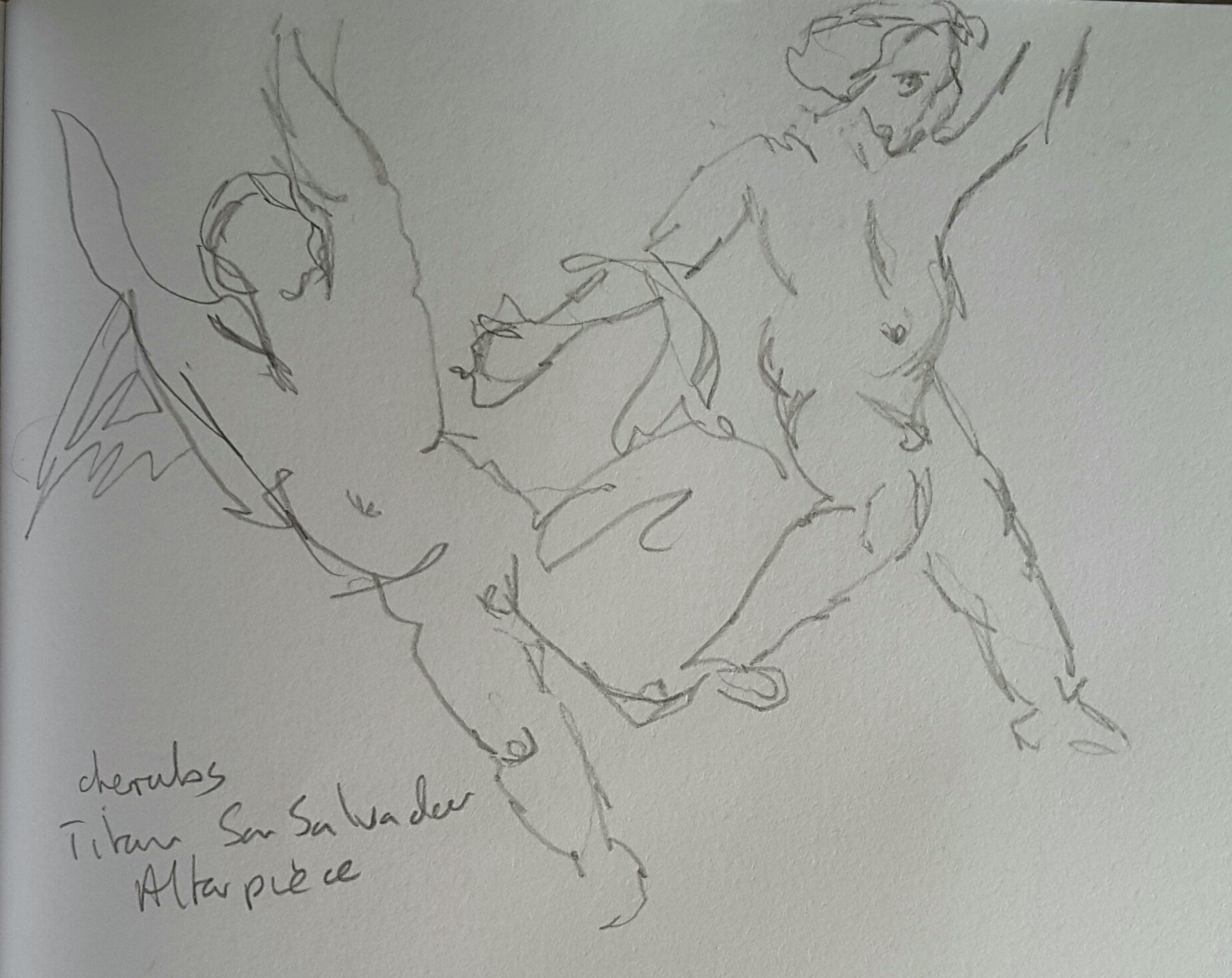
But I  couldn’t resist the  cherubs skittering around in the upper portion of the painting. 

Detail, The Annunciation, Titian, 1563-65, cherubs. My sketch pencil

Imay have seen just one too many Virgin and Child’s in this exhibition, but I did learn a thing or two.

Cafe Wednesday – the hat

It only took one look to decide what the subject of this week’s drawing would be. Strong light was delineating the rather dashing hat being worn by a man at a nearby table.

25May2016

Magic pencils and white pencil on toned tan Strathmore paper

The light also cast a dramatic diagonal across his face.