Concrete Cafe

In my first post knee-surgery outing (as opposed to doctor’s visits) we went to our local cafe. Changes, by way of a major upgrade of the pavement and landscaping of the shops, are well underway and the dinosaur is on a leave of absence. Instead there was a concreting crew waiting to pour several large slabs which will form the new, level area for seating.

Don't forget to check your pens!

Don’t forget to check your pens!

You can tell I’m a bit rusty because I made a real beginner mistake – I forgot to check my pens before I left. One was completely out of ink and the other has a dodgy nib that really needs changing.

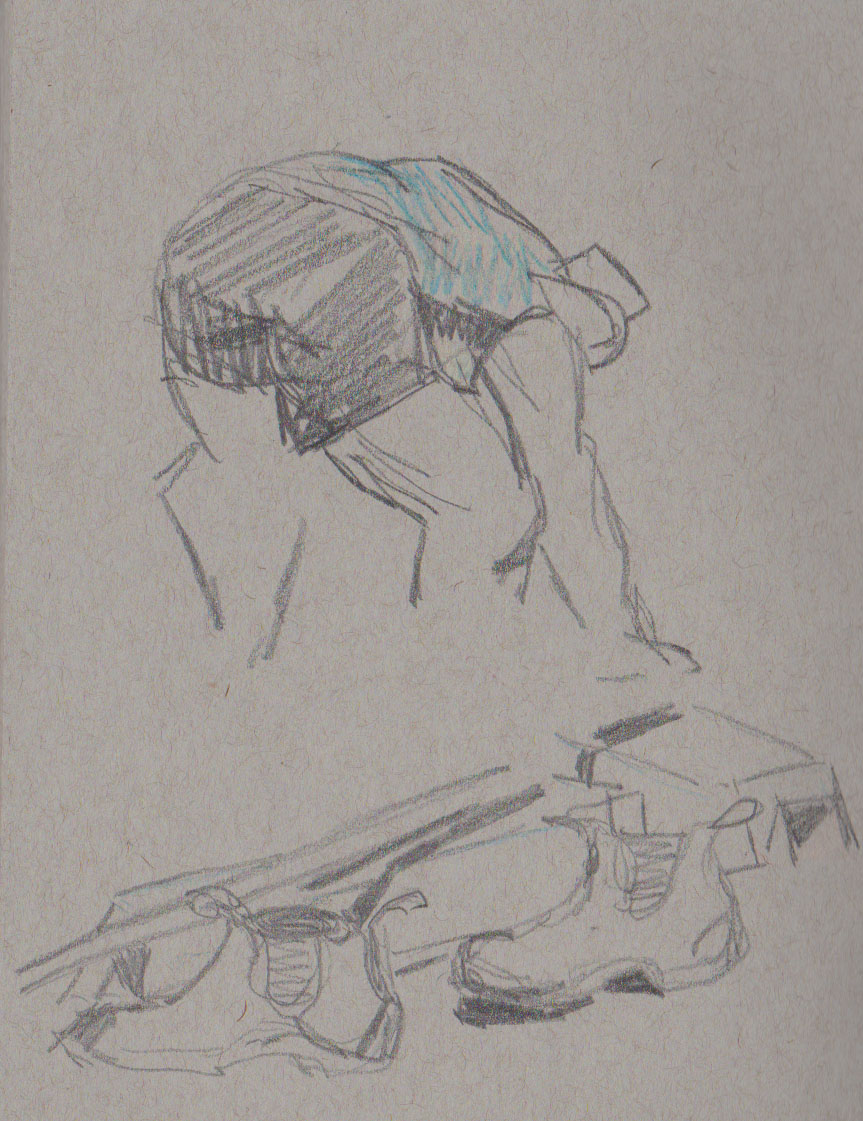
It took a while to get going with the sketches as I fiddled around finding a pencil and approach that I was happy with. In the end I began by focusing in some of the boots that were sitting ready to be used.

image

Gumboots and smoothing the edge, graphite, white chalk and coloured pencil

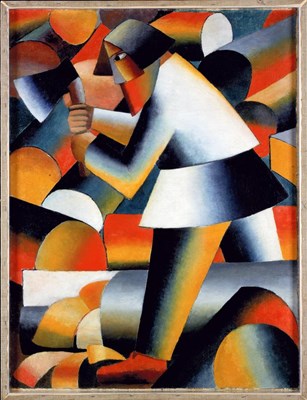
Then the concrete truck arrived and before I knew it I had sketched a group of labourers that Kazimir Malevich would have been proud of.

image

Quick movement as the man spread the concrete.

By way of comparison here is one of Kazimir’s.

image

Kazimir Malevich, The woodcutter, 1912, Collection Stedelijk Museum Amsterdam

There were several slabs to be poured so I managed to capture the action by loking for the repetitive movements.

image

Edge detailing and more work boots, graphite and magic pencil

I really enjoyed trying to capture the way the men moved, although clearly bad backs are an outcome of such work.

image

Spreading the concrete, graphite, magic pencil and white chalk

Drawing the exhibition – Encounters

This past weekend I visited the National Museum of Australia to see the exhibition Encounters: Revealing Stories of Aboriginal and Torres Strait Islander Objects from the British Museum. The exhibition also provides links to contemporary Aboriginal people and communities via a series of videos that give the visitor an insight into their view of these items. But is an exhibition that is based on a paradox. That is that many of the objects on display were taken (read stolen), without permission from individuals or communities. Yet these objects would almost certainly have not survived this long, due to the perishable nature of their construction, had they not been taken. In several of the videos I watched, people commented on how they had gained both practical knowledge and cultural strength from interacting with these objects.

Two spears, taken by Captain James Cook and his men on their first encounter with Dharawal/Eora people in Botany Bay in 1770, form the literal centre of the display. The rest of the exhibition turns around this focal point in Australian history. As a ‘maker’ I love looking at the details of these spears, the long flexible prongs still bound tightly to the hafts of the spears. At the same time I was horrified to know that these examples, out of some 40 spears collected at the same time,  were taken after the local people, who tried to stop Cook’s attempts to come ashore, had been shot at and driven away by the landing party. Sir Joseph Banks wrote in his diary:

“[We] threw into the house to them some beads, ribbands, cloths & c. as presents and went away. We however thought it no improper measure to take away with us all the lances which we could find around the houses.”

Gweagal spears

Gweagal fish spears collected by James Cook at Botany Bay (foreground), with contemporary fish spears (background)

Before I tie myself into a total knot about my feelings about how many objects in this exhibition were ‘collected’ I’d better show you some of the items I drew.

First up is a stone kodj, or axe from King George Sound, Albany in Western Australia, collected by Alexander Collie sometime between 1831-33. This kodj was one of the tools used for butchering animals.

Kodj, (axe), stone, resin and wood British Museum Oc. 4768

Kodj, (axe), stone, resin and wood British Museum Oc. 4768

Two large stone flakes have been hafted onto a wooden handle with resin (not sure what type, but possibly from a grass tree). The sharpened end was also used in the butchering process. The strange yellowish shapes I noticed on the handle turned out to be collection labels.

A more complex construction was that of a necklace made of swamp wallaby teeth, which was collected some ten years later on the eastern side of the continent. The root of each tooth was bound by fine string to a leather strap. The teeth are in excellent condition and appear quite white, with almost a blue or violet tint, hence the water colours I added when I got home.
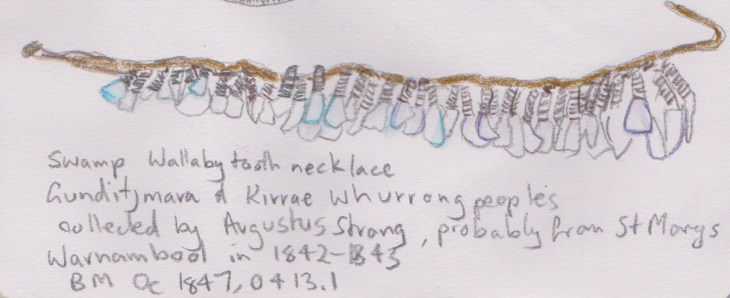
wallabytoothnecklace

Necklace of Swamp Wallaby teeth, Gunditjmara and Kirrae Whurrong peoples. Collected by Augustus Strong, probably from St Mary’s, Warnambool in 1842-43. British Museum Oc. 1847, 0413.1

I also made two drawings of a Dangal, or dugong charm used for bringing good luck while on the hunt (well not to the dugong anyway).

Dangal1

Dangal (dugong) charm, collected by Alfred Court Haddon on Tudo in 1888

When I looked closely at this charm I could see what appears to be red ochre on it’s muzzle and also in a stripe along its back. The handle made of twine goes around the head and tail and a fine piece of twine is also threaded through the body of the animal via a small drilled out tube. This is such a refined a piece of work.

image

Per usual there’s so much more I wanted to draw, but there was more in store. Out the exit and into the next room is a second exhibition called Unsettled. This room showcases five contemporary Aboriginal artist’s response to the Encounters exhibition. I thought that this was one of the best small group shows I’ve seen in quite some time.

The work of Jonathan Jones is featured in a window that opens out into the main foyer. His work, Unitled (fort), reflects on a wooden fort built by surveyor and explorer Major Thomas Mitchell and his party of 21 men on 27 May 1835 . The stockade was built to protect against possible attacks by the local Kurnu Paakantji people. Fort Bourke was never attacked and no longer exists but Jones believes it remains a marker of still unresolved frontier relationships.


Jonathon Jones

Untitled (fort), Jonathan Jones , 2015, wood

I was also really impressed by the video work of Torres Strait Islander dancer/artist Elma Kris and the contemporary take on traditional burial poles by Yolŋu artist Wukun Wanambi.

I would highly recommend both exhibitions. On at the National Museum of Australia, until 28 March 2016. Entry to both exhibitions is free.

Getting the ‘lead’ out

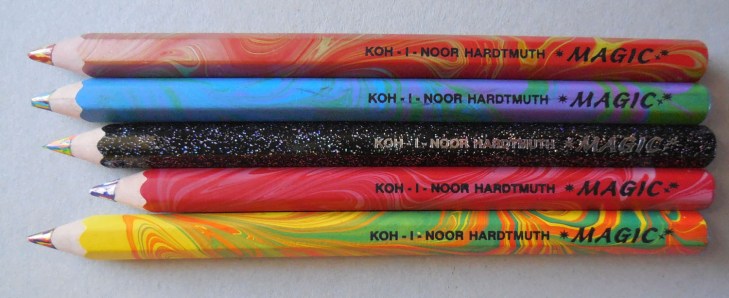
I’ve been using my Koh-i-noor Magic Pencils as my main sketching material for a few weeks now. Apart from being caught up in the sheer fun of multicoloured pencils that would be the envy of any pencil case, I find that they are ‘magic’ in other ways as well.

Koh-i-noor Magic coloured pencils

Koh-i-noor Magic coloured pencils


Koh-i-noor Magic Pencils

Koh-i-noor Magic Pencils

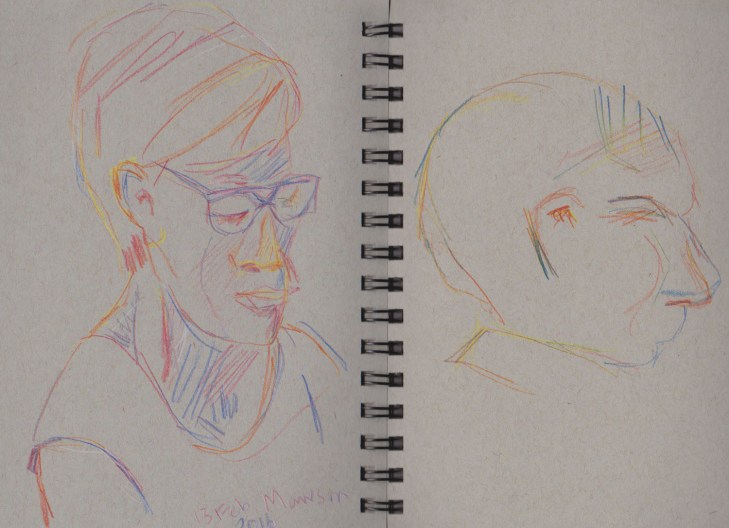
They are ‘magic’ because you can’t quite control where the colour will turn up.

Cafe drawings, Magic Pencils (America), with white chalk on the right hand side, on grey-toned Strathmore paper, 30 January 2016

Cafe drawings, Magic Pencils (America), with white chalk on the right hand side, on grey-toned Strathmore paper, 30 January 2016

They are ‘magic’ because they encourage me to play.

Two men, with multiple arms, Magic Pencils (Original, Fire and America), on grey-toned Strathmore paper, 13 February 2016

Two men, with multiple arms, Magic Pencils (Original and Fire, left; Original and America, right), on grey-toned Strathmore paper, 13 February 2016

They are ‘magic’ because they remind me to focus on the structure of my drawing – where is the light coming from? – not what colour is her t-shirt?

Woman and unfinished man, Magic Pencils (Fire and America, left; and Original, right), 13 February 2016

Woman and unfinished man, Magic Pencils (Fire and America, left; and Original, right), 13 February 2016

They are ‘magic’ because paying attention to the key elements of a subject is more important than ‘completing’ the picture.

Tatooed man, Magic Pencils (America, Fire and Tropical, 13 February 2016

Tatooed man, Magic Pencils (America, Fire and Tropical, 13 February 2016

They are ‘magic’ because they show me that drawing can be much so much more interesting than straightforward representation.


Backyard Still lifes

Sitting in the  garden deciding what to draw. I looked up and spotted this great colour combination.  (PS the strange light bands across the drawing is an artefact of taking photos in the strong sunlight).

image

Still life with punching bag and barbeque, pencil on grey tone paper, 4 February 2016

After this I turned my head and found my next subject, a folded umbrella.

image

Umbrella, handle and brick wall, pencil on grey toned paper, 4 February 2016

Material concerns

Sketching materials often cause me a dilemma. Like many sketchers I run the risk of paralysis from too much choice. When I made my trip to Brisbane last week I decided on one sketchbook – a grey-tone Strathmore and a limited selection of pens/pencils. My main pencils were Koh-i-noor Magic pencils, so I couldn’t ‘control’ to any extent  the colours that came out. I didn’t know whether I could do it! Indeed I did resort to one digital drawing.

Brisbane River Bridges, digital drawing on PS Touch app (for Android)

Brisbane River Bridges, digital drawing on PS Touch app (for Android)

Despite this small detour I did get back on track.This sketch uses only coloured pencil and white chalk. I used several types of the Magic pencils: Original, Fire and America.

Late afternoon sun on the Storey Bridge Brisbane, coloured pencil, white chalk, 20 January 2016

Late afternoon sun on the Storey Bridge Brisbane, coloured pencil, white chalk, 20 January 2016

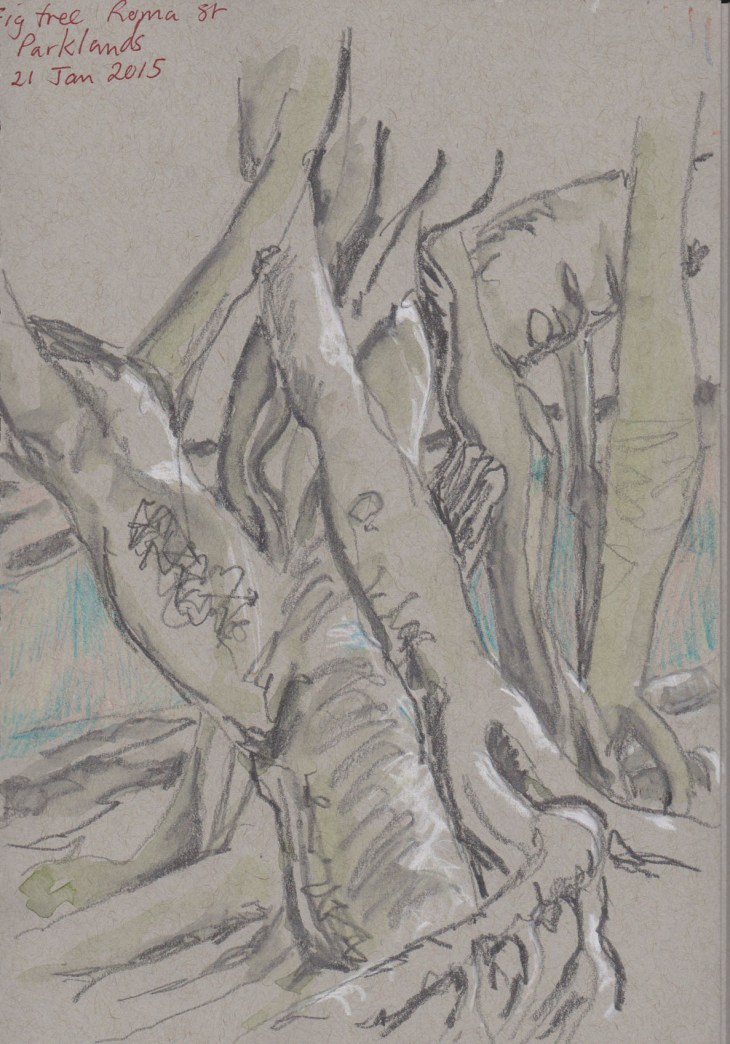
The next day we took our sketch books up to the Roma St Parklands where the twisting shapes of the Moreton Bay figs captured my attention.

Fig tree, Roma Street Parklands, white chalk, graphite and coloured pencil, 21 January 2016

Fig tree, Roma Street Parklands, white chalk, graphite and coloured pencil, 21 January 2016

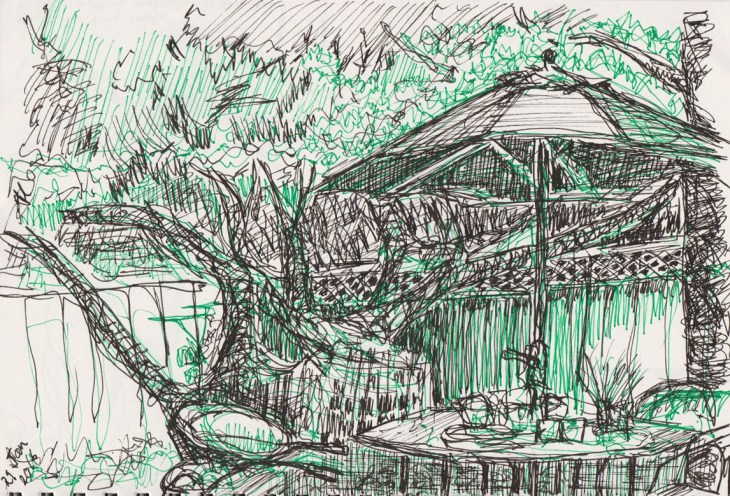
Back home I realised that I hadn’t picked up a pencil in days so I grabbed what was to hand, a green Artline fibre pen and my black ink pen and got down to it.

Backyard, green fineline pen and ink, 29 January 2016

Backyard, green fine line pen and ink, 29 January 2016

It can be a challenge just getting past that ‘perfection’ monkey, but it’s always worth getting out and just drawing.