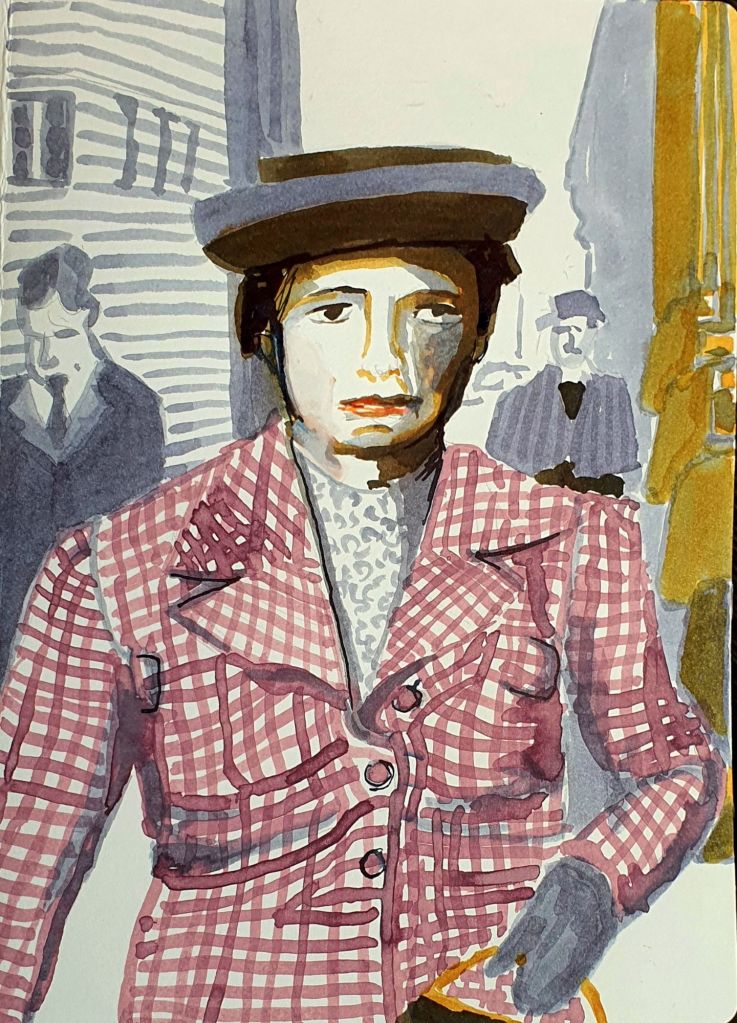
Pauline Boty

Pauline Boty, (1938-1966), was an English artist and sole female member of the British pop art movement. Boty came to prominance through unlikely paths. Initially she studied stained glass and then collage at the Royal College of Art. She had wanted to join the painting department but was dissuaded from applying because of the low success rate of applications by female students.

Drawn from a still from the film Pop Goes the Easel by Ken Russell, 1962

Boty’s good looks attracted attention, earning her the nickname of ‘the Wimbledon Bardot’ referring to her likeness to the French film star. Her appearance in the Ken Russell documentary Pop Goes the Easel, in 1962,  gave rise to a series of roles on the TV and stage and one in the film Alfie.

Pauline Boty, 1963 from a photograph by Lewis Morley

In 1959 three of Boty’s works were selected for the Young Contemporaries exhibition and in 1960 one of her stained glass works was selected for an Arts Council exhibition Modern Stained Glass. You can see her stained glass self portrait in the National Portrait Gallery London.

Throughout her studies and in addition to her acting, Boty continued working on her paintings, first showing her work in a small group show in 1961. My favourite painting of hers is The Only Blonde in the World, 1963, a portrait of Marilyn Monroe, is in collection the Tate Gallery.
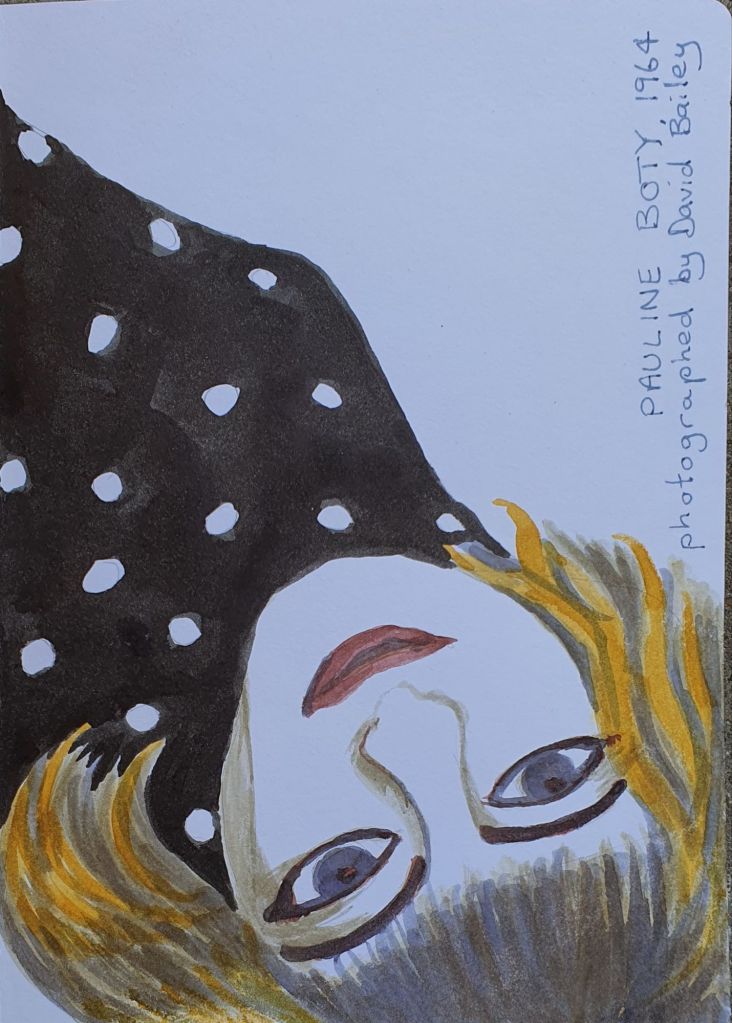
Pauline Boty, 1964, from a photograph by David Bailey.

Boty married Clive Goodwin in 1963. In 1965 she became pregnant, but during an examination it was discovered that she had an aggressive cancer. Boty decided to forgo treatment as there could be no guarantee that her unborn child would survive. Her daughter, called Boty, was born in February 1966. Pauline Boty died of cancer in July of the same year.
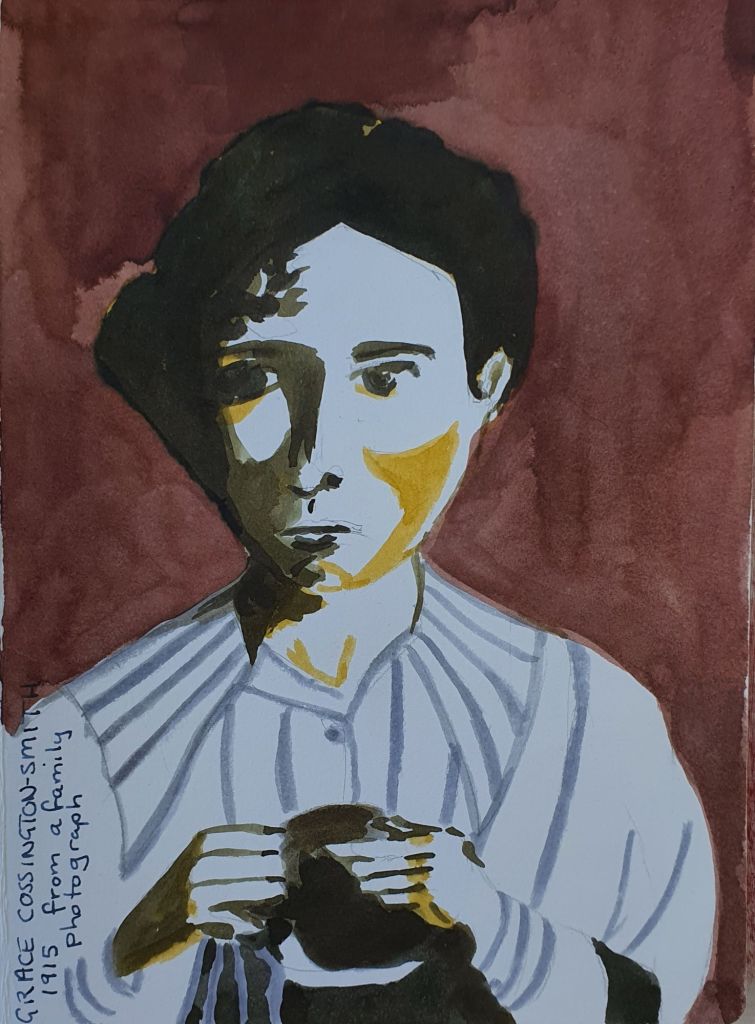
Amazing Grace

Next up is Australian artist Grace Cossington-Smith, (1892-1984), whose early works showing the domestic life of Australia during the first World War brought her to prominence.

From a family photograph taken in 1915

Post WWI her bold use of colour shone in such works as The Laquer Room, 1936.

Cossington Smith is remembered for her light filled domestic interiors that became a feature of her later years.

Grace Cossington Smith, 1937 detail from a family photo, Art Gallery of New South Wales collection.

She had a major retrospective at the Art Gallery of New South Wales in the early 1970’s, then ceased painting. She died in 1984.

Cossington Smith captured by a street photographer, c. 1930-40. Collection of the Australian War Memorial.

.

Reboot

Thanks to those of you who helped with my previous posting question.  I feel I am back on track, even if it wasn’t necessarily the track I thought I might be on.

To finish off the Georgette Chen series, I sketched from a photograph of the artist in her later life. It’s so much more relaxed than her earlier studio photos. In it she’s wearing a housecoat over what appears to be an embroidered blouse that might be from one of the Slavic countries.

Georgette Chen, in later life

Chen’s biography in Wikipedia, describes a life of such interest, international travel and melodrama that it deserves a mini-series at least, https://en.m.wikipedia.org/wiki/Georgette_Chen 

I wanted to learn more so I ordered a copy of an oral history interview with Chen, held in the collection of the Singaporean Library and Archive. Alas it didn’t deliver. Chen was very vague, not to say quite inaccurate about a number of things, including where she was born. It’s not clear if it was failing memory or dissembling, but no particularly interesting  anecdotes were forthcoming.

My next subject is a return to the USA and that wonderful artist Eva Hesse. Sad to note that Chen, born some 30 before Hesse, outlived her by over 20 years.

Day by day, sort of

I’ll spare you the daily photo dump of Inktober drawings. I mentioned previously that I’m drawing from photographs of artists. For each artist I have found several photos, where possible over different times of their lives – although some lives were not long at all.

First up is Lee Krasner. These photos are from the book Lee Krasner, Living Colour, Ed. Eleanor Nairne, Thames and Hudson, 2019. It’s a catalogue for the exhibition of the same name. Krasner has such a bold look, with her striking dark hair, that I found it easy to see how that might be translated into a graphic pen and ink drawing.

Day 1, I drew from an early photo of Krasner , so bold a pose and her eyes blocked out by sunglasses.

A young Lee Krasner c. 1938, Photographer unknown.

I ended up doing 4 drawings of Krasner, because I’m playing a lot with different approaches.

Day 2, I used two different approaches.  The first was all line work with blue and sepia ink. The second with a range of inks all applied by brush. As someone who loves watercolour the 2nd approach is the one  feel most comfortable with.

Day 2, two approaches from the same source photo taken in 1949 by Arnold Newman

For Day 3, I decided to combine line and wash, given how Irving Penn has photographed Kranser’s face surrounded by the upturned collar of her coat. I wanted to capture the dramatic sweep of the collar but to also suggest it’s textured lining.

Lee Krasner, 1972, photographer Irving Penn.