Look first then sketch.

It is always so easy to slip into the habit of drawing what you think you see, rather than drawing what you actually see.

This could be a correct perspective if I was sitting a good metre or so below this woman.

A perfectly reasonable sketch except when I came to add other people in I realised that they would, if drawn in correct perspective, be scraping the roof of this alley way of shops. The rule of thumb is all heads of people, near and far in a sketch, should be on the same level unless you are sitting way above or below you subject.

This is the second version of my sketch this morning after I realised the woman’s head was below the jars of honey, not above them.

Sitting at the same level as this woman this is the correct perspective as she is sitting at the same eye line as me.

Side by side.

Back to the cafe

Back sketching at our favourite coffee shop this morning.

So good to get back to our favourite cafe.

I spent some time thinking about what I wanted to sketch, which was one of the key points in the workshop I did with Richard Briggs last week.

Trying to leave out unnecessary details.

I was interested in the relationship between the hedge across the road and the small hedge close to me. But then I realised that I really wanted the focus to be on the cluster of small stools in front of the hedge.

A small table and stools.

While completing this sketch it dawned on me that the shadows of the stools were also fascinating. One set was being cast by the sun and the ones you see in the painting were cast from the light reflected from the plate glass windows of the cafe. Sadly time and a lack of paper meant that I didn’t make a third sketch, but perhaps I can work on that next time.

Eindhoven sketches

The last main stop on our travels around the Netherlands was Eindhoven. It was rather different to other cities we visited. It seemed quite quiet, possibly because it was university holidays.

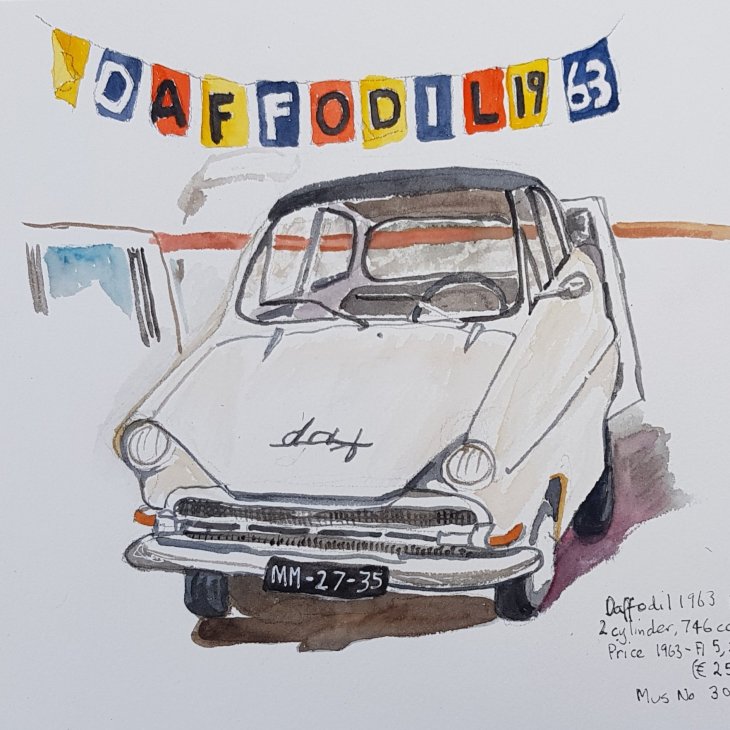
While I am probably the least car fanatical person around I was encouraged by positive comments from other non-car people to visit the DAF Museum. There certainly was lots to see and even I have to admit that there were lots of interesting older cars to sketch. The cutest car of the lot, a 3-wheeler nick-named ‘the portable raincoat’, was right in the entrance foyer, but there was no suitable place to sit and sketch. So I settled on sketching this 1963 sedan the Daffodil.

The 1963 Daffodil, DAF Museum Eindhoven.

One of the contemporary architectural highlights in the city is ‘The Blob’ designed by Italian architect Massimiliano Fuksas. This building is a commercial space and is close to two other related buildings which provide access to bicycle paking. I must say it was a real b**ger to draw. I gave up on trying to draw the whole thing and focused on one end where the glazing makes it look like a partially deflated rugby ball.

One end of The Blob, a commercial space in the centre of Eindhoven.

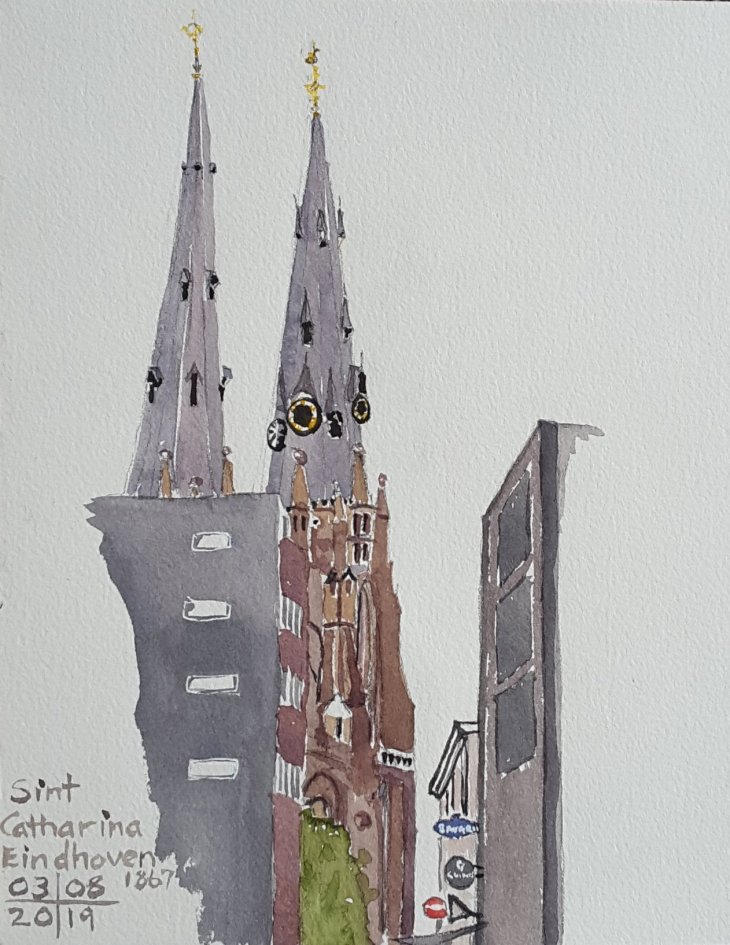
On a more traditional note is Sint Catharina in the city centre. Despite its Gothic look it was designed by Petrus (Pierre) Cupyers and built between 1859-67. It replaced an earlier derelict medieval church on the same site. Cupyers was definitely going for the over-the-top neo-gothic style, influenced by 13th century French Gothic churches. The two towers are different from each other. The slender Ivory tower symbolising the purity of the Virgin Mary and the chunkier one representing the strength of King David. Whatever. It made for two interesting elements to paint.

The Virgin’s tower on the left and King David’s tower on the right. Sint Catharina Eindhoven

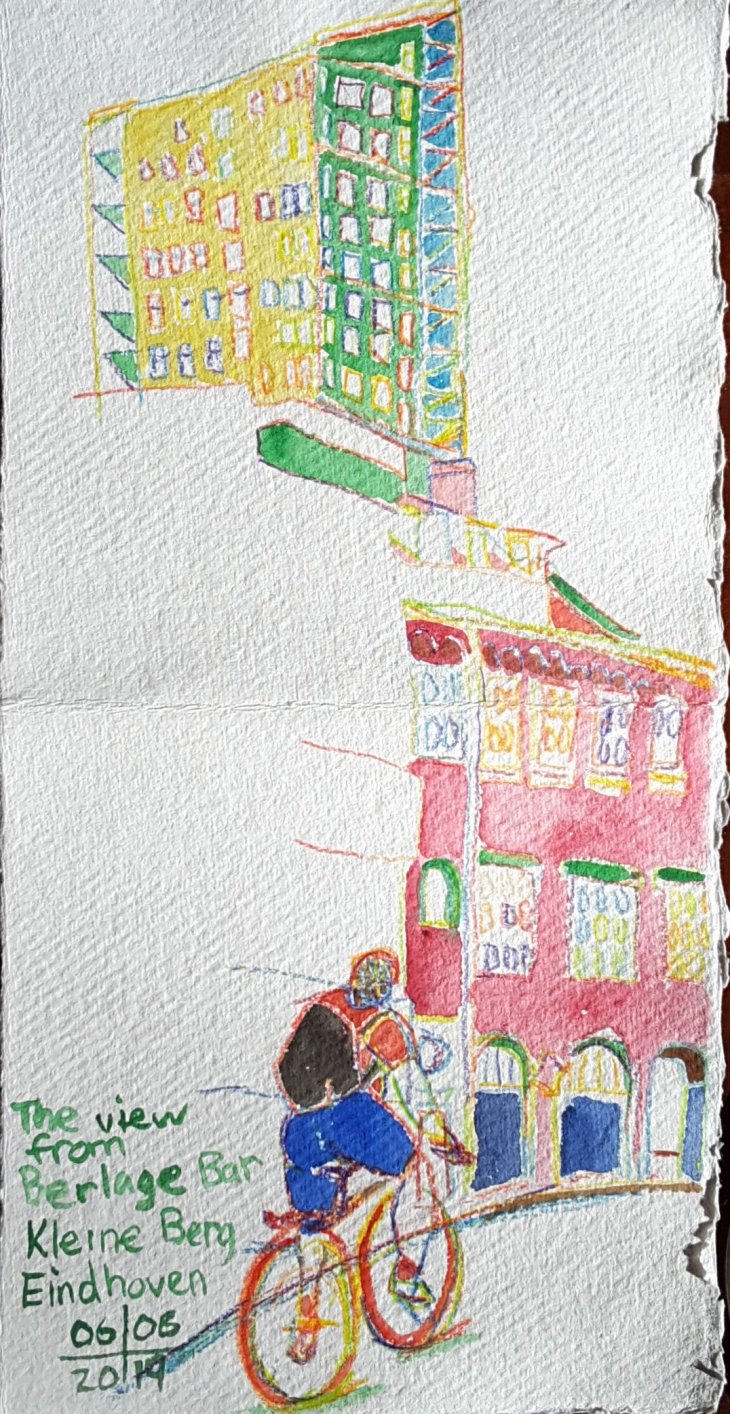
The last thing I sketched in Eindhoven was what I could see from where we were having dinner. Looking at a tower block which was catching the evening sun I tried to use some techniques I had learnt at Symposium. I focused on sketching what I was interested in, not using ‘local’ colour and working using warm and cool colours to highlight the buildings.

Final sketch of Eindhoven. A pleasant street view with a cyclist turning up at the right moment.

Some purchases in the Netherlands

Wherever I travel I like to find art materials as momentoes of my trip. As I was going to an Urban Sketchers Symposium I was well aware that an art supply goody bag would be waiting for me there. The market stalls at Symposium are also great places to find well-priced items. None the less I still managed to find some items that I knew wouldn’t be in the bag.

It turned out that I had set myself up to buy, without even really trying. Our hotel in Rotterdam, where we spent the first week of our trip, was directly across the road from two art shops!

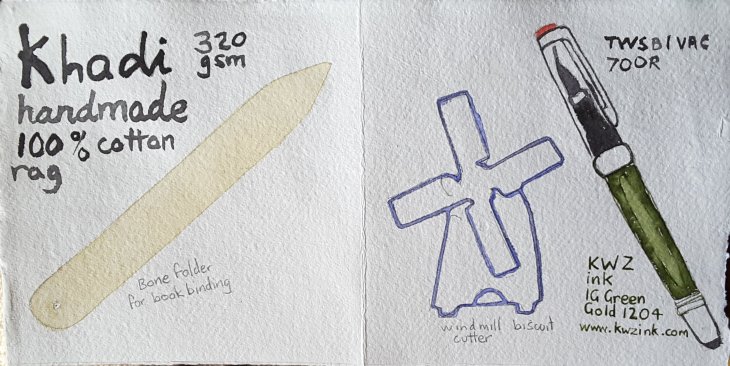
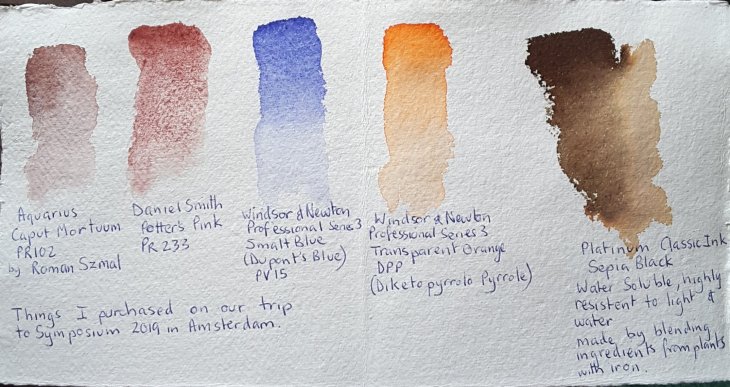
To make it easy for myself I have made a visual record of my purchases.

First purchases handmade Khadi paper, a bone folder used in bookbinding, a new fountain pen (of course I need another one!) and some new ink to go with it. And a ring in , my windmill-shaped biscuit cutter.

By way of explanation this fountain pen has one of the biggest reservoirs on the market, which makes it very useful for lots of sketching without having to frequently refill it. This KWZ ink was purchased on the basis that it was waterproof. Unfortunately there was a mis-understanding and it turns out that the green-gold ink is not waterproof. The company makes another green which is water- resistant, but this isn’t it.

My new paints, with the exception of Potters Pink which was only a replacement. A second new ink also with some odd properties.

I seem to be attracted to the blues these days. I was intrigued by the Smalt Blue (AKA Dumont’s Blue). This is a very old form of blue pigment made by grinding glass coloured by smaltite, a cobalt salt, into a fine powder. I assume it was one of the less expensive options than ground lapis lazuli. From some of the reading I have done it has, in oil paint, tended to fade over time, but not all paintings show this fault. It has a purplish tinge which I really like. I expect it will be appearing in my ‘skies’ in the not too distant future.

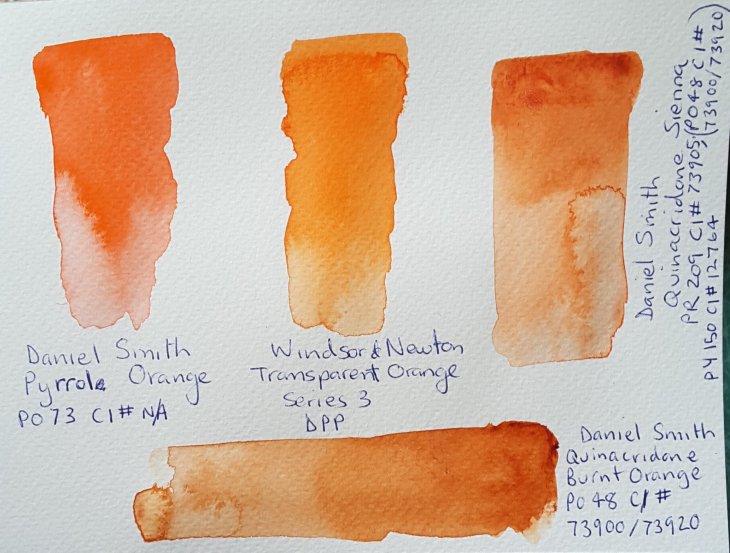
Much as I am a devotee of Pyrrol Orange (it is one of those irreproducible colours), I do sometimes find it a bit pink. This Transparent Orange, above, is a synthetic pigment with an industrial automotive history, it looks like it fits the bill for a truly orange, orange. I swatched it out, below, with some of my other orange-y paints for a comparison.

As you might decipher in my notes on the page above my Platinum Classic ink (an iron gall ink), is listed as both water soluble and resistent to water. Mmmmm?? A bit of research indicates that while some of the ‘apparent’ colour of the ink may be water soluble, over time the ink gall element should not only resist water, but darken with age. I’m not sure that I will be happy with this latter development, as the solubility of the ink has resulted in some quite pleasing effects. I used it in my workshop with Ròisin Curé, where were were channelling Rembrandt’s use of sepia ink. Here is a sample.

Sepia Black ink, line and diluted ink, part of the sculpture version of the Night Watch on the Rembrantplein in Amsterdam.

Sketches from Utrecht

Here are the sketches l made during my stay in Utrecht.

Sculpture from the Dom of St Martin of Tours cutting his cloak in half to give to a beggar. (At first I thought it was a strange image for a church, quite threatening with the drawn sword, until a passer by explained the story). The City of Utrecht also derives it’s diagonally slashed two colour red and white coat of arms to this story.

Some roofline and details of a building near the Dom.

The canals of Utrecht are distinguished by their lower level storage areas, now largely used as restaurants and cafes.

Next to the Dom are the cloister gardens, which are owned by the university. Each arch has a different tracery. I could have sketched in there for ages. While the gardens are generally open to the public they can be closed for university events. In that case they can be seen from the Dom cafe, inside the cathedral.

The character of Miffy was created by Dick Bruna, a Utrecht native. In 2014 a statue to Dick and his creation Miffy was made by Jacques Tange. The sculpture has two sides, one featuring Dick and the other Miffy.

Just outside Utrecht station, in the middle of the canal sits this whale made of 5 tonnes of plastic reclaimed from the ocean. It’s called Stranded and it was made by Studio KCA. I understand that the sculpture is travelling the world and will only be in Utrecht for a few more months.