Japanese plants and gardens

I love looking at gardens when I travel. This recent trip was the first time we have been in Japan during cherry blossom time.  In Kyoto there was one place we had to visit, Tetsugako no michi, or the Philosopher’s Path. Along a canal channeling water down from the hills surrounding Kyoto are rows of cherry trees. Both Japanese and foreign visitors alike crowded the paths to take photos of themselves, as well as the blossoms.

Taking photos on the Philosopher's Path, Kyoto, Japan.

Taking photos on the Philosopher’s Path, Kyoto, Japan.

I was able to take the time to sketch a section of the canal and while it had been my intention to add painted cherry blossom to the top of the sketch, it didn’t happen. I’m content to leave it like it is.

The Philosopher's Walk, (Tetsugako no michi), 12 April 2014.

The Philosopher’s Walk, (Tetsugako no michi), 12 April 2014.

After leaving Kyoto we travelled to Kanazawa, a city on the west coast of Japan, that developed  as a centre of gold mining – the city’s name means ‘gold swamp’. We stayed with local families while we undertook a two week language course. I was excited to find that my “host mother” was, like me, a keen forager of edible plants. During my stay she went to the local mountains with friends and also on a guided field trip to gather local wild foods. I had fun drawing the plants when she bought them home.

Kogomi, (Matteuccia struthiopteris, or Ostrich Fern) fresh fern fronds, which we ate as part of our dinner.

Kogome, fern fronds, 17 April 2014.

Kogome, Ostrich fern fronds, (Matteuccia struthiopteris), 17 April 2014.

Kuro moji, (Lindera umbellata), which we drank an infusion of. Apparently this plant is being examined for potential medicinal use. I can only say that the tea made from the plant was very pleasant.
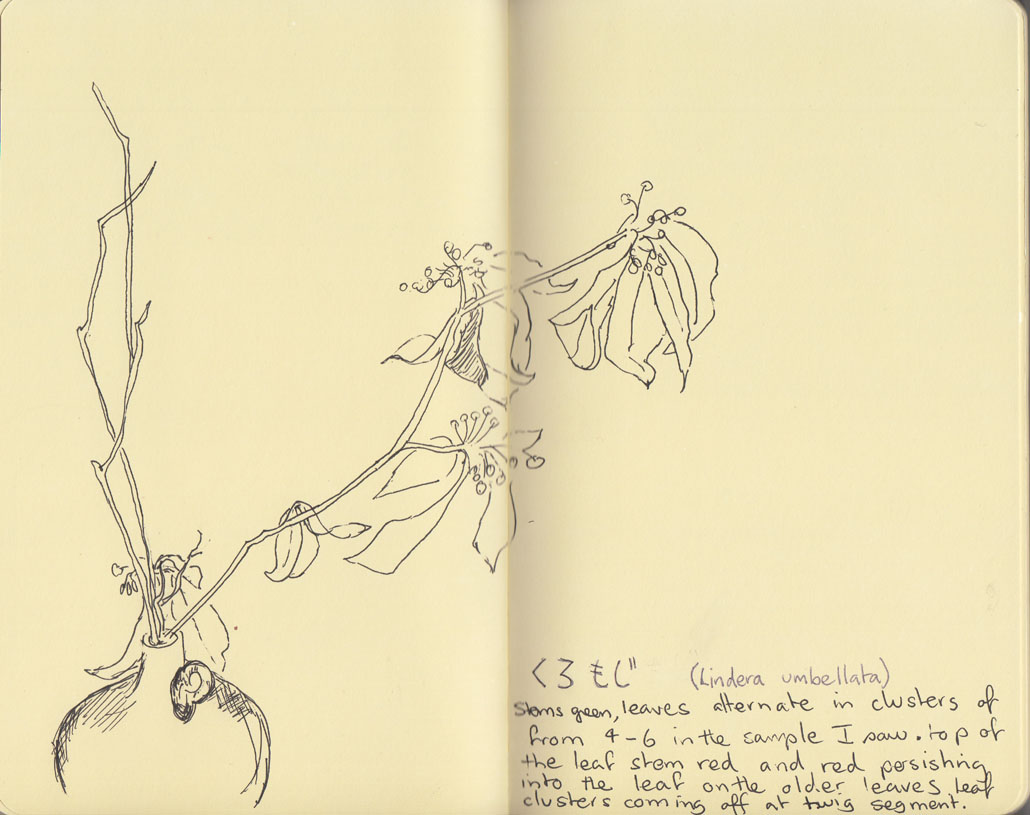
Kuro moji, (Lindera umbellata), 18  April 2014.

Kuro moji, (Lindera umbellata), 18 April 2014.

We were in Kanazawa at the absolute peak of the cherry blossom season. We visited Kenroku-en, the magnificent garden in the centre of the city.

A wedding party under the sakura (cherry blossom) at Kenroku-en garden, Kanazawa, Japan

A wedding party under the sakura (cherry blossom) at Kenroku-en garden, Kanazawa, Japan

Our first visit was with our class so there was no time to draw. Two weeks later I returned to the park to draw. The cherry blossom was all gone. Instead, I drew my favourite section of the garden, a meandering stream that is lined with irises and azaleas, under a canopy of cherry trees.
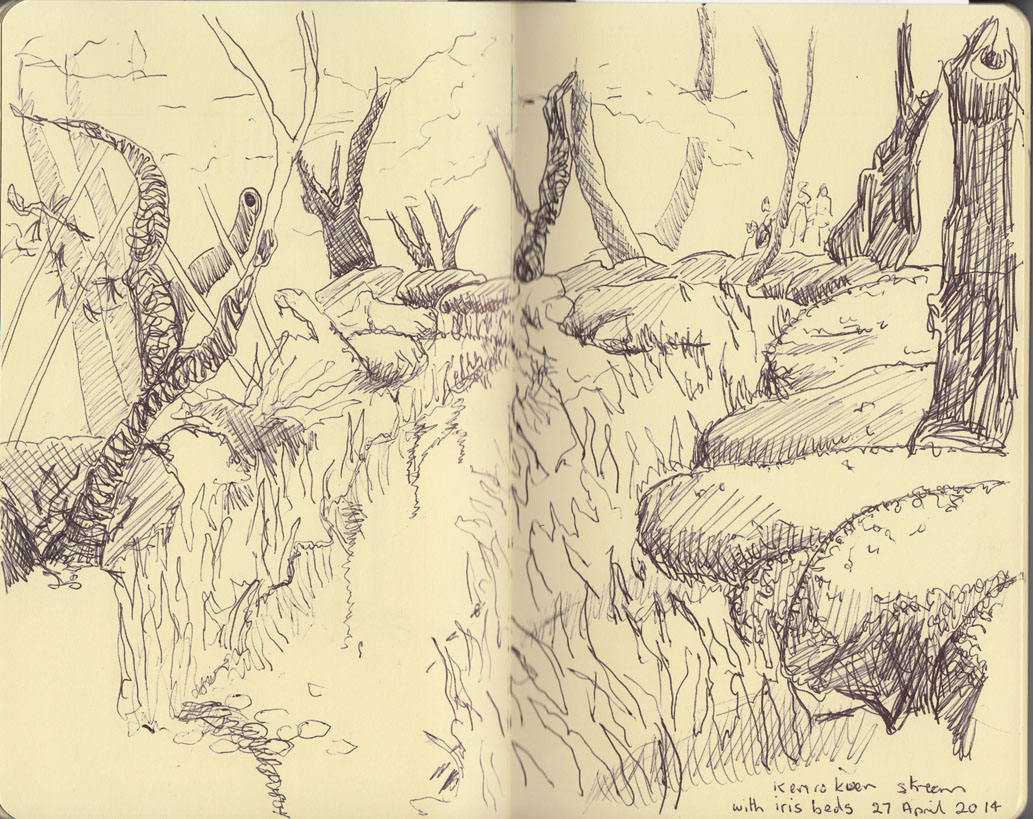
Kenroku-en, stream with iris and azaleas, 27 April 2014

Kenroku-en, stream with iris and azaleas, 27 April 2014

I would have loved to have been able to stay on a few more weeks in Kanazawa to see the iris in bloom. The best I can do is give you a link to some photos of how good it can look.
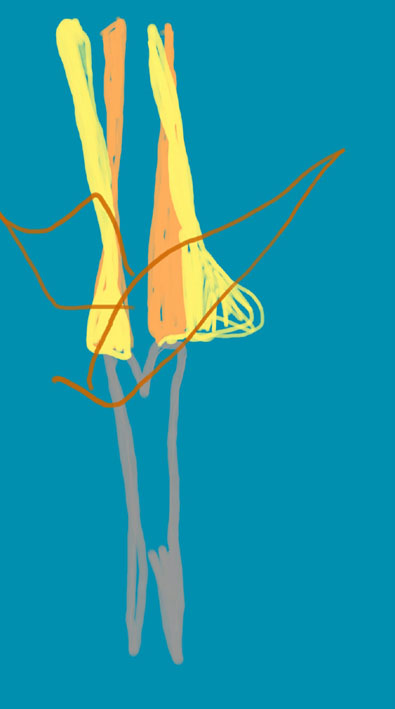
E-drawing, the moon clouds and angels wings

This week I’m trying to get back into drawing mode. You wouldn’t think it would be difficult after my holiday when I drew virtually every day. However I seem to  find it very easy to be distracted by daily life.

Angel Wings, Phil Price, 2008, exploring the interaction of wind and the structure.

Angel Wings, Phil Price, 2008, exploring the interaction of wind and the structure.

I started with a challenge, to draw the kinetic sculpture, ‘Angel Wings’, 2008, by the New Zealand artist Phil Price. OK it was a a bit of an ask to draw a sculpture that was moving in the breeze. I had my phablet with me, so I drew in Photoshop Touch. The time I spent watching the sculpture move in dips and unexpected angles around it’s gimbels was quite mesmerising.

The next day also involved drawing movement, thankfully a bit slower. In the mid morning a half moon was sitting behind a foreground of high cloud and airplane contrails. Once again I used the Photoshop Touch program to do myo drawings.

Moon cloud and contrails, 22 May 2014.

Moon cloud and contrails, 22 May 2014.

I did a second drawing as the clouds moved and the contrail dipersed.

Moon, clouds and contrail, 22 May 2014.

Moon, clouds and contrail, 22 May 2014.

Images of Koyasan, Part 2

The town of Koyasan can be roughly divided into two main areas. To the east is the Okunoin, a large cemetery and temple complex where thousands of grave markers and memorials are located. Perhaps the most dominant style of memorial marker is the Gorinto (Five-tiered stupa). The shapes of the tiers represent the five elements, from the bottom up earth, water, fire, wind and space.

A set of 3 gorintos in the Okunoin, Koyasan, Japan.

A set of 3 gorintos in the Okunoin, Koyasan, Japan.

At the other end of the town is the Dai Garan where the main temple complex is located along with many other temples and monuments.

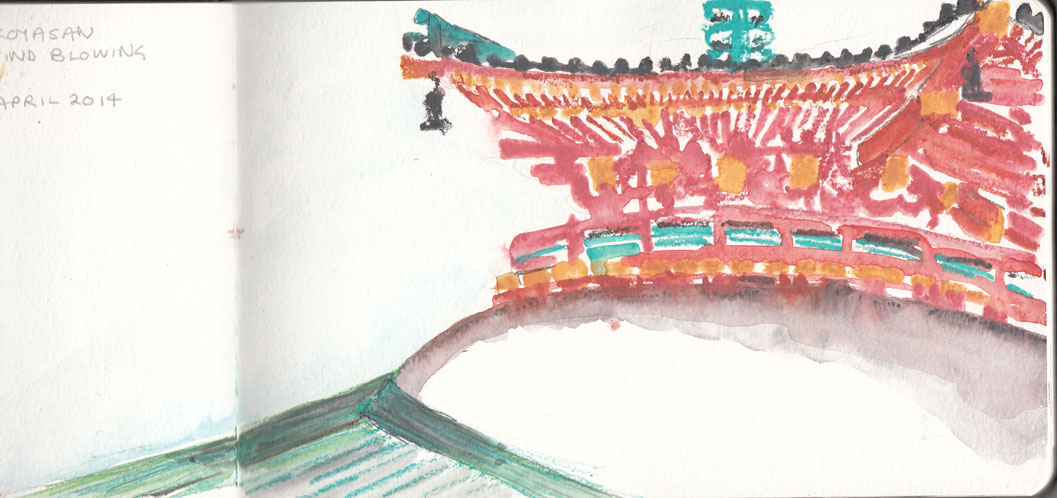
The centre of the main temple complex is the Konpon Daito or Great Pagoda. I sat painting a section of this temple in the chilly morning air, accompanied once more by the sounds of chanting coming from the Kondo or Main Hall.

Part of the dome of the Konpon Daito, Great Pagoda, Koyasan, Japan

Part of the dome of the Konpon Daito, Great Pagoda, Koyasan, Japan

This area of the town is also the home of other major buildings such as the Kongobugi Temple. The rooms of this temple are decorated, in a variety of styles, illustrating the life of Kobo Daishi (the founder of the Shingon sect). Not only were you not allowed to take photos, the signs also specifically forbade sketching. This is what I recall of one room in a series that illustrated the four seasons. This room depicted autumn; yellow and orange maple leaves fell down against a backdrop of gold leaf, a striking deep blue stream ran through the background (this is not included in my version).

Recollections of the 'Autumn' room in the Betsuden, Kongobuji Temple, Koyasan, Japan

Recollections of the ‘Autumn’ room in the Betsuden, Kongobuji Temple, Koyasan, Japan

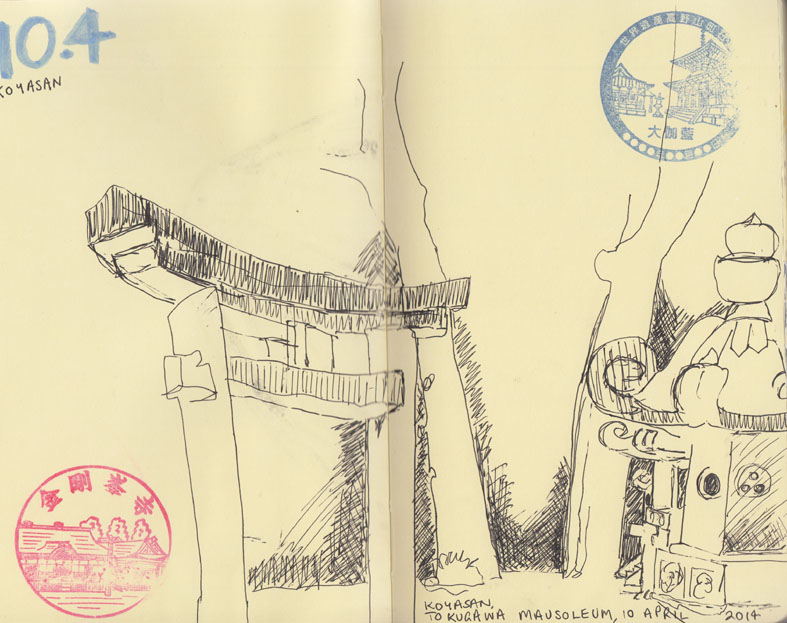
We also visited the Mausoleum of Tokugawa Ieyasu and Tokugawa Hidetada, the first and second Japanese Shoguns. From what I understand this mausoleum contains the ‘spirits’ rather than the physical remains of the shoguns. Here visitors have to content themselves with admiring the elaborate wooden carvings that grace the exteriors of the two small buildings. Views of the gold-painted interiors are restricted to glimpses in the official brochure. I enjoyed the late afternoon quiet and drew this view of the torii gate at the entrance to the mausoleums. The stamps are available at many tourist attractions, so I’ve incorporated them into my page.

Torii gate at the entrance to the Tokugawa Mausoleum, Koyasan, Japan

Torii gate at the entrance to the Tokugawa Mausoleum, Koyasan, Japan


Images of Koyasan, Part 1

Well I’m back from a great trip to Japan so I can now upload some of the sketches I made while I was there. For the most part I managed to keep to my challenge of drawing something everyday, whether in my diary/sketchbook or an e-drawing on my phablet. I’ll bring you the drawings in several chunks.

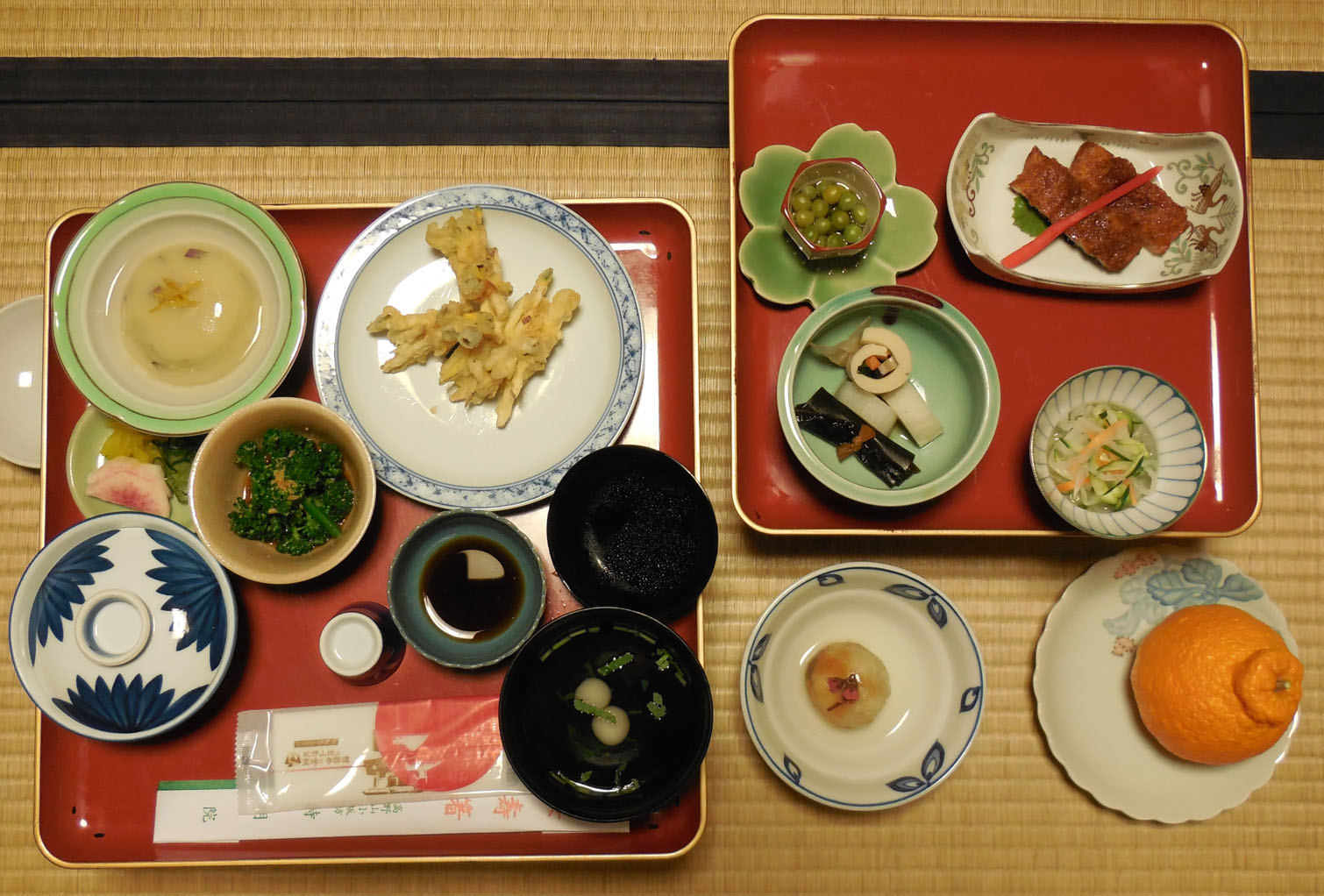
Today I’m starting with images from the mountain town of Koyasan. This town is a religious centre for the Buddhist Shingon sect.  The main form of accommodation in town is at hostels run by the various monastic temples. The main drawcard to this type of accommodation is the vegetarian cooking that is prepared for guests. Believe me when I say that this food is not a form of abstinence (well apart from not eating meat). Here is a sample of one evening meal, for one person.

Dinner for one at the Jimyoin monastery, Koyasan, Japan

Dinner for one at the Jimyoin monastery, Koyasan, Japan

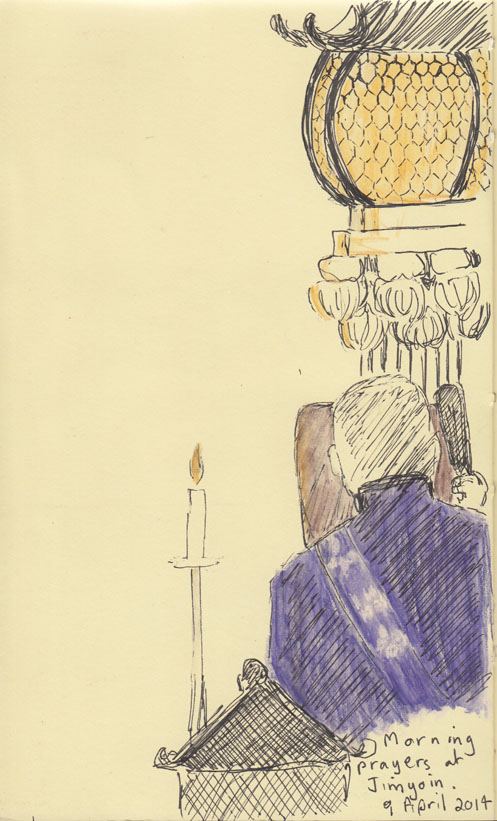
Guests, whether Buddhists or not, are invited to attend morning prayers in the temple. Prayers are led by the head priest, who is supported by other ordained priests. It was half an hour of chanting in a darkened space, lit only by candles, a time of focus and being present.

I thought it was also a perfect opportunity to practice fixing an image in my mind. This drawing was made after I returned to my room for breakfast. The first morning I was seated directly behind the head priest. The priest is marking the prayers with the ringing of a bronze bowl.

The head priest at the the Jimyoin Monastery, Koyasan, Japan

The head priest at the the Jimyoin Monastery, Koyasan, Japan

Two days later I drew another part of the temple furniture, in this case a cabinet containing images of the Buddha.

A cabinet containing images of the Buddha, Jimyoin Monastery, Koyasan, Japan

A cabinet containing images of the Buddha,
Jimyoin Monastery, Koyasan, Japan

Tokyo sketches

I realised I hadn’t done any sketches recently, so today I managed several quick drawings. All were done on my ‘phablet’. I have also been drawing in my travel diary but I have no easy way of posting those images yet.
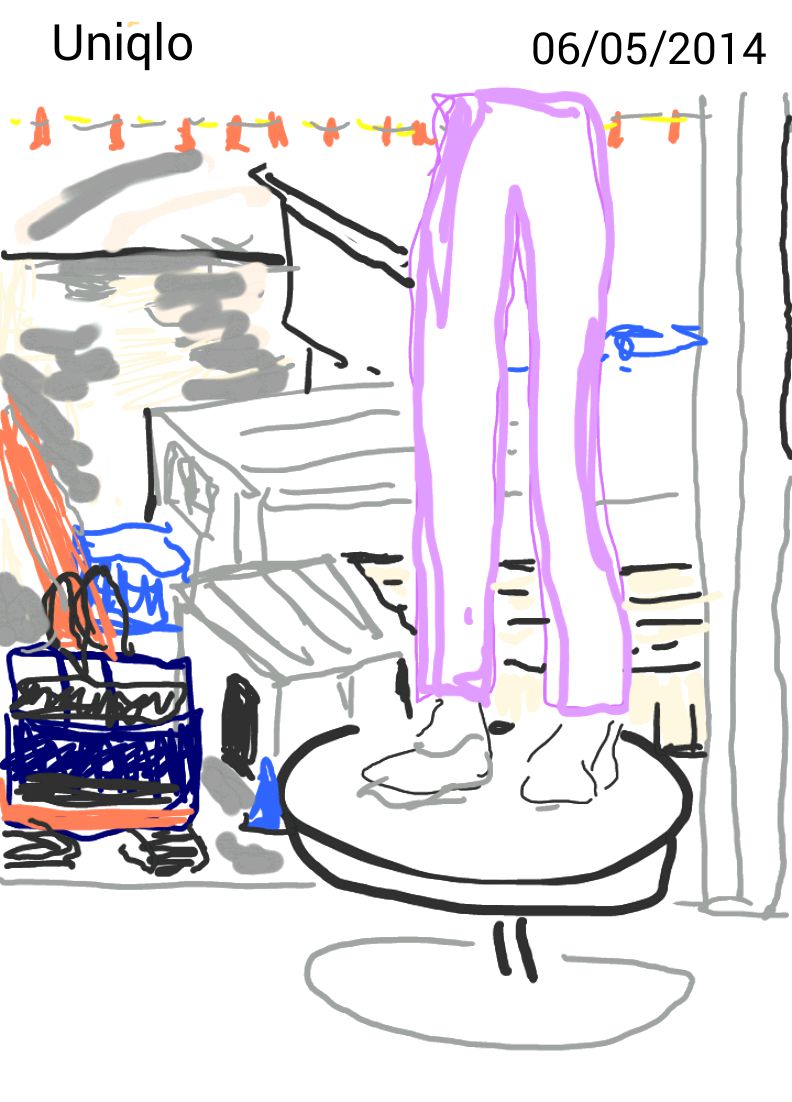
First up a view out of the window of the popular clothing shop Uniqlo, in Ginza, looking down to a construction site next door.

image

Past the clothing display down to the construction site

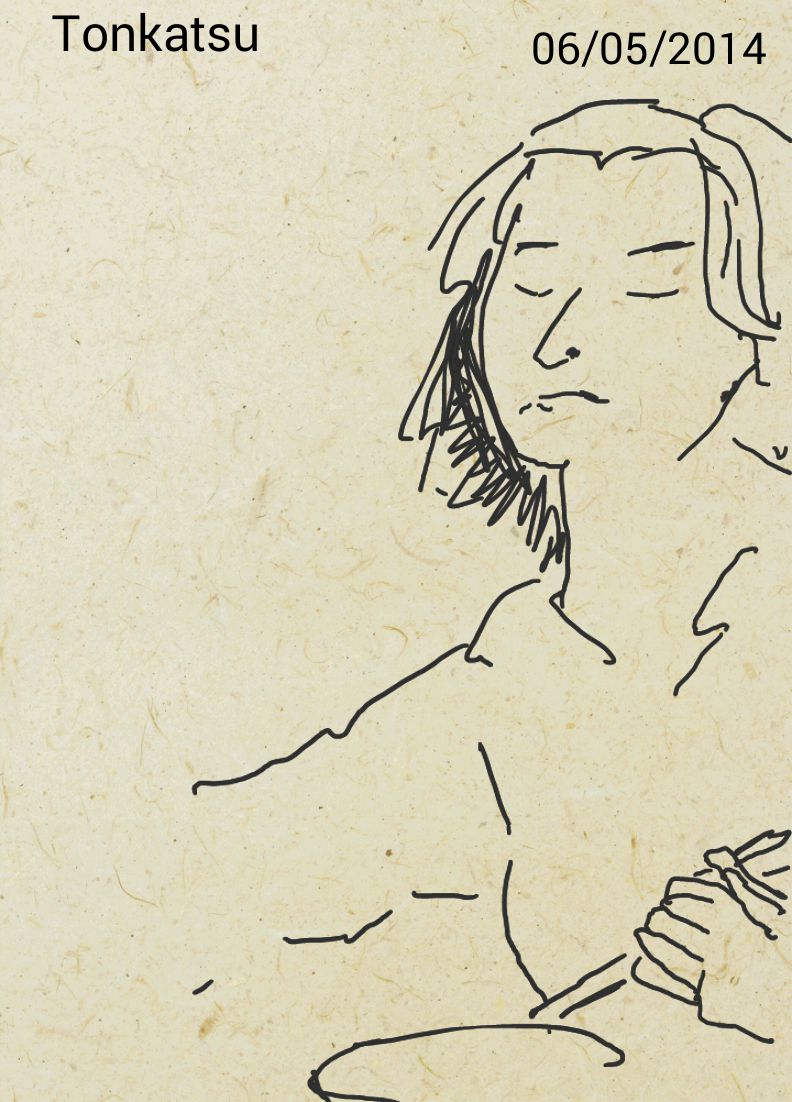
The next was a man sitting across from us when we were having lunch. And as a random piece of trivia, Muhammed Ali ate at this same tiny restaurant in 1972.

image

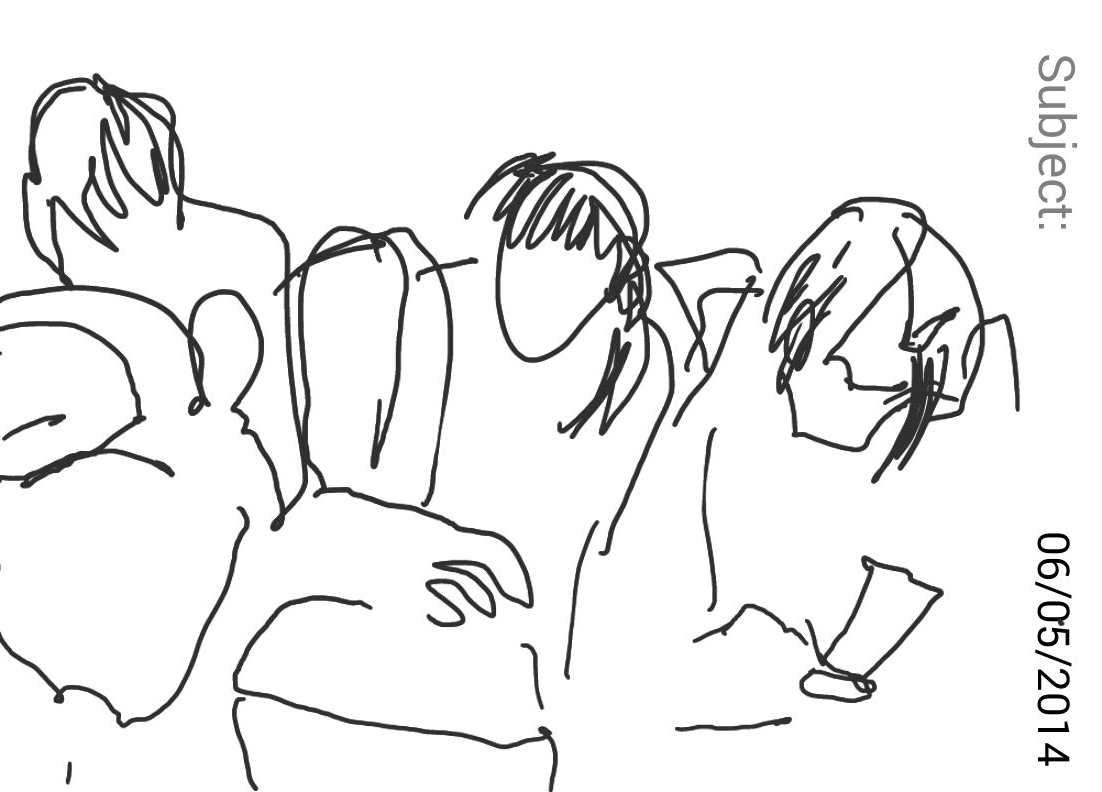
On the way back to our accommodation, something we see everyday, people asleep on the train.

image

I will upload more of my holiday sketches when I get back home and can scan them properly.