Last night we had another session with our friends online and I made one of my random collages. There’s no rhyme or reason to how I put these things together.
A magazine collaging itself! A composite image from a series of pages where I have already cut things out.
I’m working from scraps of magazines that have already been cutting up and that are literally lying around on my desk. So nothing particularly planned. Just trying to work with what I have, and trying to make it succeed.
My one hour collage.
Whether that’s happened on not I don’t know. I think just even doing this on a regular basis is the sort of thing that’s exercising those artistic muscles, playing, which is what we all need to do to make our art better.
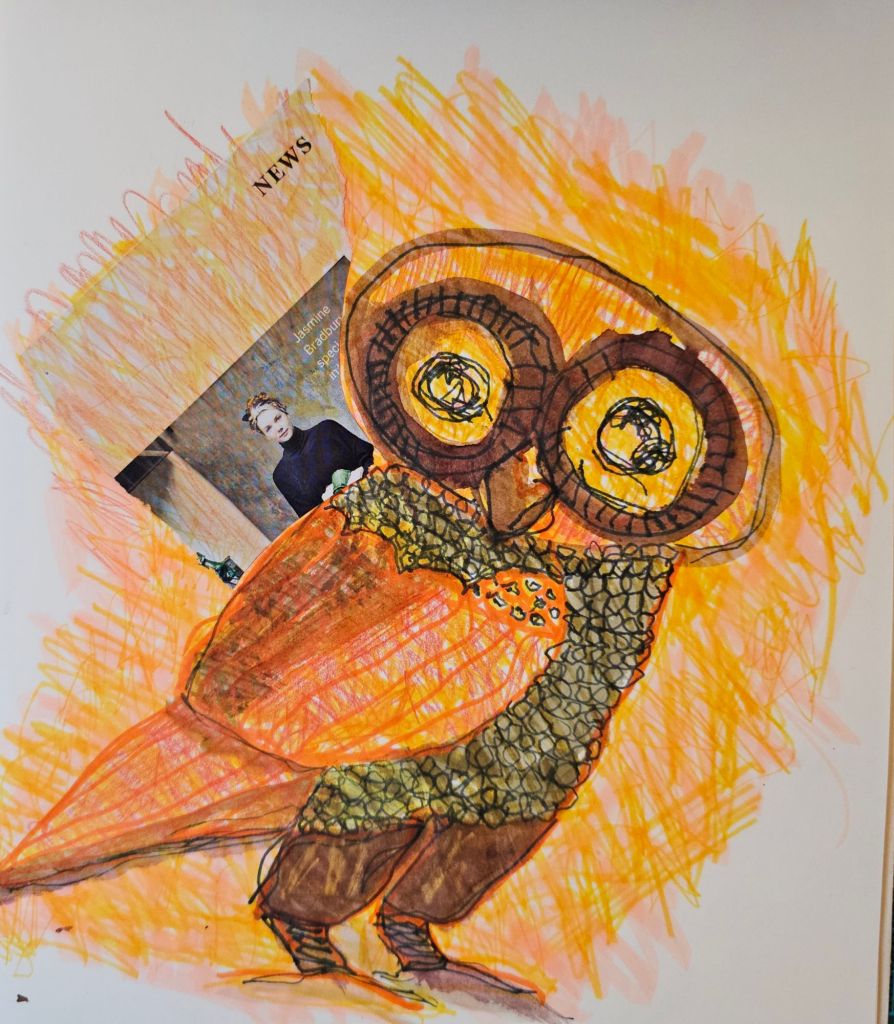
I was about to start a drawing session with friends when I accidently got in the way of some steam from the kettle – burning my hand in the process (thankfully not a major burn). It was enough to drive me to use my other hand to draw with while my dominant hand stayed wrapped in a cool damp cloth
I just picked from a variety of markers and pencils already on my table and one of my fountain pens.
Markers, coloured pencil and fountain pen with collage
I really like the result! Nothing too fussy. My inspiration was this replica of a Roman Owl brooch that was found in the city of Bath in the UK. I didn’t resist adding a touch of collage when I found this tiny scrap on my table as well.
A copy of a sacrifice to the goddess Sulis-Minerva
Today we met up with friends to explore the site of the former Honeysuckle Creek Tracking Station where the first pictures of Neil Armstrong and Buzz Aldrin walking on the Moon were transmitted to the rest of the world. (Yeah-nah, not ‘the Dish’ at Parkes).
The infrastructure is largely gone, but there is now a set of information panels and a series of sculptural elements by Canberra sculptor Michael Harding.
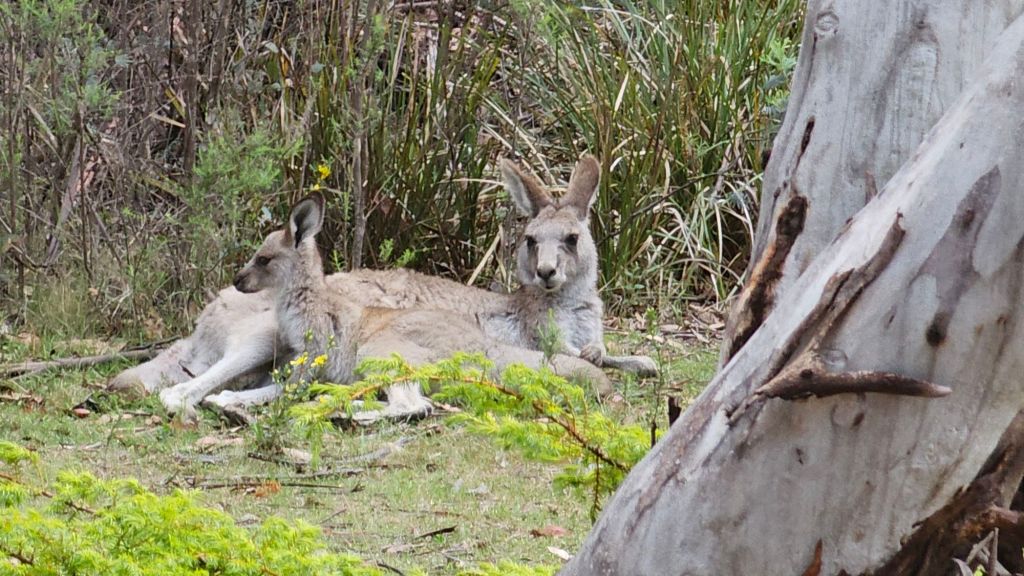
The site of the former Honeysuckle Creek tracking station.Other locals out enjoying the day!
Our intention had been to sketch on site, but it didn’t happen. We went prepared to BBQ our lunch only to discover that the gas in the BBQs had run out.
In the end we drove back to the Ranger Station and cooked our meal there. While not quite the view I was planning I did complete a sketch of the nearby rural landscape.
Tharwa Landscape
This is the first sketch in my new sketchbook. So you could say “one small sketch” (sorry that’s so lame).
[This post was originally written on 15 September, but for some reason I forgot to post it. Oops.]
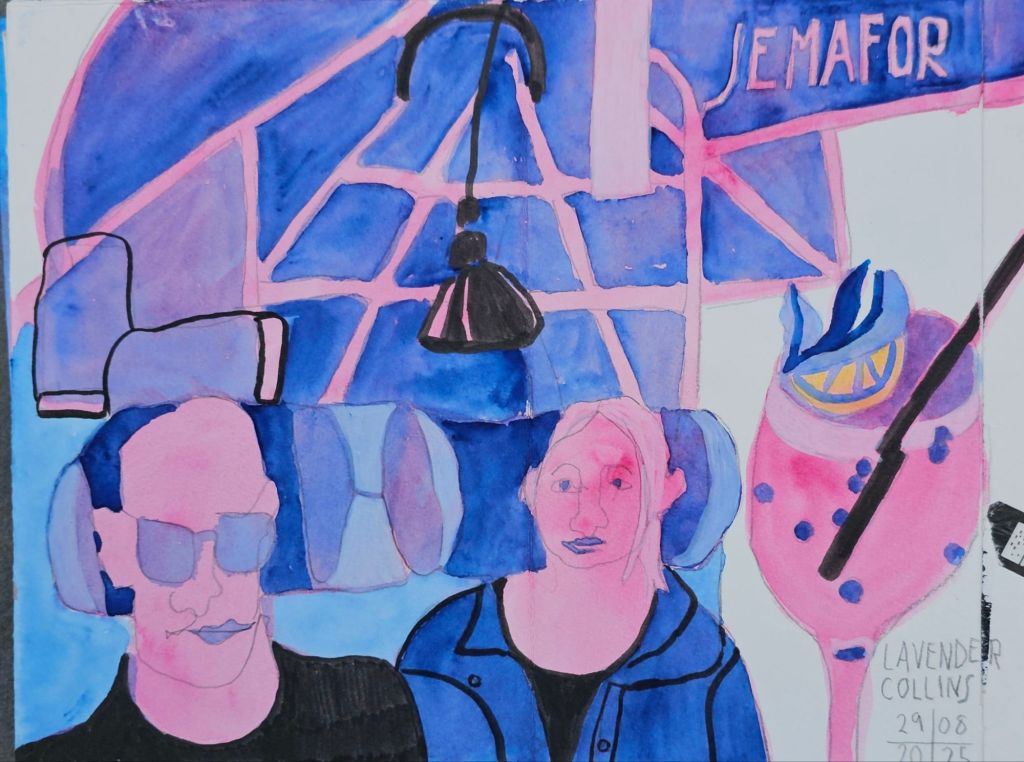
I recently went to the Urban Sketchers Symposium in Poznan, where I did a workshop with French artist Olivia Markus. She was teaching, amongst other things, an interesting approach to colouring sketches. The point of which, in part, was to reinforce a sense of depth of field in your sketch.
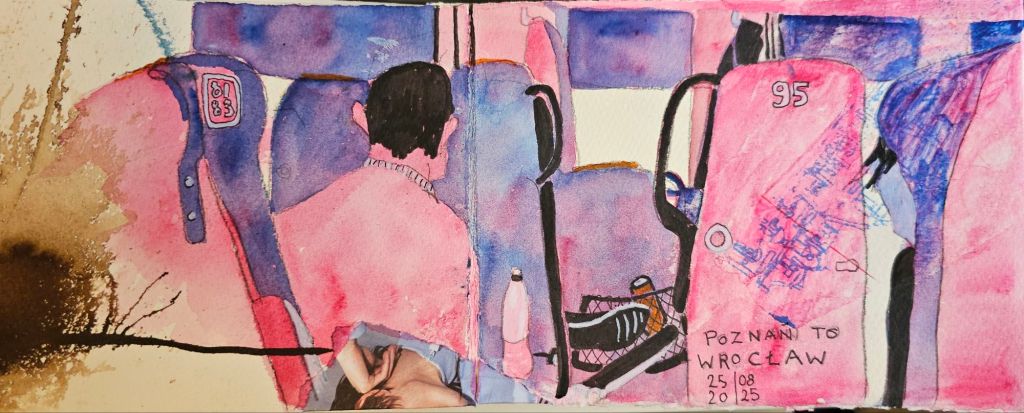
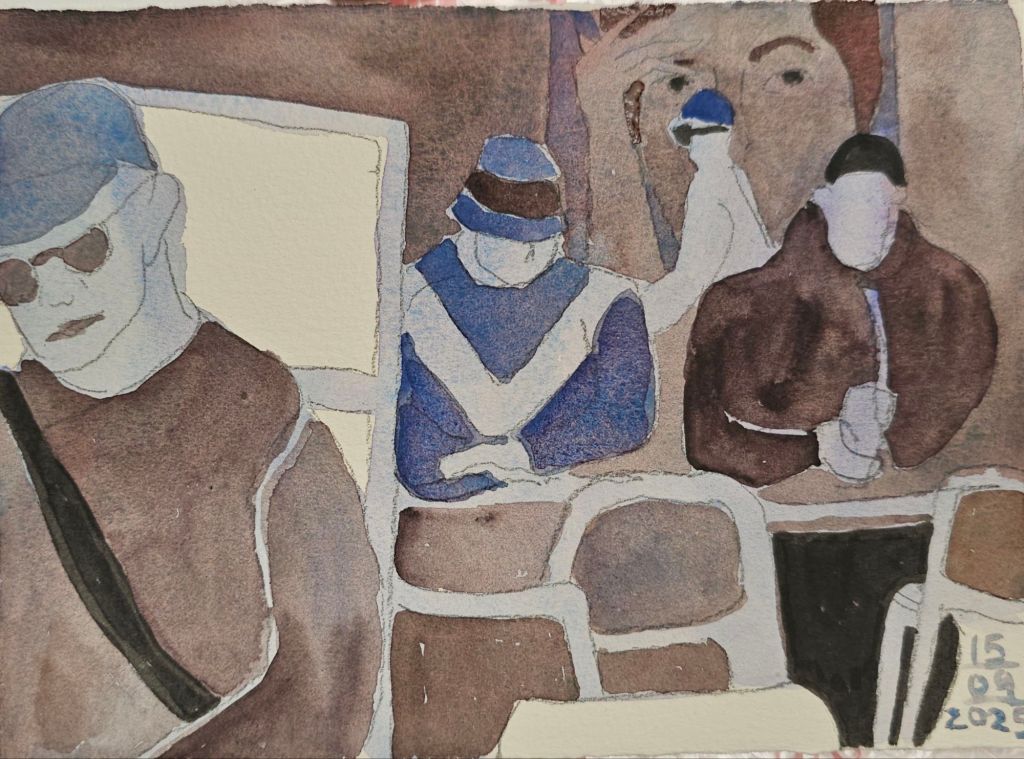
Two sketches I made at the Symposium
I think the simplified colour choices deliver exciting results. Of course, they also challenge your use of tonal contrast. So far, I’ve mainly used them for scenes with people in them. The limited colour selection imposes a unity, which is often missing from my regular sketches.
Now, I’m taking the next steps of testing out what I learned and then trying to integrate the process into my practice.
Evening moods in Wrocław On the train from Wrocław to Prague
I use watercolour as my main medium, so that does yield different results to the inks that Marcus uses. To be fair, I really haven’t tried the process with ink yet.
Demonstration in support of Palestine, London
I’m also experimenting with which colour combinations work most effectively together.
I find the stark black pen a bit strong, and it tends to overwhelm the watercolour’s subtle tones. Lately, I have been using less black, instead choosing to use a more intense pigment.
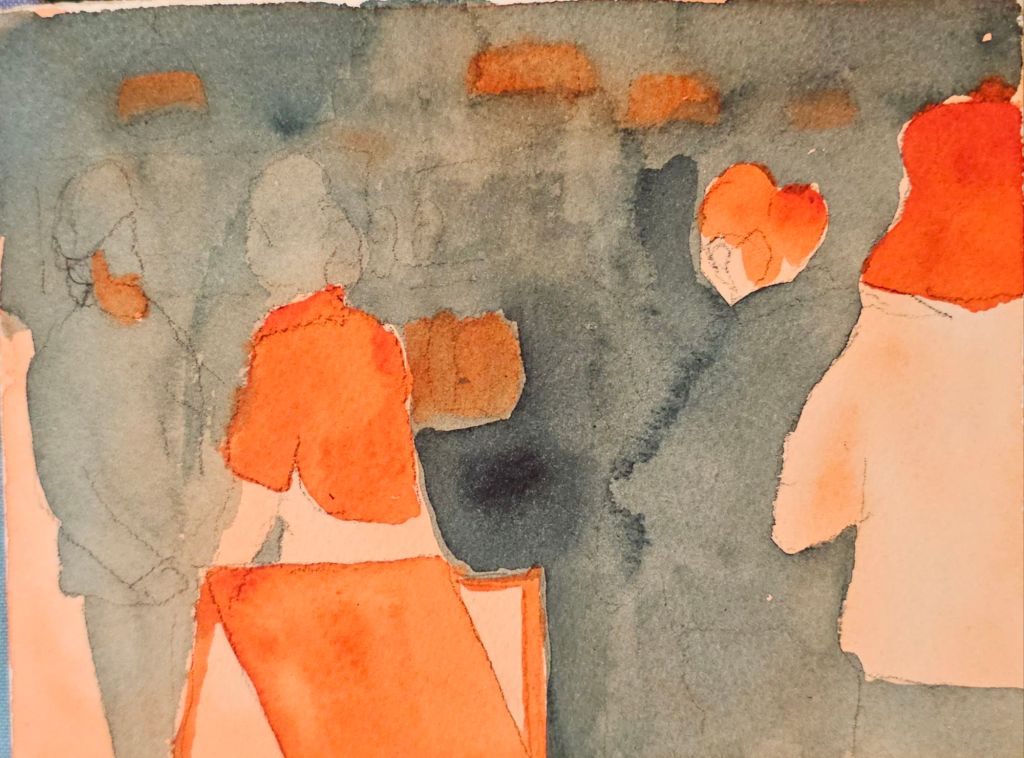
Friday, queues at the coffee shop, first version The final version with black and white marker bring added.
I’m still ‘not there’ yet in terms of the outcomes, but as today’s sketch show, there is some progress.
Every weekend we have a Zoom call with some fellow artists in the UK. We meet for an hour to make art and chat. We started this during COVID, so its great that we continue to meet, both online, and now twice in person.
One of the sides, in book form
There’s no program, other than what we feel like doing. Before we start there’s always a discussion about what we will do tonight (our time).
The other side, in book form
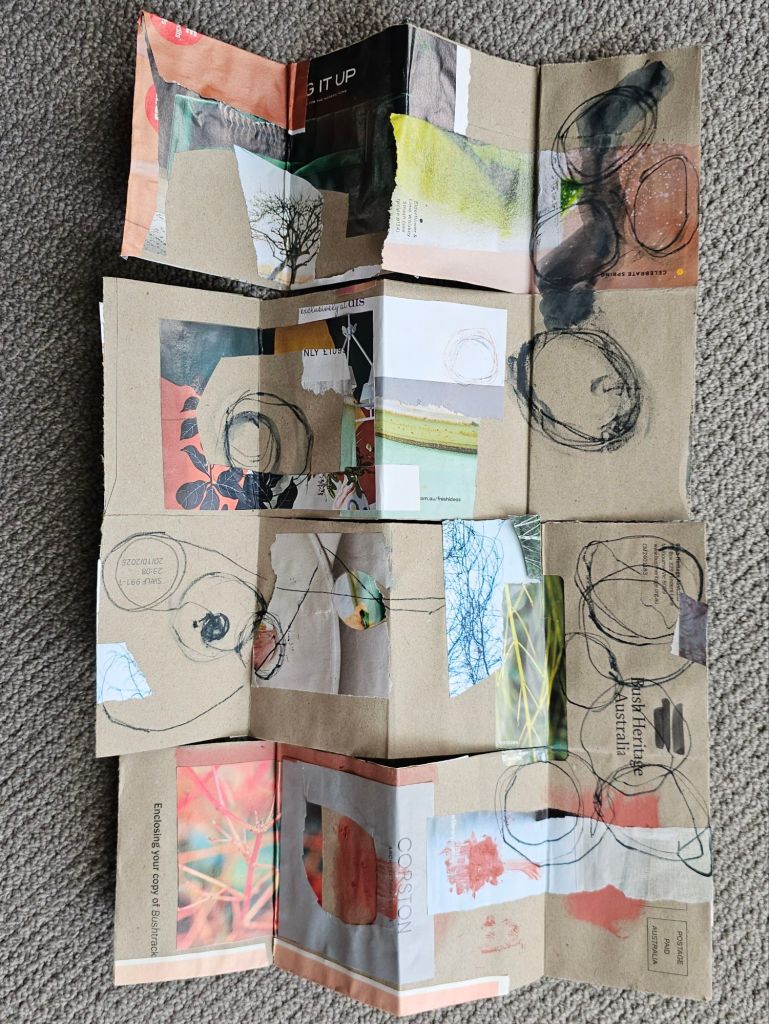
I went back to some collage yesterday. I found a large envelope that I decided to turn into a small ‘maze’ book. Having cut the basic shape I started applying very random collage and marks.
One side as collaged
In the end it did take more than our one hour to complete, but by thar stage I was so engaged in the process that I kept going until I was done.
The other side as collage
For the first time in quite a few months I felt the stirrings of excitement, the potential to make new work. I can see several ways to proceed. While it is a ‘work’ in itself I see the possibility of using it as a springboard to new pieces, where they draw on the colours and marks in the book. There’s also the potential to work directly back into the book itself.
Random abstract collageMarks made with watercolour pencilsThere are endless options to work from