Unknown's avatar

Posts by Leonie Andrews

I am an artist of the landscape of common objects. Discarded items and suburban life fuel my art practice.

… and other animals

No rest for the wicked. Today’s outing was to the National Zoo and Aquarium, which I’m rather embarrassed to admit that I had never visited in all my years of living in this city. We went armed with sketchbooks and plenty of enthusiasm to try and draw some of the animals we saw. After having a lot of fun with the quick watercolour sketch at the beach I thought that it was probably a good approach to try with the animals, which I assumed would be unlikely to be sitting still for very long.

At first we wondered whether there were any animals to see. The Snow Leopards were hiding so effectively that no one could spot them and ditto for the next few cages we looked into. At least we did see the recently arrived hyenas. The Black Capuchins (Sapajus nigritus) were more obliging and after a false start so too were the Bolivian Squirrel Monkeys (Saimiri boliviensis), who decided to come out for a play. I’d never seen a yellow monkey before! And yes, the colour I’ve used in my drawing is a close match for their fur. They are quite small, extremely agile and quite entrancing to watch.

The Bolivian Squirrel Monkey

The Bolivian Squirrel Monkey, watercolour and pencil, 9 January 2015

We decided to keep moving. On to the White lions and then the Sumatran Tigers. We were watching the female Sumatran Tiger, who is at the zoo with a view to a future mating with the male in the cage next to hers. We saw her walking back and forth in the one spot, never a good sign for a captive animal, until we realised she could see two small children who were playing on the nearby path! Once the parents had collected the children, oblivious to the tiger’s interest, the tiger moved off quite happily to other parts of her large enclosure. I was also quite excited, although that’s probably not the best way of expressing it, to see the tiger scent-marking one of the trees in her area.

Moving from the large and back to the small we stopped to draw the Little Penguins. The little penguin (Eudyptula minor) is the smallest species of penguin growing to an average of 33 cm (13 in) in height and 43 cm (17 in) in length. Apparently it’s no longer ‘kosher’ to call them Fairy Penguins, which is how I always knew them as a child. Their long, very clear pool, is built so you can lean right over to see them rocketing up and down its length. Great for drawing!
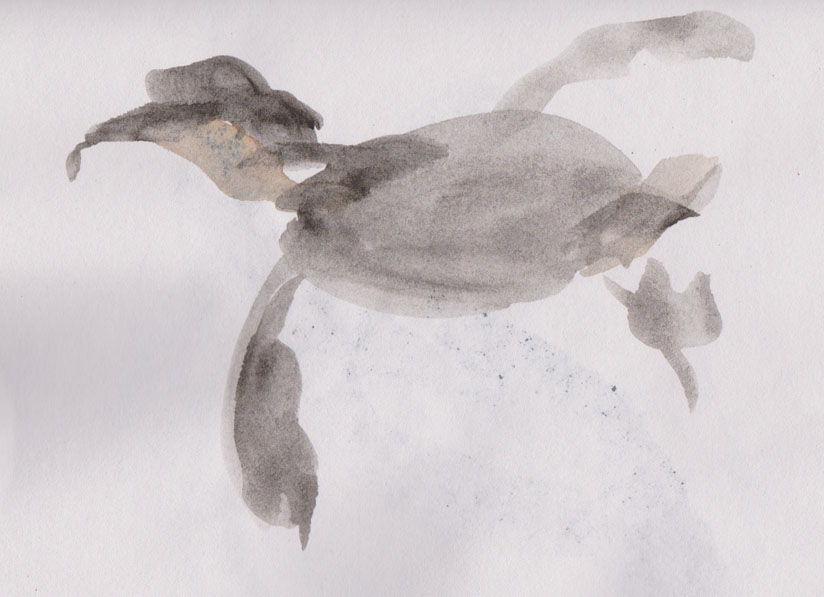
A Little Penguin floating by, watercolour, 9 January 2015

A Little Penguin floating by, watercolour, 9 January 2015

The other feature of these birds, just to pick one, is their colouring, which up close is distinctively a deep slatey-blue, hence yet another common name for them as the Blue Penguin. This particular animal had a white patch on the end of both it’s flippers and a whitish head.

The Little Penguin, AKA, the Blue Penguin, AKA the Fairy Penguin, watercolour, 9 January 2015

The Little Penguin, AKA, the Blue Penguin, AKA the Fairy Penguin, watercolour, 9 January 2015

Near the penguins were another animal I find quite fascinating, the Goodfellows Tree Kangaroo (Dendrolagus goodfellowi). It seems like a contradiction in terms but these are basically tree dwelling kangaroos. This species comes from the New Guinea rainforests, as do the majority of these odd-looking beasts. To combat the heat of the day their pens had very fine sprays of water, which also cooled the air for passing visitors. The first animal I drew was sitting inside a hutch, up a pole, along with another Tree Kangaroo, with it’s back resting along one wall.

Quite relaxed, a Goodfellows Tree Kangaroo, watercolour, 9 January 2015

Quite relaxed, a Goodfellows Tree Kangaroo, watercolour, 9 January 2015

In this case there is a discrepancy in the colours I’ve used. While the majority of the fur is chestnut red, with paler yellow ochre areas, I didn’t have the intense dark brown that characterised the darker areas on the animal’s forearms and legs and the wide stripe down its back. When the animal moved I took the opportunity to try for a tail sketch. Again its a combination of the chestnut and pale ochre in a blotchy sort of pattern. I really need to work out how to get the texture of the tail fur, which reminded me of the fur wrap in Ingres painting of Mademoiselle Caroline Riviere.

Mademoiselle Caroline Riviere, 1806, Jean Ingres, Oil on canvas, 27 3⁄8 × 27 1⁄2 inches. The Louvre, Paris

Moving on to another elegant neck, my final sketching subject of the day was the zoo’s Giraffe (Giraffa camelopardalis), who was temporarily under house arrest while waiting for some training by the keepers. The upside of this, from a drawing perspective, was that he was in one space rather than moving all over his enclosure and that space was fairly close to where we could sit and draw. He also seemed interested in having some visitors to watch while he was waiting.

There is no doubt that the head of a giraffe is more unusual than you might imagine. Can you see the head in your mind’s eye? Not only does a giraffe have two ‘horns’, or more correctly ossicones, on the top of its head, being a male this giraffe also had a well developed medium lump on the front of its skull – who’d a thought it! Luckily he was happy to demonstrate the flexibility of his lovely neck (unless you are being whacked by it).
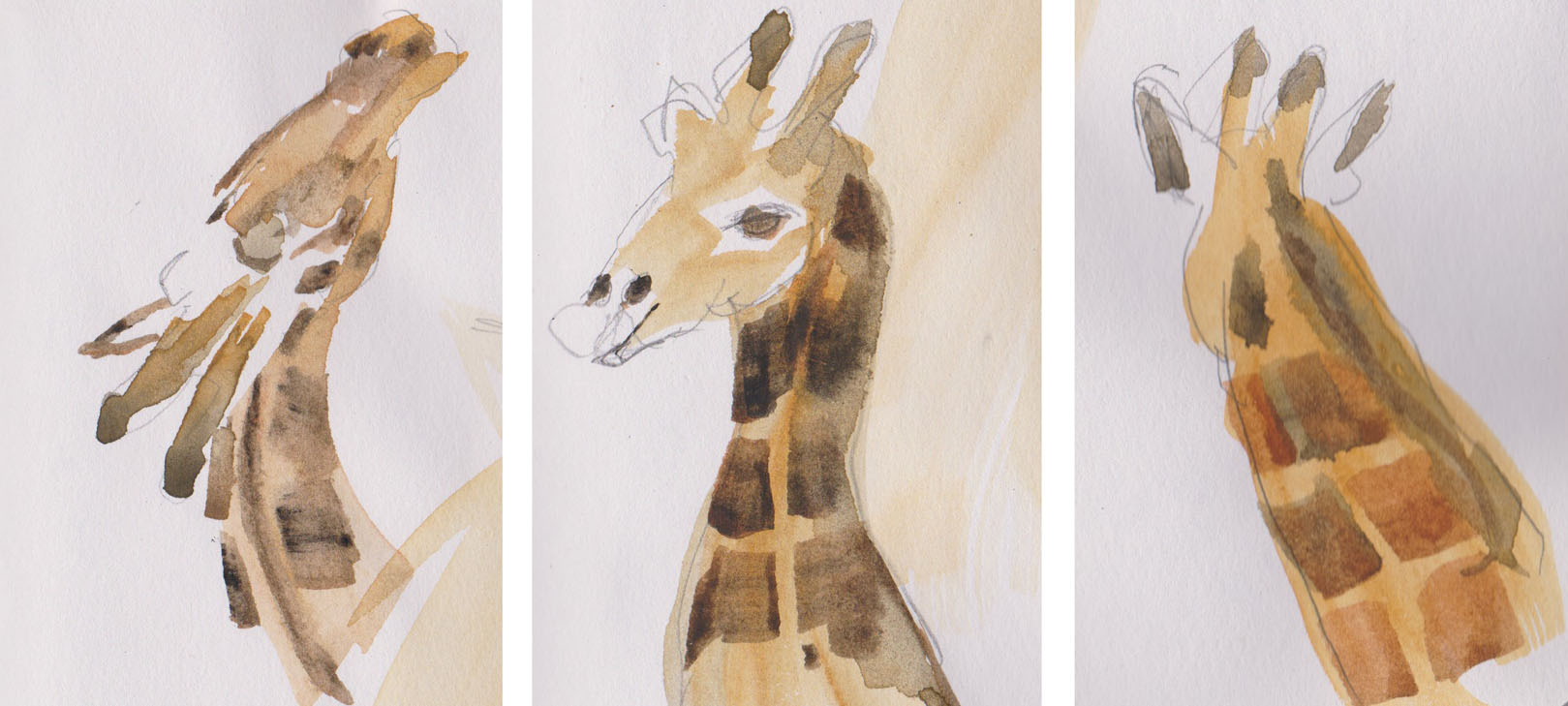
Look at me, look at me, giraffe, watercolour and pencil, 9 January 2105

Look at me, look at me, giraffe, watercolour and pencil, 9 January 2105

I found drawing the animal’s head was a challenge. It’s a wedge shape which appears way too wide at top for the overall length of the head and the very narrow, chisel shaped lips designed for grasping at leaves and other food. In fact it was so hard to draw that I had to excise one drawing which appeared to demonstrate a direct anatomical link between the giraffe and the Loch Ness monster. Not flattering to the giraffe at all.

In all we spent over 4 hours at the zoo and I can see that this is yet another fascinating place to visit, for the purposes of drawing. I’m really pleased that the Zoo has a Friends of the Zoo membership so I will be encouraged to go back whenever I like.

By the sea, by the sea …

We spent yesterday at at Surf Beach near Bateman’s Bay, on the NSW South Coast, just under two hours drive from Canberra. It was our first official swim of the summer and we plan to make a few more trips over the coming weeks.

Because we like to maximise the amount of time we spend on the beach we always take our beach shelter/tent thingy, otherwise known as the ‘Sand Palace’. This allows us plenty of shade to retreat to between swims and, as I discovered, makes an excellent place from which to sketch your fellow beach-goers without being too obvious about it. Luckily for me I’d recently re-read Lynne Chapman’s post on some of the classes she’d done at the 2013 USk symposium in Barcelona which included some great suggestions for quickly capturing people (in a drawing that is). To quote from Lynne

“… if you want to catch someone’s brief pose, you can use watercolour, just one colour, to quickly capture the main shape, then use a watercolour pencil to add just enough line to pick out details, while the paint is still wet.”

It all sounded so easy until I put my brush to the page. My first few attempts were dodgy to say the least, but I did like the umbrella, fluttering in the breeze.

First attempts at capturing quick sketches of people and an umbrella, watercolour and pencil, 8 January 2015

First attempts at capturing quick sketches of people and an umbrella, watercolour and pencil, 8 January 2015

OK moving right along, I started my second page. I seemed to be getting the hang of it. This time I quite like some of the figures. I have however, cropped the page, thereby sparing you from one of the most heinous landscapes I’ve painted in recent times.

Second page, some better results. Watercolour and pencil, 8 January 2015

Second page, some better results. Watercolour and pencil, 8 January 2015

By my third page I felt I was starting to get the hang of the process. I’ll keep working on this approach as it yields good results.

Some fun images including people carrying inner tubes and the beach flags, watercolour and pencil, 8 January 2015

Some fun images including people carrying inner tubes and the beach flags, watercolour and pencil, 8 January 2015

After Afghanistan

One of the reasons we went to the Australian War Memorial last week was to see the current exhibition of paintings by Ben Quilty, an official war artist who went to Afghanistan in 2011. To quote from the AWM website “Quilty has created large-scale portraits that focus on the intense physicality of these soldiers and on the emotional and psychological consequences of their service.”

After Afghanistan

After Afghanistan

These works display Quilty’s characteristic large slashes of paint and this completely ‘works’ with the intensity of his subject matter.

Three portraits of Air Commodore John Oddie, Ben Quilty

Three portraits of Air Commodore John Oddie, Ben Quilty

What is quite unusual is that Quilty asked the men and women who sat for their portraits to pose naked, to show what the body is like after it is stripped of its uniform and body armour. They were also asked “to select a pose that reflected an aspect of his or her experience. Some of them drew on an actual event from their deployment, others on the tiredness or the emotions they felt after their return to Australia”. The results are dramatic and almost emotionally too intimate in their outcome.

Trooper M, After Afghanistan, Ben Quilty

Trooper M, After Afghanistan, Ben Quilty

Given the intensity of these works it came as some relief to be able to step backwards and look at some of the sketches that Quilty made during his actual time in Afghanistan, including these two.

Ben Quilty, sketches made in Afghanistan

Ben Quilty, sketches made in Afghanistan

As a sketcher I’m always interested in seeing what other artists draw. I also think that these straightforward works are a great tonic for many people I meet who, when starting to sketch, are overcome by the feeling that their drawings aren’t ‘good enough’ and are consequently of little value. Quilty shows that drawings don’t have to be massively refined to be effective. It’s enough to capture what is of interest to you.

PS please excuse the poor colour quality, as these were taken without flash. More colour-accurate versions of this exhibition can be found at Ben Quilty’s website.


St John’s Church, Reid

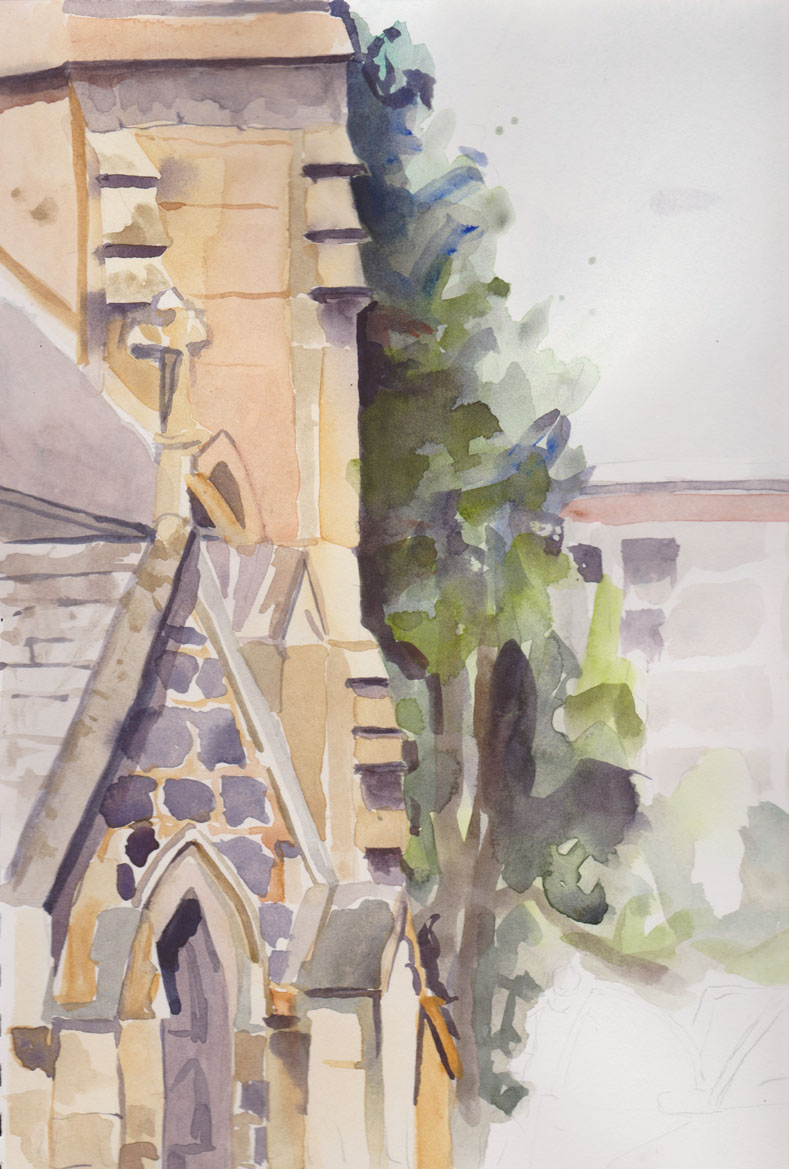
St John’s Church (or more correctly the Anglican Church of St John the Baptist), was consecrated in 1845, making it the oldest building the in area of Canberra city, (the city didn’t really take off until the decision was taken to make it the site of the national capital in 1908). The church and the associated school house are listed on the Register of the National Estate.

The view of my painting is of the northern side of the church (built between 1841-45) towards the spire (which was demolished and then rebuilt between 1865-70). The sandstone for the main part of the church was quarried from Black Mountain and also near the current suburb of Yarralumla. The side chapel, is built in the local ‘bluestone’ (or Dacitic ignimbrite to be geologically accurate), from nearby Mt Pleasant.

St John's Church, Canberra, from the northern side looking towards the tower on the western end of the building, watercolour, 5 January 2015

St John’s Church, Canberra, from the northern side looking towards the tower on the western end of the building, watercolour, 5 January 2015

The strong summer sun cast some dramatic highlights on the golden sandstone of the church. I really enjoyed ‘allowing’ myself to take the time to make a watercolour study, rather than the relatively quick sketches I’ve been making recently. I must do it more often.


Resolution

It’s New Year so of course I got asked about my new year resolutions, umm, aaah. The best I can come up with is to make fewer cafe drawings (they’ll never stop completely) and spend more time getting out to specifically draw some of the sights around Canberra. I’ll also try and steer clear of the obvious tourist shots and give you some new perspectives on our country’s capital.

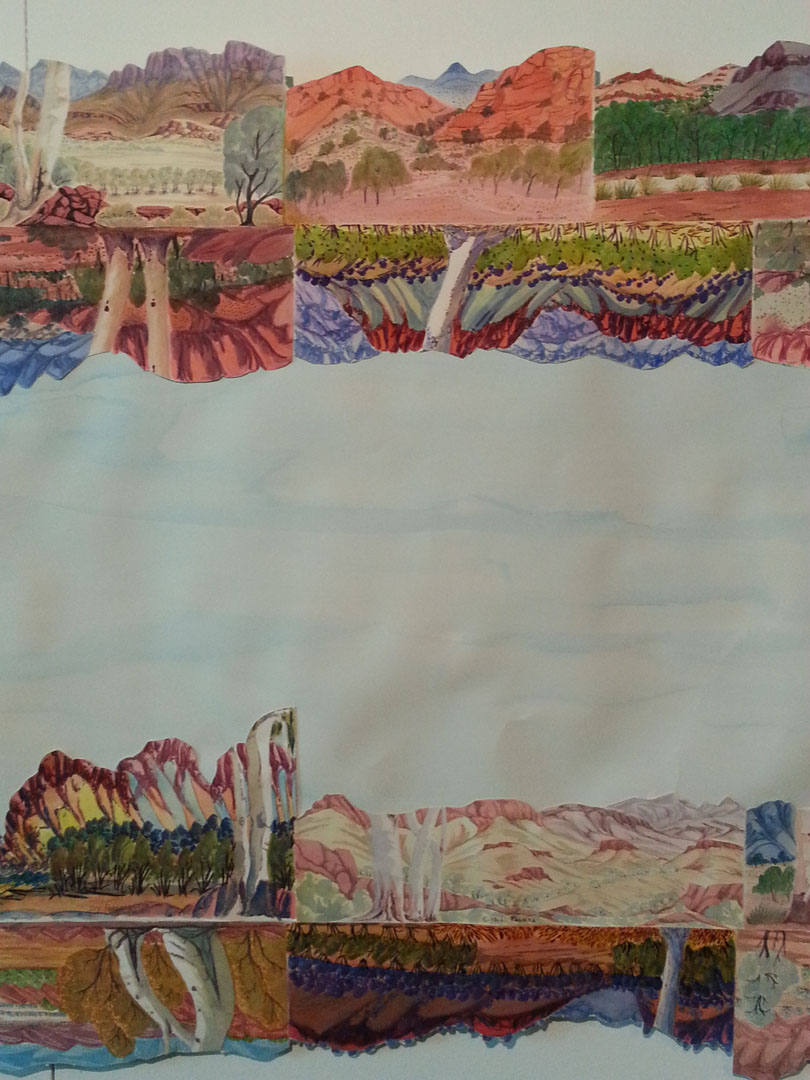
So off we go to Parliament House, where we enjoyed a small, but interesting exhibition Namatjira to Now — Five Generations of Watercolours from the Central Desert, its on until 15 February so if you are nearby it’s worth taking a look at. Apart from all the individual artists there is a most amazing collage of watercolour paintings, which, as Lenie Namatjira said

“We started off with magazines, then watercolours. We picked quick ones, not good ones. Then we cut them, then stuck them on one long piece of paper, so they would be big country, all western country – west of Alice Springs – the country of my grandfather Albert Namatjira.”

Knara, Nunaka Tywerewtye, Our Big Country: The West MacDonald Ranges The Big Picture, Collaboration with Collage, watercolour, Gloria Pannka, Kevin Wirri, Rienhold Inkamala, Lenie Namatjira, Ivy Pareroulta' Selma Coulthard Nunay with Rolande Souliere

Knara, Nunaka Tywerewtye, Our Big Country: The West MacDonald Ranges
The Big Picture, Collaboration with Collage,  Gloria Pannka, Kevin Wirri, Rienhold Inkamala, Lenie Namatjira, Ivy Pareroulta’ Selma Coulthard Nunay with Rolande Souliere

The exhibition is located near the Members Hall, (if you check out the link above there is a picture of this space from the ground floor level, 3rd small image down). This Hall is the central space in the Parliament building and goes from ground level through all floors of the building to a skylight sited directly under the flagpole. The walls are lined with Australian timbers and the vertical white columns surround the central open space.

The Members Hall, Parliament House, Copic multiliner and watercolour (added later), 2 January 2014

The Members Hall, Parliament House, Copic multiliner and watercolour (added later), 2 January 2014

I’m off to a good start so I’ll keep sharing with you where my drawing takes me.