Thinking through the brush, Old Masters – Australia’s Great Bark Artists

Given it was a dull and foggy day with no prospect of seeing the sun before midday, we decided to go to head for the warm interior of the National Museum of Australia (NMA) to see their current major exhibition, Old Masters, Australia’s Great Bark Artists. Holding the largest collection of bark paintings in the country (and I’m assuming probably the world) the Museum has access to some truly great masterworks. If possible, I’d urge you to see the works in person, however if that’s not possible you can explore a large number of these works online, through the link above. Caution: The NMA website includes images and names of deceased people that may cause distress to Aboriginal and Torres Strait Islander peoples. 

Painting on bark seems to have become the forgotten form of Aboriginal art, at least to the Australian public in general. The works in this exhibition are all by male artists from Arnhem Land in the Northern Territory. Some were collected in the mid 20th century and some of the artists represented, like John Muwurndjul, are still actively painting today. The works are all painted in ochres, clay and charcoal on sheets of bark from a stringybark tree, Eucalyptus tetrodonta.

One of the features of paintings from this region is the rrark, the fine cross-hatching that is an integral part of many works. The quality of the fine, fine rrark just stunned me. Some lines are just 1 mm thick and are consistently painted across the large  barks in steady lines. I only learned at the show that the brushes used to make the fine lines are made from human hair.

Narritjin's Brush, 1970's, a gift to the National Gallery of Australia, 1986 from Professor Howard Morphy.

Narritjin’s Brush, 1970’s, a gift to the National Gallery of Australia, from Professor Howard Morphy in 1986.

One brush used by Narritjin Maymuru is included in the show. The brush, called a marwat, is only about 10cms long and is used for the cross hatching at the final stages of the bark painting. Just in case you can’t read my pencil notes the explanatory note said:

‘See this marwat, it is very clever.’… Narritjin explained to Morphy that he ‘thought with’ or ‘through’ his marwat brush.


When I came home I couldn’t resist having a go at cross-hatching for myself. While I started with watercolour I quickly ran into trouble with getting sufficient opacity in my whites. So I just used my acrylic paint markers instead. I also tried some different colours, such as blue and clear red to see how they might work. I hasten to add that while I am interested in exploring how this technique ‘works’ I am not attempting to appropriate specific patterns that are the cultural property of the artists in the show.
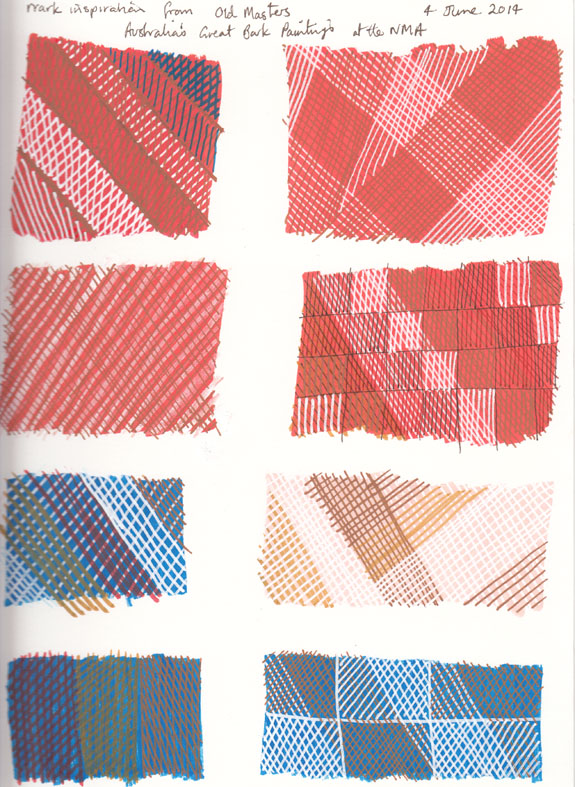
A page of cross-hatching inspired by the work in the Old Masters exhibition at the National Museum of Australia.

A page of cross-hatching inspired by the work in the Old Masters exhibition at the National Museum of Australia.

There is so much that any artist could learn from in this show. The array of compositional devices that the artist’s use would be a lesson for most of us. The striking portrayal of a kangaroo being stalked by a hunter through the bush, Hunter and Kangaroo, 1974, by Bob Balirrblairr Dirdi, I found particularly impressive – the painting  is the first image in this set. My partner also commented that these works demonstrate just how high the levels of invention can be taken when starting from such a limited range of materials.

This is another one of the amazing shows that the NMA has mounted that seem to be completely under-rated by the viewing public. I understand from the staff at the museum that visitor numbers are lower than hoped for. Much as I love the bold and bright acrylics and wildly expressive brushwork of contemporary Aboriginal art, this exhibition amply demonstrated to me the ability of these artists and the true quality of their art.

3 Cafes in 3 Days

Three cafes in three days, a bit more than my usual quota of coffee for the week. I started off with drawing a grandmother and granddaughter, having a break together. The girl developed a somewhat ‘cubist’ head as she kept moving quite quickly. A few of my strokes ended up in unintended places (well that’s my excuse).

Grandmother and granddaughter at the coffee shop, ball point pen, 3 June 2014.

Grandmother and granddaughter at the coffee shop, 3 June 2014.

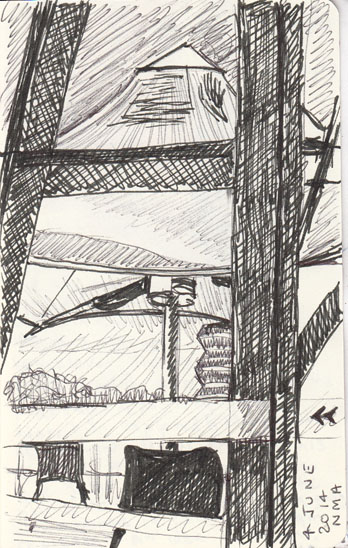
The next day found us having lunch at the National Museum of Australia, after having seen the Old Masters: Australia’s Great Bark Artists (more of that in a future post).

Umbrella and a view back towards the city from the National Museum of Australia, pen and ink, ball point pen4 June 2014.

Umbrella and a view back towards the city from the National Museum of Australia, 4 June 2014.

Lastly back to our regular place for a coffee today. The sun encouraged us to go for a walk before more clouds blew in. I particularly liked the way the fluting on the glass reminded me of colonnades and arches.

A glass architecture, pen and ink, 5 June 2014.

A glass architecture, pen and ink, 5 June 2014.

Japanese plants and gardens

I love looking at gardens when I travel. This recent trip was the first time we have been in Japan during cherry blossom time.  In Kyoto there was one place we had to visit, Tetsugako no michi, or the Philosopher’s Path. Along a canal channeling water down from the hills surrounding Kyoto are rows of cherry trees. Both Japanese and foreign visitors alike crowded the paths to take photos of themselves, as well as the blossoms.

Taking photos on the Philosopher's Path, Kyoto, Japan.

Taking photos on the Philosopher’s Path, Kyoto, Japan.

I was able to take the time to sketch a section of the canal and while it had been my intention to add painted cherry blossom to the top of the sketch, it didn’t happen. I’m content to leave it like it is.

The Philosopher's Walk, (Tetsugako no michi), 12 April 2014.

The Philosopher’s Walk, (Tetsugako no michi), 12 April 2014.

After leaving Kyoto we travelled to Kanazawa, a city on the west coast of Japan, that developed  as a centre of gold mining – the city’s name means ‘gold swamp’. We stayed with local families while we undertook a two week language course. I was excited to find that my “host mother” was, like me, a keen forager of edible plants. During my stay she went to the local mountains with friends and also on a guided field trip to gather local wild foods. I had fun drawing the plants when she bought them home.

Kogomi, (Matteuccia struthiopteris, or Ostrich Fern) fresh fern fronds, which we ate as part of our dinner.

Kogome, fern fronds, 17 April 2014.

Kogome, Ostrich fern fronds, (Matteuccia struthiopteris), 17 April 2014.

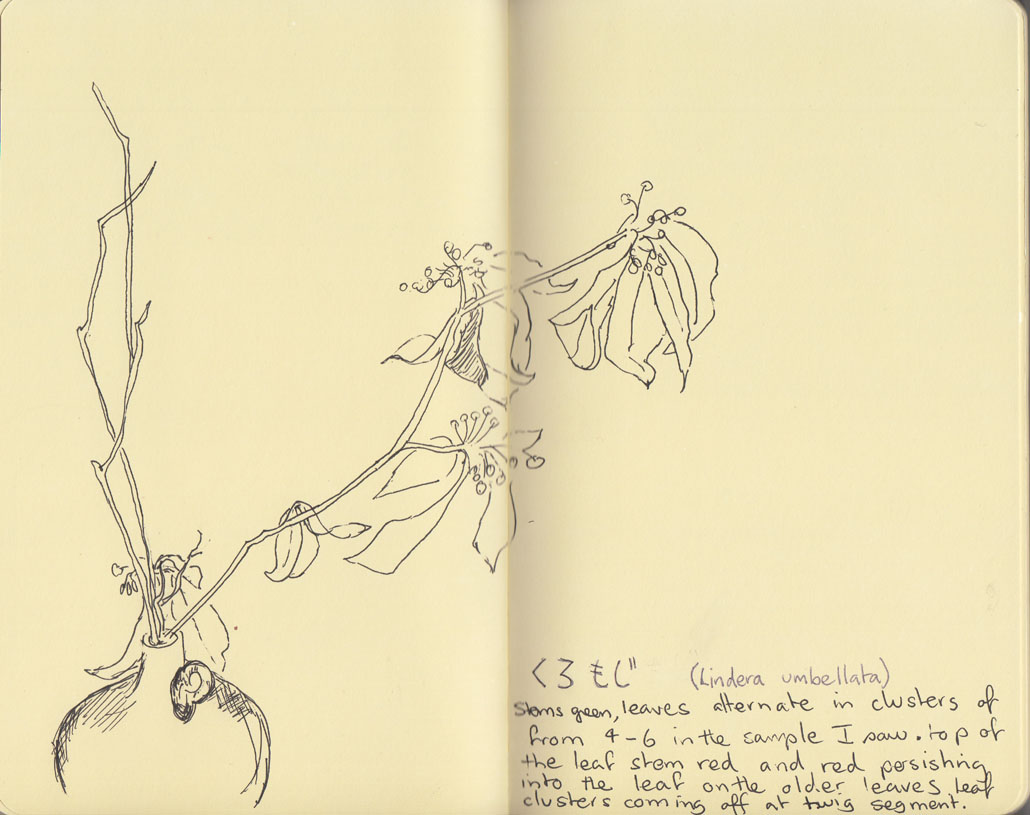
Kuro moji, (Lindera umbellata), which we drank an infusion of. Apparently this plant is being examined for potential medicinal use. I can only say that the tea made from the plant was very pleasant.

Kuro moji, (Lindera umbellata), 18  April 2014.

Kuro moji, (Lindera umbellata), 18 April 2014.

We were in Kanazawa at the absolute peak of the cherry blossom season. We visited Kenroku-en, the magnificent garden in the centre of the city.

A wedding party under the sakura (cherry blossom) at Kenroku-en garden, Kanazawa, Japan

A wedding party under the sakura (cherry blossom) at Kenroku-en garden, Kanazawa, Japan

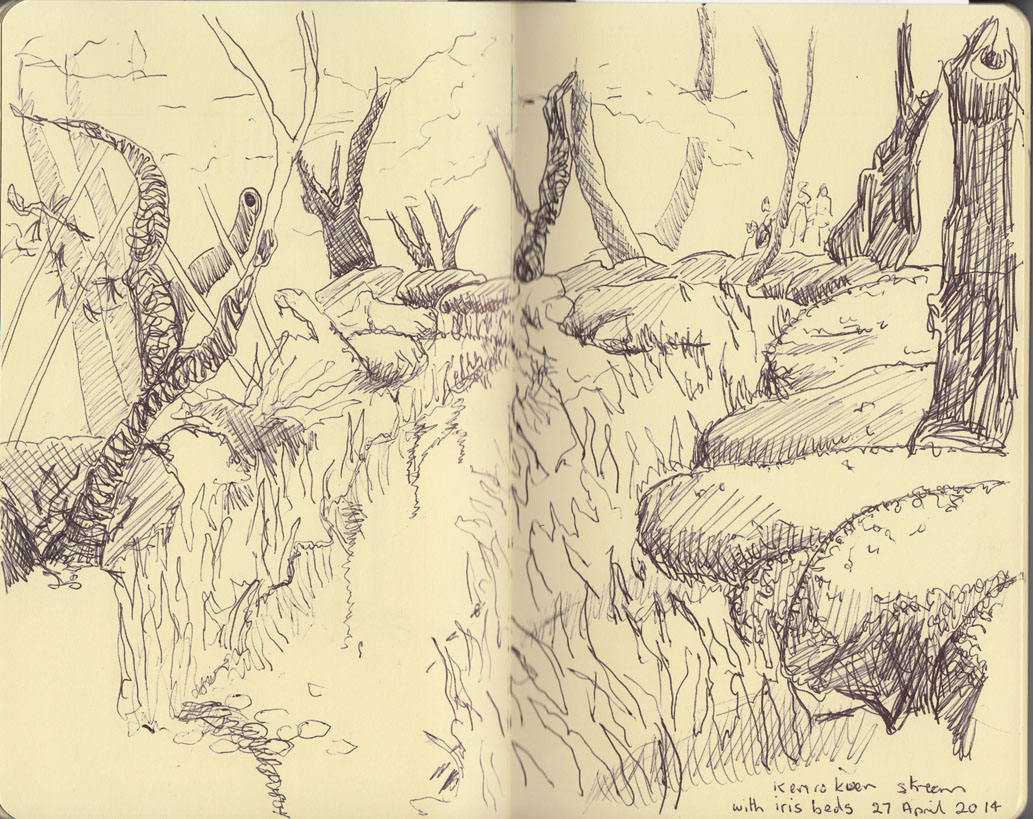
Our first visit was with our class so there was no time to draw. Two weeks later I returned to the park to draw. The cherry blossom was all gone. Instead, I drew my favourite section of the garden, a meandering stream that is lined with irises and azaleas, under a canopy of cherry trees.

Kenroku-en, stream with iris and azaleas, 27 April 2014

Kenroku-en, stream with iris and azaleas, 27 April 2014

I would have loved to have been able to stay on a few more weeks in Kanazawa to see the iris in bloom. The best I can do is give you a link to some photos of how good it can look.