USk Singapore Symposium Day 3

OK there has been a bit of a gap in the Singapore saga, a result of problems uploading my posts while traveling, traveling in general and having other things to do, like traveling. So now the big catch up.

Day 3 in Singapore saw me in a workshop with Melanie Reim, titled ‘Found in Translation – The influence of Calligraphy on Gesture in the Figure‘, exploring how we can use the influence of calligraphic marks to make lively sketches. Melanie walked us through some of the calligraphic styles found around the world and then showed us the work of artists who have used this approach. You may like to check out the work of Ben Shahn or David Stone Martin.

We were encouraged to draw using shorter, more graphically interesting lines. This is in contrast to the way I usually draw with a continuous line. As Melanie said we should look at the joints of arms and legs and the shift of weight in the body as the point where you could use a calligraphic mark to indicate the body’s movement. The other instruction she gave us was to use the notes she had provided to find the marks that might suit what we were drawing. This proved to be good advice – I don’t know about you, but I am prone to believe I’ve taken the information in and don’t need the prompt of notes – wrong!

We started with faces and bodies, the challenge was to draw 20 faces and 20 bodies in 40 minutes. Ohhh Kayyy – using a brush pen (Pentel) I got underway.

Figures and faces in the Albert St Mall, 25 July 2015, brush pen

Figures and faces in the Albert St Mall, 25 July 2015, brush pen

More figures, Albert St Mall 25 July 2015

More figures, Albert St Mall 25 July 2015

The note to myself about holding the brush was a reminder that if I used the brush as I would normally hold a pen to write I got very uniform strokes. I recalled that on the odd occasion when I have taken a calligraphy lesson I have to hold the brush in a vertical position, using my thumb and forefinger. This way I can get both thick and thin lines and a much wider range of pressure in one stroke.

After this first exercise we collected for a quick review of what we had learned and some advice on how we might better apply the ideas and techniques.

Melanie, providing an on the ground crit session in the Albert Mall

Melanie, providing an on the ground crit session in the Albert Mall

Our second exercise was to draw a scene using calligraphic marks and incorporating figures in the scene. One tip that Melanie gave us was to place an interesting figure in the foreground to help draw the viewer into the image. Just when I was asking myself “will I see someone take an ‘interesting’ stance?”, that person materialised in front of me. In my case a young man walked by with a bag held up on his shoulder – perfect! I was positioned outside the Chinese temple so I had lots of colour and movement to include in the drawing. I also, usefully, had the view-finder that Virginia gave us the day before to help focus in on my subject.
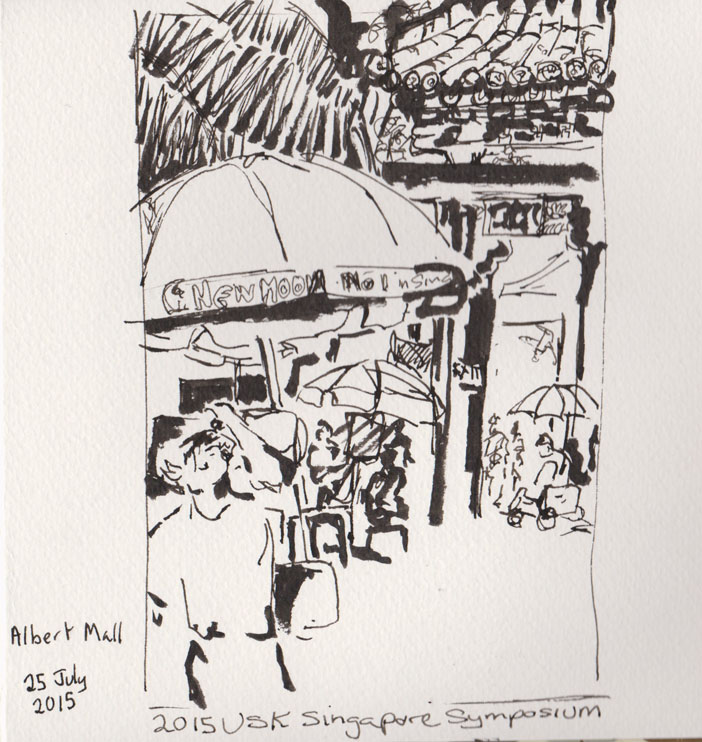
Outside the temple, brush pen, pen and ink, 25 July 2015.

Outside the temple, brush pen, pen and ink, 25 July 2015.

I liked how Melanie’s calligraphic figurative style worked so well with Virginia’s teaching from the day before on using light and darks. I was really pleased with the resulting drawing.

The next day we found ourselves in a local food court where we could sit and sketch while eating our Bandung bean curd, (a rose-flavoured dessert rather like a junket). Again Marc Taro Holmes’ lessons and Melanie’s gestural lines proved to be a good fit.

At the food court, some of our fellow diners, brush pen, 26 July 2015
At the food court, some of our fellow diners, brush pen, 26 July 2015
USk Singapore Symposium Day 2

Another early start. We were up and out to find some breakfast before the day’s workshop . This I was with Virginia Hein for Dark and Light with a Punch of Colour.
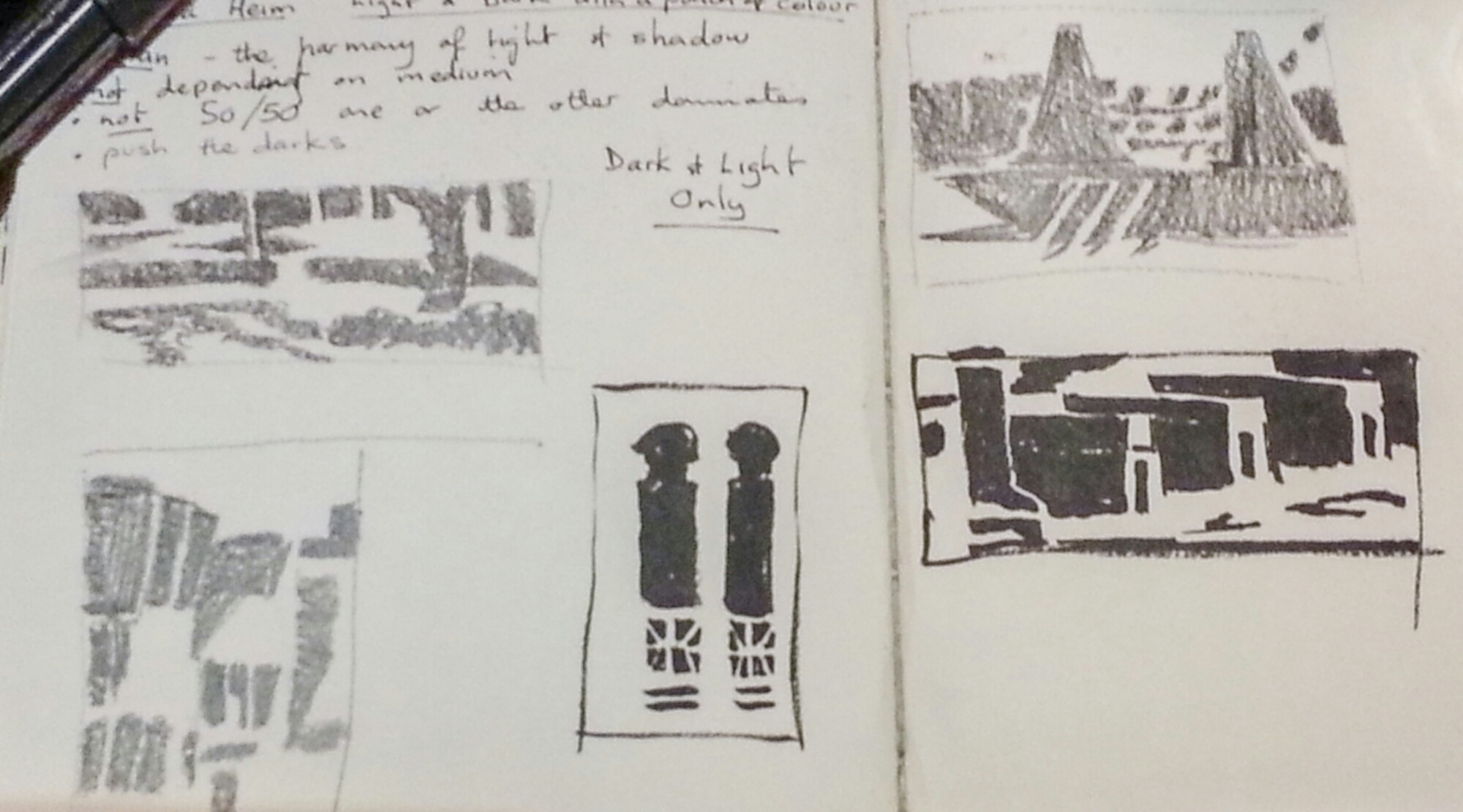
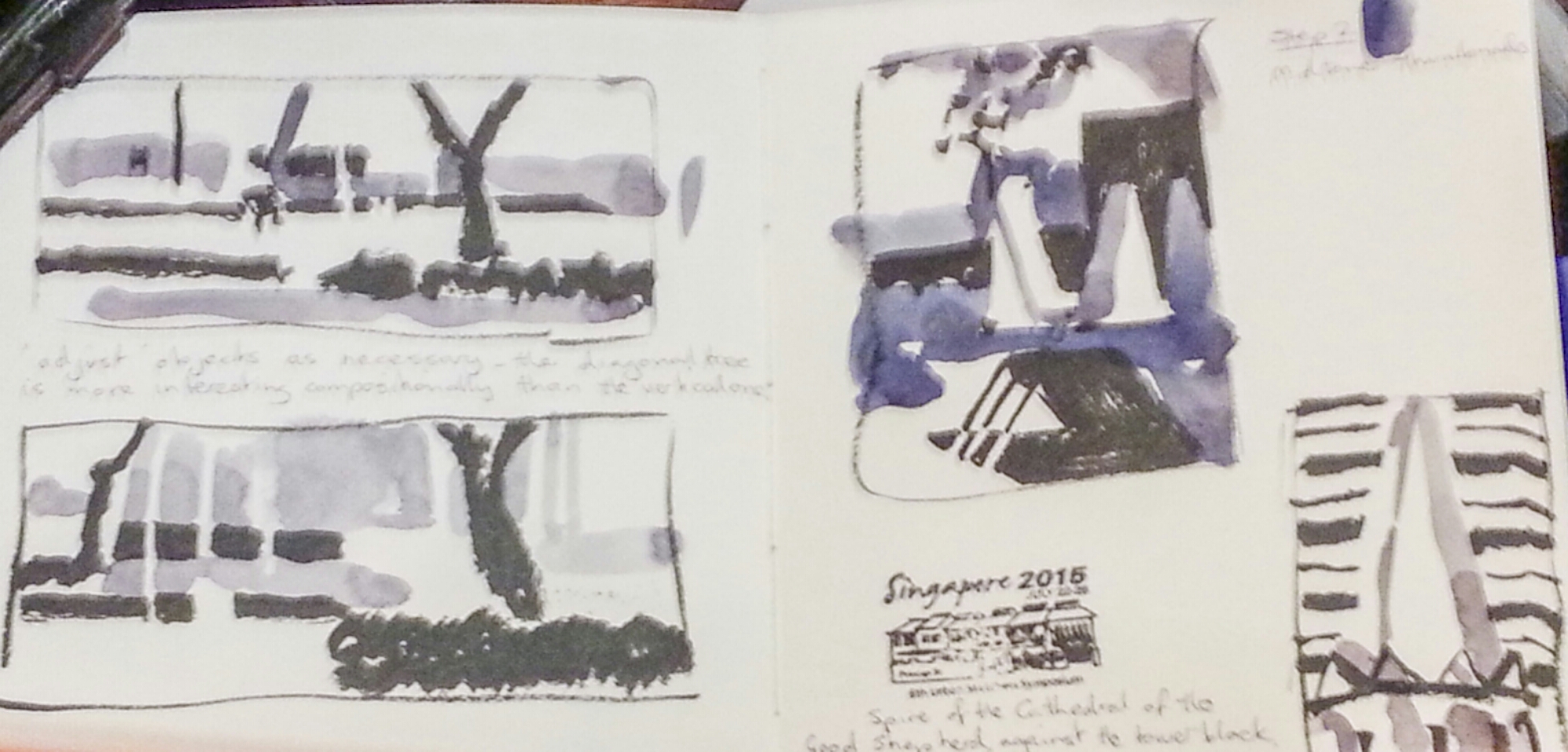
Virginia started us of by explaining the concept if notan, a Japanese word for the harmonious blance of light and dark. Not a 50/50 split but rather a means of examining the bones of a composition before making a study or final work. It turns out , unbeknownst to me at the time that this is something I really love doing.
There were three steps to the class. First drawing a thumbnail sketch in pencil , preferably a flat carpenter’s pencil, or a regular pencil drawn using it’s side , marking in the dark tones. It may help to use a view finder, that is a piece of paper with a rectangle torn into it , so you can frame a scene and select what you want to draw.

image

By the way its easy to say that there’s not enough time to make a thumbnail sketch, but it is time well spent as we were reminded. Since the class I’ve tried to stick to this approach and I’ve found it very helpful way of noting a scene particularly if I don’t have time for a full drawing.
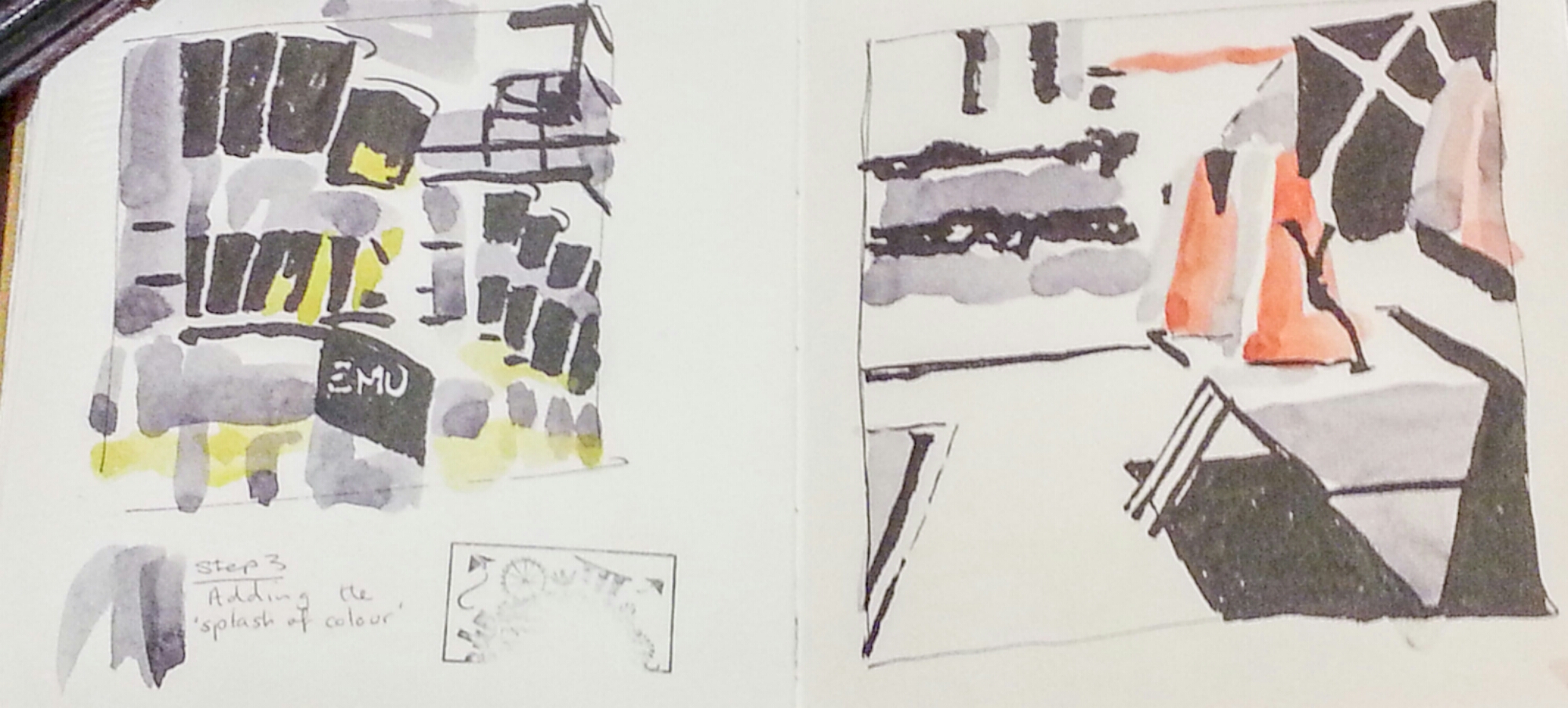
Next step is to fill in the mid-tones. For some reason I struggled with this at first. Virginia suggested that this should be in grey. You can mix your own or use Payne’s grey, just remember that the mid-tones can also be used to delineate objects.

image

Finally for that punch of colour. For our first attempt Virginia suggested that we limit it to one colour. But once you’ve got the hang of things you can try it out with more colours. One tip, remember that some of your colours may act as mid-tones, this can make your final image less satisfactory.

image

USk Singapore symposium, Day 1 workshops

It was pretty chaotic as all the workshop participants got themselves organised this morning.

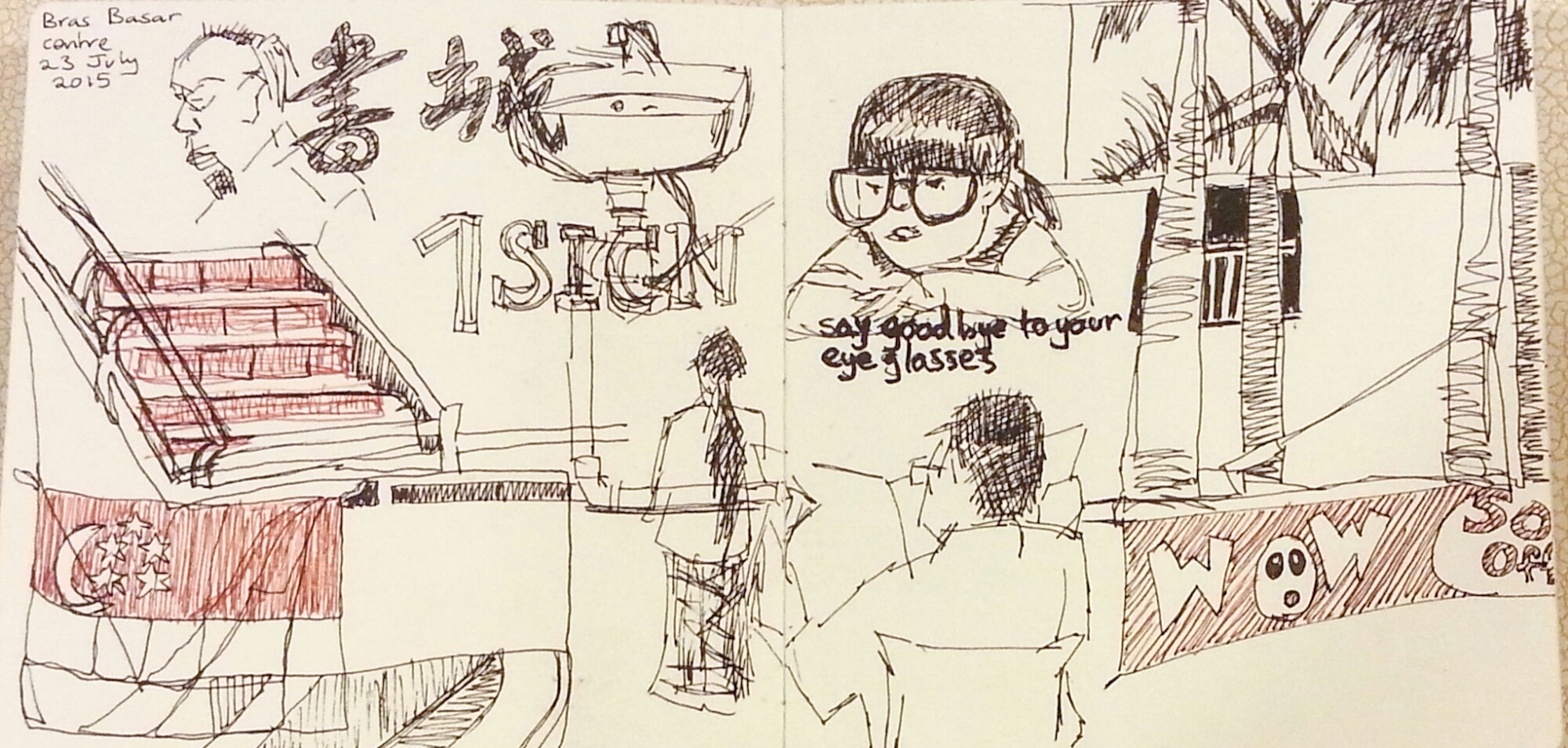
I started with ‘Thin line bold sketch‘ with Inma Serrano and Miguel Herrantz. We were literally across the street from the Nation Design Centre in the Bras Basah complex. Starting with a quick try out of different line techniques to get us thinking about how we might draw lines. After that we we let loose to do a cartoon of what was happening in the centre. We didn’t need to format it into cells but try and capture what was happening. The idea is try and capture busy scenes without drawing from A to B.

image

We also did a second exercise drawing in a spiral. Again another technique to present complex subjects. Starting with your most important subject then moving around it adding relevant details.
A bit hard to explain as the result looks similar to a ‘normal’ drawing, but you capture what you want first and work around it.

In the afternoon I went to ‘Sketching the Sketchers‘ with Mark Taro Holmes. I have Mark’s book on Urban Sketching so I was always going to choose this workshop. I need plenty of help with drawing faces so Mark’s tuition was invaluable. We went out into the Albert Mall, a bustling street which has two temples in it so there were lots of subjects to choose from.

I took my usual approach of trying to sit and draw unobtrusively but that just isn’t going to happen in Singapore. Before I knew it a stall holder had come over to see what I was doing and then she called out to the person I was drawing! No one was concerned and before I knew it I had a line up of stall holders waiting to be drawn.

Shop owner, Albert Mall, 23 July 2015, pen and ink and brush pen

Shop owner, Albert Mall, 23 July 2015, pen and ink and brush pen

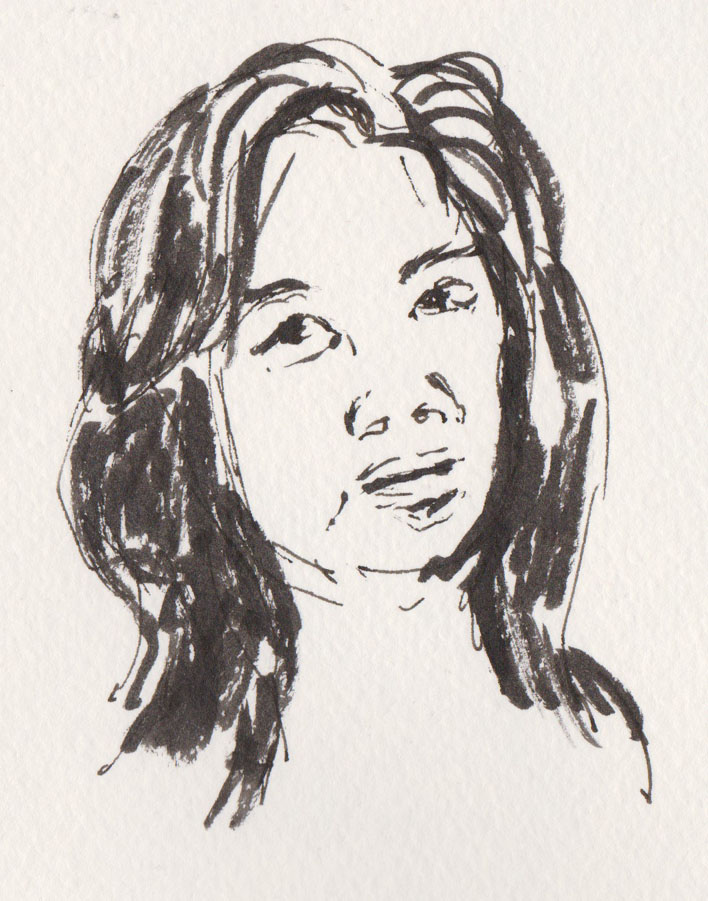
We started with a thin pen line then added stronger lines with a brush pen. Mark emphasised drawing the skull shape and hair first, then the shadows on the face. With any luck he said, you may never need to draw eyes!

Shop owner, Albert mall, pen and ink and brush pen, 23 July 2015

Shop owner, Albert mall, pen and ink and brush pen, 23 July 2015

I was really pleased with the days work, but we were so tired that we ate at the hotel and went to bed very early.

On the ground in Singapore

We are here in Singapore just about to register for the Urban Sketchers Symposium for 2015.
We’ve already run into several other sketchers and there are reports of sketchbooks and watercolours across the city.

image

Drawing boabs in the Flower Dome

We spent yesterday wandering around Gardens at the Bay an amazing place with two hugh climate controlled conservatories. In the surrounding grounds stand the Super Trees, massive metal structures some 3 stories tall, with vines and plants growing up them. You can take a lift up the towers and do the sky walk that links several of them. Behind them is the triple building with the ‘surfboard’ on top. Such a sight.

image

Super Trees and the Marina Sands Hotel


It’s pretty exciting and will get more so when we start our workshops tomorrow.
PS Please excuse the dodgy pictures as I am using the phone camera (no room for the scanner in my luggage).