Sketchwalking, Singapore Style

I’ve spent quite a bit of time talking about workshops at the USk Singapore 2015 Symposium, but perhaps the most fun thing we did at the symposium were the sketchwalks. Our Canberra Sketchers Group is still in its infancy, so getting 10 people along to a sketchwalk is a good outing. Imagine how amazing it feels when a whole street is full of sketchers. I don’t know how many people actually came on the registration day sketchwalk, here are just some of the sketchers in Purvis St. And there were two other groups in other nearby streets!

Some of the sketchers in Purvis St

How many sketchers can you fit in one small street?

While the sketchwalks are fun, they are also taken seriously, as an opportunity to get to know a new location.
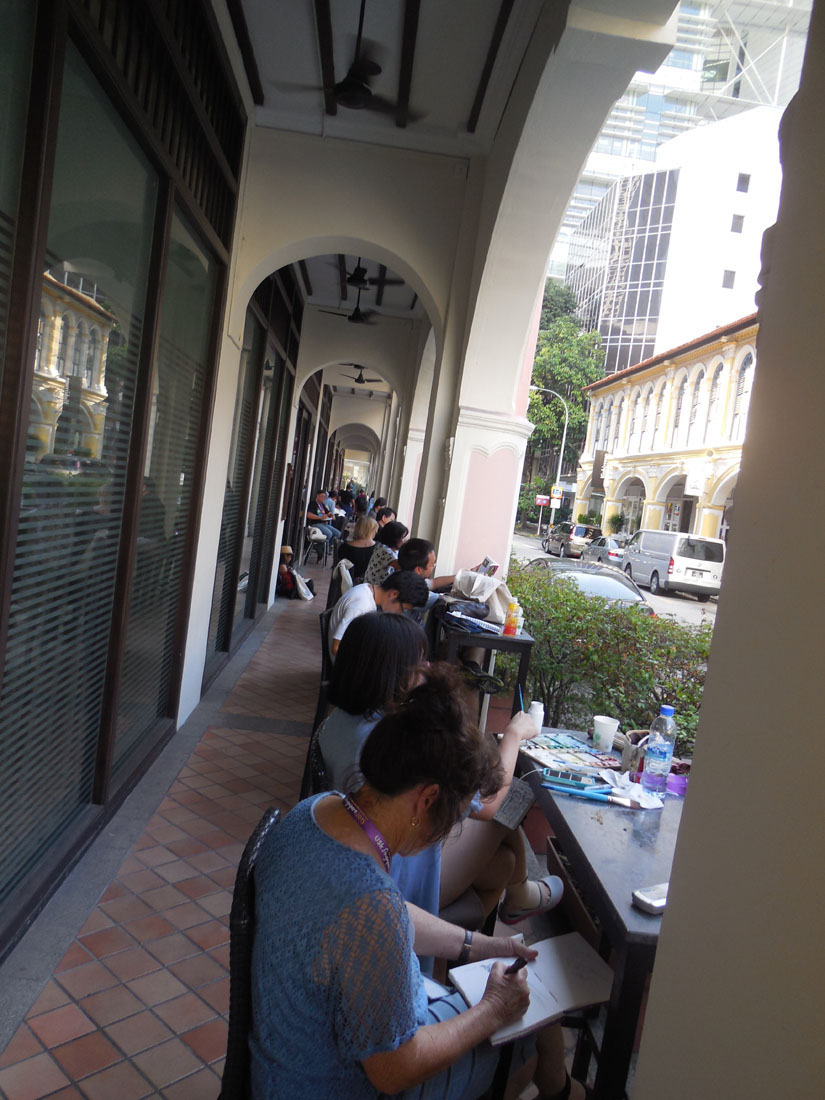
Heads down and working hard! Purvis St, Singapore

Heads down and working hard! Purvis St, Singapore

We were lucky that the restaurants that lined the street hadn’t opened yet, because we sketchers commandeered all the available seating, as well as the footpaths and anywhere else we could find.

Here is what I drew on that first day (BTW the drawings of houses at the top of the left-hand page and the patterns on the bottom of the right-hand page are washi tape I purchased at the Singapore Art Museum shop).
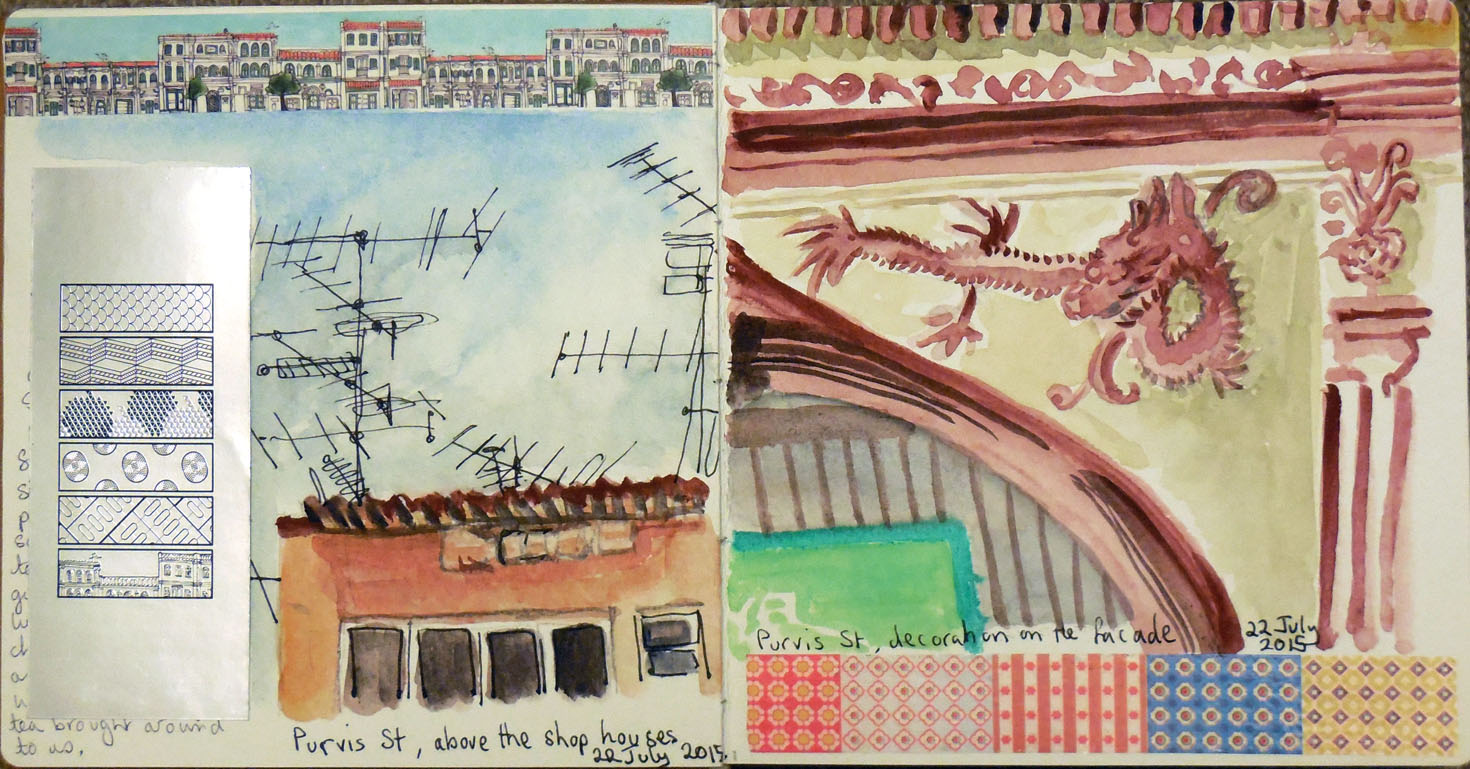
Drawings of the roof lines and building decorations in Purvis St Singapore, 22 July 2015, watercolour and pen and ink

Drawings of the roof lines and building decorations in Purvis St Singapore, 22 July 2015, watercolour and pen and ink

There were other opportunities to join similar sketchwalks, which we did on the afternoons of day 2 and day 3 of the Symposium. But the biggest of them all was the sketchwalk on the final day of the symposium. The official count was 106 participants.

The sketchwalk on the lawns of the Singapore Management University, 25 July 2015

The sketchwalk on the lawns of the Singapore Management University, 25 July 2015

It was a grand finish to three days of amazing teaching and connection with sketchers from around the world. But what thrilled me was the impact those three days had made on my work. I could never had imagined that my final sketchwalk drawing would look like this.

My drawing at the final sketchwalk, brush pen, ink and watercolour, 25 July 2015

My drawing at the final sketchwalk, brush pen, ink and watercolour, 25 July 2015

A huge thank you to all the organisers, sponsors and the Singapore USk group. All I can say is ‘do yourself a favour’ and get yourself along to the 2016 USk Symposium in Manchester.

On the ground in Singapore

We are here in Singapore just about to register for the Urban Sketchers Symposium for 2015.
We’ve already run into several other sketchers and there are reports of sketchbooks and watercolours across the city.

image

Drawing boabs in the Flower Dome

We spent yesterday wandering around Gardens at the Bay an amazing place with two hugh climate controlled conservatories. In the surrounding grounds stand the Super Trees, massive metal structures some 3 stories tall, with vines and plants growing up them. You can take a lift up the towers and do the sky walk that links several of them. Behind them is the triple building with the ‘surfboard’ on top. Such a sight.

image

Super Trees and the Marina Sands Hotel


It’s pretty exciting and will get more so when we start our workshops tomorrow.
PS Please excuse the dodgy pictures as I am using the phone camera (no room for the scanner in my luggage).

Drawing the exhibition – The Daylight Moon

It is an amazing thing to drive for an hour through a landscape, to arrive in a room where that same landscape has been abstracted into 10 works of art.

Looking eastwards across the dry bed of Lake George

Looking eastwards across the dry bed of Lake George

The Goulburn Regional Gallery is currently showing, The Daylight Moon, a collection of 10 works by Rosalie Gascoigne. Gascoigne was born in New Zealand 1917 and died in Australia in 1999, (she lived in Australia from 1943). Gascoigne is, arguably, the greatest Australian landscape artist of the late 20th century. The ten works have been selected to show Gascoigne’s response to Lake George. The Lake is the major feature on the drive between Canberra and Goulburn. It is known throughout our region as the disappearing lake, as the water levels change from full to totally dry depending on the local rainfall.

The gallery layout is simple. Partitions have been placed to  square up the centre of the gallery. The centre of that space is occupied by a large work called A Piece to Walk Around, (1981), which is a composition of dry thistle stems, thousands of them, laid in a simple grid pattern directly on the floor. In the gallery this takes the corresponding position of the lake as the central theme of the exhibition. The remaining works are hung on the surrounding walls, with space to breathe, as is appropriate to the sense of space that is present in the land around Lake George.

My immediate response to the gallery space was to stop and take a deep and relaxing breath, then let the art flow around me. I have seen many of Gascoigne’s pieces over the years, but those included in this show were largely unfamiliar. If you haven’t seen Gascoigne’s work you should know that her pieces are composed from found materials, such as corrugated iron and old timber road signs, that she collected from small town dumps in the area.

Gascoigne’s ability to visualise a work of art out of these basic materials remains a constant surprise. She described her process as follows “… you’ve got to use what you’ve got and you’ve got to fake it and fake it and fake it, until suddenly you personally see it. And whether anybody else sees it is of course immaterial.”*

I realised that I needed to slow down enough to really take in the work. So I borrowed a seat so I could sit down and draw one of the works, High Country, (1999).

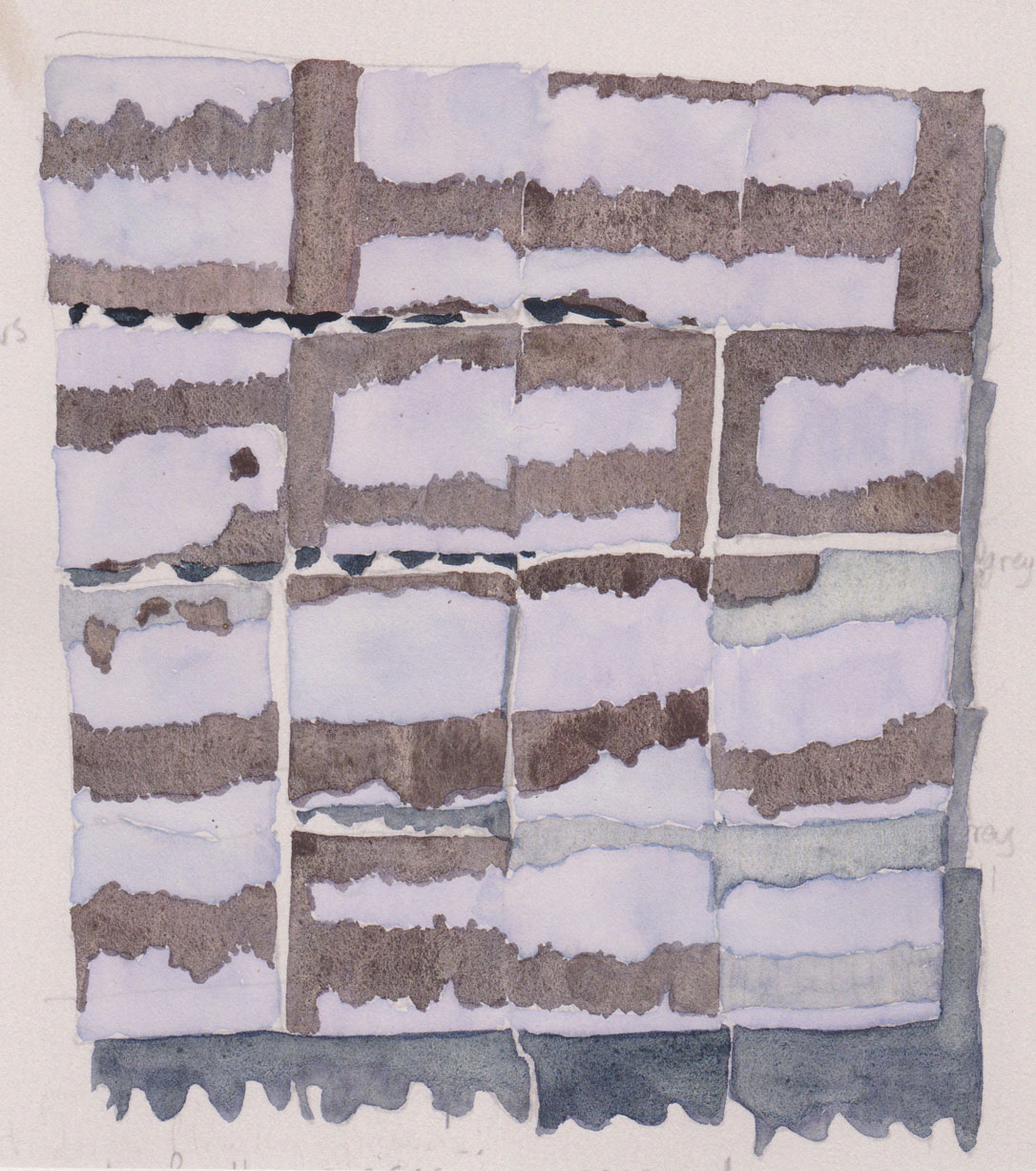
Rosalie Gascoigne's High Country 1999, graphite, 15 July 2015

Rosalie Gascoigne’s High Country, 1999, graphite, 15 July 2015

These are my notes made in the gallery, but I couldn’t resist copying the drawing onto watercolour paper and adding some colour once I had returned home.

Rosalie Gascoigne's High Country 1999, painted corrugated iron panels on wood, 134 x 121 cm, watercolour on photocopy

Rosalie Gascoigne’s High Country 1999, painted corrugated iron panels on wood, 134 x 121 cm, watercolour on photocopy

What did reveal itself as I sat and focused on this work were the shadows cast by undulations of the corrugated iron on the wall and even on the supporting wood panel. Other works, such as White Garden, (1995), cast similar lacy shadows. With closer examination you could also see where Gascoigne had worked with the original piece of iron, cutting and rearranging the individual segments into a complete work.

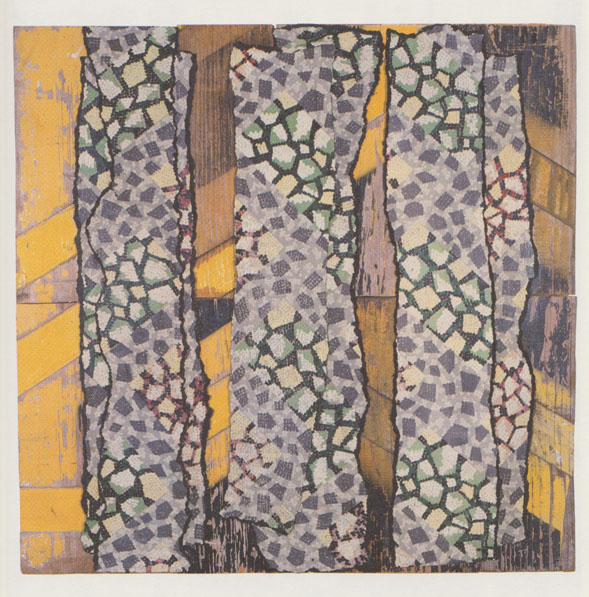
A smaller work that particularly captured my eye was Poplars 19 (1996-97).

Poplars 19, 1996-97, Rosalie Gascoigne, 60 x 62 cm, linoleum on wood with retro-reflective strip, collection of Tarra Warra Museum of Art

Poplars 19, 1996-97, Rosalie Gascoigne, 60 x 62 cm, linoleum on wood with retro-reflective strip, collection of Tarra Warra Museum of Art

This is a show that invites contemplation. It would be too easy to breeze in, glance at the walls, do a quick turn around the central floor work and walk out again. Please don’t.

If you are a local you have until 22 August to see this exhibition. Highly recommended, along with the drive through the country.

Poplars, Wollogorang Creek, NSW

Poplars, Wollogorang Creek, NSW

* Rosalie Gascoigne, interview with Stephen Fenely, Express, ABC, 4 December 1997, excerpt quoted in the exhibition catalogue.

Goulburn Regional Art Gallery
Cnr Church & Bourke Sts. Goulburn NSW 2580
t 48 234494 | f 48 234456 | e
Open Monday-Friday, 10 am – 5pm Free entry. Saturday 1-4pm

Free the people

I’ve been working on drawing people for some months now. I don’t find it easy and I might easily persuade myself to draw something else but I am persisting with it. To try and improve the outcomes – in my eyes at least – I’ve been trying out some different techniques.

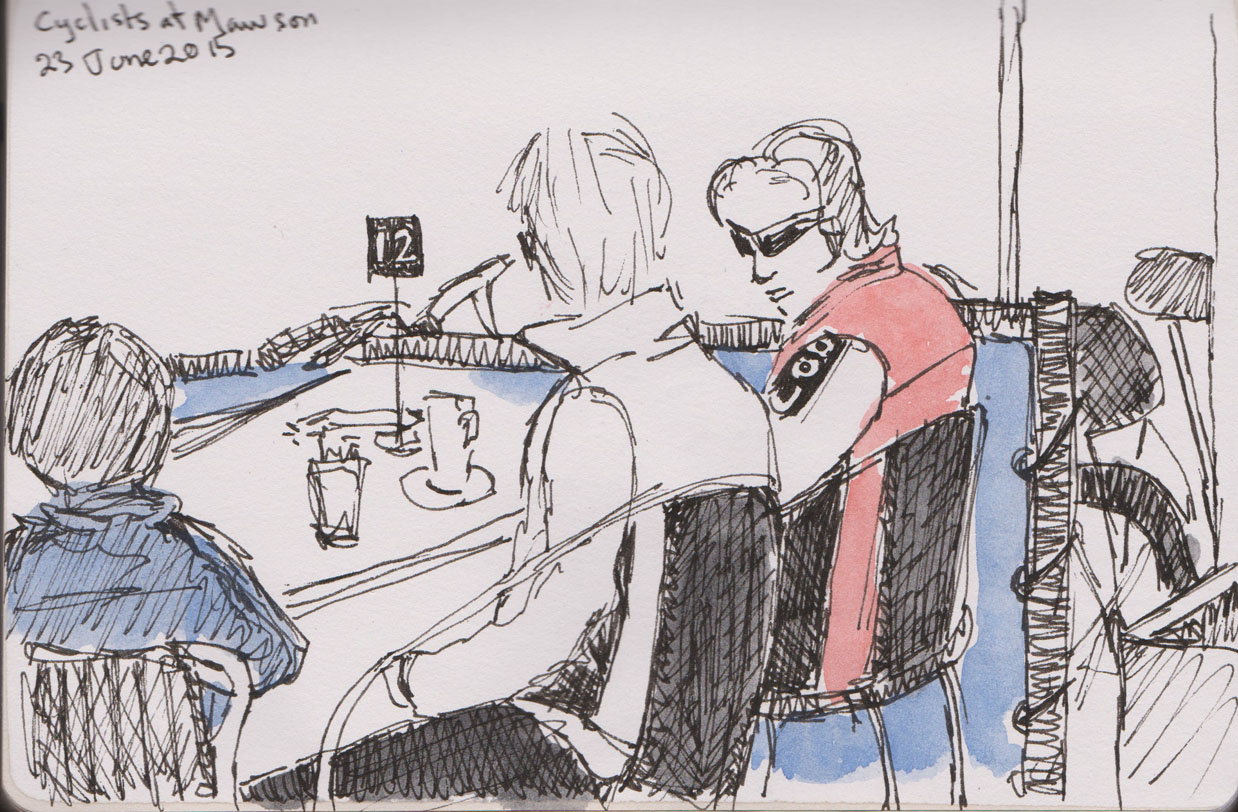
My default position to date has been a fairly realistic approach which relies on hoping my subjects are wearing sunglasses so I don’t have to draw tricky eyes and noses. Most of these drawings work, but the result is that my city appears to be occupied by shady characters at best and the random, deranged-looking person at worst.

Cyclists, pen and ink and wash, 23 June 2015

Cyclists, pen and ink and wash, 23 June 2015

I’ve been tossing around some options for changing my approach to drawing people. I was much happier with the quick sketches I did at the beach earlier this year, where I used a quick wash of watercolour that I quickly sketched into. So over the past few weeks I’ve been working on this as a new approach to people sketching in cafes.

Trying a new approach, watercolour and graphite, 24 July 2015

Trying a new approach, watercolour and graphite, 24 June 2015

I’ve mainly used a watercolour graphite pencil to add detail, I’m also trying using my pen and ink.

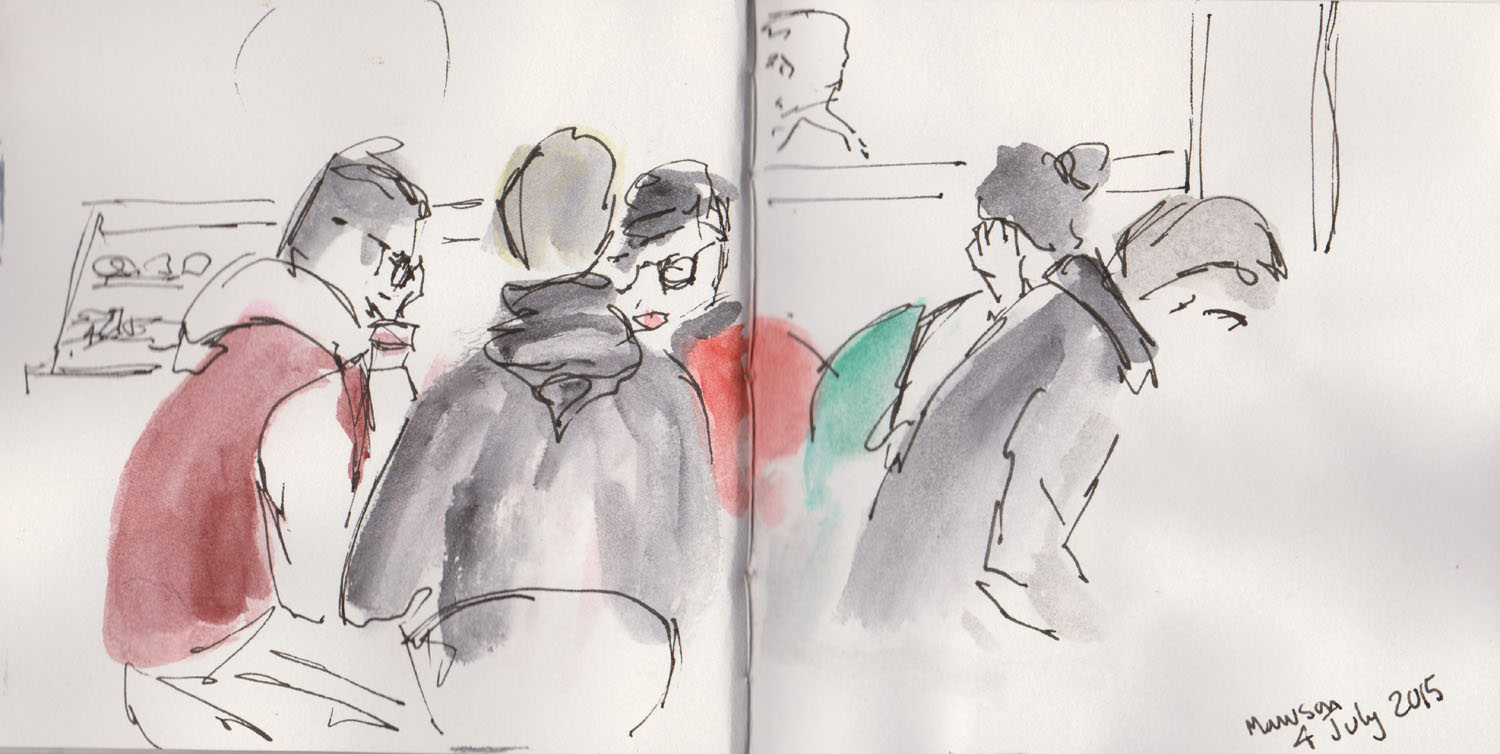
Busy Saturday, watercolour and pen and ink, 4 July 2015

Busy Saturday, watercolour and pen and ink, 4 July 2015

I’ve also found that if I put down a light wash that I can also quickly add some shadows and contours with subsequent washes.

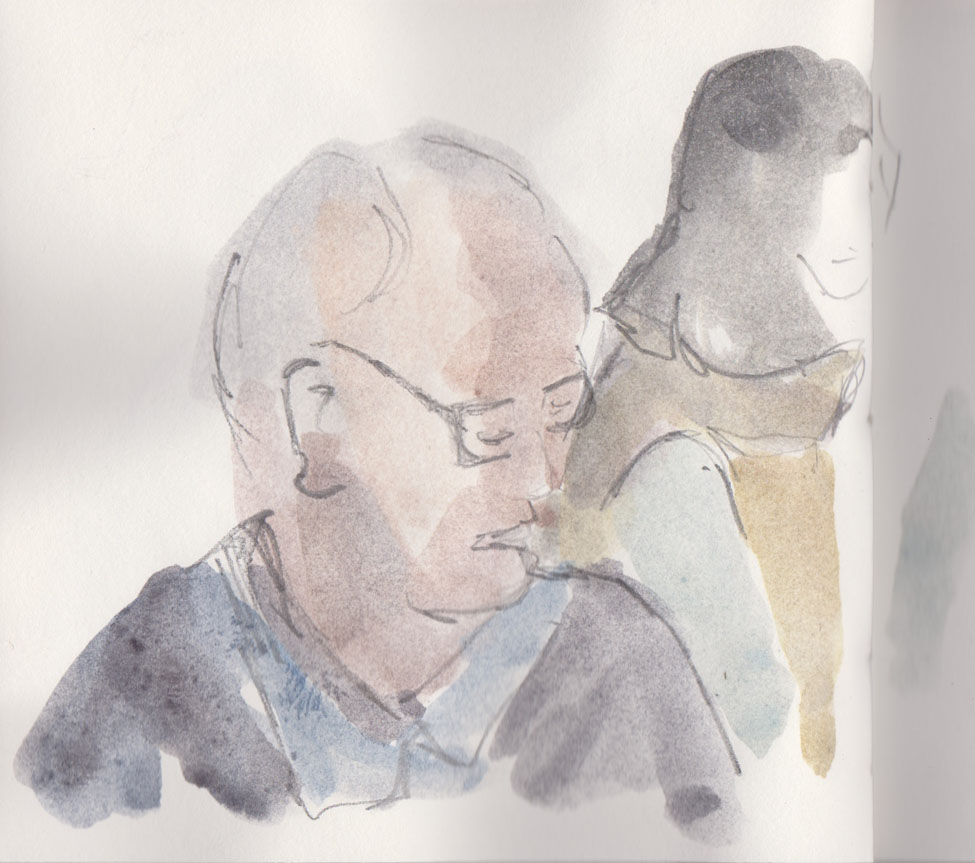
Man reading, watercolour and graphite, 27 June 2015

Man reading, watercolour and graphite, 27 June 2015

And while it might seem obvious it has also dawned on me that if I am working on a small piece of paper it is actually harder to get a well drawn face because I don’t have enough space to capture the details I want, duh!

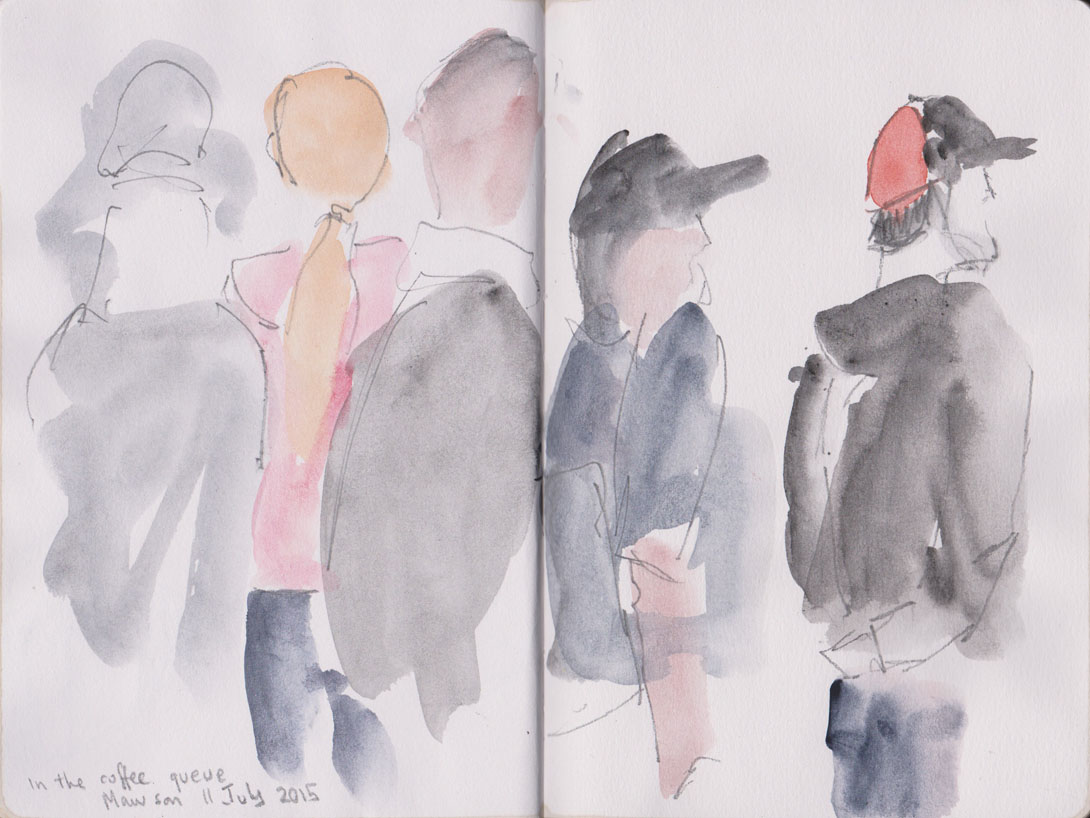
There’s no doubt that I’m still better at capturing body shapes than faces,

The coffee queue, watercolour and grapjite, 11 July 2015

The coffee queue, watercolour and grapjite, 11 July 2015

but I am keeping on with this approach.

Two people , quick sketch, watercolour and graphite, 11 July 2015

Two people , quick sketch, watercolour and graphite, 11 July 2015

Canberra Sketchers at Hotel Hotel

We decided not to repeat last month’s Canberra Sketchers Group outdoor meeting and opted instead for the warmth of Canberra’s hippest accommodation Hotel Hotel. It was hip and happening and we were there.

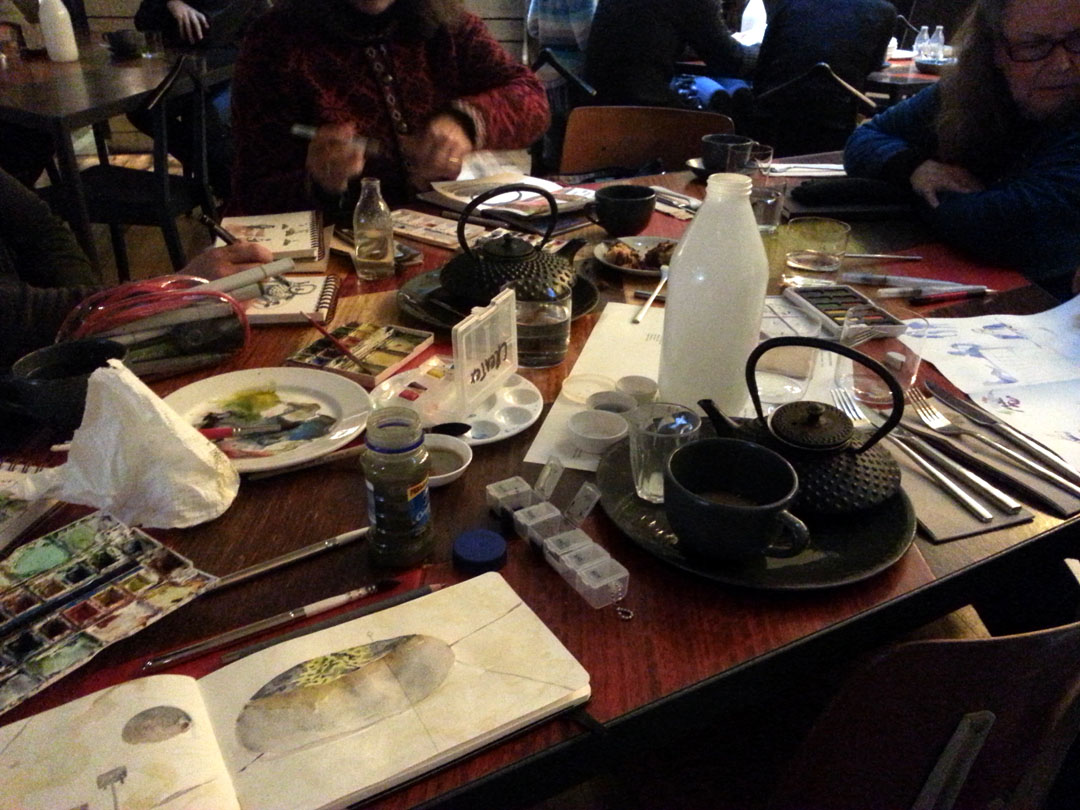
We set up at the Monster Kitchen and Bar and managed to drink lots of tea and coffee and scoff plenty of tasty cakes and biscuits and didn’t even dip our paint brushes in the wrong glass once!

Watercolours amongst the coffees

Watercolours amongst the coffees

The building provided plenty of places to sit and observe and lots to look at as well.

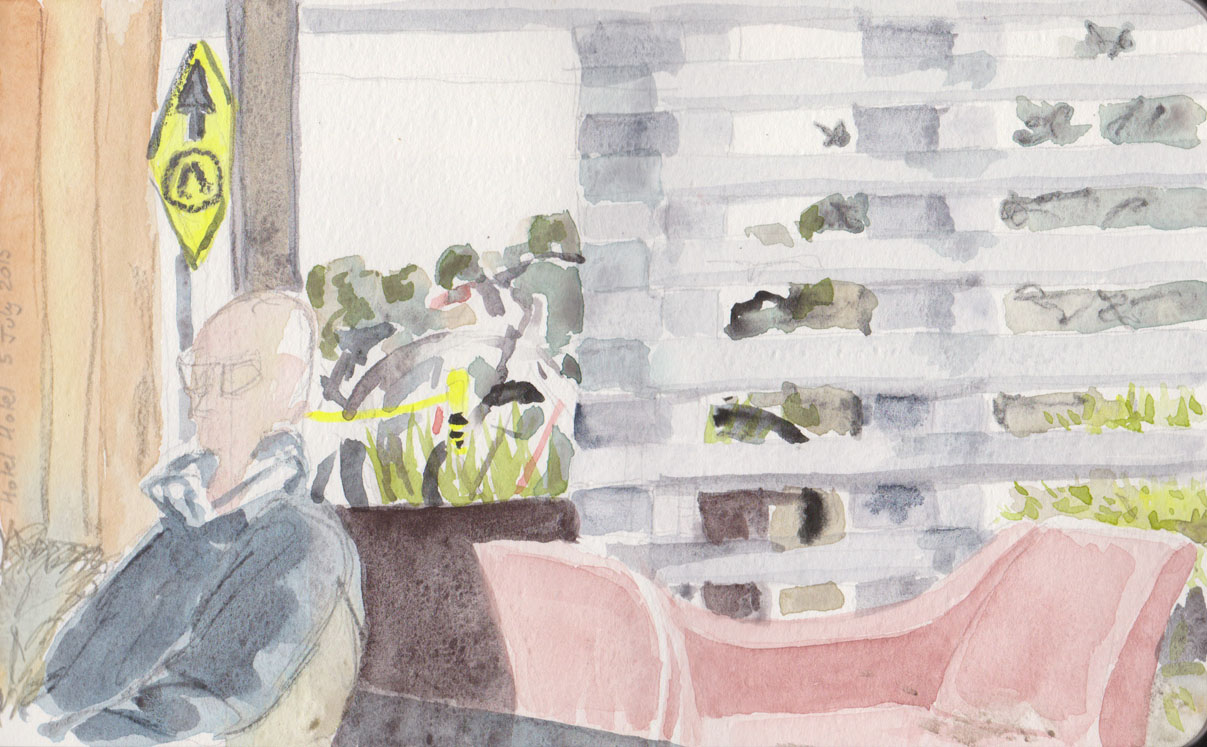
I opted for an external view to the cold and foggy Canberra morning, not that that was deterring the cyclists who parked their bikes outside the window.

Looking out to the cold, watercolour, 5 July 2015

Looking out to the cold, watercolour, 5 July 2015

It was only after I returned to the main table that I realised there were light wells overhead which looked up into gardens, wow! I did a quick sketch but, per usual would like to go back and pick a slightly different place to capture this scene. It gives one of those illusions where you can’t quite work out if what you are seeing is approaching or receding.

Looking up, watercolour 5 July 2015

Looking up, watercolour 5 July 2015

In all our production was quite high – demonstrating the value of having several books ready to go so you could swap between them as paintings were drying.

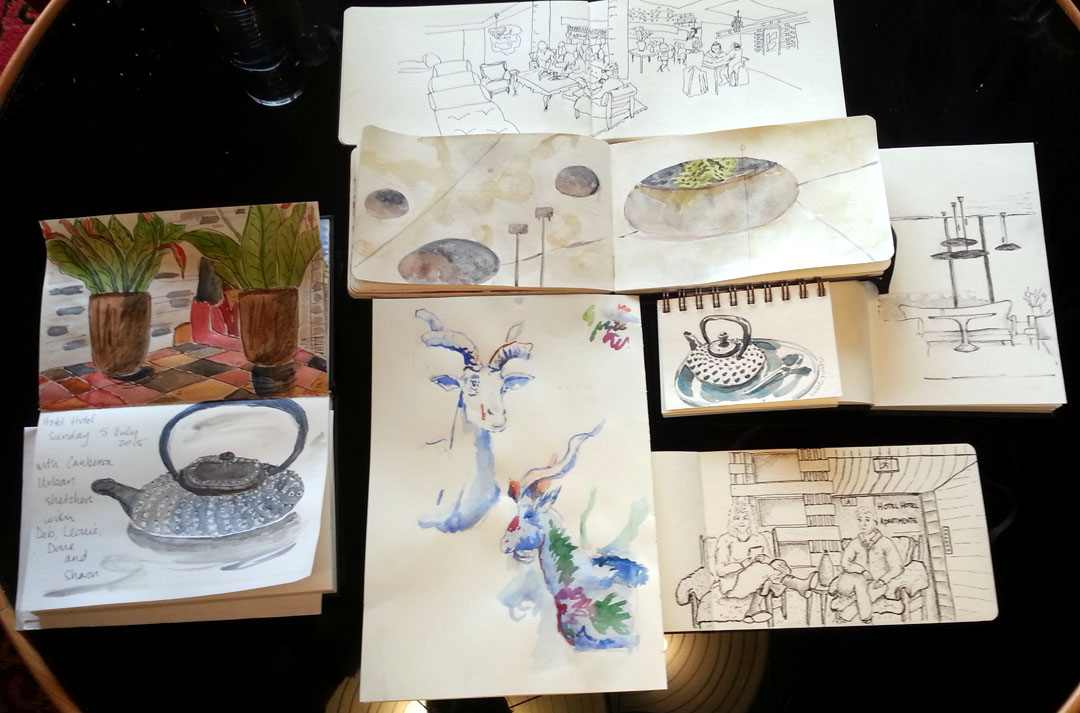
Some of the mornings output, Canberra Sketchers Group, 5 July 2015

Some of the mornings output, Canberra Sketchers Group, 5 July 2015

Next time we are meeting at the National Museum of Australia, 10.30 am on Sunday 2 August.